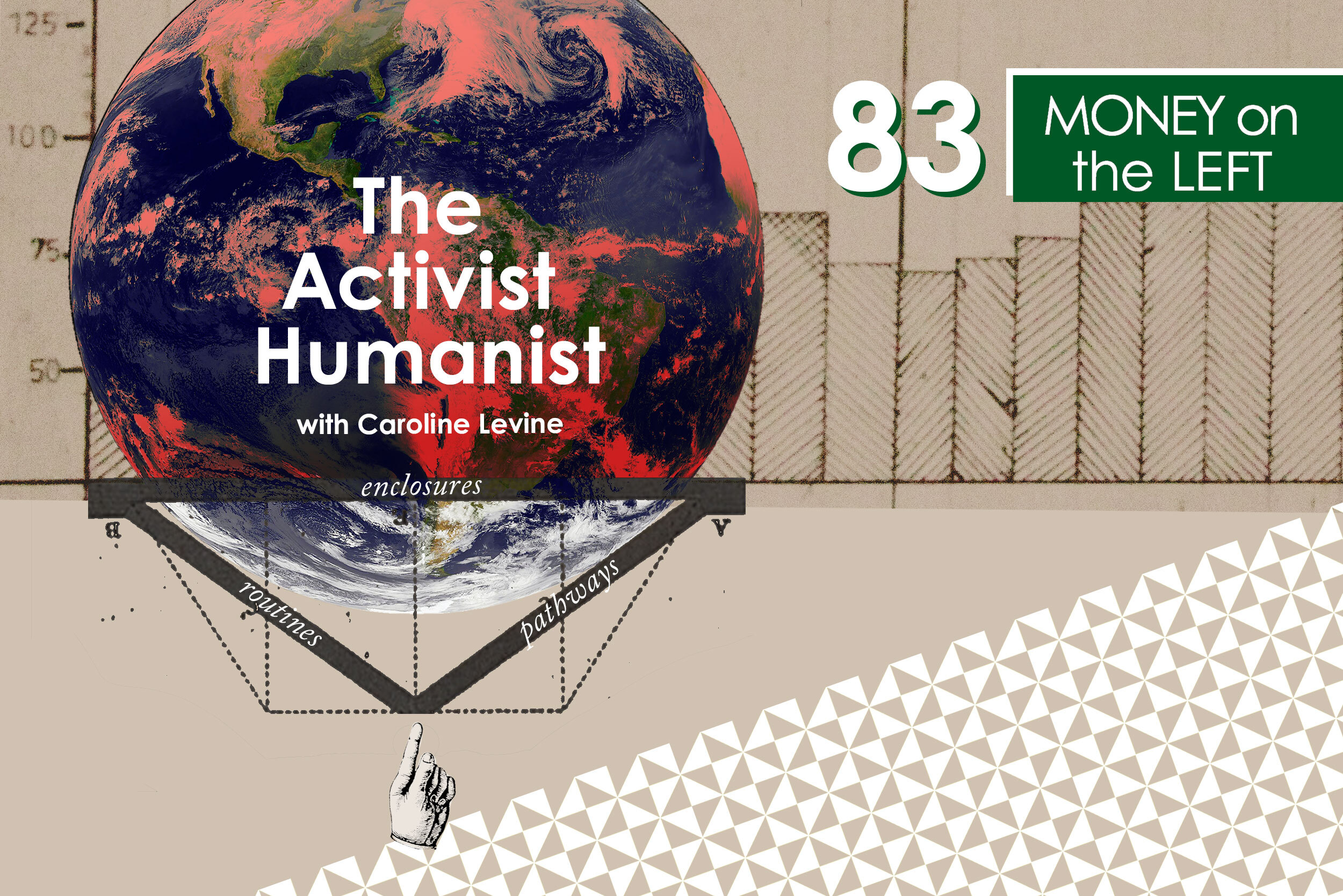
We speak with Caroline Levine, Ryan Professor of the Humanities in the Department of Literatures in English at Cornell University, about her important book The Activist Humanist: Form and Method in the Climate Crisis (Princeton University Press, 2023). Building on the theory developed in her award-winning book, Forms: Whole, Rhythm, Hierarchy, Network, Levine’s The Activist Humanist redirects the critical capacities of formalist literary study to discover and mobilize the democratic potential of political forms thought by many on the left to be irredeemably exclusive, violent, and anti-democratic. Countering scholars in the environmental humanities who embrace only “modest gestures of care”—and who seem to have moved directly to “mourning” our inevitable environmental losses—Levine argues that large-scale, practical environmental activism should be integral to humanists’ work. For Levine, humanists have the tools–and the responsibility–to mobilize political power to tackle climate change. We speak with Levine at length about this project in an effort to move beyond critical gestures of dissolution and toward an activist formalism that moves constructively between politics and aesthetics.
See the Doughnut Economics Action Lab website for more information about the upcoming screening of Finding the Money mentioned in the audio introduction.
Visit our Patreon page here: https://www.patreon.com/MoLsuperstructure
Music by Nahneen Kula: www.nahneenkula.com
Transcript
This transcript has been edited for readability.
William Saas
Caroline Levine, welcome to Money on the Left.
Caroline Levine
So great to be here.
Scott Ferguson
We invited you to speak with us today about some of your recent work, about the social potentials of form across aesthetic and political registers. Maybe to set up this conversation, you can tell us a little bit about yourself, maybe your intellectual background, your training, and how you came to your more recent ideas and arguments.
Caroline Levine
Sure. I’d love to do that. I feel like my intellectual life is a little bit of a history of my discipline, or it’s a story about the discipline. I studied literary studies as an undergraduate in the late 1980s and early 1990s when deconstruction was all the rage. We were looking for gaps, which we called aporia, like watching language disintegrate and collide with itself. Everything was coming apart.
Then I went to graduate school at the University of London in England, where just about everybody was a Marxist of some stripe or other. So, I wasn’t doing this in order, but I was going from deconstruction to Marxism. I think I was particularly shaped by Birmingham School of Marxism. That’s people like Stuart Hall and Raymond Williams, who think about ordinary people as processing culture in interesting ways, as making cultural meanings, not just passive dupes of the culture industry, which is what the other big tradition in my field is – the Frankfurt School – where the culture is made at the top and it’s fed to you and you just take it in. I was much more drawn to the Birmingham school, but there was a kind of a problem that I felt like I wanted to solve. I worked at it for many years. That is, none of the models around me that were coming out of the humanities felt to me like they were accurately describing power.
We had, on the one hand, this kind of tiny, minute, textual reading, which people would say was powerful in some way because it would take apart binaries. I actually think that the rise of trans and non-binary sexualities has a lot to owe to that movement, so it did have a certain kind of cultural and material power. But Marxism was also always not quite satisfying to me, in terms of cause and effect, like what actually makes things happen in the world. Was it always materiality in the ultimate instance? I ended up trying to figure that out by way of this category of form, which across the arts once meant sort of the shapes and arrangements and organizations of works of art.
Like the composition of a photograph or the plot of a novel or anything that shapes or arranges it. So, it could be narration, or it could be rhyme, like lots of different things are forms. It seemed to me that what we do when we read literature is usually look at a lot of those forms in relation to each other. We look at rhyme and then we look at plot. Let’s say it’s a novel in rhyme. We’re thinking about those different forms interacting and they don’t interact perfectly. Sometimes they support one another. We’ll say, “oh, this plot is all about marriage and then the rhyme also brings couples into a nice relationship,” or whatever. I just made that up. But that’s one where they go together. There are many others where you say, “well, there’s this weird break in rhyme, it doesn’t quite work. What’s going on?” You know, we learn to read for the ruptures and the divergences from the main form. I was kind of grappling with, on the one hand, the question of form generally like, what if we look at all shapes and arrangements using the tools of literary study? Not just books and paintings, but also a school system or a seminar room or a public transportation system. Aren’t those also shapes and arrangements? That helped me to start to think about the relationship between works of art and social worlds, which was the thing I was trying to grapple with as I thought about power.
Does culture just reflect those social forms? Is it a product of a particular moment? That’s what most Marxists would say, right? So, culture comes out of a particular social moment. It seems to me that that wasn’t always true with literary forms. They were sometimes jumping across lots of different contexts, for example. Did they belong to a particular moment? That didn’t seem quite right to me. But if we see them both as forms, like if we see the literary forms and the social forms as shapes and arrangements, none of which has automatic priority over the other, we can come up with a different landscape of how power works.
The first place I went for the answer to this question was whether small forms can disrupt big ones, right? Could an art form actually undo a state or something like that? And I think the answer is no. But it was an interesting question for me. And trying to think about that question, like, “what do art forms do?” What kind of power do the forms themselves exert? I started to track something that I was a little surprised by, actually, given that formalism is a longstanding way of interpreting works of art, literature, and music, which was that pretty much everybody across the humanities was anti-formalist. Almost everybody was excited about breaks in form. They’re not excited about forms, but excited about breaks in form. I started to see the whole landscape of the humanities as being about rupture and disruptions on various levels. I was like, “okay, so everybody wants to break form, but what if forms are useful? And what if they don’t only work to contain us? Or maybe containment is itself not always a bad thing.”
I started to check for forms that are used both in social and political analysis and in artistic analysis. And those are holes, containers, which have been one of the biggest problems, seen as right wing forms. Right. So, like, the nation state is a bounded enclosure or the prison cell is a bounded enclosure. There’s a pretty long tradition of understanding literary forms like the sonnet as a room. Thinking about literary forms shape as being also like bounded enclosures. And my question was, are enclosures always wrong and bad? They definitely have a bad history. The enclosure movement is the beginning of capitalism as we know it, turning everything into private property that had once been commons and public property. But, one of the examples that came to me while teaching was the seminar room. We need an enclosed space in order to think and talk together. Otherwise, there’s bugs and there’s snow and there’s people coming in and out. If we think about enclosed spaces as also affording some good possibilities, we get a different account of the politics of form. So my four forms ended up being two that we usually hate on the left in literary studies, that’s whole and hierarchy, and two that we usually love, that is rhythm and network. I argued that we should love and hate all of them, that rhythms which we often take to be sort of organic and part of the body, we have the rhythms of the heart and the rhythms of walking. Those can also be put to use in terrible ways, like enslaved people forced to sing in order to work at a particular rhythm, for example, or music in factories was another common thing, especially in the 30s and 40s. So rhythm is not always emancipatory, but it also part of our lives everywhere. Our lives are structured by all kinds of rhythms, you know, work and sleep. Not enough sleep is one of those rhythms that I myself am most upset about. But also, do you exercise every day? Do you watch TV at a certain time? Do we take a pill at a certain rhythm in our lives?
Just thinking about our lives are shaped by rhythms that are not only aesthetic. What does that mean? And then hierarchy was really my favorite one because I don’t think, as a leftist, I was ever going to be a person who would make a case for hierarchy. But I realized that I had been arguing for a really long time that equality is better than hierarchy. And what is that? That is a hierarchy. That’s a hierarchy of values. The idea of just one kind of thing taking precedence over another feels to me like actually one of the things we might fess up to on the left, that is we have values. We put human equality, for example, above certain kinds of individual freedoms. That’s a hierarchy that we buy into. I was also interested in the ways that hierarchies can upset each other and get in each other’s way, and they aren’t easily pulled together as we sometimes say in the humanities.
Scott Ferguson
Can I add something? On the left, we hate hierarchy because what we want is equality. I think another way that I’ve found it important to affirm hierarchy is a hierarchy of responsibilities. Right? So, we often think about a hierarchy of power, like “you’ve got more power than me!” As every Spider-Man fan knows, with power comes responsibility. And that’s not just like an afterthought. We need scale. We need people in organizations that have different scales and bits of responsibility and hierarchy as a form might be one way of thinking about that that’s not necessarily rigid or just flatly top down.
Caroline Levine
Oh, I love that example. Yeah, that’s a really lovely example. I talked to somebody who works in nonprofits who also said, “you know, when we think about hierarchies in an organizations, we usually think about power and money, but it’s also about what you can see.” At different levels of an organization, you have a different sense of how the organization works. A lot of my thinking on form was actually informed by being a department chair and realizing how the upper administration was working, how budgets were working, and how legal restrictions were working.
Scott Ferguson
And you had all these new responsibilities that weren’t just about producing monographs and making sure no one gets in your way.
Caroline Levine
And not that much power. As people point out, the department chair does not have much power. But to figure out how much power I did have, you know, what could be rearranged? What was possible to reformulate? So, yes, responsibility is a great way to think about it. So then, I kind of made the argument at the end of that book, Forms: Whole, Rhythm, Hierarchy, Network, that I thought you could make a better world using forms, but we shouldn’t avoid them. They’re kind of unavoidable. But we should think about which ones work better and work worse according to different values and different contexts. After I finished that book, people would say to me, “so how do you do that?” I realized I had a new responsibility, speaking of responsibilities, which was not just a call for this, “you know, let’s make a better world using form,” but actually to think about what does that look like?
That led me to the most recent book that I wrote, which is called The Activist Humanist, which I decided to take on. Speaking of hierarchies, I had to figure out what particular political problem I was going to think with, climate change seemed to me to be the one that had the largest impacts on everything else. Any other question that I had asked would be affected by climate change. And so how do you use forms to think about climate? One thing I really started to feel very strongly about and this has put me very much in the minority among humanistic thinkers, is that that urge to disrupt and to be open ended and to be subtle and to be questioning and to stop and kind of ponder our world – all of that – has actually gotten in the way of action on climate, because, in fact, big oil has wanted us to do exactly that. Doubt, delay, disrupt. And then we’ve got these authoritarian leaders around the world who are totally in love with disruption. We saw the tech industry, and then we saw Elon Musk move fast and break things. Do we really want to break things?
It seemed to me that on the left, one of our values has been actually to make sure that people have enough to eat, they have enough clean water, they have shelter. Like these are not exciting, subtle, interesting forms. They involve continuity and predictability and those were things that I started to really revalue and that changed pretty much everything about my research. So once I was like, “okay, I’m not all about breaking things anymore,” I started to think, “what forms do we need to sustain life over time?” Aqueducts were a pretty interesting example to me. They’ve lasted thousands of years carrying clean water to people. Almost all great water technology is thousands of years old, including flush toilets.
We don’t need something new. We just need it to be more equitably distributed. And there are societies that have equitably distributed water and they have forms to do that with. I spent some time in Morocco and in the countryside. A lot of Moroccan villages will divide up access to the river by times of the day in times of the year, so everybody gets equal access, for example. That seems great to me, but that’s a form and it’s constraining. Like you can only go to the river on Tuesdays between, you know, morning and lunchtime. You can’t use it at other times. You can’t irrigate from it at other times. It’s to say reevaluating containment as well as different kinds of forms to use for leftist ends.
William Saas
There’s a parallel that seems to be available to make or to draw or to observe between this kind of valorization of open-endedness in the critical humanities and defeatism is maybe one way to put it, but then also, maybe more troublingly, accelerationism. Let’s let the process play out so that we can end up with that space of open play and radical possibility.
Scott Ferguson
And the resources of that play or the energies of that play come from the accelerating dynamics of the very thing that you hate.
William Saas
Yeah. So I was wondering if you would comment on that. Also, there was a lot of therapeutic value in reading your book, and sort of rereading my own experience of being in the critical humanities and being with Money on the Left has been really affirming in the other direction. So, any more you can say about that. I know that we’re not interested in pointing fingers or assigning blame for where we are, but, oh boy, is that a possible thing that we could do.
Caroline Levine
Yeah, yeah. No, I really hear that. I mean, both my own sense of dissatisfaction too. “Wait, no, we have no plan.” We get to sit and wonder, and that’s pretty fun when you have the resources, but it’s super not fun if you’re being run over by the machines of extractivism and capitalism.
Yeah, I totally see that. As soon as I saw it, I started to get really bored of work in my field because I realized it was all ending with the soaring refusals to spell out the future. So, what I have discovered since is, I think, really powerful, which I do want to kind of take account of and recognize, which is that a lot of that kind of resistance is necessary. Right. We do have to take stuff apart. And that’s intellectually exciting and has some urgent purposes and I’ve learned a lot from it. But with the idea that, therefore, we should do nothing, I see it as both a humanistic problem across the humanities and a problem more broadly on the left of not wanting power. Because once you have power, you start to make choices that have consequences. Some of those consequences are not so great. But if you don’t take power, you get run over by the right, which is not worried about having power. They’re delighted to take power. Left pessimism, which is that kind of acceleration on the one hand and pessimism on the other hand, says “there’s nothing worth doing. We don’t have enough power to be able to stop capitalist extraction.” There’s a book that just came out this past year by Nathan Hensley in my field called Action Without Hope. He really says something like “all attempts to act in the face of climate change will simply be fed into the machine of capitalism.”
That sense that there’s no outside, there’s no position you could take that would be a genuine resistance. He ends up talking about typographical errors in 19th century poetry as the site of resistance. To me, that now really feels wrong, like it’s really in cahoots with the “don’t do anything, don’t stop anything.” I guess I have two further thoughts and apologies for going on and on, but it’s the Frankfurt School in the 1950s and 60s who I feel like they have the tightest hold on literary studies right now. It’s that notion that there really is this mass culture. It’s all about standardization and it’s all about instrumentality. So, it’s about taking every corner of your life; your entertainment, your sexuality, and putting that to some kind of use for a capitalist machine. To the extent that that was true in the 50s, and I’m not sure it was ever really true, I still have my Birmingham side, which is like “no, puppet culture also calls on people’s actual desires, their actual fears and longings and it may channel them in certain ways that are ideological, but there’s also something else in there, in a more dialectical way, that is giving us real pleasure for real reasons.” So, I’m a little doubtful about the original hypothesis, but I certainly think that that version of culture doesn’t hold anymore.
Our cultural platforms are so fragmented, and people are getting lots of different kinds of elements. They’re not getting one standardized version of culture at all. It hasn’t been better. I mean, I think in some ways a standardized culture was, you know, at least we talked to each other in some way. Now we’ve got this incredibly fractured environment and the accelerationists, I’m sure, are very happy about that, but I’m less so. But it’s hard to say, like, why are we still behaving as though culture is just one big centrist, normalizing framework when it just isn’t anymore? So that’s one problem with that version of both the left and of the humanities. The other one is, do we really think we have zero power? What tradition is that from? For Adorno, it really was like “thinking is the thing that has the most power.” Open thinking is what he calls it, and it’s not thinking towards instrumental ends. He was very critical of the 60s radicals because he was like, “oh, they’re just instrumentalizing, like everybody else, you know, putting action before thought.”
That’s okay, but I don’t think we live in a culture which prioritizes political action at all. I don’t think that’s the dominant culture of our movement. I think, if anything, you get involved in any issue to the just mildest center left all the way to the far left, and you will be vilified, you’ll be locked up, you will be doubted. That includes by other people on the left and so it’s not like we have this mass culture of everybody in the streets. We have a mass culture of everybody on their screens, which is a very different story.
Scott Ferguson
Yeah. It creates a vacuum of sorts that stimulates desire for action or what looks like action. That’s what Trumpism is giving us. Even as a pathological liar for whom every accusation is a confession, at least he’s shaking things up and doing things. Greenland is ours. It’s Gulf of America. We’re going to capture you in a van wearing masks. We’re doing stuff. I think those two things work together in unfortunate ways.
Caroline Levine
Absolutely. Yeah. That’s a very sobering point. Somebody just recently, I can’t remember who, was using the word sclerotic to describe democratic institutions. So, I guess that’s right. Like they get so crammed and stuck in ways that don’t do anything. That version of action is one of the reasons we’ve got these openings to authoritarianism right now. There is another version of action which the Marxist tradition knows a lot about. That is how you gather working people together to resist. There are a lot of people skeptical of that version of action, but I think we’re studying when that works and when it doesn’t and what forms in particular allow that kind of work to happen.
Rather than deciding from the outset that it’s not possible or if people are gathered, then somehow they will be constrained in a way – that’s a sort of libertarian leftist version. We’ve had these horizontalist movements in the last 20 or 30 years that have celebrated the idea that everybody belongs in every movement, and there’s no leadership and there’s no hierarchy. There’s another place where I think not all hierarchies are bad. It might be helpful to have some “let’s work together on an issue that we can solve.” So again, a formal question as much as kind of question of power or the two together.
Scott Ferguson
I’d like you to talk about some of the very specific examples or case studies that you work through in the book. Your training is in 19th century literature and you offer us a rather defamiliarizing reading of the 19th century realist novel, which you point out is sort of paradoxical because you’re trying to get away from defamiliarization as an end in itself.
That’s cool. But you’re also not rejecting deep familiarization either, right? You’re just saying that’s not the end all be all. That’s not where you put the period. I want to invite you to share with our listeners who haven’t had a chance to engage with your book what your reading of the novel and literary conflict and closure could mean or could afford that’s beyond just a kind of repressive mechanism, or a cruel optimism, as it were, to make us just be happy about the crumbs that we get.
Caroline Levine
The form that I study or that all 19th century novel people study and hate the most, probably of any literary form that exists in the world, is the happy ending. 19th century novels are famous for their happy endings, and not all of them have happy endings, but most of them do. And most of those endings are kind of ideologically representative of a particular bourgeois culture. You’ve got marriage and the household and reproductions. You’ve got straight white people in the house with money and that is often the end the story right there.
Scott Ferguson
And other people have to be jettisoned and die along the way.
Caroline Levine
Yes, yes. Good point. Right. So, if you’ve read Jane Eyre, then the madwoman in the attic has to be expelled for Jane to get her happy ending. It’s often queer people and people of color and poor people who have to be kind of shoved out of the frame in order for that happy ending to happen. 19th century scholars have spent a lot of time showing how that ending works. I think it’s been very persuasive. There is one piece of it, however, these days, having done this work on form, I’m always looking for the other affordances. If we say this is containing and repressive we’re practicing the habit of deciding that a particular form has a particular politics. I’m always looking for the other politics that’s possible in that form. I thought about my own being drawn to the 19th century novel as a young person and probably everybody has some image that comes from the 19th century novel of urban poverty. You’ve got Oliver Twist: waif on the streets, right?
That gave us that image of the child who is not taken care of by anybody and has to make their way in the world. So, I started to track what I now call plots of precarity, that is, the stories of characters who don’t have reliable food, shelter, wages. There’s a lot of those in the 19th century, not just in English, but in French, German, Spanish, Japanese. There’s precarity written all over modern, 19th and 20th century fiction. What do the endings of those novels give us? They don’t always give us marriage. They don’t always give us ownership of a house or property. What they always give us is a future of predictable food, water and shelter. To think about popular culture as offering people something that they actually want, I started to think, “yeah, lots of people are precarious, now. Why wouldn’t they be hungering for an ending that shows an end to precarity?” Of course, for women, this is complicated because in the 19th century, the end of precarity comes from marrying somebody who has money. That’s your only guarantee of not starving if you’re from a certain class. You don’t have any other options for work or inheritance of your own. The marriage plot is actually about this kind of material predictability, which I think is a real desire and not simply an ideological duping of an audience.
I started to look at happy endings in lots of different cases. One of my favorite examples in doing research for the book is Stone Birch Blues, which is often considered the first trans novel, by Leslie Feinberg. There’s a trans character who has been kicked out of multiple homes, can’t find stable shelter, and in the final chapters they actually get an apartment. I am going to say “they,” as they don’t use any of the updated pronouns in the novel, which came out in 1993, I think, or something like that. But they decorate an apartment, they make food, then they go to a union rally or maybe it’s a gay lesbian rights rally. They say, “we got to stick together because we have to make homes for each other.” So, it’s like the domestic plot, but writ large as, “let’s make homes for everybody.” Let’s not reject the domestic plot. Let’s think about how everybody should have access to that.
Scott Ferguson
Yeah. That’s great. And then you also carry this forward to a more contemporary Pulitzer Prize winning work of seeming nonfiction. But you track this form, this kind of realist form of the precarious plot and the potential happy ending to this work, Evicted. Can you talk about that twist in this tale?
Caroline Levine
Yes. Yes, I’d love to. It has actually been part of my work for a long time to move between aesthetic and nonaesthetic objects. Narrative, for example, is a form that you see in the novel storytelling, but you also see it in the court of law, and you see it in the doctor’s office, and you see it in gossip.
Scott Ferguson
What’s so cool about your approach is that it’s not base and superstructure. There’s not a real world that has real narratives and then there’s fakey secondary stories that are formal and that have to reflect or resist. You don’t flatten the difference between a nonfiction book and a 19th century realist novel and a closing argument in a court of law, but you also don’t fall into the standard ways of prioritizing one over the other as more real or more causally prior or something like that. Anyway, back to you.
Caroline Levine
I’m so glad you like that, because that to me is one of my favorite things about the kind of formalism that I practice. I don’t have that many takers for that.
Scott Ferguson
I took it!
Caroline Levine
You took it. Thank you for taking it. To use another literary and also Marxist term, and I’ve learned a lot from Anna Kornbluh, who is another deeply Marxist thinker on the left who’s interested in form. Every access to the world that we have is mediated by forms. Right. So, to say some are fictional and some are nonfictional is true. But if both use narrative, then thinking about how narrative works to allow us to see certain things about that world and not to see other things about that world seems to me just as interesting – both factual and fictional way of understanding what we’re understanding about the world.
Matthew Desmond Desmond’s Evicted. I think I read it just because it was being widely praised and I wanted to learn more about housing. I don’t know how many pages in – 30 pages in – I was like, “oh, my God, this guy must have read a gazillion 19th century novels.” This is one of the reasons this is such a great book, he has lots of tactics from the realist novel that really work to evoke precarity and particularly housing precarity. He tracks 8 or 10 renters in Milwaukee who are real people. He spent lots and lots and lots of hours with them. You start to really identify as a reader with these people who are doing their best and then the unfairness hits them and they’re out on the street again and it gives you this incredible punch partly because of the ways he narrates those experiences. I do some readings of the novelistic elements of it. But I was really struck by his two endings.
So, one of his endings is one of the most heartbreaking characters in the whole work, who is an African American mother of two who’s been evicted multiple times, and each time she’s evicted it gets harder to rent the next place. Her two sons are these wonderful, loving kids who probably don’t have a lot of hope for a better life. But in the last scene that Desmond narrates, the mother is saying, “I could just imagine you building a house for me, you sons, and all of us living together and laughing together.” It is like the end of a 19th century novel. It’s the home built by the children who are going to carry on the moral tradition of the mother, and she is just somebody who’s good and gets caught up in this terrible system. You have this ghost of the happy ending because she’s not going to get it and that’s tragic. Then you have a long, kind of epilogue where Desmond sets out policy prescriptions for housing vouchers and how we could, in fact, institute a system that would allow the characters we’ve come to love in the rest of the text to have stable homes into the future.
One of the problems with the 19th century novel, which I think novelists were pretty aware of, was that they could only follow one character. If you look at the end of Oliver Twist, he ends up happy but all the other workhouse kids have crappy futures. Oliver kind of says, “I wish I could save them all, you know?” The novel doesn’t know how to do that. It doesn’t know how to scale up, but policy prescriptions from a sociologist like Matthew Desmond does know how to scale up, he does know how to design a form that could create that. To me, that was this beautiful move between literary narrative forms and social forms for progressive ends.
Scott Ferguson
Thank you.
William Saas
What do you feel like the most common and maybe also the best or most compelling line of criticism or response to your work has been.
Caroline Levine
Yeah. I think you’ve hinted at two of the ones that I take most seriously, that come most often, and one is: if you do set out to remake the world for the better…
William Saas
Even modestly.
Caroline Levine
Even modestly, right, and maybe especially modestly. Let’s say you’re able to get a labor union going in your workplace or you’re able to redistribute labor, as I did as a department chair, so that it was more equitable. These are small and, we would say, not structural changes. Does that actually feed the right by mollifying us? That’s the accelerationist argument. We won’t get real revolution until people are at their most desperate. I think there’s two problems with that case. One is that: I look at the history of Marxist thought, and there’s multiple strains, but back in the Communist Manifesto, Marx says, “let’s go for things like free education for children as a way to build the left.” Large groups of people are mobilized by particular, local things that they can make better.
Rosa Luxemburg picks that up. They have detractors, but they also have a robust history on the left. So, is that true or not true? Once people are drawn into a movement for change and they “win,” do they then go home and say, “okay, I did my work, and I can rest for the rest of my life?” What seems to me to be truer, according to the data, is once you get involved in something, and especially if you win, you’re more likely to get involved in the next thing. In my life as an activist, I notice that if you go on a college campus and you try to talk to people about a particular issue that’s coming up, the same people will be active in trans rights and immigrant rights and in academic freedom and in the AAUP and they’ll be fighting for divestment. It’s because they’re the people who think, “you take action,” it’s not because taking action makes you passive. It’s because it seems like taking action actually helps to make you more active. I’ve been more persuaded by that side of things. it does seem to me true, again, in my own activist work, that the people who are committed activists often had something that pushed them into activism in the first place, and then they stay.
There’s actually really interesting work on the pro-life movement. I have also been criticized for using this because it’s a right-wing movement rather than a left-wing one. I think it’s interesting. What gets people involved in pro-life activism? A lot of people don’t have strong views on abortion before they get involved in pro-life activism. It’s all about the social world being welcoming. A neighbor says, “hey, come to a picnic,” or “come to this march with me” and you get involved, and then you get committed to the ideology. The social form comes first and then the intellectual form follows, or the political form follows. I think that is true for getting people involved in this kind of activism. I don’t think it’s a way of pacifying people. We tell way too few stories of victory and so people think activism doesn’t work when it does.
One of the stories I talk about with my students a lot is “ACT UP.” Talk about a movement that had far reaching consequences. Some of them, of course, are being rolled back right now, but many millions of lives were saved by ACT UP’s work in the 1990s. A lot of it was creative. A lot of it was in your face and some of it received backlash. Insurance exclusions for people with preexisting conditions affected just about every American. To say it failed or to forget about it or to say activism never works is to miss the ways in which these movements have long tails. We then take too much for granted, which is one of the reasons – to go back to your earlier point about deep familiarization – I do think we need to remember what we have that’s good and not only think about our society is completely immiserated and immiserating because there are good things. More access to health care is better than less. Yeah. It would be better if we didn’t have insurance companies at all. Yes, but this is better than what could be. So, you can hear my politics. I’m of the “it could be worse” persuasion in thinking about how we won these fights. We have a real aversion, and Lauren Berlant’s Cruel Optimism is a good example of this in literary studies, to ever telling a story about victory, because that is always said to be a way to somehow prop up the status quo.
I’m convinced it is exactly the opposite. The less you tell stories of victory, the less people want to get involved and the more powerless they feel, and therefore the more the right just rolls over us. So that’s one version of the story I’m working on right now. I’m trying to write about agency and to think about Marxist, post humanist and liberal theories of agency and what each of them has to offer and where each of them kind of comes up short. That’s one.
Back to your original point, though, which was a great question about the major critiques. The other is that I’m selling out the humanities because I’m turning towards these kind of instrumental plans and programs, like getting involved in action instead of sticking with the particular value of the aesthetic, which is open ended. By closing down that open endedness, I’m kind of saying, “let’s move over to the social sciences and away from the humanities.” I think I’m not doing that. I think the humanities resistance to action is not a necessary element of humanistic thinking, but it does seem to be for a lot of people. There are a lot of people who say, “once you cross that bridge from open ended thinking nuance and dissolution, you are in the realm of propping up the status quo.” This is especially true when you’re in the realm of doing that in the university, which right at this moment we need this kind of thinking more than ever.
I’ve been thinking a lot in regard to that. I don’t want to sell out the humanities. I do actually think the humanities aren’t doing what it could to be exciting to a lot of people. To my mind, one of the ways to draw people in is to say, “this could have an actual impact on making your life better, not just getting you to question things.” Though, I do believe in getting people to question things. But my own teaching has been really where I’ve been working this out the most. I teach, by choice, almost entirely non majors. I teach a lot of STEM and business students. Cornell is a very science-y place because we have an ad school and an engineering school, and arts and sciences is comparatively a small part of the university. I realize I teach much better if I go to the topics that the students are interested in and bring humanistic thinking and methods with me, then if I say, “you have to come to me.”
I haven’t taught Victorian poetry in like a dozen years because students don’t know what it is. They don’t know why they should care. They don’t. You know, those two words are not words students love: Victorian and poetry. What I have to do turns out to be what I want to do. It has become kind of a vocation for me. I think we’re better off not bemoaning the fact that students aren’t automatically coming to our classes and instead saying, “okay, you’re interested in renewable energies, how can humanistic thinking help you? Think again about that. Think about your position in relation to that.”
I just taught a fantastic poem by Juliana Spark called Dynamic Positioning, which is about the Deepwater Horizon oil spill, or BP’s oil spill in 2010. That’s a great poem. I had 30 stem majors working at that poem yesterday. I don’t think they were objecting at all. They were really using their brains and in a way that was enthusiastic. I don’t think I’m selling out the humanities. I think I’m doing the opposite. I’m trying to do the things that will keep us afloat and strong, and that has meant medical humanities, environmental humanities, thinking about humanities and business.
We have this famous hotel school at Cornell and the hotel students are basically business majors with a focus on the hospitality industry. I ran into somebody who worked in the hotel school working on undergraduate curriculum. I said, “so do the students talk about histories of hospitality. There’s so much interesting stuff in the Bible and philosophers who deal with hospitality.” She said, “they don’t even get a definition of the term.” So, I asked all my colleagues, some of whom work on hospitality, “would you like to teach a course to hotel majors?” They all said no. I was like, well, “I don’t know a lot about hospitality, but I sure find it interesting.”
Scott Ferguson
And it’s everywhere in stories!
Caroline Levine
It’s everywhere!
Immigration. Yes. Climate change, tourism…
Scott Ferguson
Motels.
Caroline Levine
Absolutely. We put so much energy as universities into orientations and welcoming people in. Hospitality is everywhere. What about the classroom and hospitality? It’s just so interesting. So, I developed a course and the hotel students who are in my other classes are often just checking off a box, like “I took a humanities course” and don’t seem like the most engaged students and often don’t get the best grades. In that class, they are 100% there. They want to think about every aspect of hospitality because they’re giving their lives to this, and they want to take it seriously. So, this is my message to the humanities, which I am told I’m selling out, but I’m like, “no, there’s 120 students in that class,” which is big by Cornell standards. Let’s meet them where they are.
Scott Ferguson
That’s great. I feel like you’re already going down this road, but I want to invite you to keep on walking. I don’t think it’s entirely fair to say that all recent left activism has been this way. But there is definitely, like, an impulse toward not only horizontalism, but also spontaneity. Your point is to say even spontaneity is a form and that might be contradictory in certain ways. There are also forms of organizing and you’re trying to give us a bit of a taxonomy of different kinds of organizing forms. So we’ve asked you about the realist novel, maybe now you can talk to us about some of the specific organizing forms with some examples drawn from your book or other research.
Caroline Levine
Absolutely. I’ve been really influenced by some very good political theorists thinking about horizontality. So, if we take Occupy Wall Street as an example, that was understood as a spontaneous kind of eruption. So, the two often go together. The idea being that everybody is welcome, there is no agenda, there’s no specific goal, everybody can speak and there’s no hierarchy in the organization. I think a lot of people found that heady and really exciting. I think there is something to what they sometimes call free figurative politics. You’re finally living in an equal world, and that feels amazing. I think a lot of people were actually transformed by Occupy Wall Street, and I don’t want to say it did nothing but the fact that it had no demands because it was open ended, deliberately meant that it was very hard to negotiate anything to say that there was a victory to do anything other than disband.
It still had a form, that is: Occupy Wall Street meant going to Zuccotti Park in downtown New York City, near Wall Street and hanging out there 24 hours a day. It was a spatial form. It was occupying a public space. I argue that we need temporal forms. We need goals especially if we think we can fight for them and win. Then we have the story of victory, which can build on itself. The civil rights movement is a great example of this, because it isn’t one movement. It’s a kind of cascade of movements. So, when Montgomery wins the bus boycott, that influences and excites people in lots of other communities to say, “well, we can win, let’s do that.” My model is different, but it imagines that a temporal form in the form of a goal is actually really important to movements. It’s important in part because it is the opposite of open-mindedness. So, if we constantly value open-endedness, we will miss the value of the organizing form of the goal, which keeps people going on a path which is often very hard and rocky.
Scott Ferguson
But this is another knotty word in the humanities: teleology. This is very Aristotelian, you know. In my college education in the 90s, that was one of the devils that I was introduced to. I’ve come around to appreciate teleology. It doesn’t always have to be terrible.
Caroline Levine
That’s right. That’s all I want to say. It doesn’t always have to be terrible. Sometimes it’s useful. We don’t just have to go pro or anti, right? We can see its possibilities. But it’s still true today that teleology is a word you can say as something to avoid without explanation or justification, which, that’s come to seem to me to be a case where whenever there’s a word like that, that’s the one I want to investigate, because that’s the word that’s carrying too much. That goes without saying. Teleology is one of the forms that I think is actually very useful for activist movements. I was very struck by the research, and I do draw in social science research. I also think there’s a lot of reasons to critique social science research. So, it’s not that I take it to be true always and forever, but I think it’s useful to study the forms that have worked and to think about why they have worked. Social scientists point out that people are most likely to get involved in activism during what they call a turning point moment in their lives. So, this is often when moving to a new place. Going to college is one of those moments. Retiring is another moment when people are like, “oh, I can take on new responsibilities now.”
You often see this in movements that very young people and retired people are often on the front lines, and those are the people who have more time and aren’t invested in the problem of keeping their jobs, for example. How do you reach people at their turning points? One of the things I worked on at Cornell was, and it’s had mixed responses and we’re still working on it, a little online module for all incoming first year students to think about Cornell and sustainability. There we get out some information that is otherwise hard to reach everybody with, like Cornell’s tap water is higher quality than bottled water and free. Maybe start out your time at Cornell thinking about the water.
In the module, we try to get them to look at all the climate organizations that are already going on at Cornell and to name three organizations that they might like to get involved in. We’re trying to get them to use that turning point moment to get involved in organizations that already exist. The other big problem for movements to be effective is scale. A small group of people can do a lot, but it’s a lot easier if you have a large group of people. I am always trying to get us in the humanities to think about scale because we’re very focused on particularity, the exception, the margins, and all of that is incredibly important to me, but not as a politics.
As a politics, I think we need to come together in ways that enact solidarity across movements. One thing in reading histories of activist movements that have worked, it seems to me that it very often hinges between preexisting organizations. You don’t just recruit one person at a time. You look at existing organizations, and you say, “can we bring this whole group into the project?” I think one of the problems we have in American universities is that students, when they write their application essays, have to prove leadership. Once they get to college, they think they have to start an organization or lead an organization. But actually, we just need a lot of foot soldiers. We just need a lot of people stuffing envelopes or whatever the contemporary equivalent of that is. If it’s not stuffing envelopes, it’s posting on social media or organizing town halls or whatever it is. We need a lot of people just doing the grunt work of showing up. What is it like to talk to people about how much time they have, what they’re good at, and how they can join existing organizations rather than having to invent something new? I’ve started to say in my activist recruitment, like, “if you have an hour a month to give, that’s valuable to any organization.” I think most people are really surprised because they think it’s an all or nothing proposition, “I have to drop all the things I’m doing.”
Most people have an hour a month. That feels manageable to a lot of people. So that’s a form, in the sense that I am trying to think about people’s busy lives. I have kids, I have a job, I have other responsibilities, how do I fit it in? Well, let’s think about what’s a reasonable amount of time and what kinds of things am I good at doing and like doing? Do I have to be the person who picks up the phone? No, I hate picking up the phone. I really don’t want to do that. Give me ten other jobs to do and I’ll do those for you. So, a lot of people think that activism is showing up at a march, but it isn’t. It doesn’t have to be that at all. It can be research and stuff like that. Getting people to understand how collective actions work is to get them to understand lots of different forms that aren’t just the visible ones that they see.
Scott Ferguson
I want to raise a question that I’m going to probably stumble around in posing, and it might not even be fully fair, because I don’t think, at least in the text by you that I’ve read, you’re actually taking this particular thing on, but it speaks to our position as sort of public intellectuals and activists of a kind. It seems like very often the examples that you’re giving about activist forms and working through in your work, for the most part, and you can correct me if I’m wrong, but for the most part, it seems like the social values driving the activism and the teleology of that activism are relatively self-evident. Now, there are exceptions like the pro-life activism.
They get people who are not even sure where they sit, but they throw a party and they’re really warm and inviting and you become convicted that that indeed this is my value. It’s more important than anything I’ve ever valued before, even though I didn’t value it last week. But for the most part, it seems like the challenge is: so many of us know, for example, the facts about climate change. So many of us know the realities of systemic racism. It’s just about getting off our butts and activating our labor power to coordinate and make change. That’s tremendous and wonderful. Our particular situation, however, is that we are actually trying to create a paradigm shift that is totally defamiliarizing.
We’re trying to say that money is a public utility. We’re trying to say that it’s not a zero-sum game, that it’s a public system that has been designed and can be designed different ways. It doesn’t have to be designed for private property and for private profit. It doesn’t have to be designed such that you rely on past revenues to finance the future. You can invent a crediting mechanism that is just full of futurity, it doesn’t matter what you earned in the past and that blows people’s minds. It scares people half to death. Often Marxists are freaked out about it. I’m not asking you to be our personal consultant and to solve our problem and it’s not like we don’t have answers. We’re trying our best. We’ve been at it for quite a while. It seems like that’s another challenge that’s a little trickier. It also braids the critical thinking and framing and rhetoric and the kinds of things we do really well in the humanities. It braids that in a different way with creating organizations and mobilizing people. I don’t know if you have thoughts about that particular problem.
Caroline Levine
It makes me realize why I love that project so much because it is so close to my heart. It’s a solution or set of solutions and ways of rethinking with practical consequences, that isn’t about necessarily smashing everything, but about using things in a much better way, which would have much better consequences. I absolutely love that. I did have the experience of telling my radical daughter about it, and she was like, “no, money is evil.” She’s a Marxist and I was like, “but wait, hold on a minute.” I see the climb and why it’s important. One thing that worries me a lot, and I spend time thinking about but not having any answers for is, “how many great projects are fairly complicated and so require attention and trust?” People are so bombarded with things that are scams and lies. What kind of context builds trust so that people can imagine actually getting involved or actually seeing how that works. So, Ben Wilson, who’s the first of the Money on the Left people I got to know, helped me to see how I could use that in my classroom.
I haven’t done it yet, but I’m planning to get real training on how to do that. That feels like, “okay, if we have a kind of thought experiment, experience, or experiential learning kind of model, I’ll get it and they’ll get it much better than if I just try to say it.” It has been one of my questions, because I always taught literature and it was really just about people in text. Then I realized, no, the real question is climate change, which I teach all the time. 96% of students at Cornell are worried about climate impacts. They are aware. How do they figure out how to act? That experiential learning, which is one of the things the quote unquote, neoliberal university loves, might actually be really useful. It doesn’t look like the traditional humanities, but it does look like learning in a way that I think people digest better and stays with people. I read these studies where you give an exam, and students retain something like 15% of it a year later. What are we doing if we’re just giving them content?
I love the idea of piloting this as a classroom project. But scaling it up is hard because you got to get your head around a lot of different pieces. I used to live in Madison, Wisconsin, and there was a joke among social scientists about the Madison effect that all sorts of scientific experiments worked in Madison, and that was partly like, “yeah, it’s a pretty progressive town and a lot of educated people.” The idea that you do an experiment is not in itself a weird thing, or that you think about things.
Scott Ferguson
And everybody is ready to play along.
Caroline Levine
Everybody’s willing to play along. How do you do that in places where people aren’t willing to play along? But again, reading about projects that work, one of my favorites that I’ve always wanted to try in the university is participatory budgeting, which works with really poor people with no political capital where they just have community and the experiences of the community. And it works. Designing it in some way that a small community can try it out and see how it works, that feels like the kind of model that could take off. I am just telling you what you guys think about all the time.
Scott Ferguson
We appreciate it. Just talking about it matters. Of course.
Caroline Levine
Yeah, right.
William Saas
I love that the language that you give us for it, affirmative instrumentality works really well for our project. Formalism for survival describes what we’re up to. Infrastructures for collective life is another. Money is a routine pathway and enclosure and you giving us different ways of talking about and reckoning with what we’re doing is super helpful.
Caroline Levine
I am so thrilled.
William Saas
Thank you.
Scott Ferguson
I am maybe working toward a conclusion. Who do you see as your fellow travelers? You named Anna Kornbluh. You name check her in the more recent book as having learned something from her. She’s been at the bleeding edge of this anti-disintegrative impulse that informs so much of humanities work. I’ve heard in the halls of academia that you’re part of the so-called New Formalism. I don’t know if that’s a thing. Do you wear that calling card? We’ve talked a lot about how you’re a lone ranger, and in many ways you are. But in other ways you’ve got community. So maybe just talk about that fellowship.
William Saas
I would throw into that mix Jody Dean as well, and work on the party as a kind of form.
01;10;47;07 – 01;11;24;05
Caroline Levine
I feel much less militant than Jodi Dean and Anna Kornbluh both. I am delighted for them to be thinking through these problems of collective forms and moving away from disintegration and so forth. I’ve had a lot of trouble being a full-blooded Marxist. I feel like I’m fully shaped by Marxism, and yet I end up not being in line with it. So, I do sometimes feel kind of intellectually lonely because Anna Kornbluth rightly says I have a really weird reading of Foucault in forms, and I do have a really weird reading of Foucault. I admitted that reading it. I think it’s a good reading of Foucault. Okay. That is, I learned from him about whole, rhythm, hierarchy and network. He’s got that mapped out in the middle of Discipline and Punish, as social forms that make us who we are. He then goes in a direction I don’t go in and neither does Anna, which is to say, all these forms converge to make one surveillance machine.
I think that’s not right, because that’s not how forms work. They continue to not go in sync with each other. But that middle part of Discipline and Punish still feels to me like the thing I learned maybe most from, and so there’s something a little weird about taking the middle of a Foucault book and splicing it on to Stuart Hall like that.
Scott Ferguson
But there’s also other parts of Foucault’s career where he’s Nietzsche in so many ways, and yes, I am definitely not a Nietzschean. But like in that sense of the generativity of world making I see that in Foucault. Maybe it’s not as developed in Discipline and Punish, and it’s developed in other places.
Caroline Levine
No, you’re absolutely right. Foucault was actually an activist. He worked in prison reform. There’s also that piece of Foucault. So, it’s just to say, who are the people putting these things together in multiple ways? Let me think of some of the people I really admire. There are many of them, but they’re motley. Rodrigo Nunes, who’s a political theorist from Brazil, wrote Neither Vertical nor Horizontal. He’s got a kind of theory of social organization that really works, I think. Political theory and cultural studies theory are not far apart. I feel like I move easily between political theorists and literary cultural studies theory people.
I keep going back to Stuart Hall. I really think there are whole portions of Hall’s thinking that are about the rise of an authoritarian right that I think we could really use now. Who else do I read and I’m just super excited? Teagan Broadway, who’s my close friend and Ben Wilson’s colleague at Suny Cortland, is, like me, a formalist who thinks across and between social forms and cultural forms. She’s been working on the question of the small group. She’s got four or five forms that she says, “we’ve thought of the nuclear family as the only kind of small group. There’s that and the nation and then there’s a big space in between.” What about the squad or the committee? These are smaller social forms that are also queer forms, she argues, made use of by, for example, ACT UP. We could use these forms as the building blocks of making bigger and bigger movements, because there’s too much space between the nation state and the family or the small friend group. There’s a lot of room in there. So, she’s somebody I read with great enthusiasm.
I think a lot of left economic thinkers, like Aaron Benanav, have a lot of practical solutions for thinking about economic equality and how we could redistribute money. Those are very exciting to me, and I think of those as formalists, even though they would not call themselves formalists. I do think I’m still fighting with a lot of literary criticism. I don’t feel perfectly comfortable in my department or my field of Victorian studies. I love to talk to people about the materials that we have in common, but even in my department, I don’t feel like I’m teaching things that other people are teaching. I’m not teaching the ways that other people are teaching. We’re not sharing our work.
Scott Ferguson
Well, I have to say, I’m disappointed and sad to hear that from you, but I think that makes these kinds of connection or hinges really important because it’s part of maintaining and finding continuities, finding an enduring spirit that is shared across disparate realms, maybe across a bunch of lonely people. We actually have community beyond our immediate contexts.
Caroline Levine
Maybe this sounds simplistic, but I think the left is my community. That is to say, I always want to talk to leftists about everything, like strategy and theories power. How do you organize and where are you and why do you think that? That’s my intellectual community, and a very rich one. It’s not always an academic community and intellectually, it’s not even always an academic community. I’m learning things that are different from what I would learn just by being in the library.
William Saas
That might be a good place to leave it for now, but, I think, Scott and I would agree that we look forward to more conversation. I thank you for joining us on Money on the Left.
Caroline Levine
It has been such a pleasure. Thank you for having me.
* Thank you to Robert Rusch for the episode graphic, Nahneen Kula for the theme tune, and Thomas Chaplin for the transcript.

Published by