By Scott Ferguson
The following text was composed as an address for the conference Public Banking for Public Prosperity: A Declaration of Financial Independence, held at the Friends Center in Philadelphia, Pennsylvania, October 22–24, 2026. Published here is the original, unabridged manuscript of the talk, which was subsequently condensed to meet the time constraints of live delivery.
We who gather here today agree: public banking is an indispensable instrument for reclaiming governing power and economic capacity from a rapacious financial sector and a feckless federal government. We have endured decades of anti-democratic austerity, compounding private wealth, and now, brazenly authoritarian fiscal sabotage. The time has come to break the duopoly of Wall Street’s private credit and a paralyzed federal purse by establishing a nationwide network of democratically accountable public banks—an infrastructure that operates explicitly in the common interest and treats credit as an inalienable public resource, rather than a vehicle for private exploitation and profit.
My name is Scott Ferguson. I am an Associate Professor in the Department of Humanities, Arts, & Film at the University of South Florida and a co-founder of the Money on the Left Editorial Collective. Our mission at Money on the Left is straightforward, but formidable. Money, we insist, is an inexhaustible public utility and, faced with nearly insurmountable social and environmental crises, there is no more urgent task today than reconstructing the global monetary system. However captured or abused by private interests, we argue, money remains a thoroughly malleable public instrument for social and ecological care. For this reason, we place money’s public design at the center of left thought and organizing, bridging political economy with law, culture, and aesthetics. Money, we contend, is neither a neutral medium of private exchange nor an irredeemable device of class domination that should be abolished. Whatever its historical entanglements with capitalist apologetics and political violence, money is the primary medium through which we organize our eco-social interdependence—and our most powerful tool for collective stewardship.
Following Modern Monetary Theory (or “MMT”) and Christine Desan’s “constitutional” legal theory, we understand money to be fundamentally public and endogenous. Monetary forms do not bubble up spontaneously from private barter or market exchange; they are active products of political governance and legal design that are rooted in the public sector. Money is an endogenous architecture of credit and debt, issuance and redemption—a dynamic legal institution that continuously brings monetary forms into existence and retires them through public authority. Money on the Left explicitly rejects dogmas that see money as exogenous: a scarce, privately hoarded value governed by immutable economic laws that no one supposedly controls. MMT correctly demonstrates that issuance always precedes redemption and that currency-issuing governments can always afford to mobilize idle resources and labor. Yet while standard versions of MMT restrict such capacity to what it defines as national “monetary sovereigns,” Money on the Left extends this logic across the entire institutional landscape. We see fiscal and crediting capacity everywhere—no matter how smothered by balanced-budget amendments, bond-market discipline, or ideological defeatism our public institutions appear to be.
My colleagues and I are honored to join this conference alongside such an extraordinary lineup of thinkers and organizers. If Money on the Left has a distinct contribution to offer this room, it lies not in technical banking mechanics or financial law, but in an overarching political-economic vision: what we call Democratic Public Finance, or DPF. DPF is designed to energize, guide, and protect our movement over the long haul. Public banking in the United States will necessarily be heterogeneous, modular, and adaptive, coordinating struggles across municipal, state, and federal scales. Yet as we embrace pragmatic strategies tailored to distinct political terrain, we must ensure that tactical flexibility does not degrade into technocratic compromise, complacency, or capitulation.
Replicating the Bank of North Dakota across all fifty states would be a monumental political triumph. It would claw back billions in public wealth from Wall Street and revitalize local economies. Still, such a triumph leaves the underlying logic of the commercial loan model more or less intact. This model casts cash-strapped institutions and organizations as perpetual debtors, forced to squeeze scarce revenues out of local communities to service principal and interest. A public bank that functions only as a benevolent lender, we warn, actually short-circuits money’s true social power. This is where DPF proves indispensable: by refusing to accept zero-sum logics of scarcity as inherent to monetary design, Democratic Public Finance keeps our movement’s horizon maximally open, experimental, and ambitious.
“Money is not a thing,” wrote Karl Marx in The Poverty of Philosophy, “it is a social relation.” This familiar gesture aims to de-naturalize money, recasting political economy as a thoroughly social, and therefore contestable, domain of collective life. The trouble is that most modern political economy—Marxism included—promptly betrays its own constructionism, reducing money’s social functionality right back to a private, alienable, and ultimately exogenous thingliness. We know very well that money is not an inert fact of nature; yet we continue to envision its possibilities as if it were a freestanding token caught in a closed, quasi-physical system. Whether pinned to marginal utility, behavior, or abstract labor time, money is envisioned as a finite chit moving through real or virtual space, carrying a scarce substance from here to there via invisible market forces. Monetary value is always tethered to the past: either to yesterday’s accumulated revenues or to debts mortgaged against future earnings. In this prevailing credo, spending–and especially public spending–remains forever prisoner to money’s supposed pastness. Shackled to tax receipts and bond yields, government is warned incessantly that ample fiscal investment will only “crowd out” private capital or trigger runaway inflation.
Trapped in this worldview, collective life is forced to operate within perversely narrow and punitive limits. Care for the many is made dependent upon the taxable gains of the wealthy few. Framing public provision as mere “redistribution” pits interdependent communities against one another as antagonistic voting blocs. At the center of this theater stands the all-powerful figure of the “taxpayer”—the mythic, hardworking, and tacitly white American around whom all legitimate public finance supposedly turns. Right and left polarize around mutually defining resentments. ‘Me first’ or ‘thee first’? ‘Taxation is theft’ or ‘generosity toward the unfortunate’? Inevitably, economic divides metastasize into cultural antagonisms: ‘High T’ versus ‘bleeding heart.’ NASCAR or Broadway? Kid Rock or Chappell Roan? Raw milk or oat-milk?
In this warped reality, abandonment is baseline. Nurture is the rare exception—born of impossible choices within a rigged game ruled by artificial scarcity. From this vantage, our most vulnerable communities count primarily as liabilities. Though replete with heterogeneous potentials and desires, they are entered into the ledger primarily as costs. Women of color, immigrants, the unhoused, disabled people, trans kids: in the eyes of orthodox finance, they are perpetual drains on the public purse, whether pitied, despised, or simply ignored. Assisting one community requires starving another. Pitched as zero-sum sacrifices, tenuous public investments in such areas rarely survive the next fiscal crisis. Last year, we funded disability services, so replenishing urban tree canopies had to wait. Next year, we will correct decades of library neglect, which means the light-rail line passed five years ago is indefinitely on hold. Want property tax relief for fixed-income seniors? That requires gutting budgets for public schools, who are then told to cross their fingers, protect their credit ratings, and beg Wall Street for bond financing.
Whereas the luminaries of Ancient Greece adopted a complex allegorical view of the gods, modern economic commentators across the political spectrum worship revenues as deadly literal deities, imagined to be the supreme fulcrum of all future finance. This is zero-sum metaphysics in extremis. According to today’s revenue fundamentalism, tomorrow’s activities are intrinsically constrained by yesterday’s returns. We at Money on the Left are sympathetic to left critiques of the profit motive as, at best, inadequate and, at worst, poisonous for collective flourishing. What such criticisms regularly overlook, however, is the far more tenacious fantasy that revenue constitutes the sole chokepoint for future provisioning across public and private domains. The tragedy of the neoliberal “bailout state” is not that it courts “moral hazard,” violating the apparently sacred principle that all institutions and organizations should be self-funding without public assistance. Rather, bailouts are unjust simply because they mobilize public credit exclusively to rescue big capital, while abandoning the rest of us to austerity.
Consider defenses of the US Postal Service. Critics rightly point out how the 2006 mandate to pre-fund retiree benefits sabotaged a viable public agency. Yet notice the trap: defenders scramble to prove the Post Office can be profitable, the right screams for privatization, and the conventional left demands taxing the rich to plug the deficit. What remains unthinkable across the board is uncoupling public provisioning from revenue collection altogether. Through this twisted prism, collective care is forced to wait on private accumulation, rather than answering the urgent needs and democratic desires of the body politic.
Under neoliberalism, fiscal sabotage becomes a routine sacrifice: a ritual bloodletting designed to coax private revenues out of sluggish markets. Someday, we are promised, we will tax away private surpluses for the common good. In the meantime, belt-tightening remains our penance. Somehow, interminable austerity will conjure the resources upon which our collective survival depends.
Enter contemporary fascism. Today’s fascism is neither an unnatural perversion of market forces nor simply their authoritarian triumph. Instead, it takes neoliberalism’s zero-sum callousness and strips away the polite fiction of economic neutrality—touting austerity not as an unfortunate market necessity, but as an overt, cruel, and often vengeful political choice. Fighting corrupt oligarchs and authoritarian puppeteers is necessary, but in doing so we also need to repudiate the fatal premise that revenue is the primordial origin of human capacity. Never forget: because, at bottom, money is not a zero-sum game, redistribution collective life need not wait on private permission to thrive.
Herein lies the core revelation of Democratic Public Finance. If, according to DPF, money is a fundamentally public and endogenous infrastructure of credit and debt, then it arises not from the needle’s eye of past returns, but rather as a function of ongoing politics and the wide berth of systemic legal design. Credit, in this view, represents the broad granting power at the heart of monetary issuance. It is not a micro-scale agreement between two parties, nor is it predicated upon scarcity. When a government, institution, or organization provides credit to recipients, it gives community members permission to carry out specified social activities. Though shaped by quantitative measures, the power of credit is thoroughly qualitative, malleable, and inexhaustible. Debt is equally plastic. Obligations can be structured in any number of ways. What is a grant but a form of credit that prioritizes qualitative commitments over quantitative returns? From this perspective, revenue is not a scarce token hoarded and spent; it is an operation of redemption—the settlement phase of the monetary circuit, not its restrictive wellspring. In our current system, revenue concentrates staggering purchasing power in private hands. Yet that distribution is not an immutable economic law; it is an active political design that must be radically contested. Revenue is neither the spontaneous outcome of market efficiency nor the indispensable precondition for future investment. To reduce left politics to revenue redistribution is to surrender our greatest instrument of collective coordination before the struggle even begins. Redistributionism, in other words, is inherently weak, like pointing a pocketknife at a firing squad.
Democratic Public Finance demands that we thoroughly re-engineer how the public sector variously grants and obliges. Stop trying to “find the money” as if it were a finite hoard buried in the sand. Our task is to design monetary architectures that are public, capacious, and democratically accountable. At Money on the Left, we articulate this project across five strategic areas: First, we challenge the dominant fiscal rhetoric, exposing existing tax and debt limits as both arbitrary and politically irresponsible constraints. Balanced-budget amendments, statutory borrowing caps, and debt ceilings are not laws of nature; they are legal straitjackets designed to enforce artificial scarcity and devalue our collective labor. We have everything to gain by unmasking these rules and showing the public how these institutional bottlenecks are constructed to suppress human capacity and ecological renewal.
Second, DPF directly confronts and aims to dismantle the deep legal architectures that enforce neoliberal austerity and protect authoritarian power. These structures are etched into federal and state constitutions, designed precisely to preempt public power and discipline democratic ambition. To leave these legal boundaries unchallenged is to resign before political mobilization even starts—conceding the myth of monetary scarcity and preemptively suffocating what our communities imagine to be possible.
Third, we seek to creatively multiply public crediting operations across the monetary hierarchy. In doing so, we redefine what counts as socially valuable by deploying complementary crediting tools across the public sector. By establishing diverse crediting channels, we can drive a planned, sustained expansion of public investment. We can revalue care and reproductive labor, mobilize neglected community capacities, and repair ecological harm. Though taxing billionaires out of existence remains a vital responsibility for any democratic movement, DPF ensures collective flourishing and participation without robbing Peter to pay Paul or deepening electoral divides over taxpayer money. Crucially, this proliferation also serves a profound pedagogical purpose: it demystifies finance in practice, proving that money is an alterable political technology open to democratic imagination and disputation.
Fourth, DPF politicizes and democratizes pricing. Supply, of course, matters. Demand is just as important. But pricing has little to do with the widely held fantasy that somehow together supply and demand naturally gravitate toward a market equilibrium that is fair, efficient, or inevitable. Prices are, in truth, always administrated, playing a key part in money’s ongoing design. The question is not if or when pricing is administered; it is how, by whom, and for what social purpose. Should we allow a corporate oligarchy and algorithmic software to raise prices in the name of maximizing private profit? Or, ought we to set a strong floor on pricing through robust public options, legal regulations, and community pricing boards?
Nowhere is the private administration of prices more aggressive—and more hidden—than in the logistical corridors of corporate e-commerce. When Amazon.com controls the marketplace, the warehouse, and the delivery network, pricing becomes a private tax on the whole world. This is why Christopher Armitage proposes a municipal alternative. “[Amazon] doesn’t manufacture anything,” writes Armitage. “It provides a website, a warehouse, and a van. In exchange, every transaction drains money out of the seller’s community.” By contrast, a municipal alternative to Amazon can directly provide such services to the public: a web interface, public couriers and, when necessary, storage for locally-produced goods. “A municipal platform has no incentive to manipulate search results, bury competitors, or launch private-label knockoffs of its own vendors’ best-selling products. The platform works for the community because the community owns it.” Implied in Armitage’s vision is that it puts pricing in the hands of the public sector, re-appropriating pricing from corporate gatekeepers and transforming it as an instrument of democratic governance.
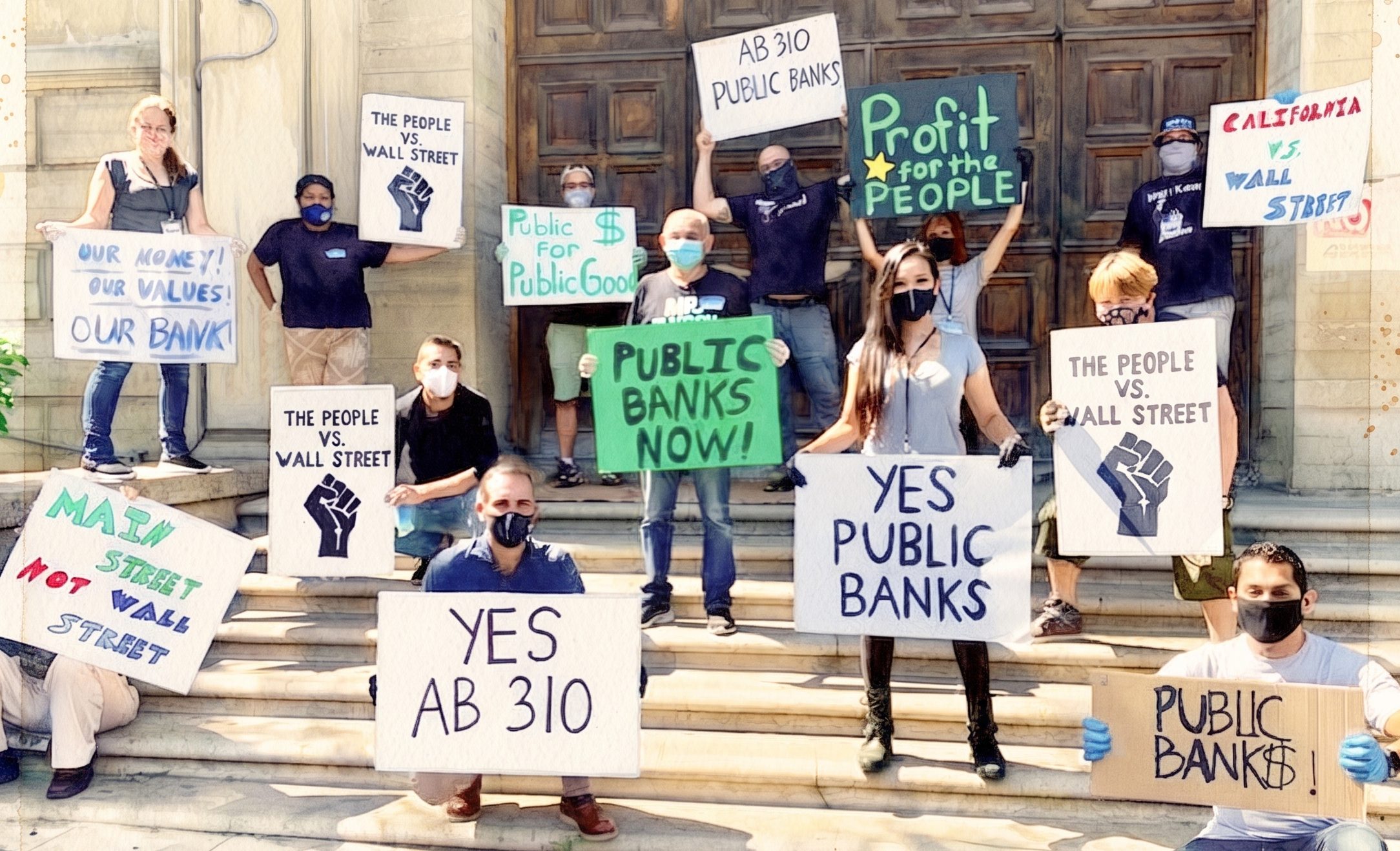
Fifth and finally, DPF demands far-reaching experiments in public banking and digital payment systems. Today, banking and payments are dominated by commercial banks, private equity, shadow banking, credit card companies, Silicon Valley apps, and payday lenders. If crediting operations engender our collective future, then we must place democratizing such operations at the core of political organization and action. By chartering public banks, we wrest public funds from Wall Street, deploy stabilizing credit during downturns, channel investment into historically divested communities, and eradicate the banking deserts manufactured by financial consolidation. Alongside these banks, we need to establish free public digital payment rails. These systems will liberate small businesses and workers from predatory transaction tolls and expand public clearing. A robust public payment apparatus is what brings our municipal alternative to Amazon to life—keeping prices low, eliminating middleman fees, and allocating wealth locally through transparent public ledgers rather than private conduits.
Democratic Public Finance enthusiastically champions every initiative to establish public banks. Yet it also challenges us to reach further—to stretch far beyond the conventional boundaries that have historically hemmed in the movement. What, after all, is a public bank? What can public banking truly achieve? Rather than assuming a single, uniform template—or merely redirecting commercial loan protocols toward benevolent ends—DPF treats public banking as an adaptable, modular project. Above all, it shatters the zero-sum fallacy that sees revenue as an absolute barrier to collective flourishing rather than as an adjustable coordinate of public policy.
A dazzling example of what DPF offers public banking is what we at Money on the Left term the Loop. First developed by our colleague Tyler Suksawat, the Loop resolves several systemic crises in a single stroke, while uncovering money’s public endogeneity for all to see. The core problem is simple: every year, billions of public dollars exit our cities, counties, and states into the vaults of Wall Street. Whenever a state or municipality issues debt to build schools, fix transit, or repair water systems, it is forced to surrender massive interest payments to private underwriters and investors. This continuous financial depletion is a primary cause of regional austerity, cementing the manufactured illusion that the public is forever broke, even as our communities overflow with real capacity and urgent needs.
By establishing a government-owned public bank, we propose, a state or municipality can not only expand public investment through municipal lending; it can also purchase its own bonds and “loop” the interest back to the government itself, rather than to Wall Street. Over time, the Loop promises to reclaim the public interest in at least two senses. First, it quite literally saves states and municipalities—not to mention school districts, universities, housing authorities, and any number of sub-federal public institutions—hundreds of millions, if not billions of dollars in interest payments annually. In doing so, it turns bond issuance into a self-reinforcing system of public finance, capable of addressing community and environmental suffering far more democratically and robustly than ever before in the history of the United States. Second, the Loop recuperates the public interest in the sense of collective concern and will, asserting democratic control over debt allocation from Wall Street gatekeepers, punishing rating agencies, and fickle investors. Ultimately, the Loop reveals what hegemonic forces conspire endlessly to conceal: namely, that money is a boundless and contestable public utility that can always be reorganized to serve community and environmental endeavors. We need only to cultivate enough knowledge, creativity, and grit to unlock money’s repressed ecosocial potentials.
For the final movement of my talk, I wish to expand public banking’s horizon of possibility even further by considering what we at Money on the Left have taken to calling the Public Grant-Making Bank. As I suggested at the outset, establishing Bank of North Dakota-style institutions across every US state and territory would represent a monumental achievement. Yet such an effort nevertheless leaves the standard, loan-based approach to banking completely unquestioned. In this model, underfunded community organizations are turned into debtors, impelled to compete for scarce revenues in the marketplace simply to repay their loans
The problem is systemic, extending well beyond the world of public banking. The difficulty stems from two interlocking factors of monetary design. First, the United States has historically outsourced and privatized money creation–a state fiscal function–to commercial finance. Rather than reducing private finance to mere competitive enterprise, that is, our analysis underscores the fiscal role of commercial banks in creating, disbursing, and redeeming the public dollar. Through this lens, the vast majority of funds emitted in the U.S. dollar system enter existence as private bank loans, placing private balance sheets at the center of the country’s fiscal architecture.
Second, because this fiscal architecture is structured primarily to maintain positive balance sheets, it harbors inherent tendencies toward austerity, default, and crisis–both within and beyond the banking sector. To be sure, banks sustain investment by continuously creating new credit, paying interest on deposits, funding operations, and supporting public debt transactions–all of which, in turn, occasion further investments. At a structural level, however, and over the long term, banks subtract more from the economic system than they add precisely because they are legally mandated to conform to a politically constructed definition of solvency. However ideologically justified by those in power, the resulting fiscal system is debilitating by design. The good news, however, is that we can always construct more nuanced and democratically responsive definitions of “solvency” and inscribe them into law.
The conventional solution to this faulty structure is so-called “counter-cyclical” spending by the state. Such spending, however, only goes so far, as it remains beholden to shifting legislative priorities, rigid budget calendars, and political turnover–not to mention the twin myths of tax-payer redistribution and bond market “borrowing.” Public outlays, moreover, typically pale in comparison to the structural deficits induced by private finance—which, as a systemic necessity, relentlessly collects more than it spends. In addition to robust state spending, then, what is needed is an ongoing, nimble, and locally sensitive fiscal infrastructure that can serve as an automatic stabilizer and answer community challenges in real time.
This is why Money on the Left proposes the creation of Public Grant-Making Banks, designed to counter and, in certain cases, even replace private banking’s regressive model of fiscal austerity. The primary pillar of this model involves restructuring finance as direct grants, rather than as loans. Instead of relying on future repayment, public banks would issue grants to projects based on their public mission. A Public Grant-Making Bank evaluates proposals by assessing their anticipated social and ecological effects. For example, funding the establishment of community-owned broadband networks would be evaluated on their contribution to equitable digital access and educational opportunity, not on a financial return model. If the qualitative assessment is strong, the grant is made. On this logic, a grant is still debt; only, it is a qualitative obligation to improve social and environmental conditions, rather than a quantitative obligation to repay a financial sum. The devil, of course, is always in the details. Yet it is essential to remember that public banking is however we design it to operate–and there is no natural or necessary law that says banks must exclusively lend at interest.
Money on the Left’s own maximalist vision calls for revising and passing the Public Banking Act at the federal level, giving public banks full discretion to create and disburse grants based directly on community needs. Instituting this authority requires overhauling federal banking statutes—from Prompt Corrective Action rules under the Federal Deposit Insurance Act to the Community Reinvestment Act—legally substituting qualitative social metrics for conventional balance-sheet metrics. Such reform needs to be paired with a statutory liability shield for bank directors, protecting them from fiduciary duty claims when making mission-aligned grant decisions. Regulatory oversight would thus undergo a structural transformation: shifting away from punitive capital adequacy ratios toward what we envision as a Public Mission Fulfillment Index. Instead of narrowly auditing balance sheets for commercial solvency, such an Index would help evaluate a bank’s adherence to its public mandate—measuring substantive progress toward full employment, public health milestones, carbon-emission benchmarks, and transparent governance. Performance is judged not by profit margins, but by documented strides toward communal problem-solving, making the social mission, not a zero-sum ledger, the legal measure of success.
The Public Banking Institute’s own Ellen Brown seems to support public grant banking at the federal level. In From Austerity to Prosperity: The Public Bank Solution, for instance, she affirms granting over loaning when comparing U.S. banking to the Chinese system. I quote her at length:
Although the Chinese state-owned banks may have more [so-called] “non-performing” loans than private Western banks, the Chinese economy itself is performing better than Western economies dominated by private sector banks; and this superior performance is supported by a public sector banking system that functions very well for its intended purposes. … [T]he Chinese government did not actually expect repayment of these funds. They were simply credits created on the banks’ books for the purpose of paying for infrastructure and services. They were in the nature of “contingent grants.” If they generated income, great. If not, they were written off as a cost of running an economy. They were government-issued money stimulating economic development. Western politicians call these unpaid loans ‘deficits,’ ‘debts’ and ‘fiscal cliffs,’ and they engage in endless debates over how to get rid of them. Meanwhile, China and its neighbors carry on building, growing and producing. They recognize that the government’s debt is the people’s credit and that a freely-flowing national credit is the key to a flourishing national economy.
For us at Money on the Left, this very lesson must be extended to sub-federal finance, to say nothing of international finance.
Still, we do not need to wait for Washington: states and municipalities can commence experimenting with Public Grant-Making Banks right now, with or without federal support. Ideally, a revised federal Public Banking Act would obligate the Federal Reserve to provision corresponding reserves whenever a sub-federal public bank issues a grant. With this, grants allocated by state and municipal banks will achieve universal receivability throughout the U.S. economy without inducing destabilizing reserve drains within the sub-national public banking system. In a bottom-up approach, however, state and municipal banks can still be empowered to issue grants in addition to loans. Such institutions can begin establishing a designated Public Grant Reserve Account, the outgoing payments from which will be at first covered by assets in other areas. After meeting mandatory operating expenses, credit-loss reserves, and statutory capital preservation benchmarks, boards of directors can disburse a defined percentage of remaining net income as direct, public-purpose grants. What is more, those same public banks can deploy forgivable loans, recoverable advances, convertible public equity, zero-cost credit lines, and blended finance windows, proving that granting is not a single, narrow technique, but an expansive toolkit of bespoke financial architectures.
Especially in large states like California, we can then move beyond the self-limiting horizon of earnings-covered grants into pure endogenous credit creation. In this case, the California Public Bank would simply credit the accounts of public entities, social housing developers, energy cooperatives, and ecological remediation projects, expanding the public equity of the commonwealth without imposing the discipline of commercial debt amortization or revenue raising. Operating at this scale without federal coordination immediately encounters the structural impediment of the payment system and, in particular, the loss of reserves. Overcoming this constraint requires pairing public grant-making banks with a dedicated state or inter-state public clearinghouse—a companion network that maximizes internal settlement to minimize reserve flight, while pooling state public assets to interface cleanly with the Federal Reserve. Thus, far from a rigid, one-size-fits-all formula, there are myriad paths to launching Public Grant-Making Banks. The essential task, we contend, is to foreground grant-issuing as an aspirational horizon–one that drives pragmatic local campaigns today while constantly reminding our movements of all that public banking can make possible.
Money on the Left does not claim to hold every answer—political, legal, social, or aesthetic. Instead, our vision for Democratic Public Finance offers a guiding ethos for collective activism and structural transformation. We offer it to inspire the public banking movement to remain inventive, resilient, and undeluded by prevailing creeds of scarcity, ensuring that even when tactical compromises are necessary, we never mistake provisional constraints for the outer limits of what is possible. At last, we must reject myths of austerity and revenue redistribution that keep millions of our neighbors impoverished, unhealthy, and disempowered. Conceding to this canard today only tightens oligarchy’s clamp on tomorrow’s political imagination. Our communities and ecologies brim with unrecognized capacity, which the present order casts off as mere costs. If money is truly public, endogenous, and inexhaustible, then it is our shared democratic responsibility to ensure that all are cared for, all are sustained, and all are empowered to author a common future.
Thank you.
Featured Image: Augusta Savage, Lift Every Voice and Sing (The Harp), 1939. This photograph depicts a small contemporary bronze souvenir cast of Savage’s monumental sixteen-foot plaster sculpture, originally commissioned for the 1939 New York World’s Fair. Inspired by James Weldon Johnson’s Black national anthem, the sculpture depicted twelve singing Black children forming the strings of a harp, cradled by the arm of God. Savage had taken a leave of absence from her role as director of the Harlem Community Art Center—funded by the Works Progress Administration—to realize the commission, only for the masterpiece to be bulldozed after the fair when neither the fair corporation nor public authorities allocated the funds required to cast it in bronze or store it. The destruction of the work emblematizes the racialized and gendered austerity Democratic Public Finance aims to redress. For this feature, the original photograph has been cropped and recomposed against a solid monochromatic field using Adobe Express.