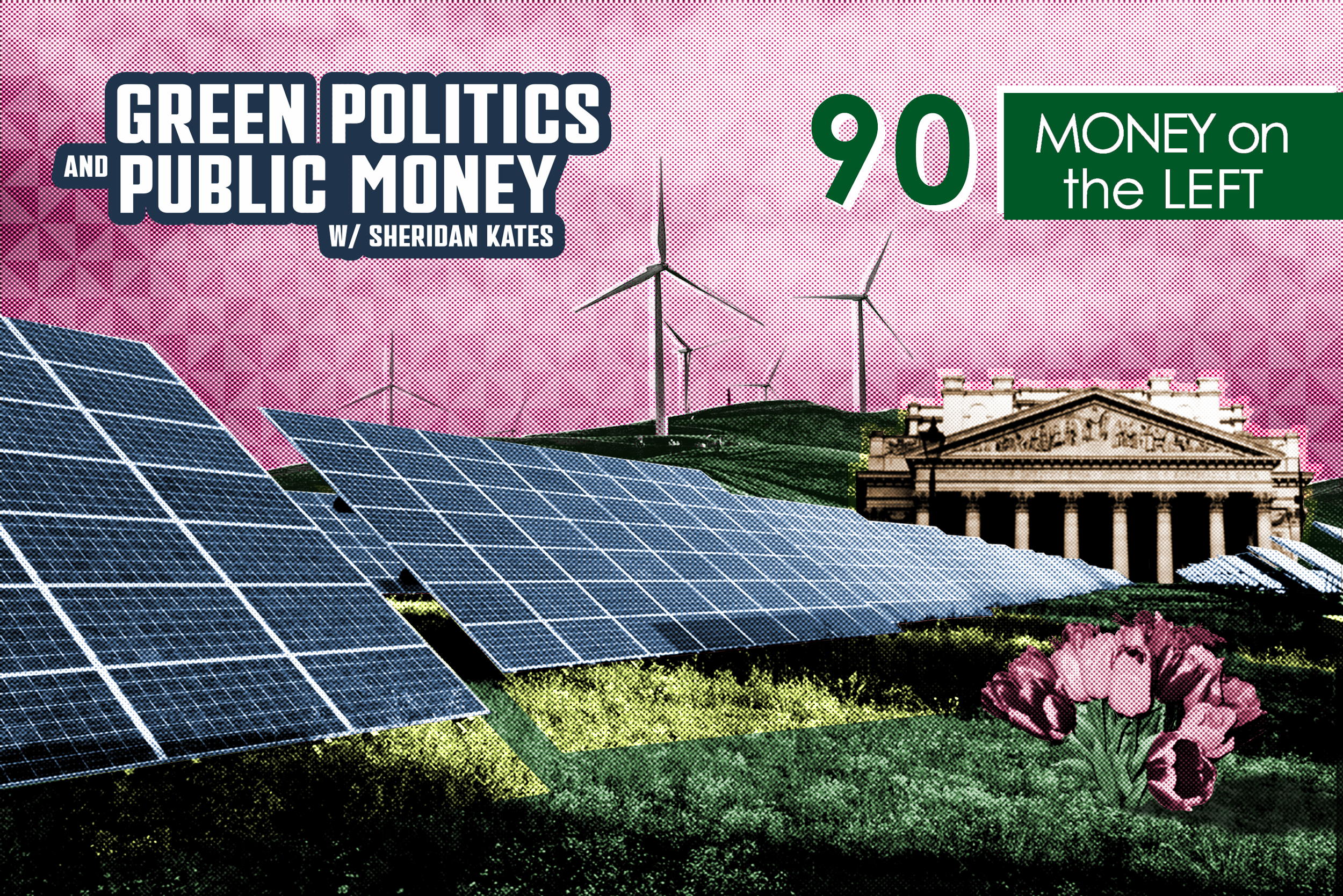
Billy Saas and Rob Hawkes speak with Sheridan Kates, ecological economist, activist and Green Party candidate for Islington Council in North London in the May 2026 local election. (Update: Since recording, Sheridan won her seat and is now an elected Councillor.) In her academic and political work, Sheridan rejects both the economics and the language of austerity, and instead prioritises democratic, inclusive, and participatory institution building. Sheridan’s activism extends into a commitment to public economics education via her work with Modern Money Lab UK, which held a series of public workshops in London and then a 2-day anti-austerity conference in Bristol in 2025. As a signatory to the Greens Organise ‘Pledge to Oppose Austerity in Local Government’, Sheridan both welcomes the gathering momentum behind campaigns for a UK wealth tax and argues that they do not go far enough. Amidst a new wave of excitement surrounding green politics in the UK, especially since Zack Polanski’s election as Green Party Leader in September 2025, Sheridan looks to a future where our economies are redesigned democratically to put people and the planet before profit.
Visit our Patreon page here: https://www.patreon.com/MoLsuperstructure
Music by Nahneen Kula: www.nahneenkula.com
Transcript
This transcript has been edited for readability.
Billy Saas
Sheridan Kates, welcome to Money on the Left.
Sheridan Kates
Thank you for having me. It’s great to be here.
Billy Saas
We are interested in talking to you about many things, but we want to start by asking you to tell us a little bit about yourself and how you found yourself where you are in your thinking now on economic and public policy.
Sheridan Kates
Yeah. Well, I have a bit of a circuitous route to where I am now. My background is completely unrelated to all of this. I started out as an engineer. I initially did a master’s in general engineering. I didn’t know if I was going to specialize in civil. I really loved the idea of building things that actually exist in the real world.
But my dad was a software engineer, so I basically went that route instead, specializing in electrical and computer science. I really did that for a long time. I worked in the tech industry. I ended up getting into the big tech worlds right out of college.
We probably knew it was starting along the evil routes but didn’t know quite as well some of the challenges that we see with some of these big tech firms that we are seeing nowadays. I was working at all these different types of companies and seeing that we were, in theory, really trying to do good by our users, right?
We wanted to create products that made their lives better. Then you’d find the things would start to really go towards the profit motive rather than what was good for the user. I don’t know if I should be naming names, but one of my big companies I worked for at the start of my career was Google.
When I started at Google, it was super clear what that ad was, right? You had a different colored background for the whole ad section. These are the ads, these are the search results. And over the years that’s become less and less obvious. I struggle as a relatively sophisticated computer user to see what an ad is on Google.
Now, there’s this tiny little badge that says ad. A lot of that is to get people to click more on ad results. They try to make sure that the users are getting a good result when they click through, but it just feels like it’s moving towards money and not actually good things for people.
I started moving through different companies and trying to see, “okay, well, you know, I’ll try and work on a company that’s like trying to help people through fighting the climate crisis or these types of things.” But then you would just find that all of them sort of ended up in this world and not necessarily even in a bad way.
They were just forced to compete in this world of capitalism where people have to choose the profit margin over what is good for users. At this climate company I was working at, in theory, it was doing this demand response for energy. So basically rather than firing off a gas power plant in the middle of the day when you needed more energy, it would say, “okay, you’re using a whole bunch of energy. Stop using energy for now, then other people will be able to use that,” and that in theory is good, right? You know, it basically means you don’t have to deploy another power plant. But they didn’t tell me before I joined the company that some of their biggest customers they were working with to turn off were bitcoin mines.
In theory, you’re helping the environment, but do we really want all these bitcoin mines? Could we not invest in battery technology instead of having all of these mines using energy? So again, this theme continued and it felt to me like I would never find a company that actually was going to be doing things in the way that I wanted.
And I came across Doughnut Economics in 2017, Kate Raworth and also Jason Hickel’s The Divide. At the time, I was very ignorant of the global north and my country’s role – both the UK and I also lived in the US for a very long time – in subjugating the global South and then putting us in the situation that we’re in now.
Then I came across the concept of degrowth and I have gone on a journey of many masters. That was my second master’s, my master’s at the University of Barcelona. That degree is really fantastic. You can do it online, but it really gives you a very broad sense of what degrowth is.
Within that, I think you can kind of find your place and for me, the thing that really stood out was economics. We are told all over the place that we will not get the good things that we want if we do not continue to have growth. That’s how, in theory, governments are providing all of these public services, but understanding money for what it is, it basically meant that I felt that I really needed to understand this from a left perspective and so I did a final master’s. As part of that degrowth master’s was really understanding that I wanted to drill into post growth economics and how that could actually work in practice, how that really works with the money system. Steven Hail’s degree, at Torrens University, Modern Money Lab really felt like the right fit for me because that gave me the grounding that I would need to really be able to speak to how money works, why I’m moving towards a post-growth economy that wouldn’t crash the economy.
In fact, it would just be a really different way of thinking about things. I ended up quitting my job to do that master’s a couple of years ago. I was lucky. I have to be clear on that. The tech industry gave me this cushion that meant that I could go and try this other thing.
I’m very grateful for that. I think it’s important to not let yourself get sucked into that world where you’re just trying to get the bigger house and then just end up living up to your means. So I did try and set that up such that I could change into this other way of giving back.
I decided to go into economic education and Modern Money Lab is the place where that final degree was offered. We wanted to put together courses, like, Steven Hail is just so generous with his time, so we facilitated some of those courses here in the UK.
We also put together a conference which I think Rob came along to, which is great, but we just really wanted to get the word out there, to try and give a political education, which I feel is missing especially around money. It’s this big scary thing.
It’s really presented to be like, “oh, you know, don’t worry about this. You can’t understand it.” I really wanted to change that. I think the approach I’m taking right now is throwing spaghetti at the wall and seeing what sticks, because I also got very involved in the Green Party about four years ago and now in local elections here in Islington, which is where I live in the UK.
What I like about the Green Party approach is that it is all about listening to people. I’m part of a team that’s been door knocking in the area that I’m working in for a decade or more. We started for this election that’s coming up in a couple of weeks two years ago. We started door knocking to find out what people had to say about the local area. We want to know what the green spaces were like, what the bin collections were like, just the stuff that really makes a difference in people’s lives. We’ve built up deep connections with people in that area now, and I think, as part of that, hopefully we’ll get elected, but we’re not going to stop door knocking after that. We want to keep doing it. We want to try and keep pulling people into forums like Peoples Assemblies where we can do participatory budgeting. I really love what Clara Mattei has been doing at the University of Tulsa with the FREE (Forum for Real Economic Emancipation) projects where she’s been doing lots of political education.
I’d love to be doing more of that locally. So yeah, it’s really kind of a wide range of areas. Oh, and the thing I didn’t mention on top of that is also the national policy. So we can probably get to this as well, separately. But, the Green Party of England and Wales, all of the policy is member driven and so we have these policy working groups and I’ve been working with the Economics Policy Working Group for about the last 3 or 4 years and then last year I took on the co-convening role of that group. So really trying to help both at a local level, but then also like a national level from the economics policy side for the Green Party.
Rob Hawkes
That’s really wonderful. Yeah. There’s so much we probably want to come back to many of the topics you’ve already raised there. I think that the point about education, about opening up conversations about money and economics, though, is such an important one. One of our friends and colleagues, part of the Money on the Left group is Jakob Feinig, his concept of monetary silencing is a really important one for us as a group.
It’s such a powerful concept. All of the conversations about what money is, to how it works, to who creates it, who gets to make decisions about where it will go, who can create money, why it can be created, what its purposes are and functions and the kind of mechanics of monetary design, monetary silencing kind of takes that off the table. Like you just said, it kind of puts us in the position of like, “:this is just the way it is, and you just have to kind of just get on with it or it’s too difficult for you ordinary people to understand.”
So, yeah, I wonder if you could just say a little bit more about those events. I was hoping to come to one of the events in London last year, and I think we were in touch around that time, but in the end I couldn’t make it. But yeah, there were two workshop events in London that Steven Hail ran as Modern Money Lab UK events and then of course the conference in Bristol that, again, I was unfortunately not able to get to in person, but I attended remotely. Can you say a bit more about what happened at those events, how they worked?
Sheridan Kates
So Steven Hail and then also Gabby Bond, who is the director of the Modern Money Lab group in Australia. Steven and Gabby put together some fantastic courses. I really love the way they’ve done it, actually. It’s broken out into modules throughout the day.
It’s almost like a taster, actually, for the two intro modules for the master’s that I did. Basically, the way that it works is that Steven will give a lecture for like 30 minutes at the start, but then they have breakout groups and they’ll randomize everyone in the room. So it’s super social.
You get to meet all these different people and then you talk about the concepts that you just heard. It might be like, you have a section on exchange rates or a Doughnut Economics crash course and then you come back into the room about what you’ve learned, but it’s kind of putting everyone on an equal footing and hopefully encouraging people by saying things like, “you know, no silly questions.”
You know, everyone is just sharing their knowledge and getting that out there. It also pulls in the Finding the Money film, which I think is a really useful pedagogical tool, which I US-focused. We need to get the UK Finding the Money. That always blows people’s minds too.
It’s just a really, really good overview. A really key feature that I really think we should be focusing and centering in all of our work is food, right? You know, there’s food included and people are eating together over lunch and there are snacks all through the day.
Clara Mattei does this as well with her FREE gatherings. I say FREE gatherings, it stands for the Forum for Real Economic Emancipation. That kind of community is really built around food and then safety around questions and unsilencing or demystifying money.
So that was incredibly powerful. I should definitely plug – or Steven will kill me – that he’s coming back in the summer to the UK and all over Europe. Maybe we can share this in the show notes or something? He is coming to Brighton and various other places over Europe, so we should definitely let your listeners know about that.
And then the conference, what we wanted to do with that was try to open up these concepts outside of just the people who come to economics conferences. We have had like three areas of focus; health, housing and employment and making sure that there are jobs out there.
What was really compelling about that is that you can get people from groups who weren’t necessarily thinking about this and just sort of present, “okay, well, is this a different lens of thinking about how government spending works and the power of public money to fund the things that you are advocating for.” I don’t know how these organizations feel about it, but it’s almost like you either want the funding or you want to put yourself out of a job, because this should be provided by the government. I don’t think we’re ever going to put ACORN [Association of Community Organisations for Reform Now] out of a job because ACORN does fantastic community organizing. Even if everyone had a house I’m sure we’d still need that. Some of the charities around poverty and all this kind of stuff, in the ideal world, I don’t think would exist.
If we can help all of these organizations understand how government finances actually work and what the real world constraints are to spending rather than the perceived ones. That was really the goal. So we specifically didn’t call the conference like anything around any school of thought, we called it The Anti-Austerity Conference. We pulled in the Keynes quote, “anything we can actually do, we can afford.”
I think it went down well because of pulling together academics, but also people from the different groups. We really tried to make sure that the online experience was as good – as much as possible – as the in-person, again, really prioritized food. There was a fantastic onsite cafe in Bristol, who did really good catering for us.
But yeah, I think those are themes of how we try and put these things together. The thing about the conference is, we’ll think about how that should evolve and we’re all doing different things, throwing the spaghetti at the wall just to see what sticks, but I do like the goal of reaching out beyond our own community. That is where we want to continue to go.
Rob Hawkes
Yeah. Yeah. Absolutely. The online experience was great as far as I was concerned, although it was Bring Your Own Food if you were an online participant. But yeah, I’ve got the full title: “The Anti-Austerity Conference: Anything we can do, we can afford,” which is, like you said, the Keynes quote, “debunking money myths to end austerity in the UK.”
One thing that did stick in my mind from being an online delegate at that conference was a moment where you were directing a Q&A after a panel, after a paper, and you quite deliberately said, “I want to hear from someone who’s not a man next.”
I think those were your exact words.
Sheridan Kates
Yes.
Rob Hawkes
Why did you say that? I mean, why do you think that was an important move to have made and perhaps how it speaks to a kind of a wider issue and an ongoing one in conversations around economics?
Sheridan Kates
Yeah. I mean, obviously there are very few non male voices in this space and often they are the loudest. I think it’s really crucial to just remind people that their voices are as important and the more that you hear someone else who isn’t a man ask questions, and they sound like you, even though it might seem small, but, I think it really does matter. It also just shows that the space is for you. It was also part of the outreach, honestly, like, we really tried to make sure that we didn’t just have a room full of the usual suspects, I do keep getting that feedback at the events that we run. They are more diverse than the ones that you typically see.
Like, we also had an event actually in UCL (University College Longon) that was a screening of Finding the Money. We had an entirely packed out, very hot room, where Zack Polanski came along and ended up doing a panel with Patricia Pino, Josh Ryan-Collins, chaired by William Thomson and that had such a range of people, like ages, genders, I think it’s just really important to make sure that we understand that economics is for everyone and keep calling that out.
Rob Hawkes
Yeah, absolutely. The Modern Money Lab master’s has ringfenced scholarships for Global South students that are specifically for women. So, so yeah, that’s kind of a little part of this wider, important conversation, isn’t it?
Sheridan Kates
Absolutely. And again, I would be remiss to not say if anyone who has money would like to sponsor more of those you can definitely reach out to Steven and Gabby we’d love to get more of those available to people. Every bit of support helps.
Rob Hawkes
It’s a wider question, isn’t it, in terms of who studies economics, who feels that they’re kind of entitled to contribute to conversations around economics. It’s bound up with other questions. When this episode goes out, Billy will have introduced it with our usual introduction to Money on the Left as a podcast that reclaims money’s public powers for imaginative intersectional politics.
Yeah. How important is intersectionality to the way we think about economics?
Sheridan Kates
Yeah, huge. Obviously, so much of the issues we see are exacerbated along racial lines. Looking at, for example, health inequalities. We see in the NHS (National Health Services) that people of different racial backgrounds are treated differently. We need everyone’s voice at the table to be inputting exactly how money should be spent and not just with equality, but from an equity perspective.
There are areas that have been massively underserved for many, many years. Where can that be improved?
Billy Saas
So part of your activation and your mobilization post-Modern Money Lab master’s has been these events and the organizing and being active in the Green Party, you’ve also been writing in those contexts. I wanted to ask you a bit about a piece that was published in November where you talk about wealth taxes in the UK. The piece that we’ll also link to in the show notes is called “Wealth taxes don’t go far enough.” Per the Modern Money Lab conference, there’s some debunking work that needs to be done around wealth taxes. Could you walk us through the scene there in the UK around progressives advocating aggressively for a wealth tax and where you’re wanting to see that argument go and evolve?
Sheridan Kates
Yeah. Yeah, for sure. I’m hugely supportive of wealth tax from an inequality perspective. The thing that advocating for wealth tax really helps us is pointing to the enemy in a lot of ways. Right? The elites have just been allowed to run away with money accumulation.
Pointing out that there’s going to be a shift towards ensuring that those types of people are taxed fairly. Why should someone who’s earning an income be relatively taxed a lot more than someone who’s getting money from capital gains and dividends? That kind of thing.
So I think that’s fantastic. I think the trap that you can get into is when you claim that it’s going to pay for everything, that the money that you’ll get from wealth taxes will cover all of the things that we need to do. I point out in the article that the numbers are vast.
There’s hundreds of billions that need to be found every year just to get our public services back to a few years ago when they were already highly degraded, they need to be much better. We need massive programs of both building, but also buying back homes to turn them into social homes, because we used to have some of the best social housing in the world here in the UK.
Now the government spends the vast amounts of money that it used to spend building council homes on funneling money directly to private landlords via housing benefits. That is just absolutely shocking. There’s a lot of money that needs to be found and the numbers don’t add up if you’re just going to be looking at wealth taxes.
This is just the start of a long journey and I think that with that blog was, there’s a particular kind of audience that will read a big blog like that, but I’d love to work more on getting some short form video stuff out there that could appeal to a range of people, but trying to get people less terrified about the idea of government spending.
What does it really represent? How does it compare to like, for example, the private credit or private credit creation that no one talks about. It’s obviously vast. Just speak to the power of government investment, especially in these industries where private companies aren’t going to get the returns.
I think Brett Christophers speaks so well about the shift towards renewable energy. The profits that you get from renewable energy are so much lower than the ones you get from fossil fuels, even nuclear to an extent.
You are not going to get the private sector to build all of this. It really has to be from the public sector, or you get into a situation where the public sector has to subsidize the private sector to build all these renewables and then the benefit of the lower prices doesn’t filter through to consumers.
You then get what we see in the UK, where net-zero is seen as a dirty word now, because there’s been all of these renewables and yet, energy prices are at all time highs. So yeah, really drawing attention to the fact that it’s not just about wealth taxes is just super key in this environment.
Billy Saas
It’s such a great conversation starter. I mean, talking about the political education of thinking about money and thinking through money, it’s something we talk about a lot. How financial literacy and the conventional refrain is sort of apolitical, but financial literacy and the critical frame that we prefer and assume is very active to what you’re up to is political to the core. I know that you’ve been doing a lot of listening and canvasing, but have you had much opportunity to share these ideas with those who have not been previously initiated into them? And if so, what’s the reception been like?
Sheridan Kates
I think it does make sense to people. I think you have to adjust for where they’re coming from because, if you’re talking to someone who thinks they know how this stuff works. You know, maybe they’re a bit of crypto investing on the side. You don’t know what you’re going to get when you’re doorknocking, right?
You have to be really careful to think about where that person’s at and whether it makes sense to be having this big conversation on the doorstep if you’ve knocked on their door unless it comes up. I think that’s tricky.
I think a lot of people came to the Bristol conference without a huge understanding of this stuff. I think like some people were saying they’ve basically been lying to us like when they learn this stuff. Obviously there’s a lot of nuance that comes on top of it.
We’re not trying to say that this is limitless, but it’s just a different kind of constraint. We know we want to be thinking about the real resources as the constraints and environmental constraints. There are planetary boundaries. Just because we can afford to reopen coal mines, should we? From an environmental perspective, probably not.
There is somewhat of an excitement in learning this stuff, but I think it’s on us to find better ways of getting to the point across snappier and in a faster way because I don’t know that I’m always the best at it. Sometimes, I think you can lose people.
Obviously people care about their bills right now, right? The cost of living crisis in the UK is horrific. If you can explain how these things will make their lives better, then, great. We have to get to the point where we’re making it clear to people we’re not trying to prove something to them that there’s a reason why we’re talking about this, that we understand what their real issues are and then get to the point where you capable people are telling me that we can’t afford this unless you increase everyone’s taxes. Look at that. Now we can have a conversation about this. But yeah, I think it’s about picking your moments.
Billy Saas
And knowing your audience. I think that’s critical. This person I knocked on the door of, do they want to talk about money or am I interrupting their dinner?
Sheridan Kates
Quite so. I will make it clear that that does not come up much on the door. Really, people care about the potholes and when their bin doesn’t get picked up.
Rob Hawkes
Right. It makes sense, in lots of ways, why the wealth tax conversation happens in the way it does. For anyone that’s kind of broadly willing to get on board with the idea, it makes sense. We can see that, there are the rich people, they have the money and so if we want to do more things for the public, we need to get some of that money. That’s an easier concept for most people to get their head around then. Well, money is a public utility that is inexhaustible and we just need to decide democratically on how we go about using the power of public money creation…
Sheridan Kates
…to mobilize the scarce, real resources that we actually have and then that’s the hard conversations, which I think is really compelling. I think what’s fascinating right now is this whole AI situation, right? Obviously this is like booming and people really don’t have any say in this. Some people find it can be cool for certain situations and stuff, but ultimately people feel like they have to learn this stuff otherwise, they’re going to get left behind. But if we can have democratic conversations about, “okay, well, these are the real resources that are actually having to be used for this whole AI boom. Do we want to be using this for this purpose? What is the impact on the environment?” and have conversations around this and maybe change the way that we approach this. I think that’s really compelling.
Rob Hawkes
Yeah, absolutely. In your piece, I’ll quote you, “In a world where we’re no longer scared of losing rich people’s money because we know it doesn’t fund our public services, we can set up direct democratic institutions like people’s assemblies and use them to decide, as a society, how much money we want to allow anyone to have for themselves.” And potentially lots of other things, too. How does that kind of democratic institution building feed into your thinking?
Sheridan Kates
I think there are multiple levels of which this needs to start happening. A lot of the local doorknocking we’re doing is about wanting to set up participatory budgeting and people’s assemblies. Also, there’s a pledge from the Greens Organise organization that 800 councilor candidates signed up for, where essentially we would try and mobilize people locally through trade unions, through local councils, but basically have them lobby up to central governments that we need like wealth taxes. It is still important to push for those, but also things like restructuring the way that we deliver social care. So right now that is completely delivered by private equity, pretty much. We want to restructure that to then take those organizations back into local economies and employ local people, making sure the money stays locally.
Building those blocks needs to start locally. But then there’s also other initiatives here in the UK around abolishing the House of Lords and potentially replacing that with the House of the People. Maybe you could get people elected through sortition, to do a four year term that they would get trained for. That would mean that anyone could come and do this like extended jury service or something like that, so that the interests of people are actually coming in rather than the interests of unelected representatives as in the House of Lords and not really democratically elected in other cases.
Rob Hawkes
Yeah. I just wondered if we should do that with the head of state as well. We should just sort of draw lots and everyone gets a turn.
Sheridan Kates
Yeah, absolutely. With the right training, I feel strongly that that should be within reach.
Billy Saas
I feel like there were a series of films in the 1990s that that was their central premise, more or less. Just like average-Joes making it to the highest…
Rob Hawkes
King Ralph wasn’t it? There was King Ralph.
Billy Saas
So there you go. I think there’s one called Dave.
Rob Hawkes
But yeah, we can include the pledge in the show notes as well because it is a really great set of commitments and talking points. One of them being an emergency summit to make communities heard, which is a commitment from all the signatories. Do you want to say more about that?
Sheridan Kates
Yeah, I mean, basically we want to keep this momentum. We have some kind of green wave happening. I’m touching all the wood around me. If we live up to this expectation, we should see a lot of green councilors coming up after the elections in the next couple of weeks.
We’re in a crucial decade for the climate crisis. We’re in a crucial time for people’s affordability. Everyone is having a really hard time right now. The rejection of the two main parties is happening right now. So with the Tories and Labour, many people are going towards Reform on that because they feel like they have this different story.
But a lot of people now are coming to the Greens and we need to show them that we are not just like the other parties. We are going to do things differently. We are going to take the trust that they’ve put in us and build something in a democratic way and this summit is key to making sure that that momentum continues and we don’t just end up being like the other people who just get into power and don’t have anything happen. So yeah, active planning happening on that. Like I said, we want to make sure that trade unions are involved because it’s a very exciting time.
Billy Saas
For those of us in the United States maybe, but elsewhere in the world, who aren’t as up to date on the Green wave, could you catch us up on the more exciting moments.This episode will be published in the middle or certainly close to those elections.
Sheridan Kates
Like six days before.
Billy Saas
Yeah, yeah, yeah. So what should we be paying attention to or what should we know as that ramps up?
Sheridan Kates
Yeah. So a quick summary. There was kind of a little bubble back in 2015 for the Green Party, which kind of got eclipsed by Jeremy Corbyn becoming leader of the Labour Party. There were very similar values. A lot of those people went over to Labour. We know what happened there with the election in 2019. Since then, there’s been a bit of a languishing. There’s been various things cropping up, but last year Zack Polanski ran for leader and I mean, Zack’s really awesome. I think I wish he’d been sort of on our radar from the economic side as well for a long time, because I went to a Green Party conference in Bristol in 2023, and he was deputy leader at the time and in his speech said, “government’s budget is nothing like a household.” And I’m like, “oh, well, I wasn’t familiar with your game, Zack!” I then reached out to him to try and get him to be a speaker on our panel at the UCL Find the Money event that I mentioned earlier..
So we’ve been trying to get him along to all of these events and actually we had asked him for the MML (Modern Money Lab) Bristol event, literally as he announced his leadership bid. I think we got very lucky because he ended up doing our conferences as one of the first things he did when he was leader and massive kudos to him that he didn’t cancel.
He really believes in his commitments. So thank you so much to Zack for coming and speaking about the political situation in the UK.
Rob Hawkes
It was like the days after he was elected, wasn’t it?
Sheridan Kates
It was days after. I think we just got so lucky because we asked him months prior. I knew that Zack would do really well. It’s been fantastic to see his rise, but I think what’s really key, though, is to call out that nothing has changed in terms of Green Party policy.
We’ve always had these really good social policies. We’ve always had these really strong environmental policies. Zack is just an incredible communicator. He’s really gotten out there. He really understands social media. From the start of Zack’s campaign, he added a lot of members to the Green Party, but after he got elected, it’s just been this crazy trajectory. Like we had maybe about 60,000 members roughly, and now we have more than 225,000. It’s only been just over six months. We are probably the second largest party at this point in the UK because the Labour Party has stopped reporting its membership numbers.
Reform is still up ahead, but we are quickly closing. The other really amazing thing that happened was the by-election in Manchester. So, Hannah Spencer is amazing and she ran an amazing campaign against both Reform and Labour, coming out on top. That’s the first time the Greens have ever won a by-election. So I think all of these things compounding are just really showing that the Greens are no longer a small party.
We’re one of the major parties. It’s also kind of wild because we have five party politics now in the UK with our first-past-the-post system. This is really causing, I think, a lot of instability. I think we are kind of lucky in that we do have this situation where an insurgent party could come in and create this kind of upset.
I know in America it’s a lot harder with the way that everything is structured. I think we are going to have to try and move towards a proportional representation approach, because otherwise we really run the risk of an unstable government, year-to-year.
Rob Hawkes
Right. For any listeners unaware in other parts of the world, Reform UK is Nigel Farage’s party and is likely to turn into a very kind of Trumpist government if elected and for a long time the opinion polling has been really frighteningly showing a big lead for Reform.
And yet, as well as membership numbers for the Greens surging, the polls have been kind of creeping closer and closer. At least one recent opinion poll actually put the Greens kind of slightly ahead or a fraction of a percentage point ahead.
Sheridan Kates
That’s right. The average of polls are showing definite drops for Reform now and Greens on the way up. So we just have to keep at it with the hard work. But I think it’s quite an exciting time.
Rob Hawkes
I want to just go back to that sentence you mentioned from Zack Polanski about the government not being like a household. Zack Polanski said the government is not like a household, as you say, before he was elected leader, but he said it on the day he was elected leader. He went on BBC, the flagship BBC Newsnight program.
I think it’s difficult to maybe get across to listeners outside the UK of just how that was quite an extraordinary moment, actually. It was the first time I’d heard anyone on a kind of mainstream BBC flagship news program, sit on the sofa and say, “government budget’s not like a household.”
He said something similar again in a major speech of, around a month ago, at the New Economics Foundation, on economics. I imagine that most Money on the Left listeners will be familiar with this, though, and it’s not a surprise to many of our listeners.
But, why was that such an important thing to say and such an extraordinary thing for a leader of a major British political party to say?
Sheridan Kates
Especially since the 80s when Thatcher told us “there’s no such thing as public money, it’s only taxpayers money,” we very much have adopted and endorsed this idea that we need to balance the budgets. Austerity years, like we were sold by George Osborne, that we had been very irresponsible as a government before the financial crisis and the only way to address this was via austerity. I think he actually even referenced that Rogoff and Reinhart paper that was discredited and I don’t think that was ever actually a big kind of reckoning to that publicly. Basically saying that we needed to reduce our debt, where all of the measures for austerity only increase the debt.
So we’ve really been playing in this sphere where the government doesn’t have any money, and we need to be taxing it and we can’t be borrowing because look at those yields, look at the interest rate that it has to pay on the bonds.
It’s much higher than all these other countries and she’s really got to tighten her belt. So I think just having a major politician out there saying, “well, you know, actually this is not the analogy we should be looking at.” The BBC actually has been pulled up in the past for saying things like “maxing out the credit card” and saying that there is no money left, but they continue to do it.
Having a politician on there challenging them, and I think honestly really throws them and it’s delightful to see presenting this alternative. I think he does it in really good and interesting ways as well. Speaking to things like multipliers where it’s just common sense, right?
That if you spend money into the economy and it goes to a place that’s going to then be circulated multiple times in the economy, rather than just going directly to subsidize some billionaires to provide Covid personal protective equipment, which is like a large part of what happened on our side, then this is actually a really big benefit to the economy.
So, yeah, I think it’s just a real game changer. The thing that we really need to do now is find more people in Zack’s position, because he can’t be the lone voice out there. I think we need to give him cover and make sure that more people are talking about this publicly.
Rob Hawkes
Yeah. Yeah, absolutely. I think the other thing that has really struck me from the things that he’s been saying is the emphasis he places on storytelling. He often says, telling a different story is really important. Of course, as a humanities kind of person and at Money on the Left where, you know, we’re all about kind of narratives and metaphors and storytelling as so fundamentally important.
I’ve said and written myself saying that storytelling is another word for accounting. The way we account for things in monetary terms is all to do with how we tell stories about who’s important, who matters. It comes back to those questions we were talking about before, of the kind of intersectional questions of whose voices are loudest, whose voices are being pushed to the margins. It is partly to do with how we tell stories and how we account for people.
Sheridan Kates
Yeah, that’s really interesting.
00;43;51;16 – 00;44;16;25
Rob Hawkes
Kind of tied to that point and going back to the documentary Finding the Money, Maren Poitras’ brilliant film. Maren’s a former guest on Money on the Left many years ago when she was making the film. But, another former guest, Lua Yuille, says in the film a line that really sticks in my mind from it, “if money is natural, then who has the money is natural as well.” Again, it comes back to the kind of monetary silencing thing. If we accept that everything is the way it is, that is just the way it is, then, the kind of the status quo is natural as well.
Five men have all the wealth and the power. But once you start to realize, “oh, the system has been designed this way, but we could design it differently,” that’s when we can open up new kinds of conversations and new ways of imagining the future.
Sheridan Kates
Yeah, exactly. Actually, I really loved one of Zack’s Bold Politics podcast episodes recently. This author, Zakia – I have completely forgotten her last name, I hope we can drop that in the show notes as well – (Zakia Sewell) wrote this book called Finding Albion. It is all about finding the old folk tales from thousands of years ago that center completely different people.
So,even the name Albion is the old name for England. It references white, but it’s not necessarily clear what that white was. Was it the white cliffs of Dover? There’s also a story about this Syrian refugee who went to England. Her name was Albia and she set up a matriarchal society there.
These stories that got lost through history, the ones that got kept are the ones that they wanted to be kept right. The ones that they had was the history that they wanted to teach people, to believe that we were just amazing in the two world wars and don’t think about what we did in the Empire. It’s all about thinking how we frame stories, which stories we bring to the forefront.
I think that is also the way to convince people that the story might be living through right now could also be different. So I think that that episode is really great.
Rob Hawkes
There was a bit of a hooha, as we say in the UK, about the potential redesign of banknotes about a month ago, wasn’t it? The Bank of England announced that the banknotes were going to be redesigned and the new designs were going to feature animals on them.
Nigel Farage in particular got very upset. A man in the Newsnight and in the BBC Question Time audience got very upset about it as well and blamed those Greens and he said, “oh, it’s those greens with that kind of woke agenda that are responsible for all of this.”
Nigel Farage posted a video about replacing Winston Churchill with a beaver, and he literally said, “I’m not making this up. They’re going to replace Winston Churchill with a beaver.” He obviously was making it up because the Bank of England quite clearly has said they haven’t decided which animals are going on the banknotes anyway.
Sheridan Kates
That was not to mention the fact that it was voted for by the public.
Rob Hawkes
Yeah, it’s a democratic monetary design.
Sheridan Kates
Exactly.
Rob Hawkes
It seemed sort of silly or you could dismiss it as a bit of a silly media moment, but it was telling, wasn’t it, that he was upset about replacing Churchill, but he wasn’t upset about Jane Austen or Alan Turing.
Again, it sort of comes back to question kind of whose stories are we telling and who’s the center of the story.
Billy Saas
Perhaps we could find our way down by doing a little bit of storytelling – Sheridan, if you’ll indulge us – about the kind of the future that you see yourself fighting for that is motivated by or at least sort of supported in some way by this kind of public money perspective, we’ll call it. What do you see coming down the line? I think we could all use a little bit of that optimism that you referenced or alluded to before. How do we be positive about where we’re going?
Sheridan Kates
Yeah. Gosh. When you’re so focused on helping people with the problems of the now, and then you have to jump back up to e visions of the future, I do think that is really compelling. I think ultimately, democracy, but proper democracy, direct democracy underpins all of this.
Just thinking about, collectively, how we can design a better society. If we were thinking about the kinds of jobs we thought should exist in the world or just in our country to start with, just look at even the NHS situation where resident doctors are graduating their programs and there’s no placements for them to move on to.
Understanding that that’s a designed world. The world that we could create would make sure that all of the placements that we need for all of the doctors and to staff the struggling NHS, this would be a conversation that we could have together. Money should not be the thing that holds that back.
It’s the real resources. Here we have resident doctors who literally could be going into these placements, and so extending that to every part of your life. Obviously, the unions won the five day working week, but you know, with fewer jobs available, why shouldn’t we be thinking about making these four day working weeks so that we have more time to spend in our communities, with our families, and think about all of these things about how we should design the world.
I think moving towards a framing of efficiency, which is something that we don’t really talk about. In this world where we talk about growth, how do we keep growing the economy so that, in theory, some of that will trickle back down to provide the services that we all care about.
Well, what if we actually were just designing the economy to provide those services in the first place? I think it’s just an incredible rethinking of how, rather than just leaving things up to the market, we can work together collectively. There are huge multinational businesses already who are doing this kind of design, like at Google, where I worked, you couldn’t launch a new product until you talked to the team that controlled all the machine resources. If you needed to launch something that was going to increase the amount of traffic to a Google service by a certain amount, you need to make sure that those machines are there because otherwise, the whole thing’s going to fall over.
So they want you to believe that it’s far too complicated for us to design our economy in this way. But, some of these companies have annual revenues that are higher than entire countries. If they can do it, why can’t we do it? When you start to understand that this is within your control, we could be completely transforming our streetscapes in city areas, we could be training up people to restore the beautiful parts of the environment. We could move away from ads everywhere.
It could be public art, or it could be advertising community events. There are all these things going on in people’s areas, but they don’t know about them. The epidemic of loneliness is another huge issue in the current situation that we’re in. Then obviously, as part of this as well is moving away from fossil fuels. We are in a scary time. It’s hard to talk about it without freaking people out but the temperature rises that we’re seeing are pretty intense. This was supposed to be the decade that we were stopping the increasing EV emissions and getting that back down again. Understanding that through public money, we could be investing in that complete transition, but also not in a way that just requires business-as-usual, but just with renewables. We get back to this “efficiency” conversation here, right?
Do we need AI, for example? Like if we didn’t have AI, maybe we could have far fewer data centers and require far fewer renewable resources. Everything is connected. I think it’s work. It’s a different kind of work, but I think it’s a nourishing work that actually puts us in a kind of communion with the people who are around us and makes us realize that we’re not just all individuals.
Billy Saas
That’s beautiful. I’m all in.
Rob Hawkes
That’s really wonderful.
Billy Saas
You’re a great storyteller, and I appreciate that. Yeah.
Sheridan Kates
Oh thank you. So sweet.
Rob Hawkes
Yeah. Absolutely. That’s really wonderful. You might have just answered what I was just about to ask you, but one of the things that still comes up or one of the lines of attack now against the the Green Party of England and Wales is that it’s not really green anymore or it’s been kind of it’s just been taken over by the Corbynites who left the Labour Party and it’s about these kind of crazy economic ideas or it’s about wokery, but it’s not really interested in the environment anymore. I think you may have answered that, but do you have any more to add?
Sheridan Kates
Yeah, I think it’s wild. I think a lot of these attacks are coming from people that it’ll take a while for them to kind of come along to this way of thinking. Anyway, those policies are not going anywhere. It’s just that people already know that we are for the environment. The brand that we need to be building is that we are about people and planet.
Zack likes to say this thing, “Our vested interests are not big businesses. We only have two vested interests: people and planet,” and so many of these things are connected. This kind of goes back to the start of my journey. Seeing the relentless quest for profit, all of these things are connected to the continuing stress that we’re putting on the planet. There’s evidence that we can decouple carbon emissions from GDP because of renewable energy, but then obviously, there’s also the issue of the sacrifice zones. We mean the mining areas in Chile or the Congo where we’re taking these minerals or deep sea mining right now, which is a terrifying idea. There’s all these minerals on the bottom of the ocean that they can scrape them up with big trawlers, but they don’t understand what that will actually do to the whole ecosystem.
Just as a normal person and just thinking about, “would this be a good idea?” It seems like a terrible idea. Yes, there’s some decoupling from GDP and emissions, but there is no evidence whatsoever that there’s any GDP decoupling from material use, anything that is driving GDP is very much increasing material use.
Even with the emissions, decoupling is not happening fast enough. We need to be on a pathway where we are massively reducing, especially in the global north. People will say, “okay, the UK is a small percentage of like the overall emissions,” but historically we are not a small percentage. The Industrial Revolution started here.
It is on us to be at the forefront of making sure that we decarbonize, and we’re very much not at the forefront right now. Obviously, China’s doing a fantastic job, but it, overall, still has high emissions. But it is on us and why should any other country do this if the people that originated the Industrial Revolution don’t do it as well.
So, yeah, I could talk about green stuff all day, but, I also want to talk about the way that people’s lives could be different because that’s so connected.
Billy Saas
That feels like a splendid place to end it. Sheridan Cates, thank you so much for joining us on Money on the Left.
Sheridan Kates
This was an absolute pleasure. Thank you.
Rob Hawkes
Thanks so much.
* Thank you to Zachary Nosbisch for the episode graphic, Nahneen Kula for the theme tune, and Thomas Chaplin for the transcript.

Published by