by Jonathan Haynes
A different girl now, but thereโs nothing new
โ Olivia Rodrigo, โdรฉjร vuโ (written by Olivia Rodrigo, Daniel Nigro, Taylor Swift, Jack Antonoff & St. Vincent, and everybodyโs team)
The Taylor SwiftโOlivia Rodrigo โfeudโ is bullshit. It makes me angry โ and, Iโll admit, it breaks my heart โ to watch the Livies and the Swifties snipe at each other online. And it frustrates me that every Olivia profiler has to circle back to it, when somehow Swift never gets asked the same question, yet lives by its terms to the degree that her last album often plays like a hymn to a certain celebrity football playerโs[1] phallus.[2] I know parasocial investment can be real and even nourishing. But this particular mystery is doing harm. Itโs not how art works. It is, depressingly, how oligarchic neoliberalism works.
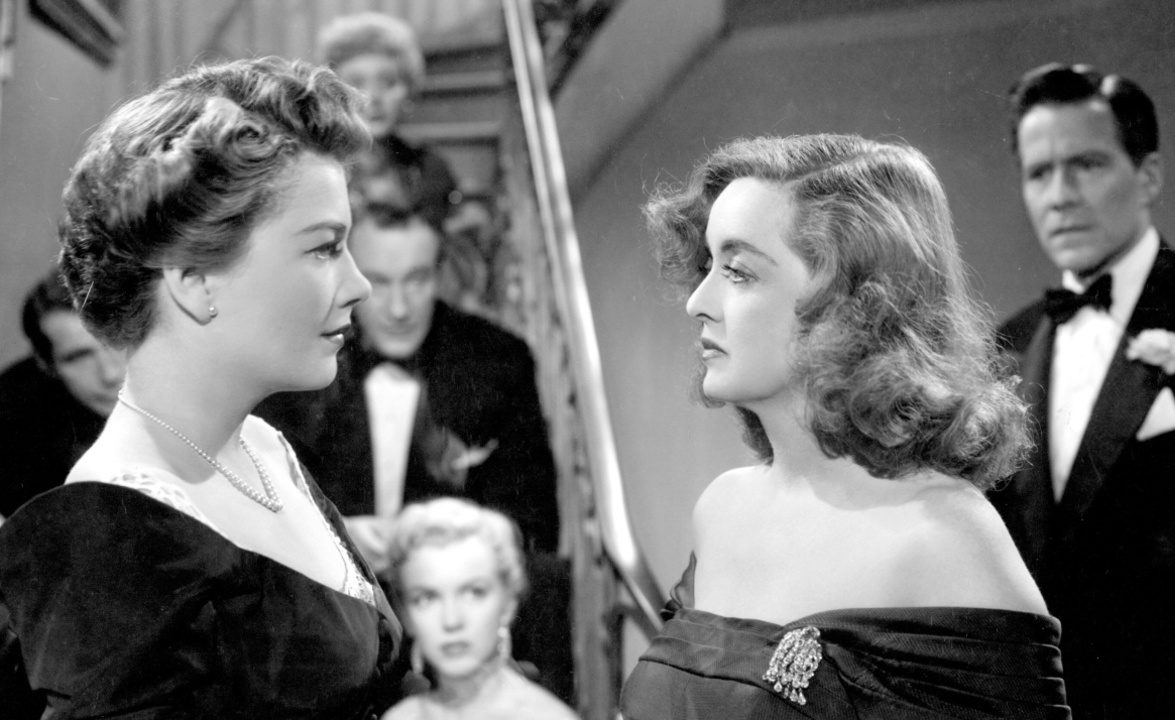
The story the culture wants to tell about Olivia Rodrigo and Taylor Swift is All About Eve (Joseph L. Mankiewicz, 1950): the adoring ingรฉnue who studies the star, learns her moves, and then slips the knife in. And the aging star, watching it happen, curdling into vindictiveness as the protรฉgรฉe takes what was hers. Itโs an irresistible script because it gives everyone a villain to choose. Either Rodrigo, a self-proclaimed Swifty from early childhood on, is Eve Harrington โ the thief, borrowing too much and calling it homage, who echoed Swiftโs โCruel Summerโ on โdรฉjร vuโ closely enough that Swiftโs camp landed a retroactive writing credit to the tune of millions of dollars โ or Swift is Margo Channing at her most petty, the elder star so threatened by her younger (self) that she has to litigate a credit. And itโs a stupid bind, because the script only offers those two roles, jealous predator or past-her-prime grudge-holder. The more honest story โ the one the All About Eve, Taylor vs. Olivia mythology obscures from us โ is lineage.[3]
Call it the Catfight Economy[4], and grant right away that the diagnosis isnโt mine โ critics have been describing this for years, and the manufactured rivalry has a whole literature behind it (and about it; among many other works, Brian De Palmaโs 2012 film Passion also tells the All About Eve story, via Persona [Ingmar Bergman 1966] and Mulholland Drive [Lynch 2000]). To summarize: two successful women cannot share a professional space without one of them being a threat to the other. The press supplies the frame, the fans supply the labor, the platforms supply the distribution, and that leaves two artists narrated into a fight neither one started, so far as any human who doesnโt actually know them personally knows. And surely their friends donโt even know, really, whether or not Swift and Rodrigo are โfrostyโ in real life.
What interests me is less the mechanism than its ideology: the things the Catfight Economy quietly trains us to believe. It teaches that influence is theft, that admiration is weakness, that producing art is powerful and receiving art is debt (I fully intend the sexual resonances there). That there is only ever one musical chair and the other woman is already sitting in it. It is a scarcity story dressed as gossip.
The machine is not exclusively aimed at women. Pop has always run on manufactured antagonism, Beatles versus Stones, Beach Boys versus Beatles, Blur versus Oasis, Biggie versus Pac. But the menโs versions tend to read as competition between equals, a sport with two champions, even a spur to better work. Consider the KendrickโDrake cage match of 2024, which also managed to steal the spotlight from the quiet revolution surfacing at that yearโs Grammys, where six of the eight Album of the Year nominees were women, including Rodrigo and Swift (the eventual winner โ Iโm still throwing beers at the screen that told me Midnights beat GUTS), a changing of the guard that held the stage about as long as it took two megalomaniacal, multi-millionaire assholes to start calling each other domestic abusers and pedophiles in public (I love much of the work of both of them). America crowned Kendrick Lamar the winner of the Drake battle-to-the-death the following year, when a hundred million people, both in the bleachers and at home, sang along as he hurled a blistering insult at his former collaborator at the Super Bowl.[5]
A metaphor for America in general in 2024, I guess.
When turned on women, the same machine sours[6]: the rivalry curdles into a catfight, and only one of them is allowed to survive it. A field with room for only one is a field that never has to take womenโs art seriously as a tradition.
Consider the blows Swift absorbed to clear the commercial ground Rodrigo now shares with her. She came up through the Nashville songwriting machine as a teenage girl who had to have the best idea in the room just to be heard by professionals twice her age.[7] She spent years as a target of an online abuse campaign that ran through Kanye West and the people around him. And in 2019 she watched the masters to her first six albums get sold out from under her when Big Machine was acquired by Scooter Braun โ who had managed West for years โ an event that crystallized, in public and at her expense, exactly how little her little girl selfโs signature on a contract was worth. Each of these events is also a Catfight Economy event in its way: each got covered as drama, as personality, as Taylor-being-Taylor, when each was actually structural โ a girl up against an industry built to extract from her.
Rodrigoโs generation negotiated in the shadow of that lesson. Where Swift had to re-record her own catalogue to reclaim it โ Taylorโs Version โ Rodrigo and peers like Chappell Roan entered an industry where creative control had become a thing a young woman could think to ask for, because they had all just watched the cost of not asking. There will never need to be a GUTS (Oliviaโs Version). That absence is Swiftโs bequest. This is the inheritance the rivalry frame canโt see: the older artistโs losses became the younger artistโs terms.
Which is what makes the recently announced Daisy Chain Fields concert so important. The festival Rodrigo founded is something more than a festival and more than a tribute to the Lilith Fair; it is the Catfight Economyโs exact inverse, built on purpose. Where the Catfight Economy profits by pitting women against each other, Daisy Chain Fields is dedicated โ in Rodrigoโs own words[8] โ to the belief that โjoy, community, and creativity can inspire meaningful change,โ celebrating the voices, artistry, and contributions of women in music. Where the Catfight Economy extracts value from women and routes it to platforms and press, Daisy Chain Fields routes its net proceeds outward, to nonprofits advancing and advocating for women and girls. Where the Catfight Economy insists inspiration and curiosity must harden into competition, the mission statement insists on โknowledge, strength, and action.โ It closes on an image that is Oliviaโs whole argument in one line โ daisies are โwild and beautiful,โ and โas a chain they are strong and unbreakable.โ
Seen this way, Rodrigoโs so-called evasiveness about Swift in interviews[9] stops looking like coldness and starts looking like intellectual consistency. She has been on the record about hating the manufactured-feud framing, and her refusal to feed it is the same gesture as the festival: a person who has built an explicit stand against the Catfight Economy is not going to step into its oldest set piece on cue.
So the mythology gets it backward. All About Eve is a story about a theater with one dressing room and one star, where the only way up is to displace the woman already standing in the spotlight. Eve doesnโt want to make her own work, she wants Margoโs part, Margoโs audience, Margoโs life. That is the only plot the Catfight Economy knows how to run, and it is the plot it keeps trying to cast Rodrigo into. Swift, more than anyone, knows it, and she has spent a career writing it (among millions of other things) down. โClara Bow,โ the closing song on The Tortured Poets Department (2024), is the It-girl assembly line set to music: the industryโs eye slides from Clara Bow to Stevie Nicks to, in the final verse, Taylor Swift herself, each new arrival told sheโs the real thing, dazzling, the new god worth worshipping โ until the eye moves on to the next one, who has an edge the last one never did. It is Margo Channingโs nightmare written by Margo, the star narrating her own replacement on the same conveyor that carried her in. And believe me, there is a ton of fan and critical speculation that this is one of many Swift songs about Rodrigo, which is so much more than missing the point. Itโs a cruel[10] irony.
Swift is the great chronicler of the trap. But the interesting relationship between these two artists isnโt antagonism, itโs transmission: the elder who took the structural punishment, and the younger who studied the wreckage and wrote her way around it. Rodrigo is rejecting the whole theater and building a field of daisies. Swift sings the cage with unmatched clarity, and thus, somewhat like the Jane Austen of D.A. Millerโs monograph[11], transcends it; Rodrigo, standing on the ground Swift cleared, gets to start dismantling it.
[1] Travis Kelceโs.
[2] Taylor Swift, โWood,โ The Life of a Showgirl, Republic Records, 2025.
[3]A caveat, because it would be ultra-shitty to let it pass without saying so: getting a retroactive co-write on a song you didnโt write is a graceless thing to accept, and Swift accepted it. But the music business is litigious to its bones, and a young artist is so incentivized to hand over the co-credit and the royalty points rather than prolong the online nastiness that โ five years later โ it is somehow still a story that Elvis Costello did not sue Olivia Rodrigo. None of which is to claim Swift invented the position she occupies. She has predecessors, obviously, and similar All About Eve stories have been told about Madonna and Mariah Carey many times over. But the lineage Iโm tracing isnโt stylistic, itโs structural โ the terms of creative control a young woman can now think to ask for. And the asymmetry of admiration matters: Rodrigo arrived a self-proclaimed Swifty, modeling herself on a songwriter-auteur with total command of her own persona and catalogue. Swift arrived a girl gushing about LeAnn Rimes โ herself a teenage phenom, but the inheritance there was a way of singing, by way of Patsy Cline, not a way of owning your work. The bequest I mean is the one Swiftโs own losses created, not the longer history of women in pop, which runs back well beyond her.
[4]I am thinking here of Gloria Steinemโs โCatfight Theory of History,โ from an editorial she co-wrote with Eleanor Smeal, president of the Feminist Majority Foundation. The occasion was the release on streaming of Mrs. America, an historical film (TV show? Content thing?) that she believed portrayed the fight for the ERA as a catfight between her and Phyllis Schlafly instead of โa battle between the ERA and economic interests.โ (LA Times, โWhy โMrs. Americaโ is bad for American women,โ July 30, Covid year zero).
[5]โA Minorโ is funny and clever. Lamar is also a genius who won a well-deserved Pulitzer Prize. Nonetheless, if I were scoring that Superbowl scene, it would be to โAll the lonely people,โ and โEleanor Rigbyโ (The Beatles, Revolver, Capital Records, 1966) is in E minor.
[6]Olivia Rodrigo, Sour, Interscope Records, 2021.
[7] See Taylor Swiftโs interview for the NYT project, The 30 Greatest Living Songwriters (2026). Come to think of it, why isnโt Billy Joel on that list? I havenโt checked, but I bet Swift had him on her ballot. And Olivia โ who might have made the list herself had the new one come out before the list dropped โ David Byrne nominated her on his own (citation forthcoming, I know I read that somewhere) โ well, we already know from โdรฉjร vuโ that she was โthe one who taught you Billy Joel.โ
[8]It could have been her โteam.โ What is an author?
[9]See (hear?) the NYT Popcast interview with Rodrigo, in which Joe Coscarelli and Jon Caramanica ask her intelligently designed questions about the โfrostinessโ between her and Swift, so that she can redirect without sounding like sheโs hiding something. Good journalism still happens there!
[10]Taylor Swift, โCruel Summer,โ Lover, Republic Records, 2019.
[11]Miller, D.A., Jane Austen, or The Secret of Style, Princeton University Press: 2005.