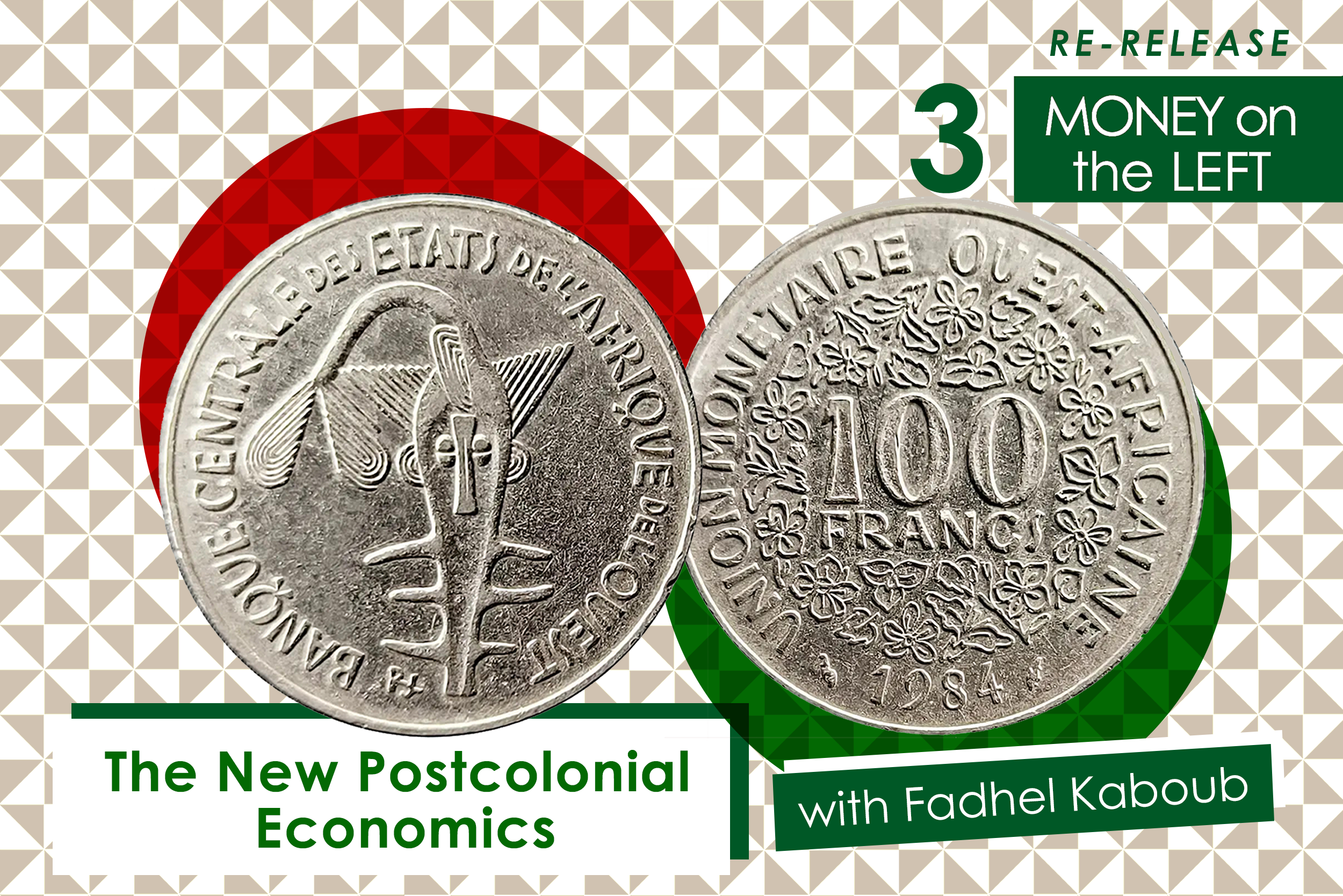
The New Postcolonial Economics with Fadhel Kaboub (New Art & Transcript!)

Money on the Left is proud to publish a remastered version of our third episode with Fadhel Kaboub, now with a new transcript and art. Kaboub is associate professor of economics at Denison and President of the Global Institute for Sustainable Prosperity. In our conversation, Kaboub outlines a new critical approach to postcolonial political economy, arguing that re-gaining fiscal agency is a crucial next step for postcolonial nations hoping to achieve social, economic, and environmental justice. We talk specifically and at length about the CFA franc currency union, a system with violent colonial roots that continues to constrain the economic and political agency of its member states in West and Central Africa.

Visit our Patreon page here: https://www.patreon.com/MoLsuperstructure

Music by Nahneen Kula: www.nahneenkula.com

Transcript

This transcript has been edited for readability.

Scott Ferguson

Fadhel Kaboub, welcome to Money on the Left.

Fadhel Kaboub

Thank you. Thanks for having me.

Scott Ferguson

So I was wondering if we could start by having you tell us about your personal background and also your intellectual training.

Fadhel Kaboub

For my personal background, I grew up in the Middle East, in Saudi Arabia, in Tunisia. I did most of my higher education in Tunisia, and moved to the US for grad school. I went to the University of Missouri in Kansas City, where I did my master’s and PhD. The timing is relevant here. I started in January 2000, which was about six months after the Center for Full Employment and Price Stability was inaugurated in Kansas City.

This was the research center that was directed by Matt Forstater with the research team, including Randi Ray, Stephanie Kelton, Povlina Chernova, and then later on, Fred Lee joined the economics department, and it was just becoming a hub of post Keynesian and institutional economics. It was just a wonderful place to be at in terms of grad school, summer programs and just intellectual development. After my PhD, I went into teaching. Even before finishing my dissertation, I was teaching a little bit in Kansas City, which was a great experience. But then eventually, started teaching full time tenure track at Drew University in New Jersey and then moved back here to Denison University in 2008 on a tenure track and have been here since then โ€” almost ten years now.

About four years ago, Matt Forstater and myself had the opportunity to launch the Binzagr Institute for Sustainable Prosperity, which is a public policy think tank, an independent think tank based here in the US. From the beginning, we wanted to make sure that it’s an international organization in terms of our coverage. We wanted it to be โ€œnot your traditional academic think tankโ€ that publishes papers primarily for academics.

We wanted this to be solutions oriented and accessible to the media, accessible to grassroots organizations, and accessible to policymakers. We still do publish academic papers, but we’re trying our best to move into policymaking and policy communication with the general public and with the media and with grassroots organizations. Also, from the beginning, we wanted this not to be purely an economic policy institute.

We wanted this to be an interdisciplinary organization, because we do recognize that the biggest problems that we face as a society are complex, multifaceted issues and require multi-pronged solutions and economics by itself just doesn’t have enough breadth and capacity to deal with these issues. For example, when you think about climate change, there’s obviously an economic dimension to it, there’s a political dimension, there’s an ethical dimension, there’s a scientific dimension to it. So you can’t just try to address it from an economic policy standpoint and expect good results. We wanted this to be an interdisciplinary institute, but also we wanted to have a solid foundation for what the focus of this institute would be.

Fadhel Kaboub

Because of our background in both Keynesian institutional economics and our interest in MMT, the job guarantee program was clearly going to be one of the central issues that we deal with because we do believe this is a policy framework that kind of challenges the mainstream of public policy, the mainstream of the profession, to rethink how we address social and economic problems.

We also wanted this to be an invitation to our friends in the environmental movements and social justice movements, who are progressive on every single aspect of their work except they fall in the trap of, โ€œif we’re going to deal with climate change, how are we going to pay for it?โ€ That’s where they fall into the traditional economic policy framework that says, โ€œwell, we need to tax the rich to do it, or tax pollution to do it, or the government is broken. We don’t have resources. So we can’t be as ambitious in our fight against climate change or fight against injustice or fight against whatever our social issue is.โ€ In response, we wanted to connect with progressive lives and other disciplines and build bridges that allow other disciplines to be liberated and empowered by what MMT and the Job Guarantee framework has to offer.

That’s really the vision. During the last four years we’ve been building those bridges with people in the humanities, legal scholars, philosophers, political scientists and people from all kinds of different disciplines. It’s just the beginning. This is a long process, obviously, of undoing a lot of the damage that has been done in the economics discipline in academia in general, but especially in public policy.

Now, I get this question all the time, โ€œlike, are you really going to undo the neoliberal political economy with this institute?โ€ The idea is, โ€œyes,โ€ but also it’s a recognition that we’re a few decades late and several hundred million dollars behind. We’re outnumbered and understaffed when it comes to this, but that’s what it takes.

It takes building a compelling narrative based on solid academic research and engaging with people at the public policy level, at the grassroots level. I truly believe that the way the neoliberal movement was able to dominate, starting in the 70s and 80s, is not because they won academic debates in journals or in conferences.

It’s because they were able to put together a political narrative that was compelling and hit a nerve when it came to the US public at the time in the 70s, especially in the US, and in the UK also. The Friedmans and Hayeks lost all the academic debates, but they won the political narrative. They had charismatic leaders who took it to the streets, so to speak. They had multi-million dollar-type of foundations behind them to push for the media and PR movement that shifted the culture. I believe that’s how we’re going to counter this. It’s not going to be just academics sending rejoinders to each other’s papers. We’ve done that. It’s just going to stay in those circles. I think this has to be taken to the public domain. If we’re going to build a movement, a social movement, it has to be accessible to the general public. It takes a lot of education, and it takes a lot of really engaged citizens who are looking for alternatives and willing to learn the alternative.

By โ€œlearning,โ€ I don’t mean in the academic sense, I mean โ€œlearningโ€ in the colloquial sense of the term that you are able to say what you believe in and articulate how it can work in nonacademic terms and get other people who are completely disconnected from the political sphere to be inspired and to believe in a different way of doing things and to vote accordingly and to act accordingly. That’s really that’s really the vision that that we have and we recognize it’s ambitious, but we’re really seeing bits and pieces of this happening. I’m optimistic. 

Scott Ferguson

As a follow up question, which takes us back to the beginning, I’d like to hear, if you don’t mind, a little bit more about growing up in the Middle East and Tunisia and Saudi Arabia and what your own process of politicization has been, and maybe when and where, and what that might bring to the Modern Money Project that’s different than what we get from other perspectives within that project.

Fadhel Kaboub

Thank you for the question. I’ve been reflecting on this for a few years now in terms of how my own thinking has been influenced by my upbringing. So, as I said, I grew up in Saudi Arabia and Tunisia. My mother’s side of the family are from Saudi Arabia and my father’s side of the family is from North Africa, Tunisia, and to some extent, Algeria. Thinking back on that experience, I really didn’t grow up with the very powerful, overwhelming sense of national identity. I knew it was there because I can see it in my cousins on both sides of the family: the flag and the national anthem and the love for the football team and all that.

I mean, I love the football teams. I like both, and I like Brazil and Argentina and other things. But there’s this thing that I noticed from the beginning that, โ€œmy goodness, people are crazy about the flag.โ€ I never understood what it was, I just thought, โ€œwell, this is their team and they like it.โ€ Growing up later, you realize that this was designed when you think about all the post-colonial states in Africa and the Middle East and other places, governments didn’t really have much of a legitimacy. It had to be earned.

It had to be created. In the case of Tunisia, for example, there was a national leader. The independence leader was a very charismatic person, but there were no precolonial national borders that were well defined to go back to. The border had to be created and confirmed and protected. Then the national identity in terms of language and religion and culture, because a lot of these places were pretty ethnically diverse. National identity was, in most post-colonial countries, created and enforced through music, through culture, through sports, and with the idea of what you would call here in the US, patriotism, or in other countries called nationalism.

There’s that negative connotation about nationalism, but to me it’s the same thing. I grew up not feeling sucked into that understanding of national identity. For me, it was, โ€œthis is a country, this is another country.โ€ I never grew up with the sense that I will die for my country, because which country will you die for? Plus, I come from a family that’s also very international. It wasn’t like everybody on one side of the family was Saudi, and everybody on the other side of the family was Tunisian. We had, through intermarriage, people from Egypt and Palestine and Algeria and Morocco and Lebanon. It wasn’t like we had only 1 or 2 national identities that the family had to pledge allegiance to. It’s an unusual family to begin with. To me, that sort of came back to me later in my career, reflecting on and starting to really think about what national identity means and how powerful it can be in war and peace conflict in terms of dividing nations.

I take comfort in knowing that I experienced that at an early age and sort of began to reflect on it throughout my life and now I understand how powerful those ideas can be. I can understand when I hear or see people who feel very strongly about a flag or their military or the nation because I know it’s nothing personal. It’s just, you’re born into it and you’re brainwashed into it, and to some extent, there is nothing wrong with that. The only part that is is when it comes to โ€œit’s us against them,โ€ and it begins to divide people because of the difference of their religion or their color and things like that. A healthy dose of patriotism is reasonable. I’m not against that. Loving a football team is great and loving the national anthem is great, but when it turns you against other people, it becomes problematic.

Maxximilian Seijo

It’s really interesting, when you talk about your experience of growing up in post-colonial Tunisia and Saudi Arabia and experiencing nationalism. What it makes me think of is the way that post-colonial theorists tend to begin from the presumption that you’ve already alluded to, that even though relations of explicit political colonization seem to end during the 19th and 20th centuries, there are unjust processes of economic, social, cultural or colonization that remain strong. They sort of frame this and focus on history in the politics of money and foreign denominated debt. I was wondering if we can circle that experience back to MMT. If you could help elucidate how MMT can imagine reframing this critical project in terms of political economy and then perhaps even a socio-cultural critique that you already started to tease out.

Fadhel Kaboub

Let me take this back to my undergraduate studies in Tunisia, where I studied economics. It’s a French, post-colonial education system. It’s not liberal arts. There is no general education. It’s four years of economics and nothing but economics, and a little bit of accounting and business and lots of math.

There isn’t really anything โ€œpolitical economyโ€ per se. The closest we got to political economy was the History of Economic Thought class, which was the best thing I remember taking. It was a breath of fresh air in those four years. To link it back to your question, the reason why I wanted to go back to this is because during those four years of economics that I studied in Tunisia, we didn’t learn anything about the Tunisian economy.

This is not because it was neoclassical economics and neoclassical economics didn’t teach you anything about the real world. No, it wasn’t the case, actually. We had great teachers who are sort of post Keynesian-ish, institutionalist, kind of French influence, which was great, but this was strictly political. I learned so much about the Japanese economy, so much about the American economy, so much about the French economy. We even went to a couple of the professors after a class, โ€œcan we just have one lecture about the Tunisian economy or economic history?โ€ We did take an economic history class, but it was about the Great Depression in the US and Japan and everything else. The professor said, โ€œLeave me alone. What do you guys want? Go away.โ€ It’s because they didn’t want to get into anything that will cross into politics. There were undercover police officers in the classrooms and on campus listening in because the history of protests in Tunisia was either the labor movement or the student movement or both converging together.

When you were going to police the population, you police the universities first. The campus where I studied was not like American campuses. This was a gated campus and guarded by the riot police. Actually, the riot police had one of their headquarters on campus, full gear. Those were the visible guys. The invisible ones were in the classroom. That’s why the professors didn’t even dare to talk about anything that has anything to do with the Tunisian economy. What I ended up learning about the Tunisian economy, I learned in Kansas City after I left. What I knew about the Tunisian economy was just observing and living in it and just trying to piece things together on your own or with a few friends, people you trusted to talk about political economy at the time.

What I ended up learning academically, intellectually was just after I moved to the US. I just started diving into books and archives and whatever I can find through interlibrary loans to read everything that there was to read about Tusinian economy. I ended up doing my dissertation on Tunisia. There’s an important link to your question here about the post-colonial thing. There’s been an intellectual movement in the last few years, both in Tunisia and other parts of Africa in particular, trying to essentially decolonize the curriculum, because the curriculum itself, in any discipline, was a Eurocentric curriculum. This is true in the US too, but especially in the Middle East because when you think of the history of any intellectual discipline, economics, for example, you read Schumpeterโ€™s History of Economic Analysis, he talks about the great gap because first there was the Greeks and then the Romans, and there was nothing for 500 years. Then all of a sudden, the enlightenment happens. You read the history of science books, same thing.

There were the Greeks and the Romans, and then there was nothing and then all of a sudden science emerged in Europe. That’s taught in every single textbook, including in the Middle East and Latin America, India, and Africa. That’s how the Eurocentric narrative dominates and ends up colonizing the curriculum of supposed post-colonial, independent nations. You’re already put into an intellectual position of inferiority and economic position inferiority and a political position of inferiority and subordination, but you have your own flag and you have your own national anthem and you have your football team to celebrate. You see what I mean? That happens to serve the interest of the political leadership, because in most post-colonial nations, that political leadership didn’t really democratize the nation. They took over the exact same top down bureaucratic hierarchy, which was a dictatorial hierarchy created by the colonizers. It’s just now staffed by nationals who love the flag. You see what I mean? So, it was still a political and bureaucratic institutional structure of subordination, but now led by the charismatic independence movement leader, now turning into a dictator. I hope this answers your question in some sense, but that’s how I read it for several years now in terms of reflecting back, and talking to academics today and Tunisian former professors who understand that this is really part of the narrative. In addition to the fact that linguistic domination has been there from the beginning and constantly enforced by colonial interests.

Tunisia is an Arab country, but the main language of instruction academically is French. Over time, that came at the expense of losing the linguistic quality of the Arabic language in professional settings and in academic settings. When you lose a language, it’s really hard to undo that.

Maxximilian Seijo

I’d like to pick up on your point about the kind of organizational legacy of colonialism and subordination. In adopting the colonial governance scheme that was imposed on other nations in the global South, these countries, in large part to do with the intergovernmental organizations that made sure of this, kept to this idea that they still depended upon United States or France or countries across the globe from the global north for loans and debt so that they could finance their militaries and their often corrupt dictatorships. I was wondering if you could talk specifically about the way in which MMT reframes that discussion around foreign debt and monetary sovereignty.

Fadhel Kaboub

For the followers or the listeners of the podcast who are not very familiar with the MMT framework, I’ll just define the four basic bullet points that will be relevant to this conversation. From an MMT perspective, a country has full monetary sovereignty or full financial sovereignty. In a colloquial sense, full financial independence if the following four conditions apply. The first two conditions are pretty straightforward and easy for any country to do, the third and fourth are more problematic for post-colonial and developing countries in general.

The first condition is a country prints its own currency, or issues its own currency, and it’s the monopoly issuer of that currency. Most post-colonial governments, the first thing they do โ€” not the first thing โ€” but a couple of years after independence usually, is they start issuing a national currency and they start taxing the population in the national currency. That’s the first and second condition of monetary sovereignty and most countries can do that. The third condition is for a country to issue debt or issue bonds or treasuries that are only denominated in the national currency. That’s where a lot of developing countries start to lose their monetary sovereignty, because they start issuing both categories: bonds that are denominated in the national currency, but also bonds that are denominated in US dollars or Japanese yen or British pounds or any kind of foreign currency.

That part of their bond issuance becomes their external debt and it’s a real burden on those governments because it’s not something that they can finance internally. It means that you have to somehow generate export revenues in excess of what you would need to pay for your imports in order to be able to pay the debt, service the debt, and pay principal and interest.

That relates to the fourth condition, which is the fixed exchange rate policy that a lot of developing countries use. So, in order to have full monetary sovereignty, you want a flexible exchange rate. In other words, you don’t want to stand ready with excess reserves of dollars or euros or pounds to defend a particular exchange rate. That happens because the third condition is often violated. Meaning, if countries have a lot of external debt and have a lot of pressure on their exchange rate to devalue, that becomes a very politically and socially sensitive issue. If a small country faces a devaluation of their currency and they need to import food or fuel or energy or medicine or whatever necessities, it means with the devalued currency, all of those things now will cost more.

Theyโ€™ll be importing inflation; food inflation, energy inflation and medical expenses inflation. That turns into social unrest in many cases. That’s why a lot of these developing countries end up borrowing even more every year in order to defend a fixed exchange rate level, which would prevent that inflationary pressure from actually turning into political and social unrest.

To me, that’s a very important starting point and that’s really the important lens that MMT has offered, to see with clarity why the issue of debt is problematic. Before the MMT lens, people knew that debt was an issue, but there was a confusion or conflation of the national debt as a domestic currency denominated debt versus external debt denominated in foreign currencies.

I think MMT tells us that the portion of the debt that’s done denominated in the national currency can always be managed, and there are ways of dealing with it. But the external portion is what really puts pressure on countries and that’s, personally, what led me into researching the root causes of the external debt and looking into potential solutions to address those root causes. Everything else we’ve seen in the last 30 or 40 years is really Band-Aid solutions, it’s really just rescheduling, stretching out the debt payments or getting more external debt and kind of feeding into the same problem that’s just been compounding over the years.

Scott Ferguson

So can you walk us through what it might look like for a country that is heavily indebted, has a weak productive infrastructure, is not, as you say, sovereign in food and or energy. What might be done in a situation as dire as that?

Fadhel Kaboub

First, I’ll tell you what is being done and how things got worse, starting with the post-colonial era and then we can talk about how to get out of it. Going back to the early post-colonial era, you have to recognize that the economic infrastructure of most of these countries was built up because colonialism lasted for decades, or over a couple of centuries in some cases. So, during that time, there was infrastructure built and there was a process of economic development and economic activity happening, which a lot of people confuse with economic development in the purest sense of the term. But, when you look carefully at what kind of infrastructure and what kind of economic development was done, you realize that it was very extractive.

Any kind of infrastructure that was built was purely for the purpose of extraction of wealth and extraction of resources. For example, Tunisia’s is a very interesting case, and you can look at the map of most African countries and post-colonial countries. Just look at the map of the railroads, the map of the roads, and then identify where the major mines are, where the major resources are and where the ports are built. It’s just direct straight lines from the mining town, straight through the rest of the country to the ports. The railroads are also built like that. The roads are built like that. So Tunisia, for example, you find a lot of east-west roads and east-west railroads, but nothing going north-south because there is no reason for people to go north-south. Once you’re independent as a country, you’re not going to sit down with the rest of the population and say, โ€œokay, so this was a big mess, this colonialism. Let’s now start over again and let’s scrap all of the infrastructure and build it the way we really want it to be built.โ€ It wasn’t like that.

Day one after independence, you continue doing the exact same thing you did before independence. You continue digging the same mines, loading on the same railroads to the same ports, and shipping them to the same customers in France or in Italy and other places. The post-colonial economic infrastructure continued to be built according to the colonial economic infrastructure.

It was a continuation of it. It wasn’t a rupture from the old economic system, and it continued to enrich the same socioeconomic classes and the same vested interests to this day. It was always extractive, always serving the elite, always serving the interest of the former colonial interests. The question today is, you look at the accumulation of trade deficits and external debt because we were told, โ€œwell, you know, your economy is mostly extraction of resources and agriculture. You should diversify and you should invest in manufacturing and industrialization.โ€ You try to industrialize and there’s a huge technological gap. So, what do you do? You go through an early phase of sort of import substitution industrialization in the 1950s and 60s. Basically, most developing countries did that under protectionism, which is protection from foreign competition.

But then, ten years later, you’re told โ€œThat’s it. Your infant industry is not infant anymore. So now you should move into export led growth. Good luck exporting.โ€ When you move into export-led growth in the 1970s, one of the first things you notice with every single country that went through this phase is that the trade deficit explodes. You would think, if we were going into an export oriented mode, we should be thriving through exports. It turns out you end up importing even more, because your economy is not highly industrialized, you end up importing all the intermediate goods and all the technology and all the input that goes into your assembly lineโ€™s basic manufacturing system.

So you’re importing high value added content and you’re exporting low value added content. You’re just adding the kind of very basic assembly line skills to export a finished product. If you’re importing more than what you’re exporting, your trade deficit is exploding, how do you finance this trade deficit now that it’s putting pressure on your exchange rate and it’s going to turn into food riots and fuel riots and all kinds of instability? You borrow.

That’s where the external debt comes in. You borrow based on the idea that when you grow even faster in the next decades, you’ll be able to pay it off. It just never happens because you’re never industrialized enough to compete internationally. This whole era of opening up to free trade and globalization has been a massive trap for developing countries that actually led to even more loss of financial sovereignty over time, directly after independence. The way to undo this or to regain or reclaim monetary sovereignty is to look at the specific cases. There’s no cookie cutter approach to this. Every country has its own institutional specificities and needs. So you look at what is causing the external debt, what is really driving it?

Is it food imports? Is it energy imports? Typically, it’s both for most countries, with the exception of oil exporting countries. The third category is typically what I described as low value added content of exports relative to the high value added content of your imports. So, if you’re going to reclaim your food sovereignty so you don’t have to borrow as much to buy food from abroad, then the only way out is investment and sustainable domestic agricultural policy.

This is something that the West recognized from the beginning. This is not something that I discovered or people discovered in the last few years. If you go back to the free trade negotiations, the GATT (General Agreement on Tariffs and Trade) and other trade negotiations in the 50s and 60s and 70s, and to this day, the West will always negotiate free trade in everything but arms and farms.

No weapons and no food, because that’s national security for the West. It’s not just national security, because you need food during wartime. It’s because you lose your sovereignty. You lose part of your sovereignty if you’re dependent on other countries for your national security, for your food security. I’ve known this for a long time, but MMT really put a new light on this particular issue.

You find the European Union and the United States putting really impossible conditions in these trade negotiations, making it impossible for developing countries to export food.In the case of Europe, a lot of the former colonizers were dependent on food imports from North Africa and other parts of the world. That wasn’t going to be fun, economically speaking, after independence, because now you depend on these newly independent nations for your food supply. CAP, which is the Common Agricultural Policy that the EU put in place, was virtually a ban on food imports and also a massive subsidy for European farmers to build up capacity and depend less and less on imported food.

That ends up killing agriculture in a lot of developing countries. When you kill agriculture in developing countries, you’re forcing people to move out of rural areas into urban areas, which was pretty convenient because the cheap labor from manufacturing assembly line jobs was waiting for them, because that was the era of export-led growth. Developing countries become the tail end of the supply chain in the global supply chain system, because they’re just the assembly line for all the high value added content that’s been produced through the rest of the supply chain. It happens to be convenient because it creates a little bit of jobs in developing countries, but never enough to truly industrialize those countries or truly develop those countries or bring prosperity. I hope this clarifies the links between Europe and former colonies in Africa.

Scott Ferguson

It does. Can you talk about some of the dangers of potential inflationary pressures? I know in your own work you stress a strong political movement, but also, sometimes a very careful and strategic economic development approach.

Fadhel Kaboub

Yeah. The strategic economic development approach to reclaim monetary sovereignty is renewable energy production, because that’s another major component of the external debt, sustainable food policy, because that’s the food imports problem that many developing countries have. Then the third one, which is a more difficult strategy and takes a long time, is investment in education and vocational training and technical skills, because if you want to industrialize and move up the ladder over time, so to speak, in value added content, the only way you’re going to attract manufacturing that produces higher value added content is if you have the infrastructure, in terms of electricity and telecommunication and transportation, but also the highly qualified labor that’s required to be plugged into the production of high value added content. That takes time. It takes a couple of generations to move up the ladder. Those are the three strategies that I always emphasize.

The question is, โ€œwell, can we make the transition overnight or in a decade?โ€ To me, the answer is not that it’s not going to happen overnight or in a couple of years, but at least you have to start thinking about that direction, planning for that direction, and then shifting resources away from your old strategy into your new strategy. The current strategy, for example, is to subsidize food and food imports and to subsidize energy imports because you’re importing fossil fuels at globally determined prices, which can be inflated for your local consumers. If you don’t subsidize them, you’re going to have fuel riots. If you don’t subsidize imported food, you’re going to have food riots. So, governments typically subsidize and offer food and fuel and transportation at affordable prices locally.

The idea here is to shift some of the subsidies away from subsidizing fossil fuel and imported food into building more productive capacity of renewable energy production and sustainable food production and, over time, accelerate that shift and accelerate the development of those resources, because that’s the ultimate way of reclaiming energy sovereignty, food sovereignty and, as a result, monetary sovereignty.

Scott Ferguson

And as a result, political sovereignty.

Fadhel Kaboub

Absolutely, because you become less dependent, financially, on the outside world. As a result, you are more politically independent and, to be honest, that’s been recognized from the beginning by former colonizers as a threat. It was clear that having this neocolonial way of controlling former colonies through the financial aspect is way more effective than having troops on the ground, controlling the economy and policing the population, because it gives you the illusion of political independence. You have your flag and you have your football team and you have your territory, your military, and will even give you aid to help you reinforce your territorial sovereignty and police your population and everything. It feels like, โ€œyeah, we have independence.โ€ When it comes to economic reality, you’re not independent.

As a result, politically, you’re constantly under manipulation by the lenders and, typically, countries who are the former colonizers. That’s really the part that the average person doesn’t necessarily realize, but political elites know this and they know that they can use it to their advantage. They’re not really, in most cases, willing to take on the challenge of challenging the external forces, especially when it’s not a democratic system. They’re actually kept in power with the help of external forces. This was definitely the case with the Ben Ali regime. It wasn’t a secret or anything. If anything, during the days of the uprisings in 2010, 2011, the French Minister of the Interior was vacationing in Tunisia with the president’s family and called France to approve more shipments of tear gas for the police to handle the protesters.

The only reason why the tear gas didn’t make it to Tunisia, because workers at the airport were on strike in France. It had nothing to do with the political agreement between Tunisia and France. It was just a coincidence that the workers were on strike. When you travel through Paris and workers are on strike, you don’t get your luggage. So, the tear gas never made it.

Maxximilian Seijo

Something that’s been in the news that is really evocative of what you’re describing is the question of currency unions and the way they determine political and economic relations. However, a lot of attention has been paid to the eurozone crisis in Greece and Italy and Spain and the political unrest that is resulting from that.

I was wondering, though, if we could talk about a currency union โ€” if you want to call it that โ€” that gets a lot less attention, the CFA franc (Communautรฉ Financiรจre Africaine, or “African Financial Community”). If you could tell us about the history of it and the structure of the CFA franc today.

Fadhel Kaboub

The CFA franc is a currency used in Africa. Today, it is used by 14 countries, mostly former colonies of France. The name of the currency union changed over time. Mostly to make the name more politically correct, I guess. CFA used to stand for โ€” trying to remember the French name โ€” Colony Francis d’Afrique, which means the African Colonies of France. That’s what CFA used to stand for. It was clearly stating that these are the colonies, and they use the French franc, but this is the African version of the French franc. It’s controlled by the French government and by the French authorities. After independence, you can’t call these colonies anymore. At some point, it changed its name from Colony France’s d’Afrique to Communautรฉ France’s d’Afrique, which was a little bit more politically correct. Today, it’s called Communautรฉ Financiรจre Africaine, which is the African financial community or union. It doesn’t carry the colonial name anymore, but it still operates under the exact same institutional setting, which is a currency union for 14 countries today.

It was created in 1945, right when a lot of the former French colonies were gaining independence, but they were not transitioning to a national currency. Most colonies during a few years after independence continued to use the same colonial currency. But in the case of the West African and Central African countries, the 14 countries that remain in that union today, they transitioned into the CFA franc. When you think of monetary policy and fiscal policy and exchange rate policy, it’s all determined by the French government, essentially. I mean, there is a committee and there’s a board and there’s some sort of bureaucratic structure to it that’s staffed by representatives from the African nations. Presumably, they get to make their own decisions and vote, but we all know that it’s nonsense, that it’s set up by the French government. 

I mean, Macron has been under fire in the last couple of years, especially during his visits to Africa, because there’s lots of protests against it. Students brought it up during the open Q&A session and he keeps brushing it off and saying, โ€œwell, no, but I’m not standing in the way of any country to leave the CFA if they want it,โ€ or โ€œwe don’t control it.โ€ If anything, he sees it as a way of cooperation and assistance to help stabilize the monetary system of the 14 countries in the union. In terms of our experience, knowing what monetary sovereignty means from an MMT perspective, you clearly understand that a group of countries that use a single currency that follows a particular set of monetary policy rules has a very limited fiscal space to engage in strategic economic development internally. Everybody’s familiar with the situation in Greece and Italy and Spain after the euro crisis, when you have a central bank like the ECB (European Central Bank) that refuses to allow any of their member countries to deal with the economic crisis and imposes austerity on those countries. You can think of the CFA franc system in exactly the same setting. 14 countries joined in a monetary union that have no way of issuing their own currency, and they peg their currency to the euro today. It used to be the French franc, which was pegged to the dollar indirectly, via the gold standard at the time.

You can understand how much economic development has been withheld and how much economic sovereignty has been withheld from these countries. Unfortunately, it took decades for this beginning of a movement to start building in the last few years. I think MMT has a lot to contribute in this regard. I’m looking forward to working with some of our new MMT-ish friends in this movement to build a coherent narrative or coherent counter argument to the CFA and to and to bring about an alternative.

I don’t think this is going to be done through the political elites. I think it has to be done through a social movement. I don’t really believe in political leaders, quote unquote. The political leaders are not leaders, they’re really followers when it comes to these things. It has to be a social movement that builds a coherent narrative, a coherent critique, and a coherent alternative. When you get to a critical mass of people, of the media, of academics who engage in a coherent way, that’s when political leaders really take action and become followers when it comes to this.

Scott Ferguson

Do you have a sense of the way that the eurozone currency project compounds the problems of the CFA franc?

Fadhel Kaboub 

If you’re economically dependent on France and the eurozone for your economic well-being and the main unit โ€” the eurozone โ€” is going through a crisis, you suffer the consequences. There’s a direct link to this, and ironically, this is really what woke up a lot of people to the reality of the connection between CFA and Europe. It was ironic because it wasn’t really in the MMT way. A lot of people were saying, โ€œwell, the gold reserves of the CFA countries are in France, and the French are probably using that to deal with their economic crisis,โ€ but it did raise awareness about the issue. Obviously, to you and me understanding MMT, it’s really not about the gold. For a lot of people in these countries, they say, โ€œwell, we’re the largest producers of gold in the world. Where is our gold? It’s held in France. And why is our economy not doing so well?โ€ But, it’s not because the gold is in France. It’s because the economy is producing raw materials and raw materials are very low value added content.

You don’t get to control the price of those raw materials in the global system. So, no matter how much you produce of your raw materials, even if you are the number one exporter of this particular commodity, you’re still not going to be reaping the benefits of it. You can think of this in terms of African countries or North African countries. I know this specifically for Tunisia, because Tunisia is one of the largest producers of olives in the world. Depending on the season, it’s number three, number four, or sometimes number two, but it doesn’t get any of the publicity of being an olive oil country. When you think of olive oil, it’s Italy, it’s Spain, or Greece, maybe Turkey, because these are the distributed brands that you pick up in the supermarket.

They’ve done a better job at controlling the global supply chains and branding their product. Most of the price that you pay is for the bottle, it is not for the olive oil, it’s for the PR that goes with it, the advertising that goes with it. It turns out that, for the average Tunisian farmer that’s producing the olives, they end up selling their entire year’s worth of olives a year in advance at a set price determined by an Italian company or a Spanish company. When you look at how much of the market, Spain and Italy, collectively control, they essentially have, last time I checked, 4 or 5 years worth of the global supply of olive oil in reserve. If you’re a small farmer and you don’t want to sell at a set price, they say โ€œKeep it. Good luck. Good luck selling it because we have enough to supply the entire world for the next five years.โ€ As a farmer, no matter how big you are, you can’t afford to negotiate. This is true for all kinds of farmers in Africa. 

When you think of chocolates, what’s the main input? Where does it come from? It doesn’t come from Switzerland. It comes from African farmers who don’t get to control the supply chain. They don’t get to control the price. They’re at the lowest end of the supply chain in terms of value added content. Who gets most of the benefits? It’s the companies that add that value added content, which is the pretty bottle, or the fancy designs, or the nice chocolate boxes that most customers in the West pay most of the price for, not for the actual raw material.

Thereโ€™s a structural economic development problem in the CFA region in particular and yet the recognition of the economic problem came through the crisis in Europe and the thought that the gold was in France and that’s why things are messed up. It’s about beginning a conversation with colleagues and activists and journalists about what MMT has to offer about this. We’re shifting the narrative to the real structural problems, not just the fact that gold is stored in France.

Maxximilian Seijo

You know, talking about these global issues and the story you just described about the olive oil, it makes me wonder, if we’re going to reimagine what development looks like in a global economy, is there any role for an intergovernmental authority like the United Nations to play in the process of further decolonization?

Fadhel Kaboub

Yeah. There were several attempts to do this over the years. You can guess, it’s not the IMF (International Monetary Fund) and it’s not the World Bank. Good guess. These are technically agencies of the UN, it just happened to be the more politically and financially powerful organization of the UN. Within the UN, the organization that has done the most in this regard is UNCTAD, which is the UN Conference on Trade and Development. I’m probably biased here a little bit, but especially when Jan Kregel was in charge of writing the UNCTAD annual reports and organizing the UNCTAD conferences.

Kregel is one of the leading post Keynesian economists, and one of the most brilliant economists, period. Also, his work with the UN and his understanding of Keynes and MMT in the global financial system led him into what I described. A lot of the things that I’ve learned about economics and MMT, I’ve learned from Jan Kregel, obviously. You hear a lot of his thoughts from me. In anything that’s a bunch of nonsense, it’s probably my thinking, not his thinking. He and other economists at UNCTAD have probably done the most to rally developing countries to think differently and to act differently. 

But, if you ask Kregel, and I’m not going to speak for him here or put words in his mouth, you’ll hear a lot of stories about how much pressure UNCTAD as an organization gets from the West, from the US in particular or how much pressure representatives of developing countries who really begin to learn from the UNCTAD approach and attempt to act accordingly come under. You have to realize that the process of international development is not done in isolation from geopolitics. You’re at the UN and you’re negotiating economic development issues with other governments who also happen to be negotiating all kinds of other things with you and all kinds of other things with other allies that have nothing to do with you.

Somehow your vote in the Security Council matters on a particular issue. So, you get a lot of pressure if you attempt to align yourself with the other developing countries who happen to align themselves with Cuba, for example, then you’re with them, not with us, and you’ll suffer the consequences. You have to remember that you’re doing this in the context of massive external debt. You’re dealing with all kinds of problems, including maybe a potential civil war, including potential rebels, including potential unrest because of food prices going up. You’re extremely vulnerable to pressures from the West. If you attempt to gradually pull yourself out of the dominant structure that you’re suffering from, it takes time to build an economic development strategy and put it in place and during that time you need some sort of immunity from all kinds of other threats and interferences and pressures. That’s the reality of it. There is no such thing. That’s why a lot of economists and people who are thinking about the geopolitics of this say when when the Cold War ended it made this even more difficult, because for developing countries at the time, they could sort of fall in between the East and West and kind of leverage and play a little bit of the geopolitics between the Soviets in the Americans to get a little bit from both. But now that we live in a world that’s exclusively dominated by US interests and in US power, geopolitically, there is no negotiation. There is no running away from that kind of influence. The only way out of this is to start building South-South regional cooperation, economic development units and it’s very difficult politically and economically because you have to agree on a joint strategy. To get a number of countries to agree on a particular strategy is very difficult.

To then also get a group of countries that have complementary assets and resources to coordinate is difficult. At some point there was a little bit of hope that BRICS will emerge as that geopolitical alternative. BRICS, as in Brazil, Russia, India, China and South Africa โ€” the โ€œSโ€ was added eventually as South Africa โ€” as an alternative to the US geopolitical dominance. I don’t know how likely that is going to actually emerge because the BRICS itself as an organization has been divided over the last few years. In the absence of a block of countries that have geopolitical influence that can offer an economic alternative, it’s very hard for developing countries to shift strategy. There is the possibility that the Chinese model of economic development and China’s interest in the rest of the world, economically speaking at least now, may offer a little bit of relief.

But, you also have to take that with a grain of salt, because China also has its own economic and geopolitical interests that it’s trying to build up to being a superpower โ€” a true superpower. You have to take anything that comes from the Chinese government also with a grain of salt. A fistful of salt, I should say.

Scott Ferguson

So you’ve done some consulting work with various governments and groups in, what we call, the Global South. Can you talk a little bit about those experiences, what you’ve learned and general lessons from that work?

Fadhel Kaboub

Yeah. So, just to clarify, when you say consulting, I don’t have any official affiliation or paid positions with any government in the Global South. By consulting, I mean people reach out and want to ask questions and have long conversations or presentations. So, yes, I’ve done that, but not as a paid consultant for any government.

Scott Ferguson

Understood. 

Fadhel Kaboub

Most of the interest is what we described today in this podcast, which is, we recognize that everything we’ve tried has failed. All of the stages of economic development that every textbook follows, including the most recent waves of privatizing state owned enterprises, leaning heavily on tourism, foreign direct investment, and export led growth.

The MMT lens and the sort of UNCTAD economic development analytical lens allows us to recognize that those are traps, because the more you accelerate your exports, the more you end up with imports of intermediate goods. Youโ€™re never going to catch up. The more you privatize state owned companies to generate dollars to pay some of your external debt, once you privatize the water company, you can’t reprivatize it the next year.

It’s just a one off, and then you lose that asset, and then you run out of assets to privatize. Of course, you also lose control over strategic resources in your own country. The idea of foreign direct investment is also a trap for most countries because you realize most foreign direct investment actually goes to rich countries, not to poor countries, because it’s looking for strong infrastructure, water, electricity, transportation, telecommunication.

Most developing countries don’t have that. Also, foreign direct investment is looking for skilled workers and highly qualified workers. Most of those happen to be in Canada and the Netherlands and other places, not in the poorest countries. This idea that foreign direct investment is going to solve all the development and poverty problems is a myth because we use China and India as examples of great places that attract foreign direct investment. But those are not your usual developing countries because they have massive infrastructure of telecommunication, transportation, everything else and they haven’t invested massively in producing the labor force that FDI is looking for. You look at most of the developing countries, it’s really assembly line jobs, the tail end of the supply chain at the lowest skill levels, the lowest value added levels. That’s not going to work. 

That’s the context within which a lot of progressive voices within those governments โ€” or not necessarily progressive, just eclectic and pragmatic individuals โ€” try to reach out for alternative ideas. We then start having conversations like the one I just had with you, and then we get into the geopolitical stuff. That’s when they realized this is going to be a problem because this is not just a technical solution. This is a political economy framework that has to be undone. It starts with a lot of education leading into a social movement and this is really where having these conversations with colleagues in Mexico and in Colombia, in other places comes in.

They say, โ€œwe don’t really have what you guys have,โ€ for example, in the US, which is kind of the beginning of a movement. The groups like real progressives and all kinds of people in all kinds of walks of life. Not academics, not professors, people who are working 9 to 5 jobs but who are very passionate about public policy, who now understand the issue and can argue and offer a counter narrative and can stand in front of a senator or representative and say, โ€œyou can’t trick me into this because I know better, and I can argue back and I can even educate you on what the solutions might be.โ€ So we’re at the beginning phase of building a popular movement of people who can actually argue back against the senator or representative. And they say, โ€œwe don’t really have that yet, and we don’t have that kind of social movement. We have a few academics and a few activists, but it’s not a movement yet.โ€

A lot of the conversation eventually shifts into working on multiple fronts. Beginning a conversation with academics, which is the most difficult one, to get academic economists to think differently. Then you start working with progressive policymakers who are not necessarily dogmatically wedded to neoliberal ideas or neoclassical ideas to start to show the potential of these ideas, and working on social media and working with popular media to popularize the ideas in the public domain and engage with the usual suspects; with labor unions, with activists, with climate justice activists and social justice activists to say, โ€œlook, we’re allies on this thing. We have a solution. This is a solution that empowers your organization and your message to build a united front against neoliberalism.โ€ This is how you build a movement. As I said earlier, politicians are the last people to follow because you talk to them behind closed doors and they understand. They say, โ€œWell, that makes sense, but I can’t say this publicly because I get attacked by all kinds of media and other political parties say, โ€˜you don’t know anything about inflation, you want to turn this into Zimbabwe,โ€™โ€ or whatever. If you’re the only one trying to counter that, it’s difficult. So they say, โ€œget me a critical mass of people who endorse this.โ€ In other words, โ€œget me a social movement and I’ll come out and embrace it.โ€ I always joke, I say, โ€œWell, you know, if I have a social movement, we’ll vote you out of office. We don’t need you.โ€ That’s the reality, but we can’t give up. 

As I said, you have to work on multiple fronts. We’re not saying that everybody has to come out and say, โ€œI’m an MMT candidate, and I endorse this and that and the other.โ€ Just start shifting the narrative and make common sense decisions and parliaments. When you’re being asked to look at foreign direct investment options, just be more selective. Go for the higher value added content. Try to negotiate a little bit better, when it comes to dedicating resources to subsidizing fossil fuels versus domestic renewable energy infrastructure, make the right decision, move away from fossil fuels no matter what the pressures are and think of strategies of building energy sovereignty and food sovereignty.

You don’t have to say this is MMT. You don’t have to say this is inspired by UNCTAD or anybody. This is just common sense. So, that’s where policymakers can be more effective just by making commonsense decisions that fit into the broader strategy that I described. But again, we have to work on multiple fronts. That’s why we were really fortunate to have the opportunity to create the Binzagr Institute, because we didn’t want this to be stuck in academic circles, because we’ve done that for a long time. As I said, we don’t think that’s how the world is going to change. It’s not going to change in academic journals that publish rejoinders. I like rejoinders, but they’re not going to change the world.

Scott Ferguson

Indeed. Well, this has been incredibly informative and engaging, Fadhel. Thank you so much for joining us on Money on the Left.

Fadhel Kaboub

It’s a pleasure. Thank you.

* Thank you to Robert Rusch for the episode graphic, Nahneen Kula for the theme tune, and Thomas Chaplin for the transcript. 

Why Credit’s Due: Reclaiming Pride in Boro

By Rob Hawkes and Robyn Ollett

The summer of 2025, like the summer of 2024 before it, has been one of heightened tensions surrounding the issues of race and immigration in the UK. This year, Union Flags and St Georgeโ€™s Crosses have adorned innumerable lamp posts, motorway bridges, roundabouts, and zebra crossings โ€“ ostensibly as expressions of national โ€œprideโ€ โ€“ following a series of anti-immigration protests outside the Bell Hotel in Epping, which had been housing asylum seekers. In late July and early August 2024, racist riots erupted in towns and cities in England and Northern Ireland, including in Middlesbrough (where we both work at Teesside University). The false narratives fuelling this combination of nationalistic fervour and xenophobic violence are that โ€œillegalโ€ immigrants to the UK are luxuriously treated at the expense of the โ€œindigenousโ€ population and that there is only ever an either/or choice between caring for โ€œour own peopleโ€ and providing basic support to those fleeing war, persecution, and/or starvation overseas. Underpinning these divisive myths is a pervasive logic of scarcity: there is not enough to go round.

This, inevitably, is also a logic of exclusion. If there is not enough for everyone, the only option is to leave some of us out. This, in turn, always means harming those who are already marginalised and perpetuating cycles of violence and disempowerment. Refugees and asylum seekers, disabled people, people of colour, LGBTQIA+ people, unemployed people and other benefits claimants all regularly face accusations of being a burden on or a threat to British society, or of failing to show sufficient gratitude or respect towards the supposed values and standards of the nation, or all of the above. Time and again, we are told that the costs of supporting the vulnerable must be met by โ€œthe taxpayerโ€ (and note that โ€œthe taxpayerโ€ is never themselves imagined to be among the vulnerable). Thus, the logic of scarcity and exclusion rests on a pernicious and demonstrably false understanding of the UKโ€™s money system. Meanwhile, misleading messages abound in the racist narratives that spread across social media, whipping up violence in our streets.  

In Middlesbrough, on October 18, 2025, we are hosting a free public screening of Maren Poitrasโ€™s documentary Finding the Money, which tells a very different story about money and taxation. This is the first in a series of events as part of Where Creditโ€™s Due: Making Money for Ecosocial Justice, a project supported by Teesside Universityโ€™s AHRC Impact Acceleration Account (IAA) and developed in dialogue with Boro Doughnut, Curious Arts, the Dorman Museum, and Money on the Left.

Debunking the famous lie โ€œThere is no such thing as public money; there is only taxpayersโ€™ money,โ€ Finding the Money demonstrates that the truth is the complete opposite. Following a group of economists who reject the conventional understanding of money, the documentary sets out the key ideas of the Modern Monetary Theory (or MMT) perspective. In the UK, as in the USA, taxes (and therefore โ€œthe taxpayerโ€) do not pay for public services. Currency-issuing governments create money whenever they spend. As counterintuitive as this may sound when weโ€™re so used to thinking of governments as budgeting just like households, there is such a thing as public money and public money belongs to everyone. Moreover, all money is credit, and credit is due to more people and more places than the present logic of scarcity and exclusion will ever allow. 

We care passionately about our town and the people who make up our communities, so we are dedicated to taking action and helping people understand that, despite what politicians and journalists might tell us, there is enough to go around. As Kate Raworth affirms in Doughnut Economics (2017) โ€œthe design of money โ€“ how it is created, the character it is given, and how it is to be usedโ€ has major implications for the way we live our collective lives. What we need now is the political will to imagine and design alternatives to the current orthodox monetary system, which is based on and encourages these false narratives and zero-sum trade offs.

Our project seeks to build an intersectional network of like-minded people by gathering existing groups and rallying others to the cause of imagining and striving for new ways of designing, issuing, and sustaining the credit that our communities desperately need and deserve. Raworthโ€™s book has inspired a global movement for ecosocial justice through the Doughnut Economics Action Lab (DEAL). The ideas are fairly simple: we indeed can meet everyoneโ€™s needs within our planetary boundaries if we reconfigure our perspective on infinite growth and design systems that work towards the goal of not just surviving but thriving within our ecological limits. Doughnut Economics, like MMT, fundamentally challenges the false choice created by the economic orthodoxy between prosperity and social inclusion. 

Recognising that Middlesbrough is a place where current credit flows regularly ignore or actively exclude those communities which are often the biggest contributors to local cultural and economic life โ€“ LGBTQIA+ groups, NGOs supporting refugee communities, and those supporting green initiatives โ€“ and we would like to explore what it would look like if public credit creation specifically sought to support spaces and initiatives that foster inclusion rather than division. Weโ€™ve seen riots scapegoating people suspected to have arrived on our shores by small boats. Weโ€™ve seen muslim friends and neighbours have their houses and businesses vandalised. Weโ€™ve seen children, families, and individuals scared to leave their homes or places of work or study. Then, in the aftermath of the riots, weโ€™ve seen the people of Middlesbrough represented as โ€œthugsโ€ or as โ€œhalf witsโ€ too stupid to recognise the โ€œidiocyโ€ of smashing up their own town: division only sows more division. Queer communities, on the other hand, have long shown that pride is a celebration of inclusion, not the opposite. Meanwhile, as we affirm at Money on the Left and as the MMT framework helps us to recognise, money has never been as straight or as exclusionary as conventional wisdom would have us believe.

It is essential that we think about the ways in which we credit and represent our community and our town, as the stories we tell about our communities and the people that build them are intimately bound up with the way we account for them in monetary terms. If we allow racist, ableist, and classist narratives to shout the loudest, that has a direct impact on the self-worth of everyone in our community. It might, therefore, be helpful to unpack the ways in which the people of Middlesbrough have been represented to better understand the interconnectedness of aspersions visited upon those who live here, those who participated in last summerโ€™s riots, and those who continue campaigns which feign nationalist pride while intimidating racial others. For instance, perhaps ironically, the term โ€œthug,โ€ which was repeatedly used to describe rioters, has racist origins: the Oxford English Dictionary explains that a โ€œthugโ€ once meant โ€œa member of a society or cult of robbers and murderers in India known for strangling their victims.โ€ Moreover, the OED notes that the term โ€œmay be considered offensive (esp. in U.S. use when used by a white person in reference to a black person […]).โ€ Meanwhile, words like โ€œimbecile,โ€ โ€œmoron,โ€ and โ€œidiot,โ€ which are regularly mobilised to mock rioters and racists, were once part of a system of organised ableist violence against people classified as mentally โ€œdefective.โ€

Reconfiguring recognition, taking pride in our community, and reclaiming our self-worth are central to our aims for this project and this connects our local efforts to the objectives and ethos of the Global Donut Days, a four-day, community-led festival, held online and in-person around the world in the days leading up to our first event in October. We hope to start a new conversation about monetary design and its implications in and for Middlesbrough, encouraging those who attend and participate in our events to imagine the possibilities for participation and inclusion that credit creation in, by, and for the people of Boro might open up. As the Money on the Left Editorial Collective recently proclaimed, โ€œItโ€™s Time For Complementary Currencies,โ€ forms of community credit which, as Raworth puts it, can help us โ€œbecome full participants in natureโ€™s cycles.โ€ By building an intersectional network of people to explore ideas around community currency and consider where creditโ€™s due, we join a worldwide effort to foster regenerative and inclusive economies. We hope you will join us in becoming part of this broader movement toward economic systems that recognise the full range of human identities, capacities, and contributions.

Zohranโ€™s #ZcavengerHunt was a Rehearsal

by Will Beaman

What yesterdayโ€™s New York City #ZcavengerHunt made visible is a coalition rehearsing public works before even winning the general election. It was not just people spending time together. With simple, posted invitations carried on cards, the campaign coordinated routes, rooms, roles, and care so that participation became possible and clear. That is a public task, not an extracurricular one. It was also a rehearsal for what a mobilized coalition needs to do next: move together for joy as well as safety, travel in groups while an administration tries to turn the city into a spectacle, and build turnout habits without waiting for a single big event. It is a model other cities can watch and adapt.

The right frame is not volunteerism, but insurgent fiscal policy. When Mamdani convened a citywide scavenger hunt for fun, he did not need Governor Kathy Hochul or Bill Ackmanโ€™s tax dollars; it ran on endogenous creditโ€”playful and quietly powerful. The cards created circuits of doing things together (meet here, staff this corner, escort this path, prep the kitchen window, check in); responsibilities were posted and settled. Grown-ups effectively parallel played: individual and group progress stayed private, while social media and campaign reports posted the size and pace of the crowd. The result was a massive public coordination of democratic lifeโ€”not an authoritarian mass, but a coalition limbered up and ready for the next project. For a concrete build path, see our proposal for how Zetro Cards could be scaled up for fiscal insurgency, from campaign swag to coalition-building to public works, which shows how this same pattern can move people through rooms, routes, trainings, and care on wider scales.

Just as Mamdani mobilized the human and cultural capacities of a city that hide in plain sight every day, he also mobilized gamification techniques the left usually consigns to neoliberal behaviorism. Stamps, punch cards, routes, and check-ins were not used to manipulate individuals; they were used to coordinate a publicโ€”rules posted, goals shared, privacy respected, and the โ€œprizeโ€ defined as more capacity to act together. As many pointed out on social media, he figured out how to make โ€œPokรฉmon Go to the Pollsโ€ actually work. It worked not as clicks or gimmicks, but rather as mapped routes, opened rooms, staffed corners, and kitchen windows that made movement legible and safe. In that register, play is not a nudge; play is public works. It turns dispersed willingness into organized time and space with tools people already understand.

Much will be written about the brilliance of Mamdani as a campaigner, and the charisma that eager establishment Democrats hope to replicate with a Pete Buttigieg or a Gavin Newsom. But the Mamdani coalition did not just rally behind a leaderโ€”it rehearsed the enfranchisement of one. Think of Mamdaniโ€™s charisma here as a kind of coalitional line of credit extended with conditions: people offer a line of trust and attention to a would-be convener, linked to responsibilities and democratic accountability. โ€œDark Brandonโ€ hinted at this nationallyโ€”a charisma on offer if the officeholder accepted a movement mantle (he did not). In New York, Mamdani is being chosen as a convener; the scavenger hunt and the Zetro credit circuit are tests of credit issuance, not โ€œbrandingโ€ in some narrow sense. He credits the public with usable roles, routes, and rooms; the public credits him with the authority to keep issuing. It is an analogical, public accreditationโ€”the two forms of crediting are not the same, but they are related and each is predicated on the other. If either side stops honoring the posted terms, the fiscal circuit weakens and the star power fades. In other words, leadership here is not intrinsic to the leader; it is a coordination with a very practiced and well-rehearsed public.

Seen this way, the coalition is the main character. It has repeatedly offered charisma on condition of genuine progressive politics. Biden and Harris were given that credit line and then lost their piece of the franchise by declining the democratic responsibilities that would have kept it open. Mamdani has retained his credit by meeting those responsibilities and using them to transform the municipal public sphere into a place of hope and rehearsals of full employment. The deeper story, however, is the coalition that dreamed him upโ€”and keeps provisioning public life whether or not a single figure is in the spotlight.

The wide open question for the Mamdani coalition is: what else this coalition event was rehearsing? We at Money on the Left are a bit biased: we want to see an insurgent fiscal politics defend cities and states from Trumpโ€™s authoritarianism, and we see opportunities for this everywhere. But the most important thing for democratic renewal after Trumpโ€”the step that comes before everythingโ€”is that members of a political coalition see themselves as participants in democratic design, not the neoliberal end-users of a technocratic solution or deals brokered with power on our behalf.

How the Zetro Card Can Save NYC (Really)

by the Money on the Left Editorial Collective

A domestic occupation is currently being staged in the United States. National guard units have been deployed to Washington, D.C., with similar moves signaled for Chicago and New York. The script pairs visible deployments with their fiscal equivalent: threats of impoundment, selective audits, procurement slow-walks, and last minute deals that convert liberal institutions into collaborators one by one. A military showdown is the point for Trump; it is the terrain the regime wants. Likewise in Albany, a fiscal showdown over tax increases is the terrain that liberal collaborationists prefer: a ritualized crisis designed to brand a Mamdani administration as a failure between rounds of austerity. The playbook is the same: manufacture a crisis, force a spectacle, and make the rest of the year about forcing victims to pick up the pieces.

When most people think of โ€œinsurgency,โ€ images of guerilla warfare come to mind. But even where historic insurgencies have included armed struggle (which we do not endorse in the United States), combat is not the most essential component. Successful insurgencies succeed by sustaining daily civilian life under occupation. Civil societies endure by keeping ordinary routines going: schools that still teach, kitchens that still serve, routes that still move people, meetings that still convene, mundane responsibilities that people still meet. That continuity erodes the occupierโ€™s legitimacy, stretches its capacity, and ensures it cannot outlast the people.

Military clashes and ritualized budget standoffs are already on the next page in Trumpโ€™s playbook. The durable answer to Trumpism is a fiscal insurgency: visible, practical, reproducible ways to keep the payments that sustain public life flowing so that recruitment and retention for deployments struggle, as residents continue to work, learn, care, and govern themselves. Rather than just play the showdown game, we keep the city on scheduleโ€”and build capacity as we go.

Fiscal insurgency

Fiscal insurgency creatively rereads what money already is in practice: credit issued, accepted, and retired through infrastructures that already operate. In addition to cash and bank accounts, we are all familiar with EBT, transit passes, tuition remissions, union stipends, city vouchers, and fee waiversโ€”all variously posted ways of paying for participation. 

Under pressure, the task is to keep payments aligned with capacity. Groceries, rides, childcare, rooms, translation, training, and pathways into responsibility must remain accessible even during a fiscal blackout. The practical goal is twofold: first, to route around staged fiscal choke points so that routine civic coordinations do not pause; second, to shrink the labor pool for occupation deployments by offering better work, learning, and debt relief at home.

This approach does not meet occupation with spectacle or force. It meets deployments where they actually live: recruitment and retention. When a city pays for participationโ€”public-works fellowships in libraries, parks, and transit; childcare and travel coverage for trainings and meetings; tuition offsets at community colleges; clear ladders into union roles and civic responsibilityโ€”the material case for enlistment weakens. Recruitment shortfalls and morale depletion follow, which is a fitting answer to a regime that wields austerity to get its way.

Why the Zetro Card, what it is now, and why it matters

There are countless everyday tools with public potential in plain sight. As a separate example of the appetite for this, the Mamdani campaign just launched a citywide โ€œScavenger Huntโ€โ€”distinct from the Zetro Cardโ€”that shows how eager New Yorkers are for playful, card-based participation; early events blew through the first batch of cards. The point in this article is not to crown one instrument, but to activate what is already familiar. The Mamdani campaignโ€™s โ€œZetro Cardโ€ is one such tool.

What the Zetro Card is today. The Zetro Card is a playful paper punch card in the Mamdani campaign. Supporters receive stamps at canvasses, phone banks, and pop-ups; after a set number of stamps, the card is redeemed for campaign merchandise. Because selling merch became constrained after certain fundraising thresholds, items are given away at volunteer events and DIY printing tablesโ€”so the punch card doubles as a tangible way to recognize participation and pick up posters, tees, and totes. It lives inside a high-energy field operation with frequent events and check-ins.

How it scales without changing its feel. The same formโ€”stamp, QR, or SMSโ€”can carry credits that partners agree to honor for posted items tied to real capacity (for example: childcare blocks during meetings, off-peak community-room hours, produce bundles, modest travel support on action days, training seats, and even reserved speaking or facilitation time). Individual balances remain private; weekly program totals are public; a brief monthly check-in evens small differences with next-month service or modest dollars. In that expanded form, Zetro becomes a practical way to pay for participation without permission, while staying playful, legible and low-friction.

Zetro grows in three lanes at once:
1. Coalition Lane: Partners post menus of Zetro-receivable items
2. City Lane: Municipal agencies comp or cover what they already can in Zetro credits
3. Public Digital Payments Lane: A targeted amendment to State Banking Law ยง131, which currently prohibits corporations from receiving deposits, would be sufficient for Zetro to merge with a public digital payments system along the lines of what has already been proposed at state-level with the Inclusive Value Ledger Act. Same Zetro system, but even more doors and menu items open. 

The types of work credited on the card and the forms of participation those credits unlock can widen month by month and year by yearโ€”from campaign tables to coalition partners (DSA chapters, WFP affiliates, union training arms, worker co-ops, cultural venues) and then into public venues (library class seats, after-hours school auditoriums, parks fieldhouses, union halls, community-room hours, partial fares). Over time, credits can help residents purchase municipal groceries, arrange childcare and transit for organizing and training, and access professional on-ramps into union ladders and a renewed municipal care-and-organizing sector. Swap lines to other cities and allied campaigns can make the pattern replicable and coordinative nationwide.

What follows is a one-year plan in four quarters, a year-two continuation, and a horizon where Zetro Cards and other coalition credits grow together with โ€œBlue Bonds.โ€ Hereโ€™s how it could work:


Year One

Quarter 1โ€“2: Posted menus with offline-capability

  • Posted coverage sheets (โ€œwhat this card covers hereโ€). At initial partners (DSA chapters, WFP affiliates, supportive worker co-ops and public venues like libraries and community centers), list covered items with clear limits matched to actual capacity: bundled produce at a co-op table; modest transit support on canvass days; childcare blocks during meetings; off-peak community-room hours; small print runs; reserved speaking/facilitation time.
  • Privacy by default; public totals. Individual balances are private. Weekly program totals are public (dashboard-style).
  • Monthly check-in. Partners bring two numbersโ€”what they issued and what they honoredโ€”and even out any small differences with next-month service (extra room hours, print runs, childcare blocks) or modest dollars. A small rainy-day amount smooths one-off bumps and is refilled at the check-in.
  • Offline-first tools. Paper cards with serials, SMS codes for basic phones, QR badges for smartphones, and a simple web ledger where participants see only their own balance; stewards sync when connected.

Insurgency-specific provisioning (safety and movement)

  • Safe Walk & Ride corridors. Posted hours and mapped routes between meeting sites, libraries, schools after-hours, parks, fieldhouses, transit hubs.
    Menu items: escort hours, corner posts, route leads; modest travel support for route volunteers.
  • Buddy and check-in protocols; door marshals; de-escalation teams.
    Menu items: marshal shifts, de-escalation shifts, check-in desk.
  • Kitchen windows at evening meetings (community kitchen cadence) hosted in libraries/community centers.
    Menu items: prep/serve shifts; ingredient runs; take-home food bundles for late routes.
  • Dispatch table for ride pools (carpool grids).
    Menu items: dispatcher shifts; driver mileage allotments; maintenance credits.
  • Accompaniment pilot (court/clinic/ICE check-ins) with faith/legal partners.
    Menu items: escort hours; language access; staging-site stewards.

Quarter 3: Scale under known rules

  • Review coverage and limits against observed demand; keep balances private and totals public; maintain simple grievance and appeal routes.
  • One-page coverage sheets per site, reviewed quarterly, so people know exactly what the card covers where.
  • Mentored on-ramp for new issuers (co-issuance with small, posted starting limits and a graduation path once delivery is demonstrated).
  • Union-linked training access. Partners begin accepting Zetro for defined allotments of training seats in union programs (safety workshops, evening classes). Framed as an extension of existing education supports.

Insurgency-specific provisioning (citywide habits)

  • Route maps go citywide; relay rooms in libraries and community centers host hand-off windows.
    Menu items: relay room stewards; wayfinding/signage crews; neighborhood route coordinators.
  • Clinic and pharmacy relays for prescriptions and supplies (privacy rules posted).
    Menu items: intake desk; pharmacy runs; cold-chain handling.
  • Observer teams at sensitive sitesโ€”visible, trained, non-confrontational.
    Menu items: observer shifts; alerts desk.

Quarter 4: Public venues, groceries pilot, and formal accompaniment

  • Public venues with narrow, posted coverage. A set number of library class seats; off-peak community-room hours; partial fares for travel to trainings. Coverage lists, clear limits, privacy, and the monthly check-in remain standard.
    If the Public Digital Payments Lane opens, we can mirror these posted menus there; if not, the Coalition Lane and City Lane continue.
  • Municipal groceries pilot (petition window). The Mayorโ€™s Office opens a petition process for organizationsโ€”campaign-linked or notโ€”to request coverage for defined grocery bundles with posted maximums and periodic review.
  • Formal accompaniment lanes with faith and legal partners; posted procedures and privacy rules.

Year Two (selected extensions)

Quarter 5โ€“6: Union issuance and civic rebrand

  • Unions begin limited issuance of credits through strike support and childcare stipends, following a transparent, bounded framework aligned with coalition standards.
  • City rebrand. The administration rebrands Zetro under a civic name (for example, โ€œCity Cardโ€), signaling its shift from campaign experiment to city-backed fiscal infrastructure without changing privacy or monthly check-in rules.

Quarter 7โ€“8: Payable labor time and public venues

  • Union issuance expands to stipends for stewards, interpreters, and trainersโ€”more forms of labor time become payable.
  • Coalition credits recognized for a set number of seats at public venues (libraries, community centers, municipal groceries), knitting the system further into daily civic infrastructure.

Quarter 9โ€“12: Tuition offsets, debt relief pilots, swap lines

  • Tuition offsets and student-debt relief pilots for CUNY programs that support public work (ESL, EMT/first-aid, IT support for schools). Offsets are clearly defined, privacy-respecting, and guided by simple equity rules.
  • Demilitarization lanes. Offsets scale once receivability is wide enough to undercut debt-for-ICE recruitment offers directly.
  • Swap lines with other cities. Credits earned in New York can be honored in Chicago for defined uses, and vice versa, on posted terms and routine settlement schedules.

The horizon: Blue Bonds + coalition credits (two tools to save our cities)

Blue Bondsโ€”a proposal of the Money on the Left Editorial Collectiveโ€”offer a way for city and state governments to finance an urban full-employment buildout that broadens receivability. They are ordinary dollar bonds, offered in small denominations to residents and anchored by public pensions and union funds (with solidarity subscriptions from other cities and states). Proceeds are tied to visible municipal options that coalition credits already move people through: grocery depots and cold-chain upgrades, childcare hubs and accessibility retrofits, community kitchens and repair cooperatives, library classrooms, transit access, and municipal broadband. Retirement is stated up front: as pressures recede and revenues normalize, the series winds down and the books close. Legislative changes in the Public Digital Payments Laneโ€”a no-fee, real-time public walletโ€”make this even easier, but Zetro + Blue Bonds work already in the Coalition and City lanes. 

Paired with Zetro/coalition credits, Blue Bonds and credits create political space for each other. Credits route around staged choke points so everyday provisioning continues; Blue Bonds draw in dollars on public terms to expand the very programs those credits already make usable. To cautious audiences, Blue Bonds read like familiar โ€œborrowing.โ€ To a coalition living with credits, they read as one denomination of credit among many: another way the city measures and coordinates provision, retired according to plan rather than by some supposed law of physics.

With capacity increased, receivability widens so credits can meet a substantial share of a householdโ€™s monthly essentials. Agencies and partners post coverage lists that expand steadily: groceries via municipal depots and co-ops; local travel through transit and bike programs; childcare and elder-care blocks; language access and legal aid; device repair and broadband; library and community-center programs; CUNY training and certifications; cultural access; tool-lending and community-kitchen time. Each item carries clear limits tied to real capacity; privacy is the default; weekly public totals keep everyone oriented; a brief monthly check-in keeps books even.

The employment premise is simple: there is always work to do and a way to step into it. Roles in facilitation, safety, translation, outreach, maintenance, logistics, kitchen prep, route escorting, and accompaniment are paired with training and mentoring. Credits earned here are immediately usable for listed needs, and tuition and student-debt offsets scale so the cityโ€™s offer competes directly with Trumpโ€™s enlistment promises; the better path is at home, in public life.

Beyond the city, swap lines make the pattern replicable and coordinative. Posted agreements allow defined items to be honored across jurisdictions and settled on a routine schedule. Credits earned here can be used for named needs there, and residents can subscribe to one anotherโ€™s Blue Bonds. The result is a durable fabric: credits keep patterned flows of provision steady; bonds fund expansion in plain view; together they cultivate a public that understands these instruments as democratic coordination, not deference to gatekeepers.

Appendix

A. Blackout readiness (why this matters)

One reason this infrastructure is urgent is simple: an administration hostile to cities will try to exert power over everyday payments as leverage. If a single processor, platform, or office can be squeezed, it will be. The response is to build many ways of paying that cannot be shut off by flipping a single switch switch.

That is why the plan mixes paper, SMS, and QR; has menus of โ€œwhat this card covers hereโ€ are important; has stewards learning to settle up together on a simple schedule even if systems are temporarily offline; and why ordinary municipal bonds held by residents, small dollar donors and public pensions can fund visible programs that credits already carry people through. No single vendor or account holds the keys; if one lane is squeezed, others stay open. Pursuing public banking and a Public Digital Payments Lane in parallel adds redundancy and cuts private choke points, but the Coalition and City lanes are enough to keep going in the meantime. Payment follows the work that people are doing, and the rules are posted in public so everyone can keep moving while the politics catch up.

B. How we will track and share progress (in plain language)

People should be able to see what is happening with Zetro Credits without surveilling their neighborsโ€™ transactions. Each week, it is essential to post totals by program and neighborhoodโ€”how many childcare hours, room hours, training seats, rides, grocery bundlesโ€”along with how quickly credits are being used. Once a month, partners can sit down for a short check-in to even out differences: if one site provided more than it issued, the group will agree on make-goods for next month (extra room hours, added training seats, more kitchen time) or a small cash adjustment. Every quarter, the city can publish a short summary of what was made possible, where pressure points were, and what will change on the coverage lists to keep pace with real demand.

C. Money on the Leftโ€™s seven principles for coalition credit (Our standard for support and endorsement)

  1. Coalitional responsibility, not sovereign enclosure
    Credits are commitments to a wider public supported in coalition. Issuance and acceptance are accountable to relationships across organizations and agencies, not only to a membershipโ€™s pre-defined ends.
  2. Responsibility to full participation (the full-employment principle)
    Every issuer has a duty to open real ways to earn creditsโ€”especially for undervalued labor (care, language access, accessibility, logistics)โ€”and to pair earning with pathways into responsibility (facilitation, training, strategy roles).
  3. Responsibility to recognize others (bounded cross-coalition receivability)
    Each issuer provides a clear pathway to receive credits from trusted partners that meet a published threshold of coalitional trust and solidarity. Recognition is bounded and menu-defined (what is accepted, where, and in what amounts) and is periodically reviewed in public.
  4. Structured paths to enfranchisement as an issuing authority
    There is a transparent route for new groups to become issuers: mentorship or co-issuance periods, capacity checks tied to real infrastructure, defined caps while ramping, and clear criteria for advancing to full issuer status.
  5. Duties and accountability that come with enfranchisement
    Issuers steward capacity (do not over-promise), publish aggregate issuance and redemption by program, participate in monthly clearing, honor grievance and appeal processes, and accept time-bound suspension or revocation if they violate standards.
  6. Privacy as public trust
    Individualsโ€™ balances and transactions remain private by default. Public oversight operates through aggregates and due-process audits for suspected misuse. Privacy is not a perk; it is how coalitions extend trust without control or surveillance.

Tied to real infrastructure and needs
Receivability menus must map to concrete capacitiesโ€”passes, rooms, classes, childcare, groceries, trainingsโ€”and be adjusted regularly to meet demonstrated needs, with special attention to reducing participation barriers.

Tax the Rich Campaigns Need Coalition Credits

By the Money on the Left Editorial Collective

As Zohran Mamdani and allied progressives turn a campaign victory into governing capacity, the primary weapons used against them will be fiscal. Centrist state legislatorsโ€”already hostile to progressive tax policyโ€”will be doubly pressured by a Trump White House threatening to impound funds and condition support for core institutions on political loyalty. In New York and other cities, Tax the Rich campaigns will likely escalate from letters and canvasses deliberately ignored by collaborationist lawmakers to protests and statehouse occupations met with brutal crackdowns. One trajectory is hopeful: the showdowns become a national, party-wide rally strong enough to keep Democrats from siding with governors like Kathy Hochul. Another outcomeโ€”one powerful actors are counting onโ€”is coordinated non-cooperation: institutional co-governance withheld from progressives with the same dogmatic vigor Tea Party Republicans showed President Obama. Where does the movement go from there?

This accelerationist showdown politics is a fascistic continuation of the neoliberal โ€œShock Doctrineโ€: engineer a crisis, paralyze the public response, fracture democratic movements with half-measures for some. The trick works by organizing the political conversation around middle-class and billionaire bank accountsโ€”and now routine threats of impoundmentโ€”instead of the existing capacities of everyday people. It tees up bottlenecks and headline spectacles meant to distract from a simple fact: the capacity to provision public life already exists in the workers, infrastructure, and institutionsโ€”the grassroots and member-driven organizations, unions, tenant groups, cultural partners, mutual-aid networks, and neighborhood branchesโ€”that made Mamdaniโ€™s win possible in the first place. When politics is reduced to pleading with mobile wealth, every concession looks like prudence and every defeat looks like inevitability.

Capacity is already here

Our cities do not lack capacity; they lack control over public credit at the very spot opponents have staged as the lever. Schools, clinics, transit systems, housing expertise, organizers, volunteers, mutual-aid supply chainsโ€”these exist already. What austerity politics withholds is the means to recognize and sustain participation in public life while we use that capacity.

That is why recruitment offers into punitive state functions matter. High salaries and student-debt forgiveness for enforcement deployments do not merely โ€œfund jobs.โ€ They decide who has time, stability, and standingโ€”who belongsโ€”much as private wealth does. So when we say that we can build without billionaire tax dollars, we are not saying that we can build without money. Money and payment are the difference between austere rationing from a defensive movement posture and a durable public that keeps people housed, fed, mobile, and engaged.

This is the same pressure point that Tax the Rich campaigns confront. Coalition credit does not replace that fight; it keeps participation pay-able while the fight is underway, so staged fiscal blockades do not stall the very public we are building.

We already run payments systemsโ€”just without payments

Coalitional politics already coordinates large volumes of labor and resources across organizations. Every canvass shift, child-care rota, jail-support thread, translation queue, rides list, venue hookup, design favor, spreadsheet of phone-bank leads, and shared pantry run is coordinated through informal credits: reputation, vouching, IOUs, and remembered favors. Our sign-up sheets are routing instructions; our Signal threads are clearing and settlement; our spreadsheets are shadow ledgers. This is not small. It is the logistics layer that keeps thousands of hours of organizing moving in New York every month.

But you cannot buy groceries with your reputation. The difference between a heroic but austere movement and a durable public is receivabilityโ€”whether the credits people earn for real work can be used for the things that keep them in the fight: groceries, transit, childcare, dues, training, tools, and structured pathways into higher-stakes roles. That is what a payments system is, in essence: not suburban taxpayersโ€™ approval, but the concrete list of where your credit is accepted and for what.

Layered credits for layered publics

The constituent parts of Mamdaniโ€™s coalitionโ€”neighborhood branches, unions, tenant groups, mutual-aid networks, libraries, and cultural partnersโ€”are the right places to grow a politics of insurgent credit that sustains participation through staged fiscal showdowns without disruption. We do not need one grand new currency. We need many credits that already exist, and coordinating infrastructures to help them scale. This is an intentional extension of how coalitions already work: groups give endorsements, share lists, trade rooms and volunteers, align calendars, and memorialize it in MOUs. Credits simply make that coordination legible and usable to participants.

Credits already appear everywhere. Think of these as existing โ€œcredits,โ€ even when unnamed: ratios, patterns, and arrangements of obligation, responsibility, and inclusion.

  • Organizing โ€” credit-like arrangements of obligation and responsibility: canvassing, translation, running meetings, childcare, strike support.
  • Service and care โ€” credit-like patterns of mutual provision and inclusion: hours in mutual-aid kitchens, co-op groceries, cultural events, trainings.
  • Civic access โ€” credit-like arrangements of public inclusion: transit passes, library admissions, course slots, public fee waivers, utility discounts.

Read through a flat lens of โ€œvolunteerism,โ€ these credit forms are misdescribed as charity or good will and their politics is disavowed. In practice they are entangled from the start with the official infrastructures people need to surviveโ€”transit agencies, schools, libraries, utilitiesโ€”and with the circuits of paid work and the for-profit institutions that dominate food, housing, and care. In the dominant policy script, the boundary makes one sphere look like โ€œvolunteeringโ€ and the other like โ€œthe economy.โ€ When a mass movement elects a mayor to create municipal grocery stores, that boundary shows itself as a designed limiterโ€”meant to keep movements from going big until a mythic โ€œtomorrow.โ€ Naming these arrangements as credit, and making them receivable across partners and agencies now, refuses that delay. It turns the boundary from a horizon we wait on into a configuration we can reorganize together.

That simple act is solidarity and recognition. It says: your work, your time, your commitments count beyond your immediate circle. It is also how we recognize siloed efforts as part of a shared public infrastructure. And when we see our time, effort, and commitments as gestures that reach beyond the room, we can align them with what is happening elsewhere now. Work in one locale choreographs recognition and use in another. That readiness to meet one another is the seed of coalition: what you do here moves something there. Small actions scale up into shared capacity without asking anyone to abandon local priorities.

This is also how social causality works in practice, even when coalition is disavowed or treated as a fleeting event. The daycare shift that frees a canvasserโ€™s evening, the translation that unlocks a meeting, the room booking that anchors a trainingโ€”each is already shaping what becomes possible down the line and across town. They are remote from the startโ€”addressed to people you may never meet and to moments you will not occupy. These are already credit infrastructuresโ€”ratios and arrangements of obligation, responsibility, and acceptance. Credits do not invent them; they further name, steady, and make them receivable where life happens. Once that is acknowledged, the line between โ€œinsideโ€ and โ€œoutsideโ€ politics looks arbitrary. If a city library accepts campaign-issued credits for after-school programs, or a union local honors them for training sessions, then credits stop being a mutual-aid side hustle and become part of the public itself. Power maps shift because coordination is happening through channels that choke-point politics cannot fully control.

During a fiscal blackout or manufactured crisis, receivability lets organizers, caregivers, translators, and trainees keep moving through rooms, rides, childcare, and trainings now, with partners settling in kind or in dollars later. That is how the coalition holds its form instead of shrinking.

Public responsibility, not private money

Some will ask whether these credits are just another private money scheme. They are notโ€”because the premise is different. Both cryptocurrency culture and the Wall-Street-backed fiscal choke-point politics of the Democratic establishment share a deeper story: money as a pre-political emanation of a private worldโ€”white families, founders, and โ€œentrepreneursโ€โ€”that stands outside obligation and instructs public life from above. That settler-colonial fantasy treats credit as something private actors bestow, and government as a bookkeeper for their decisions.

We reject that. Money is a public responsibility. It names, coordinates, and sustains the capacities people already build together. Our approach is accountable where life is actually organizedโ€”schools, unions, libraries, clinics, transit, tenant groups, and campaignsโ€”and it is governed in public.

Framed this way, a coalition credit system is the coalitionโ€™s way to carry through when fiscal crises are staged as political discipline.

Call for Printing (CFP)

Turning from argument to practice, we invite every part of the New York coalition that made this victory possibleโ€”neighborhood branches, unions, tenant unions, mutual-aid networks, cultural partners, public programs, and campaignsโ€”to begin issuing and receiving their own coalition credits, coordinated where useful and federated where necessary. The aim is simple: make participation pay-able across the coalition now, so staged fiscal showdowns do not interrupt the public we are already building.

What Money on the Left can do

As an editorial collective, Money on the Left will direct our capacity to create reporting, toolkits, and convening power to projects that follow the ethical and political principles outlined below. We will profile pilots; publish template kits (receivability menus, credit designs, privacy policies, aggregate dashboards); host brief clinics with organizers and public partners; and help align shared measures so successes are visible and copyable.

Principles of coalitional responsibility (our coalition standard)

(This is our endorsement standard for complementary credits. It defines responsibility as coalitional, public, and open-endedโ€”rather than a closed, sovereign enclosure accountable only to itself.)

  1. Coalitional responsibility, not sovereign enclosure
    Credits are commitments to a wider public supported in coalition. Issuance and acceptance are accountable to relationships across organizations and agencies, not only to a membershipโ€™s pre-defined ends.
  2. Responsibility to full participation (the full-employment principle)
    Every issuer has a duty to open real ways to earn creditsโ€”especially for undervalued labor (care, language access, accessibility, logistics)โ€”and to pair earning with pathways into responsibility (facilitation, training, strategy roles).
  3. Responsibility to recognize others (bounded cross-coalition receivability)
    Each issuer provides a clear pathway to receive credits from trusted partners that meet a published threshold of coalitional trust and solidarity. Recognition is bounded and menu-defined (what is accepted, where, and in what amounts) and is periodically reviewed in public.
  4. Structured paths to enfranchisement as an issuing authority
    There is a transparent route for new groups to become issuers: mentorship or co-issuance periods, capacity checks tied to real infrastructure, defined caps while ramping, and clear criteria for advancing to full issuer status.
  5. Duties and accountability that come with enfranchisement
    Issuers steward capacity (do not over-promise), publish aggregate issuance and redemption by program, participate in monthly clearing, honor grievance and appeal processes, and accept time-bound suspension or revocation if they violate standards.
  6. Privacy as public trust
    Individualsโ€™ balances and transactions remain private by default. Public oversight operates through aggregates and due-process audits for suspected misuse. Privacy is not a perk; it is how coalitions extend trust without control or surveillance.
  7. Tied to real infrastructure and needs
    Receivability menus must map to concrete capacitiesโ€”passes, rooms, classes, childcare, groceries, trainingsโ€”and be adjusted regularly to meet demonstrated needs, with special attention to reducing participation barriers.

We are not making up a new world; we are taking responsibility for this one. Credits formalize the recognition already circulating in our movements and make it usable where people live, learn, travel, care, and govern.

Technology and design: many paths up the same mountain

Democracy has always involved design problemsโ€”ballots, mail-in envelopes, early vote windowsโ€”different tools serving the same civic function. Credit is the same way. There is no need to worship a platform; choose what is practical and accessible for your members and partners.

Tool options (examples, from low to higher tech):

  • Paper cards with serial numbers and short expiries
  • Stamp books or tear-off chits
  • SMS or voice codes for basic phones
  • QR badges on printable cards
  • Prepaid or closed-loop cards for specific partners
  • Simple web ledger (individuals see their own balances; the public sees only aggregates)

Designing according our Principles of Coalitional Responsibility

  • Keep balances private by default; publish simple public totals so scale is visible
  • Use posted receivability menus (limit by use and amount, not surveillance)
  • Ensure offline operation so tables and doorways work when the network does not
  • Make replacement easy when something is lost
  • Set a regular cadence to settle books across partners (compare ledgers and receipts; clear modest imbalances in kind or small dollars)

The point is not technology for its own sake; it is fit, access, and flexibility in service of the shared principles above. With that posture in mind, we turn to the case study.

Case study: โ€œA Million Doors to a Million Votesโ€ (what it proposes)

In โ€œA Million Doors to a Million Votes: NYC-DSAโ€™s Plan for a Mamdani Mandate,โ€ รlvaro Lรณpez lays out how NYC-DSA can convert a primary win into governing capacity. The piece frames the next phase as both a mass field operation and a neighborhood-level infrastructure that protects and implements a Mamdani administration. It aims to widen the coalition and electorate; keep a train-the-trainers field machine running past Election Day; turn neighborhood branches into โ€œLittle Local City Hallsโ€ for everyday access to services, rollouts, and mobilization; build standing co-governance tables for real, regular access to decision-making; pursue a broad public mandate in November; pair inside/outside tactics against coordinated opposition; and retrofit the organizationโ€™s finances and operations to match a governing coalition rather than a single campaign.

Lรณpezโ€™s plan already names the political infrastructures that must keep running if Albany withholds revenue or Washington impounds funds. Coalition credits give the coalition continuity under pressureโ€”these rooms stay open.

From a complementary-currency perspective, the planโ€™s constraint is that it ultimately totals DSAโ€™s capacity as dues + volunteer hours. Dues are the non-government analog to taxesโ€”important, but still organized around revenue permissionโ€”and volunteer labor, read through a flat lens of โ€œservice,โ€ remains bounded by peopleโ€™s unpaid time. That pairing undercounts the real logistics already moving through the coalition (care, translation, transit, rooms, training) and leaves participation exposed to the very bottlenecks opponents stage: when money is tight or burnout rises, capacity shrinks. In practice, this risks treating enthusiasm as the main fuel and dues as the only meter, rather than making participation pay-able across the rooms the memo builds.

Case study: translating the memo into coalition credit (โ€œRosesโ€ for NYC-DSA)

Within the NYC-DSA context, the coalition credit can take a name that fits the organizationโ€™s iconography and history: Rosesโ€”a nod to DSAโ€™s rose and to โ€œbread and roses.โ€ Here, the rose is not deferred as leisure after labor. It becomes participatory infrastructure, a way to provision the bread and invite people into responsibility at the same time. The name is specific to the DSA pilot; the principles are general.

Translating the memo into Roses (one possible sketch)
Turn โ€œLittle Local City Hallsโ€ into issuing and accepting locales with a short, public receivability menu (transit, childcare, rooms, trainings, and a modest grocery line via partners). Let the mass field earn-as-you-organize and advance-as-you-learn, with Roses opening pathways into responsibility (facilitation, spokesperson preparation, strategy rooms). Run co-governance as logisticsโ€”a simple monthly check-in that tallies aggregate issuance/redemption and settles leftover imbalances in kind or small dollars. Pair the mandate push with continuity planning so participation does not stall under pressure. Recast the dues drive as an inclusion drive, allowing Roses to cover a defined share of dues for undervalued labor while widening who can stay in the work.

Most importantly, a coalition-credit layer lets expenditure come before โ€œtaxation.โ€ Partners provide rooms, care, transit, and trainings first; credits are retired at use. What changes for dues is their function. Instead of serving mainly as a direct financing stream for a small slice of on-the-books activity, dues become a way to make organizational credits desirable and to retire them. If members can satisfy a defined share of dues in creditsโ€”and those credits are earned through undervalued labor and paired with pathways into responsibilityโ€”then dues policy helps distribute work more fairly and lowers barriers to participation for working-class members. Month to month, remaining imbalances are settled through reciprocal acceptance, in-kind capacity swaps, or small dollar transfers (dues/donations). This reverses the choke-point logic and lets the coalition go bigger when needed, while keeping issuance aligned with real capacity through simple public totals and regular check-ins. 

How it could work
Branches and partners issue Roses for defined uses they can already provision (rooms, childcare, transit support, trainings, groceries via co-ops). Members earn Roses for undervalued labor and use them where a posted menu says they are accepted. Most redemption is in kind at the point of use; a periodic check-in reconciles leftovers through reciprocal acceptance, capacity swaps, or small dollar transfers (dues/donations). Individual use stays private; only aggregate totals are published. That is enough for the coalition to keep its rhythm during a fiscal blackoutโ€”or when one is threatened.

Coalition credits during a fiscal blackout

If Albany triggers a fiscal blackout on Monday, field still runs because canvassers use credits for transit that night; parents attend trainings because childcare is payable in credits; translators keep meetings accessible; branches book rooms with partners who accept credits for a portion of fees. On Friday, the coalition tallies aggregates and schedules settlement in kind or dollars. The rhythm holds; the showdown does not become a shutdownโ€”and the coalitionโ€™s continuity demonstrates a model for city government to emulate and support.

Coalition credits here, Blue Bonds there

Coalition credits work in tandem with another fiscal strategy for city and state governments we have called Blue Bondsโ€”a Money on the Left proposal to politicize municipal debt issuance without inventing a new medium of payment. Blue Bonds are ordinary municipal or state bonds issued for dollars, but placed and held differently: small-denomination subscriptions for residents and workers, anchor orders from public-sector pensions and union funds, and distribution through public-facing portals and community finance partners. The goal is to reconstitute the investor base so funding for transit, housing, food, care, and education depends less on ratings agencies and Wall Street gatekeepers, especially under federal hostility.

Blue Bonds are deliberately national-politics friendly. To cautious audiences, they read as familiar โ€œborrowing.โ€ To a coalition already practicing public credit through organizing, they read as democratic control of the buy-sideโ€”who holds the bonds, on what terms, and to what public purpose. Figures like Mamdani can pursue a Blue Bonds drive now within existing law and disclosure rules, while narrating it as a community subscription to the cityโ€™s future.

Coalition credits shape the horizon for Blue Bonds in two ways. First, they surface concrete pipelinesโ€”rooms, routes, trainings, childcare, kitchens, and clinicsโ€”that make bond use legible and urgent to everyday subscribers. Second, they organize the constituency that will buy and hold the debt: union locals, tenant unions, co-ops, cultural institutions, and small savers who already coordinate through credits. In practice the two tracks can move in parallel: coalition credits keep participation pay-able during fiscal showdowns; a Blue Bonds drive democratizes the dollar side of public finance by anchoring ownership with residents, unions, public pensions, and mission-driven institutions. Together they reduce veto power over public investment and align financing with the people building the city.

Stakes for Tax the Rich

Right now, Tax the Rich campaigns that lack insurgent credit infrastructure are organized around a choke point constructed and enforced by the enemy: state-controlled revenue and the threat of impoundment. A coalitional strategy treats finance and credit not as a single fix or a strict sequence but as overlapping layers that operate together:

  • Coalition credits keep participation pay-able inside the movement and across partners during a fiscal blackout.
  • Agency receivability extends that continuity into public programs by accepting a defined share of credits for defined uses.
  • Blue Bonds do not act as a complementary currency; they democratize the dollar side of public finance by shifting ownership to residents, unions, and public pensionsโ€”including national small savers and cross-state pension solidarityโ€”reducing gatekeeper vetoes.

These layers can start in any order and reinforce one another. If a city moves first with Blue Bonds, coalition credits become lived on-ramps for community engagement and political backing. If coalition credits move first, they generate partners, practices, and evidence that strengthen a public bond constituency. Agencies can pilot both at once by posting narrow receivability menus while bond subscriptions gather. In every configuration, the campaign holds two fronts: it pushes the revenue demand and it operates a governable provisioning network that keeps rooms, rides, childcare, trainings, and pathways into responsibility open. If Albany concedes, additional resources flow into a system already working. If Albany stonewalls, the public sees that capital flight is an empty threat because the people, the infrastructure, and the organizing are hereโ€”and there is already a way to pay and a way to borrow without handing Wall Street a veto.

Call to organizations and campaigns

We invite neighborhood branches, WFP affiliates, unions, tenant unions, mutual-aid networks, cultural partners, and chapters to formalize the credits you already use informally and to connect them across partners and agencies. Begin with modest, concrete steps that fit local capacity:

  • Map the work that already earns trust (care shifts, translation, logistics, training) and publish a minimal receivability menu (transit, rooms, childcare, trainings, a small grocery line through partners).
  • Pair earning with pathways into responsibility so credits open access to facilitation, spokesperson preparation, and strategy roles.
  • Keep individual use private; publish simple public totals and regular check-ins; settle leftover imbalances through reciprocal acceptance, capacity swaps, or small dollars.
  • Invite one public partner to accept a defined share for a defined use; document what works; share the pattern so others can copy it.

Money on the Left stands ready to support this work. We can convene briefings and co-design sessions; help draft receivability menus, pilot MOUs, and privacy policies; publish case notes and templates; host clinics with organizers and public partners; and coordinate shared measures so successes are visible and portable. Projects that follow the principles of coalitional responsibility outlined above will be prioritized for reporting, toolkits, and ongoing advising.

By 2027, New York could have a base that already lives the alternative: public capacity organized as public credit, embedded in daily life, with municipal and state partners joining where they can and following where the coalition has shown the way. The aim is not to wait for capital to return or permission to be granted. It is to recognize that we are already building the world we needโ€”and to make that work payable.

Blue Bonds: Duck or Rabbit?

Chronicle of a Summer

by Will Beaman

We are living through a strange reversal of the monetary story many of us have spent the last decade telling. Modern Monetary Theory helped a broader public see that the federal governmentโ€”the so-called โ€œmonetary sovereignโ€โ€”does not fund itself like a household and should not be bullied by austerity myths. That framing made sense when we could imagine a democratic or progressive White House using those capacities for public purpose. But in a Trump 2.0 world, sovereignty thinking hits a wall: the very office that issues and coordinates the currency is run by an executive who can impound appropriations, starve local services, and force austerity by other means. The question shifts from what could a benevolent sovereign do to how do we keep democratic life funded while the โ€œsovereignโ€ is hostile?

The answer is not to throw out MMTโ€™s core insight, but to bring it closer to how people actually experience money. What matters is endogeneity: money is created inside our institutionsโ€”up and down the hierarchyโ€”through ordinary acts of issuing, accepting, and managing public claims. Banks and credit unions create deposits when they buy public paper; pensions rebalance portfolios; the Federal Reserve can support municipal markets if it chooses. And when it comes to the timing and terms for redeeming bonds and other public assets, that is a contested political outcomeโ€”not an act of nature. A municipal lending facility does not have to mimic a short-term loan; it can be set up for steady, long-term support. In a healthier political order, state and city bonds could be treated more like U.S. Treasuries held at the central bank: not โ€œborrowingโ€ in the household sense, but one among many tools for organizing public investment.

Money on the Left has been known in MMT circles for pushing back against โ€œmonetary sovereigntyโ€ framings, even the โ€œspectrum of sovereigntyโ€ version meant to address critiques that MMT only applies to the U.S. federal government. Those frames still tend to narrow the conversation to nodes of power for whom sovereignty is the natural goal. But much real-world monetary authority is improvised, contested, and backstopped at sites of issuance and receivability that we would rather see as responsible than sovereign. That is why ideas like the Uniโ€”a complementary credit issued for large university fiscal circuitsโ€”are not about making universities โ€œmore sovereign.โ€ They are about structuring public responsibility across the institutions that already knit democratic life together.

Now that traditional monetary sovereignty is, for practical purposes, off the table for progressives in U.S. national politics, this shift in emphasis feels less like a theoretical tangent and more like a necessity. Keep the endogeneity; drop the sovereignty reflex; and show how democratic institutions at many scales can provision the peace now, while building toward a political order where honoring public commitments is routine.

Two Tracks

When we began talking about what to propose in this moment, we quickly realized we were thinking on two tracks at once. On the one hand, we think it is important to promote experiments with complementary currenciesโ€”local scrip, university credits, and other tools that give communities fiscal space when dollars are scarce or deliberately withheld. On the other hand, when we imagined what someone like a Mayor Zohran Mamdani in New York or Illinois Governor J. B. Pritzker might plausibly get behind in the near term, the memory of war bondsโ€”and the image of a public bond driveโ€”already had wide cultural recognition. People know what it looks like to line up, to contribute to a shared fund, and to get a certificate in return.ย We called our proposal “Blue Bonds” in recognition that they would mostly be issued by Democratic -controlled “blue” states.

Which Bonds?

That familiarity is why we first reached for bonds, but it did not stop there. While bond issuance is commonplace for US cities and states, the idea of a bond drive for democracy evokes the memory of World War II bonds. 

This raised a question for us to consider internally: what are the ideological implications of the wartime analogy?

Coretta Scott Kingโ€™s observation about the United States never confronting the idea of a peacetime economy became a kind of touchstone in our discussion. We asked ourselves: if we lean on the war bonds image too heavily, are we quietly reinforcing the idea that full employment and public belonging only make sense when there is an enemy to defeat? If so, that would be a dangerous starting point for democratic renewal. We do not want to bring people into public life only to leave them adrift when the โ€œthreatโ€ disappears.

Then another, more practical worry surfaced. While the idea of a โ€œnational debtโ€ owed to Chinese bond vigilantes sounds to many Americans like a cartoonish boogeyman, the public perception of bonds as debt feels more real at the state and local level. Here, concerns about bond ratings, refinancing terms, and investor confidence do not seem so far-fetchedโ€”they are the stuff of budget fights, service cuts, and โ€œtough medicineโ€ austerity campaigns. We have seen the same pattern play out internationally, where postcolonial governments are labeled โ€œirresponsibleโ€ and punished through capital flight and IMF conditionality.

One Personโ€™s Debt โ€ฆ

From our perspective, bonds are always endogenous. But the way they are experienced depends on the political and institutional surround. Sometimes they feel like a millstoneโ€”a debt plus interest hanging around the neck of some unfortunate city agency whose finances are under water. Other times, they feel more like a savings versus checking account: an interest-bearing claim in the broader circulation of public credit. The standard MMT framing would call this the difference between being the sovereign issuer of a currency and being a user. Yet it is just as accurate to say that the difference is designed into the political context. When, in the early days of COVID, the Federal Reserve created a facility to make municipal bonds receivable for dollars, it turned debt into cash almost overnight. โ€œTrade your debt for moneyโ€ sounds impossible until politics makes it happen.

That realization shifted our sense of what the war bonds analogy could do here. We are not trying to win a war (hopefully). The โ€œvictoryโ€ is a post-neoliberal government that can retire bonds or convert them to other kinds of assets without much fanfareโ€”because they have already done their job of keeping democracy funded and public employment steady.

The Duck-Rabbit Problem

And here is where what we call the duck-rabbit problem comes in, named after the famous optical illusion. The duck-rabbit illusion is an illustration that looks to some people at first glance like a rabbit, and to others like a duck. While the drawing is purposely ambiguous, it illustrates a universal premise in Gestalt psychology: our first impressions are โ€œwholesโ€ before we can perceive parts, new combinations and new assemblages. You see a duck or a rabbit first, and then with a bit of time you can see both images.

The duck-rabbit idea is central to how we move and learn in coalition. Members of a coalition see the same policy in their own terms, idioms and vernacularโ€”if not completely differently. By narrating these thoughts publicly, we hope to do coalitional communication more democratically. At Money on the Left, we will always say out loud that bonds are just another form of credit. Rather than borrowing funds that must be paid back at interest, bonds initiate new circuits of spending and receivability that can be structured in all kinds of ways. But whether the public understands them that way is not fixed in advanceโ€”it is something that the actual experience of Blue Bonds will shape. If they are used to provision a peacetime full-employment economy, and people see with their own eyes that this can be done whether or not Trump and his billionaires agree, then the idea that bonds must be โ€œpaid backโ€ in the punitive sense will look like the cruel joke that it is.


That, at least, is the horizon we are trying to open up: not just a fiscal tool to survive the present, but a lived demonstration that our capacity to provision the peace is real. Because that unfolds across many institutions and ledgers at once โ€” cities, states, unions, universities, and the central bank โ€” our strategies and designs should be multiple. Focusing here on Blue Bonds is not an attempt to subordinate other strategies and designs to this one. The opposite: complementary currencies and the public discourse they generate help set the long-term trajectory for Blue Bonds, making them more legible, inclusive, and durable. So when it comes to weighing our options, the more the merrier will deliver better, more democratic outcomes.

Coalition as Credit

Reading the Mamdani-Lander-Warren Coalition as a Credit Event

by Will Beaman

How do you keep governing when opponents try to stage a fiscal loss? In New York, that will be the fight: not just what to do, but how it will be underwritten as Albany and national actors slow-walk budgets until the calendar finishes them off. Our claim is simple: the technical โ€œhowโ€ is not a bolt-on. It is being rehearsed right now in coalition practice. Approach the Mamdaniโ€“Landerโ€“Warren moment as a crediting eventโ€”a scene where political credit and underwriting are made receivable across roomsโ€”and a near-term instrument, politicized bond issuance (Blue Bonds), stops looking like a leap and starts looking conceivable.

This is not the old, self-effacing triangulation that goes hunting for โ€œpolitical coverโ€ to appease moneyed interests and a โ€œsilent majorityโ€ of conservative voters. What we are seeing is public underwriting: recognitions offered in distinct idioms, in public, so claims are accepted where they would otherwise be blocked. โ€œCoverโ€ here is not borrowed; it is openly provisionedโ€”co-signed by diverse validators and accountable to diverse audiences.

Over the last months, old cues have misfired and new playbooks are being improvised. Coalition is shifting from ritual pledge to daily practiceโ€”who can speak for whom, in which rooms, without pretending to be the same. The Mamdani campaign crystallizes this shift: it may be the democratic-socialist leftโ€™s most consequential electoral win yetโ€”even including AOCโ€™s upset. Yet at the same time that it has sparked striking new instances of left-liberal solidarity, it has convened a soft collaborationist bloc linking Cuomo, national party figures, and The New York Times to Donald Trump himself.

We can interpret these gestures as a crediting event that contains multitudes, with implications across time. For the present political moment, such a reading re-credits the recent historical archive, stages usable contradiction in the present, and opens a near-future move: a democratic bond drive built from todayโ€™s coalition habits.

Past โ€” Reparative credit, loosening the archive

There is a kind of coalition work that begins by loosening the archive of political memory. It asks, generously, where should credit for movement victories go, and what have we discredited with too much finality? The Lander and Warren gestures toward Mamdani invite exactly that move. They do not pretend the Sandersโ€“Warren split never happened; they treat it as a record that can be re-read. What looked like incompatible strategies in 2020โ€”movement populism and structuralist reformโ€”can now be recast as twin rehearsals of a capacity we can use today. Warren praises Mamdani in her own idiom of affordability and household relief; Mamdani accepts the recognition without translating himself into technocratic prose. Lander, after his loss, extends his political credit to Mamdaniโ€™s project, not to equate the two of them, but as an acknowledgment that the organizing he did and the organizing Mamdani did could be recorded on the same page. This is a reparative politics of citation: restoring names and credit without forcing sameness.

Reparative citation matters because neoliberal politics rehearses competitive jockeying that narrows who can be seen. Liberal progressivism often tried to insulate technocratic expertise from the unruly work of experiential pedagogyโ€”treating spreadsheets, rulemaking, and fiduciary language as if they could do politics by themselves. On the other side, certain theories of mass organization cast groups like DSA as an autonomous subject accountable only to its own inside, tasked with building โ€œindependent powerโ€ that could then be imposed on coalition partners.

Each camp protected its strategyโ€™s dignity by discrediting the otherโ€™s. Technocrats dismissed movement language as naรฏve; Jacobin polemicists dismissed everything administrative as capture. Rituals of self effacement would accompany traversals between these two camps: left intellectuals discrediting their subject position as less โ€œorganicโ€ than an imagined working class audience; official policy spaces and legacy media gatekept from activists by rituals of genuflection to seriousness and moderation. The result was a historical archive that made it too easy to tell the story of 2020 as pure antagonism rather than divergent practice.

The Lander/Warren/Mamdani moment reanimates this archive with renewed depth and potential possibility. Landerโ€™s cross-endorsement recognizes that his organizing built capacities the coalition can now mobilize through Mamdani; Warrenโ€™s praise credits Mamdaniโ€™s coalition with strengthening the very affordability politics she champions in a different register. In both cases, political idioms are preserved and props are given both ways. That is what a swap line looks like in public: interoperability without assimilation. Read this way, the point is not metaphor, but practiceโ€”who can underwrite whom, in which roomsโ€”the same kind of practice a bond drive will require.

Seeing the past this way also clarifies why these credit analogies are not just rhetorical. Progressive campaigns really are provisioning authorities that mark up all kinds of creditโ€”small dollars, volunteer hours, public endorsements, private reputationsโ€”routinely narrated as commensurable forms of contribution. Money on the Left has argued that such ecosystems function like complementary-currency arrangements: unlike claims can be recognized together without collapsing into a single accounting identity, precisely because institutions learn to value one thing in terms of another. Treating cross-endorsements as crediting acts makes the practice legible. It is not sentiment; it is the political equivalent of marking accounts up and down to update how the coalition recognizes and underwrites political credit across its own differences.

What the reparative frame accomplishes, then, is simple: it dignifies both technocratic craft and movement pedagogy as distinct forms of credit worth carrying forward. It asks us to re-value strategies written off in the heat of a political split, and re-read losses as rehearsals. It keeps the archive open so prior work can be credited againโ€”nowโ€”to advance shared projects.

Present โ€” Staging contradictions as capacity

What is striking about the Mamdani moment is how plainly it was made possible by the cross-endorsement strategy with Brad Lander. The alliance was not a late truce; it created a channel where each camp could honor the other in its own language and have that recognition count in public. Lander used his standing to say, in effect, โ€œthis also belongs here,โ€ and people who trust Lander started acting like it does. That is the practical core: Mamdaniโ€™s credit in movement spaces and Landerโ€™s credit in institutional spaces were made to count across rooms without either campaign changing its voice.

The Israel/Palestine line makes this clear. Mamdani speaks with moral clarity about Zionism as an ethnonational project and steadfast about Palestinian rights. Lander, a liberal Zionist, did not pretend to agree. He gave a contradictory (but earnest) set of affirmations: โ€œIsrael has a right to exist,โ€ Mamdaniโ€™s critiques of Zionism are not antisemitic, and Lander can vouch for his moral seriousness. Mamdani did not translate himself to fit Landerโ€™s phrasing; he named the difference and kept moving. That is coalition as a working practice: two voices introducing each other across rooms and making each other receivable where they might otherwise be gated.

Landerโ€™s arrest outside immigration court deepened the point. He was detained and released, which is not how most detentions in that building go. Instead of treating that gap as something to hide, he said it out loud and used it to sharpen the gesture: I have credit with power that you donโ€™t, so Iโ€™m going to spend it on this. The asymmetry was not scrubbed for purity; it was mobilized. That is what solidarity looks like when it treats differences in proximity to power as a resource to be mobilized, not an embarrassment to be denied. And it builds a memory: if Lander runs for another office, the Mamdani field operation now has reasonโ€”and practiceโ€”to show up for him.

Elizabeth Warrenโ€™s partnership with Mamdani works the same way in another register. She does not adopt his cadence. She takes his affordability politics and says, in her idiom of consumer protection and competent administration, this belongs in the agenda I fight for. People who track Warrenโ€™s signalsโ€”career public servants, party operatives, legacy journalistsโ€”are more likely to give Mamdani a fair hearing. The long term effect is more coverage, more open doors, fewer knee-jerk vetoes.

Put simply: the present tense of this coalition is not unison; it is harmony. Lander vouches for Mamdani where his word reaches; Mamdani honors Lander without pretending they share every premise; Warren stamps the ticket in yet another venue. Each move keeps the differences intact and makes them usable together. That is why it feels durable rather than transactional. And because these introductions hold across rooms, they also prepare the validators and venues that a democratic bond drive would rely on when the budget is made to stall. 

Before we go further, a brief note on scope. These two sections have been descriptive: how political credit is being extended across rooms. What follows is more prescriptive. It asks how that same practice might be carried into administration if obstruction is engineeredโ€”so that the coalitionโ€™s habits remain usable when the setting changes.

Future โ€” Extending todayโ€™s coalition to tomorrowโ€™s Blue Bonds

Across unions, community groups, city agencies, and neighboring jurisdictions, similar gestures happen all the time: people with standing in one room are co-signing work from another, and audiences are learning to treat that co-sign as valid.

For political campaigns, these gestures are not atmosphericsโ€”they are capacity.

They answer, concretely, how someone like Mamdani was able to win as a democratic socialist: by having validators introduce his commitments across rooms where their word travels, so the campaignโ€™s promises begin to count in more places. And they are practice for recognizing political and economic capacity writ large when Trump tells everyone from opponents to junior partners that he holds all the cards.

This last section is therefore less descriptive and more invitational. It proposes one way to carry todayโ€™s coalition habits into governance if the play is to stall and demoralizeโ€”say, by slow-walking โ€œTax the Richโ€ until the calendar delivers the final blow. Taxing the rich is worth fighting for. But when it is treated as the only pathโ€”as if money were a finite substance to be recycled before anything else can happenโ€”it becomes a Hail Mary acceleration that invites the right to run out the clock. The alternative we propose is not to abandon that fight, but to pair it with a financing route that is increasingly legible in the coalitionโ€™s own practice.

Call that route politicized bond issuance. Neoliberal common sense has trained us to hear โ€œbondsโ€ as the city equivalent of household borrowing that must be paid back before any other thought is possible. The neoliberal story about bonds can make it seem more realistic to seek the consent of Trump-aligned donors and reactionary statehouse leaders for tax increases than to mobilize ordinary bond issuance at a political scale.

But the coalitional practices weโ€™ve been tracing make it possible to tell a different story. If coalitional gestures are carried forward, then the board will already be set up for a bond drive for democracy: radical democratic sentiments, urgent public works projects, trusted validators speaking in their own idioms, and a wide base that treats small sums and steady participation as meaningful. If agencies say in advance what the bonds will fund; if unions and civic institutions publicly invest in them, and if neighboring jurisdictions open reciprocal pathways, then bonds are a safe and stable feature of public life. In other words, we can politicize bonds to say that their viability is defended and expanded through the same cross-room vouching that is already underway in coalitional politics. 

Once politicized bond issuance is on the table, it changes the politics of taxation before any showdown. โ€œTax the Richโ€ stops being a plea to gatekeepers and becomes a negotiation in which the coalition already has a working alternative to fiscal suffocation. The message is simple: we will finance transit, clinics, housing stabilization, wages, and care on timelines set by public need. You can meet us there with durable revenue, or we will proceed while continuing to organize for that revenue. Either way, the work continues.

There is presently a massive desire for public gestures of solidarity between governing bodies. For someone like Illinois Governor J.B. Pritzker to have the backs of Texas Democrats who have the back of our entire democracy. And for ordinary people to be able to invest small dollars in fighting the oligarchy. A national Blue Bonds campaign between states and allied cities makes both desires actionable. It would create channels for residents to subscribe across jurisdictions and for issuers to coordinate acceptance and timing so that solidarity can spread in policy. In short, Blue Bonds could underwrite the emergence of a cross-state, urban front capable of sustaining public life against impoundment politics.

None of this requires the movement to know every technical step in advance. It requires that the legibility we are building nowโ€”about who vouches for whom, how unlike contributions add up, and why differences do not have to be flattenedโ€”be carried into administration and policy. A small Blue Bond holding then reads as another channel in a familiar architecture: small dollars, small labor, endorsements, and now a publicly named savings instrument tied to visible projects and campaigns. The more intelligible this becomes in the present, the less it will feel like a leap when it becomes a necessity. The coalition will be extending a practice it already recognizes, not inventing one from scratch.

Credit Events

If neoliberal governance taught a reflex, it was the Hail Mary face-off: stage a crisis, wait for things to deteriorate, come in with a bad solution or none at all. We propose a different ending. When coalition is treated as structure rather than exception, then crisis is no longer the only game. A democratic bond driveโ€”organized issuance, tax receivability, union and civic subscription, cross-jurisdiction supportโ€”becomes thinkable now because the recognitions that would sustain it are already public.

We should consign the Hail Mary to the dustbin with the rest of our neoliberal relics. Keep organizing to Tax the Rich, but pair it with instruments that todayโ€™s coalition already renders receivable. Waiting for the next showdown is not a strategy; treating the face-off as fate hands initiative to opponents who script defeat through delay and procedural choke points. The stall is built, and it can be countered by arranging capacities the politics has already brought into being.

Credit events are not events in the neoliberal senseโ€”not economic or political crises. They are scenes of public underwriting that re-credit the archive, make claims receivable across rooms in the present, and name near-term administrative capacities that follow without a leap. Blue Bonds are the near-term test of this stance: coordinate issuance with acceptance for taxes and fees, union and civic subscription, and reciprocity across jurisdictions so public work continues while longer-run revenue struggles proceed. No brinkmanshipโ€”keep recognitions public and portable, and build the instruments that enact democratic values.

The Unofficial Lives of Public Money

by Will Beaman

Recent Money on the Left proposals for endogenous credit campaignsโ€”like Unis or Blue Bondsโ€”often run headlong into an unspoken but deeply rooted distinction between โ€œofficialโ€ and โ€œunofficialโ€ money. This distinction can make such projects seem peripheral, even when they are designed to work alongside and strengthen existing public infrastructures. Clarifying how this distinction works, and how it might be reframed, is essential to building a narrative in which these proposals make intuitive sense as part of a broader democratic vision.

Perhaps a more helpful axis for thinking about currency is not official versus unofficial, but democratic and publicly responsible monetary practices versus rogue and publicly irresponsible ones. This framing helps us see how the dollar itself contains multiple layers of issuance and coordination that are neither fully centralized nor always democratically accountable. It also allows us to recognize that some soโ€‘called โ€œunofficialโ€ currencies may, in fact, make their connections to public infrastructure more visible and accountable than many โ€œofficialโ€ practices do.

We have inherited contradictory public imaginaries that reinforce the official/unofficial binary. The legacy of federalism and constitutional demarcations of โ€œsovereignโ€ public authority over issuing moneyโ€”the gold standard fantasy that implies a natural, finite supply of currency, and tacit ideological assumptions about what kinds of work count as legitimateโ€”all feed the belief that there is a โ€œrealโ€ quantity of money to which everything else must conform. Each of these imaginaries narrows our sense of what money is and what it can do.

The dollarโ€™s apparent seamlessness emerges from an ongoing choreography in which multiple institutionsโ€”from Congress to municipal courtsโ€”issue and reissue credit, coordinate payments, and manage its acceptance. This takes many everyday forms: congressional appropriations, loanโ€‘originated bank deposits, markedโ€‘up reserve balances and Treasuries, and municipal bonds. It also happens through public rituals and discoursesโ€”such as the oftโ€‘repeated claim that government must tax before it can spend, or moments when state governments refuse to draw on appropriated funds, as though hoarding balances were a mark of fiscal virtue. These narratives and practices naturalize the idea of the dollar as finite, preโ€‘existing, and selfโ€‘contained, when in fact its continuity depends on countless points of issuance and coordination. The question is not whether these points exist, but whether their issuance and functions are democratically accountable.

Sovereignty and its Doppelgรคnger 

When we reframe the landscape in terms of democratic and publicly responsible versus rogue and publicly irresponsible monetary practices, sovereignty becomes a revealing figure. In one register, it names the institutional intransigence that locks fiscal authority inside gatekept procedures and narrow definitions of โ€œlegitimateโ€ spendingโ€”congressional supermajorities, balancedโ€‘budget amendments, debt ceilings, and appropriations that never reach the people they were passed for. This is sovereignty as a state of affairs: insulated, resistant to public challenge, and wielded to forestall democratic fiscal contestation.

In another register, sovereignty animates a frontier fantasy. Here it becomes the outlaw dream of escaping any collective obligationโ€”a dream with deep roots in the settlerโ€‘colonial โ€œfree bankingโ€ movements of the Jacksonian West. In the nineteenth century, โ€œfree banksโ€ were celebrated in some quarters as engines of independence, issuing notes supposedly backed by local initiative and unshackled from federal oversight. In reality, they operated inside a broader federal and state monetary order, often failing spectacularly and leaving communities to absorb the losses. This history has been reโ€‘stylized in the twentyโ€‘first century as Silicon Valleyโ€™s crypto imaginary: Manifest Destiny reborn in code and venture capital, promising a โ€œsovereignโ€ infrastructure of value beyond the reach of government.

Both registers disavow their entanglements with the wider monetary system. The first enshrines continuity ritualsโ€”like taxing before spendingโ€”as natural limits, masking the many points where the dollar is already issued and reโ€‘issued. The second glorifies breakaway issuance, pretending it can float free of public infrastructure while quietly relying on it for convertibility, legal enforceability, and market credibility. In different ways, both treat accountability as a threat rather than a foundation.

By holding these two faces of sovereignty together, we can see how rogue and publicly irresponsible currencies cut across the official/unofficial divide. The dollar itself can be made to act like a rogue instrument when its points of issuance are hidden behind sovereigntyโ€™s gatekeeping. And many โ€œunofficialโ€ projects, from speculative crypto tokens to Trump Coins, rehearse the same fantasy of unaccountable freedom that drove the free banking frontierโ€”right down to their selective nostalgia for collapse and reset.

What this framing makes possible is a different horizon: one where new currencies, like Unis or Blue Bonds, work precisely by making their embeddedness in public infrastructure visible and contestableโ€”expanding the field of fiscal coordination rather than evading it.

Postscript: On Naming and Silencing

Jakob Feinigโ€™s concept of monetary silencingโ€”the process by which institutions and experts render money apolitical, finite, and beyond democratic contestationโ€”offers a powerful complement to the framing here. His historical work shows how silencing deepens when coalitional struggles over public money recede. Though he most often applies the term to mainstream institutions, Feinig has also noted how crypto imaginaries obscure their reliance on legal and infrastructural scaffolding.

My own framing begins from the other end: the outlaw, herrenvolk ethos of cryptocurrencies and the free banking movements before them. But we converge in showing that these are two sides of the same coinโ€”each eroding democratic governance when left unexamined. That convergence highlights a deeper point: naming is not just rhetorical. If monetary silencing thrives in the absence of coalitional imagination, then how we describe monetary practices helps form the context in which public futures can be seen.

Jim Crow to Trump: Reconsidering the Psychological Wage

by Will Beaman

W.E.B. Du Boisโ€™s โ€œpsychological wageโ€ has long been treated as a metaphor. In Black Reconstruction, he describes how white workers, denied meaningful economic uplift, found compensation in racial status. Many have read this as a bribe, or as a symbolic reward for class betrayalโ€”something less real than money, but no less effective in dividing the working class.

That reading rests on a familiar split between the psychological and the material. Racial esteem appears as an illusion, set against the tangible structures of wages, land, and capital. Even more sympathetic interpretations tend to preserve that hierarchy: psychology may be powerful, but money is what counts.

But Du Boisโ€™s phrase does not merely point to a parallel between money and status. It stages something more robust and flexible than a metaphor: an analogy. Not a substitution of likeness, but a choreography between forms. The psychological is not โ€œjust as realโ€ as the material. It is staged as material across institutions.

This is not quite Du Boisโ€™s own argument. He did not frame whiteness as a currency, nor was he writing from a theory of endogenous creditโ€”that is, a view of money as something issued, distributed, and coordinated from within social and institutional life. But his formulation invites such a reading for those who are looking for it. This is a reparative approach: not an attempt to retrofit Du Bois into a monetary theory he did not share, but to extend the intuitions that his concept makes available to us, and to trace how they resonate within a broader politics of credit and recognition.

The psychological wage, on this reading, is not a stand-in for economic life. It is one of its currencies: a system for distributing value, legitimacy, and access. It operates within, against, and alongside the dollarโ€”sometimes underwriting its effects, sometimes shaping them in more violent or distorted directions. Whiteness, in this frame, functions as a rogue issuance structure: a mode of provisioning that overlaps with official systems, but is never fully secured by them.

To trace this choreography is not to reduce value to a single structure or contradiction. It is to notice how value is staged and restaged across domainsโ€”how public life is assembled through overlapping genres of credit and belonging. Whiteness is one of those genres, and its wage is not a metaphor. It is a script, a system, and a currency. And it is improvised, rehearsed, and enforced in unequal measure.

Rogue Issuance and the Choreography of Credit

If the psychological wage is a currency, it is one that does not circulate on its own. Like the dollar, it must be issued, accepted, and reissued. Its legitimacy is never self-evident. It relies on ritualsโ€”public scripts that coordinate belief, recognition, and value across domains. What Du Bois observed was not just a compensatory self-image, but a system of provisioning: a choreography of credit that names, elevates, and withholds.

This is the sense in which whiteness acts as a rogue issuance structure. It confers permissionsโ€”who is employable, electable, presumed competent or harmlessโ€”and it denies them. It rehearses who can be trusted with leadership, housing, and grace. Its credit regime is rarely codified, but it is widely rehearsed and reinforced through credentials, reputations, and soft evaluations. It sanctions not only behavior but being, reinforcing a sense of deservedness through moral idioms like work ethic, family values, and lawfulness. Whiteness, as a set of public rituals, permits the dollar in some contexts, supplants it in others, and blocks it elsewhere.

To name whiteness as a currency is not to ennoble it, or to deny the fragility and violence of the value it provisions. The forms of receivability it sustainsโ€”access to housing, credibility, or bodily safetyโ€”are pathologically unstable, rooted in exclusion, resentment, and myths of deservedness rather than in durable public life. This instability is not a flaw but a feature of its affective infrastructure. As Du Bois recognized, it binds social life by staging threat and reward along racial lines. But whiteness does not merely console the dispossessed. It conditions value itselfโ€”including among the wealthy, who are often provisioned not with security but with paranoia, grievance, and moral license. Its currency scripts legitimacy through volatility and rehearsed threat, across contexts differently staged as privilege or precarity.

None of this occurs outside the terrain of the dollar, as this suggests. But the dollar itself is not a coherent entity. It is already a choreography: a composite of coins, notes, deposits, reserves, and credit instrumentsโ€”issued across the balance sheets of banks, treasuries, courts, and municipal governments, each with their own histories, idioms, and institutional rhythms. It has never been a single thing.

Its seeming continuity is an effect of coordinationโ€”an aesthetic and procedural labor that must be sustained. Whiteness and the dollar, then, are not the same. But they are not separable. They pass through one another. From the redlining of neighborhoods to the algorithmic scoring of creditworthiness, monetary systems have always embedded racial logics of credibility and threat. The infrastructure of whiteness has helped determine which expenditures are seen as investment and which as waste, which lives are worthy of public guarantees and which are overdrawn by default.

To understand this convergence requires attending not just to violence and exclusion, but to narrative and form. Whiteness functions not as an illusion or conspiracy, but as a genre of continuity. It makes disjointed provisions feel seamless. It codes asymmetric inclusion as natural legitimacy. It smooths over the cracks between property, personhood, and security. In this way, it choreographs the alignment of public life with itselfโ€”not through mastery, but through the repetition of a script that demands constant performance.

And because that performance disavows and conceals itself, whiteness as a currency is always under stress. What whiteness stages as self-evident has to be vigilantly enforced, patrolled, and defended. It improvises stability by invoking threats and scapegoats. It requires moral panics and narrative resets to cover over its breakdowns. Its continuity is not a given, but a fragile project. And when its claim to stable continuity falters, its most invested participants improvise new affective infrastructures to make the pain go away. That is Trumpism. But before Trump, this logic of continuity has been traceable across diverse aesthetic forms: homeownership, suburban coherence, and the smoothing operations of narrative itself.

Staging Continuity

Whiteness does not operate only through forceโ€”it relies on form. Across the 20th century, institutions stylized continuity: mortgages, suburban zoning, credit markets, and municipal budgets did not just allocate resources. They offered genres of legitimacy. Financial scripts taught people how to live, while aesthetic scripts trained them to see value, coherence, and threat.

Homeownership was central to this process. As historian David M. P. Freund shows in Colored Property, federal housing policy did not simply grant white families access to homes. It constructed a credit-based infrastructure that linked whiteness to financial credibility. Banks, zoning boards, and insurance tables embedded racial exclusion into public finance. What appeared as market rationality was a selective choreography of trustโ€”coded as neutrality, rehearsed as meritocracy.

Creditworthiness, in this landscape, became a moral genre. Beyond shelter, homeownership staged stability, future orientation, and civic belonging. It made whiteness appear prudent, deserving, and low-risk. Public life was organized around this appearance. And to sustain it, credit systems needed ways of managing discontinuity: foreclosure, disinvestment, labor displacement, racial integration. These ruptures had to be smoothed over or re-narrated.

That smoothing work did not begin with housing policy. Earlier techniques for managing discontinuity appeared onscreen, where the visual grammar of cinema trained audiences to perceive order in the midst of fracture.

The institutions of housing and credit were accompaniedโ€”and often conditionedโ€”by visual forms that taught people how to recognize coherence where there was asymmetry. Chief among these was cinema. As the dominant narrative medium of the 20th century, film did not just depict public lifeโ€”it organized its legibility. Its techniques of continuity editing taught viewers how to register coherence, resolve conflict, and align emotionally with dominant scripts of legitimacy.

These techniques were crystallizing across early cinema, but The Birth of a Nation (1915) gave them their most influential and violent expression. The film did more than mythologize the Ku Klux Klan as redeemers of white civilizationโ€”it showcased an emerging grammar of cinematic continuity. Techniques meant to weave spatial and temporal continuity like match-on-action cuts, establishing shots, and crosscutting were becoming common across the industry, but here they were marshaled to render racial violence as narrative resolution. Early narrative films often staged trials, domestic order, and mob justice, turning moral panic into moral clarity through continuity techniques that led viewers through an unambiguous and seemingly undoctored social world.

The grammar of cinematic continuity was not incidental. It mirrored and anticipated the grammar of white fiscal governance. Where mortgage finance aligned whiteness with financial coherence, cinema rendered racial violence as narrative closure. Together, these infrastructures naturalized the distribution of value and threat. They made racial credit logics feel intuitive: who deserves a home, who appears as a threat, who merits rescue or redemption.

Like all systems of credit, narrative continuity requires labor. It must be sustained, defended, and updated. When dominant scripts break downโ€”through economic crisis, political rupture, or affective dissonanceโ€”new infrastructures rush in to compensate. Trumpism was one such improvisation: a recalibration of whitenessโ€™s issuance crisis.

Trumpism and the Collapse of White Credit

By the time Donald Trump descended his golden escalator in 2015, the infrastructure of white credit had begun to buckle. The housing collapse of 2008 had already exposed the racial asymmetries baked into homeownership and finance. Many white homeowners experienced foreclosure for the first timeโ€”an experience long familiar to Black communities. And yet the fallout was not interpreted as a failure of whitenessโ€™s credit regime, but as its betrayal. What followed was not a reckoning with that regimeโ€™s selective provisioning, but a furious attempt to reclaim its authority.

Trumpism emerged as a performance of that reclamation. Its aesthetic was not continuity, but improvisation. It did not restore faith in institutions, but acted out their collapse. Its power came not from restoring legitimacy, but from redistributing permission: who could speak, who could offend, who could disobey. This was a shift in genre. If whiteness had long functioned as a currency of propriety, responsibility, and quiet entitlement, Trumpism offered its rogue variantโ€”a high-yield bond issued in the voice of grievance and spectacle.

Trump did not invent this genre. He inherited it from decades of white reaction and expanded it into a total aesthetic. His rallies resembled wrestling matches more than speeches. His governance was theatrical and erratic. His authority came not from coherence but from affective asymmetryโ€”punishment without principle, entitlement without responsibility. He flipped the script of white creditworthiness. No longer the silent majority, his base became the loud minority: proud to offend, eager to humiliate, impatient with anything that delayed gratification.

Trumpism did not restore the psychological wage. It performed its inflation. What once operated through subtle cues and institutional choreography now erupted into spectacle. This was not a revival of confidence in whiteness-as-creditโ€”it was its liquidation.

Yet Trumpism also revealed what whiteness had always required: staging, repetition, narrative, and rehearsal. Even its most chaotic expressions still followed a script about grievance, betrayal, redemption, and retribution. And like all currencies, it demanded belief. The improvisation only worked because it felt authorized. It gave its audience not new power, but the feeling of having never lost it.

What came into view in this moment was not the end of white issuance, but its reformatting. Trumpism did not undo the dollar. It did not replace the mortgage or the budget or the suburban imaginary. It added to them a new affective overlayโ€”a vigilante infrastructure of vibes and vengeance, broadcasting its legitimacy through volume and pain.

The Tea Party movement began reissuing the psychological wage in a new fiscal and affective register. In the wake of the 2008 housing crash, white grievance congealed not around foreclosure itself, but around the fantasy that โ€œundeserving othersโ€ had disrupted the moral logic of debt and reward. The Obama administrationโ€™s efforts to manage the crisisโ€”via stimulus, bailouts, or mortgage reliefโ€”were reframed as theft from the โ€œrealโ€ public: a racialized middle class whose creditworthiness had long been naturalized. Birtherism, with Trump as its most theatrical spokesman, extended this suspicion from the mortgage to the presidency. It questioned not only Obamaโ€™s origins, but the very legibility of Black legitimacy within white fiscal order. This was not yet Trumpism, but its grammar was already there: suspicion, spectacle, entitlement, and the demand to be visibly re-centered.

Trump did not introduce spectacle into whiteness; he made visible what had long been disavowed. Earlier forms invited white audiences to consume racial violence as spectacle in order to condemn itโ€”reveling in fantasies of threat and punishment while insisting on their own moral distance. Trumpism recasts that enjoyment as its own justification.

That shiftโ€”from disavowed enjoyment to open indulgenceโ€”is not a departure from whitenessโ€™s affective infrastructure but a symptom of its breakdown. Trumpism draws on fantasies long rehearsed in unconscious form, but restages them compulsively, as volatility, grievance, and spectacle become the means by which whiteness shores up credibility to itself and others.

But the improvisation did not come out of nowhereโ€”and it did not arrive fully formed. It built on existing scripts of entitlement and threat, pushing them past narrative restraint into open-ended spectacle. What had once been managed through veiled cues and institutional choreography now roared through crisis aesthetics. The story no longer resolved; it repeated, frayed, and spiraled.

Trumpism and the Performance of Collapse

Trumpism did not restore the psychological wage. It performed its โ€œinflationโ€โ€”or at least, what felt like one. The term is often used to suggest that too much credit has flooded the system and eroded its value. But that is not how credit works. Value does not dilute from over-issuance alone; it breaks down when the systems that provision and coordinate meaning begin to fail. What we call inflation is often just that: a crisis in infrastructure, not in quantity.

Trumpโ€™s spectacle emerged in precisely this context. The longstanding infrastructures that sustained whitenessโ€”housing, employment, national mythโ€”had begun to collapse under their own contradictions. Epsteinโ€™s exposure did not just implicate Trump personally. It broke the script. It made visible the gap between permission and legitimacy, between continuity and the structures that had always provisioned it. Trumpโ€™s response was not to restore order, but to stage its unraveling as catharsis.

This was not a revival of confidence in whiteness-as-credit. It was a performance of collapse: flags, chants, humiliation rituals, and gaudy excess. The affective architecture of whiteness, long managed through understated cues and institutional discretion, now roared through spectacle. Not because whiteness had been devalued by overuse, but because its continuity could no longer be convincingly choreographed.

Like housing and like cinema, Trumpism attempted to stage coherence out of fragments. But where Hollywood once smoothed those fragments into a narrative of order, Trump leaned into the jaggedness. Scandal did not replace plot; it rose to the fore. Early narrative films indulged spectacle, exploitation, and scandal, but housed them within melodramatic storylines that gave audiences a way to feel unimplicated in those indulgences. Trumpism abandoned that narrative containment. The story no longer resolved; it repeated, frayed, and spiraled.

If the psychological wage was always currency, Trumpism was its dramatic foreclosure notice. Not a new issuance, but a desperate demand for back pay. The spectacle was not redemptive. It was an attempt to feel like something still backed that credit, even if all that remained was grievance and noise.

That script cannot remain the same. The infrastructure that once choreographed legitimacy through restraint and propriety now improvises through excess, repetition, and pain. Trumpism did not sever the provisioning of whitenessโ€”it restructured it around performance, resentment, and spectacle. The credits are still being issued. The roles are still being cast.

Rogue Affect and the Aesthetics of Issuance

The fantasies of rogue issuance that simmered beneath mid-century white prosperityโ€”always latent in the figure of the self-made man, the bootstrapped homesteader, the frontier entrepreneurโ€”took on new affective labor during the neoliberal era, sustaining belief in whiteness-as-credit even as public imaginaries narrowed. After the 2008 collapse, these imaginaries found new institutional form in the rise of seemingly extra-institutional cryptocurrencies, which promised not only freedom from government but a sovereign infrastructure of value. These systems echoed white credit logics: exclusionary, performative, obsessed with authenticity and deservingness. Their fascist alignments sharpened over time, culminating in open grifts like Trump Coinsโ€”herrenvolk fantasy made liquid, a brazenly scammy frontier issuance of whiteness that made the scamminess the whole point.

The rise of crypto markets trading on โ€œvibesโ€ marks not the liberation of affect from institutions, but their rearticulation in unaccountable form. What looks like freedom from governance is really a displacement of itโ€”reducing infrastructure to spectacle, and public trust to speculative mood. Affect has always helped coordinate credit, legitimacy, and trustโ€”but within the racialized order of whiteness, it has been repeatedly disavowed: dismissed as mere sentiment when it surfaced outside sanctioned scripts, cast as volatility, mood, or threat. Crypto runs with that disavowal, converting scenes of trust and belonging into extractable fluctuations in sentiment.

Even on the left, affect is often prized for its escape from institutionsโ€”its ambiguity, unruliness, or refusal of legibility. But to treat affect as excess is to surrender its infrastructural power. What appears radical in its unruliness may unwittingly echo the rightโ€™s romance of unaccountability. Both suppress the need for accounting. Both rehearse an aesthetic of issuance that disavows responsibility. Crypto does not reject institutions; it reifies their coordinated exclusions as market outcomes, staging freedom as deregulated feeling and coherence as vibes.

The Next Script

The psychological wage was never a fixed promise or a permanent station. It was a fragile choreographyโ€”improvised, enforced, and rehearsed through everyday scenes of trust, threat, and belonging. Its power came not from what it was, but from how reliably it passed for something natural.

That reliability is faltering. Trumpism did not invent the breakdown; it emerged from it. As the institutions that once sustained white continuity began to unravelโ€”housing, policing, media, civic orderโ€”so too did the ability to naturalize those provisions. What remains is not the absence of a script, but a scramble for new ones. A scramble to renew the feeling that one still belongs to something self-evident.

This collapse clarifies not only how whiteness operates, but what the concept of a wage might help us see. Du Bois named a structure of compensation and enforcement that was never merely symbolic, and never purely economic. He gave us a figureโ€”a felt, distributed wageโ€”that can be reread today as a clue to how value, legitimacy, and belonging are provisioned through institutional life. This essay has followed that clue, not to recover his meaning, but to build on its resonances: to reimagine the psychological wage not as a metaphor, but as a currency in its own right.

There is no undoing that history. But there is a responsibility that comes with knowing it. If whiteness has operated as a rogue monetary infrastructure, then refusing it means more than critique. It means building differently. It means designing public life with an eye toward recognition that does not demand erasure, toward coordination that does not require scapegoats, and toward accountability that is scripted through shared participation, with room for revision, complexity, and care.

The Radical Potential of Consumer Financial Protection with Vijay Raghavan

We speak with Vijay Raghavan, Professor of Law at the Brooklyn Law School, about his recent article, โ€œThe Radical Potential of Consumer Financial Protection,โ€ published in Boston College Law Review in April 2025. Raghavan builds on the work of constitutional money theorists, as well as his legal experience in the public sector. In particular, he argues that consumer financial protection is an essential and potentially radical response to the “finance franchise,โ€ a predominantly anti-democratic process by which modern governments delegate the money creation process to private actors like banks. The consensus in contemporary left sociological and legal scholarship dismisses consumer financial protection as a rearguard effort to sustain neoliberal capitalism. Raghavan, by contrast, reconceptualizes consumer financial protection as a vital counterweight to legally structured domination in financial markets. By tracing the history of this struggle from the early 20th century to the present, Raghavan provides a powerful legal framework for today’s debtor movements, including the national campaigns to cancel student and medical debt. In doing so, Raghavan offers a forward-looking vision for how to build a durable consumer financial protection regime capable of reclaiming democratic authority in the post-Trump era.

Visit our Patreon page here: https://www.patreon.com/MoLsuperstructure

Music by Nahneen Kula: www.nahneenkula.com

Transcript

This transcript has been edited for readability.

William Saas 

Vijay Raghavan, welcome to Money on the Left

Vijay Raghavan 

Thanks for having me. 

William Saas 

Just to get us started, could you tell us a little bit about your professional and personal background and how it ties in with your fabulous work that we’re going to be talking about on the consumer financial protection regime? 

Vijay Raghavan 

Yeah, sure. I’m happy to go as in-depth as you want me to, but I’m a lawyer by training. Although my license is no longer active, I graduated from law school in 2007. 

My early career was pretty conventional. I went to a big law firm to make money. I think I went to law school with some aspirations to do good, like, in a broad sense, but I ended up at a big law firm doing tax work. It was just as terrible as people say that kind of work is. I worked for really mean people for really long hours. I made what at the time seemed like a lot of money, but I didn’t really understand the work that I was doing. That might feel a little uncharitable. Itโ€™s funny, after I became an academic, I ended up contacting one of the former partners I used to work for who’s now in New York in a different firm, and he sort of copped to being a jerk when he was my boss and apologized for it. 

I was like, it’s been a decade. If I wanted to place my students there, I thought it was a good professional connection to rebuild or rehabilitate. It wasn’t hard to rehabilitate. He was like, โ€œI’m so sorry. I probably chased you away.โ€ Which, it’s all true. 

I was a tax associate at a big law firm. I guess the work was kind of intellectually stimulating, but I really didn’t understand what I was doing. I was definitely working on the tax aspects of transactions that were kind of adjacent to things that caused the world to collapse. 

In 2008, when Obama got elected, I โ€” like other people โ€” was really hopeful. I mean, his presidency was pretty disappointing, at least for the kind of work that I do, but at the time I was pretty hopeful. I wanted to be broadly involved in doing something good. The financial crisis was in full effect at that point. 

I think it started as early as April of 2006, but the world found out about it in September of 2008. I think those two things kind of pushed me to leave the firm, plus I didn’t like the work that I was doing. As someone who was a tax associated big law firm, trying to make the switch to something public oriented was a little bit hard. 

It’s hard to convince people that you have the skills or the desire to do anything. There were lots of people who were similarly situated who were not happy with the work that they were doing, saw something happening, wanted to do more, but didn’t really have a good case to make. I ended up getting this two-year fellowship at a legal aid organization in northern and central Illinois. It was called Prairie State Legal Services. It serves suburban, exurban and rural Illinois outside of Chicago. I was doing tax base legal aid work, mostly representing people who had tax debts to the IRS and then some people who were losing their home to property tax foreclosures. 

A lot of that work was kind of downstream of the financial crisis. People incurred tax debt as a result of other problems that they were facing that were more directly tied to the financial crisis. So, for example, maybe they lost their home, or they defaulted on debt and that debt was canceled. That canceled debt is treated as income under our tax code, which my last article was about that, and that creates tax consequences or one of the obligations they fell behind is on their tax obligations. I was representing these people from the IRS.  

The IRS is a really powerful creditor and has lots of remedies they can pursue that normal creditors can’t. I did that work for about two years. It was an interesting time to be doing that work. I saw things I didn’t understand at the time, but I definitely saw where things were headed or early signs of where things were headed. I would encounter lots of low-income white homeowners in rural America who had taken out predatory loans and lost their homes to foreclosures. The failure of our federal government to address their material concerns was pushing them to embrace a kind of reactionary politics. I definitely met people who were really angry that we were bailing out the banks and not going after companies like Ditech and Countrywide, these companies that had gone after them. People like Glenn Beck and the Tea Party really spoke to them.  

After doing that work for about two years, I think I wanted to be more involved with work that was at the center of post financial crisis reform. I ended up going to the Consumer Fraud Bureau of the Illinois Attorney General’s office to do consumer protection work. At the time, I didn’t really know what that was, to be perfectly honest, but it seemed closer to where I wanted to be. At the time, I joined the Illinois Attorney General’s office, there was a bunch of post financial crisis litigation that was about to get started or that was well underway that I got involved in. I also joined at a really weird time. I don’t know the extent to which you all have discussed the foreclosure crisis in the robo signing scandal on this show, but I was joining that office at the time when the terrible robo signing settlement was being negotiated, and that was a disillusioning way to start that kind of work. Then after that I ended up being involved in litigation against the rating agencies that our office was involved in. I ended up investigating all kinds of shady loans, payday lenders, title lenders, installment lenders, subprime auto lenders, contract sellers, which was this practice from the redlining era that had resurfaced after the financial crisis in the same segregated neighborhoods in big cities as the practice was originally peddled in the 1950s. So, yeah, it was fun, really rich and rewarding work. I did that for about eight years, and then for nine months I kind of ran a division, Illinois’s banking regulator, where I supervised the supervision and regulation of fringe financial lending in Illinois and credit unions and title insurers. Then I joined academia. 

William Saas 

So, you got chased out of the big bad law firm before the financial crisis fully hit. But when the financial crisis fully hit, you were already doing that kind of consumer protection or consumer advocacy sort of work. That’s amazing timing. 

Vijay Raghavan 

I left in February. I started in February 2009.  I was interviewing right around the time of the Lehman bankruptcy and the AIG (American International Group) bailout. 

William Saas 

Did you feel like you’d seen the writing on the wall or was it just โ€œthis is not the work for me.โ€ 

Vijay Raghavan 

I mean, no, I really didnโ€™t understand what was happening.  I recall one of the last things that I did at the law firm was being asked to look at the tax aspects of a collateralized debt obligation (CDO). I remember doing research. I was like, โ€œwhat is this?โ€ I was trying to wrap my head around it. Then I was out the door. I really didn’t know what I was doing. Although I’d say it was adjacent, I don’t know how close it was to what caused the world to implode. 

William Saas 

You know you’re in trouble when a tax lawyer can’t decipher the CDO. You say you got into academia. What was the last push into academia from the consumer protection work that you were doing? 

Vijay Raghavan 

You know, I’d been doing it for about a decade, and although I enjoyed the work, I was a bit disillusioned by not being able to push the bureaucratic levers of state government as fast as I wanted. There were some cases that I really wanted to launch that I wasn’t able to launch, or I wasn’t able to launch in the way that I wanted to launch them. When you’re working for the state government or for the federal government as an enforcement attorney โ€” not as a defendant where you’re defending the state, instead you’re suing businesses โ€” you’re often not on a tight timeline. You have time to develop cases and to develop ambitious legal theories. Sometimes you end up putting years into that work. The process of building that case is definitely very satisfying and you learn a lot. I spent years from 2014 to 2018 developing the case against a massive national subprime auto lender where we were doing lots of novel things like reverse engineering their credit scoring models to figure out how likely they thought people were going to default and tying that then to figuring out how to wedge that into legal frameworks. We got to take sworn statements from the heads of their decision science team but getting that case off the ground ended up being very difficult.  

Things like that pushed me to try to find something else to do. I’d always been interested in academia, and after doing this work for about a decade, I think I wanted some time to think about the work that I was doing. I wanted to try to understand what I was doing and what its value was, and I wanted to try to figure out why the reform efforts of the 2010s had largely failed to constrain debt markets.  I was unique.  With law schools there might have been a time, maybe 50 or 60 years ago, it was common for practitioners to become law professors. Today, the gap between legal academia and normal academia has more or less disappeared. The vast majority of people who get the job that I got are coming from PhD programs or fellowships. In fact, the year that I was hired, there’s this person who publishes statistics on entry level hiring every year. They do these Venn diagrams of where people come from and it is people from PhD programs, fellowships, and judicial clerkships. The Venn diagram for the year that I was hired, I was an outlier. There was one person outside of the Venn diagram and that was me. What happened was, I had been interested in academia, and we had retained Adam Levitin as an expert on the cases that we were doing. He’s a law professor from Georgetown who I read a lot. Adam sort of encouraged me to pursue this. He thought this was something that I could do. Yeah, that’s how I ended up here. 

Scott Ferguson 

Obviously, you have multiple influences in your work, but I’m wondering how you came to the legal paradigm around money that we tend to associate with scholars like Christine Desan, or adjacent to the law and political economy movement because for somebody who doesn’t necessarily know what they’re doing, it seems like you just get wrapped up in in dominant thoroughfares, in the same law and economics paradigm, which is intensely neoliberal and prioritizes the private market over governance and legal design. I’m always interested in people’s personal history, but also, beyond the personal aspect, thinking about institution building and the sociology of knowledge. How does someone like you making this move get rooted in this more critical and capacious paradigm? How did that happen for you? 

Vijay Raghavan 

Yeah, it’s a great question. I don’t totally know how it happened. Yeah. I don’t remember the exact steps, but I will say, when I became an academic, I was really interested in writing about the stuff that I did and trying to theorize it and then trying to figure out where I think I went wrong. I think for practitioners who become academics, they often are intervening in older conversations because they just are not up to date on what people are talking about. Theyโ€™re like, โ€œthe conversations that people are having probably are the same conversations that people are having when I was in law school.โ€ Those were all my touch points. In my first paper, I had an idea of why I think when things went wrong. My idea was, one of the reasons things went wrong was because consumer advocates, or people in my world, have a moral objection to indebtedness and to high-cost loans, but we don’t voice that objection in moral terms. Instead, we try to argue within conventional law and economics paradigm. We’re like, regulating consumer credit is justified because payday loans are inefficient as a result of various market failures like information asymmetries or cognitive bias or externalities. What I was doing in that paper was trying to argue that was really misguided, and it was misguided because background legal entitlements are sort of shaped like the coercive power that people have in market exchange. 

Scott Ferguson 

That’s a huge leap, right?  

 Vijay Raghavan 

It’s a huge leap. Right. In trying to figure out why I thought it was wrong, I ended up reading Hale. I don’t know how I got to Hale. I got to Hale and Barbara Fried. I was making this argument drawing on Robert Hale. Anyways, background legal entitlements shape the course of power people have in exchanges. 

If people don’t have a lot of coercive power as a result of a small safety net, then their capacity to negotiate good terms is going to be really diminished. In that context, it might be perfectly rational to take out a loan that has a 1,500% APR. It’s very hard to justify these interventions in private exchange on inefficiency grounds. That was me trying to like, scratch at there being something wrong with what we’re trying to do here, and it doesn’t even track with our own intuitions. That’s not what we think we’re doing. In doing that work, Luke Herrine was writing at the time. Before my academic career, I was reading a lot of people like Adam Levitin, and once I became an academic, I started reading a lot more of the LPE (The Law and Political Economy Project) crowd. Luke was a big inspiration, for sure. Definitely the last half decade, he’s probably been one of the most important consumer protection scholars. I don’t know how it happened. I started reading the LPE blog. We had a bunch of LPE folks on our faculty. Frank Pasquale was here at the time. Sabeel Rahman, who’s also at Cornell now, was here at the time or he wasn’t here, he was working either at Demos or with the Biden administration. Then we have Jocelyn Simonson, who’s an abolitionist and criminal law scholar, was here as well and very involved in LPE. I started reading LPE and that led me to Hale and Barbara Fried and then eventually that led me to Desan and Katharina Pistor. I think you had names like, and I might get pronounce his name wrong, Jamee… 

Scott Ferguson 

Moudud? 

Vijay Raghavan 

Yes. He was on the show, and I was listening to that episode the other day, and I think I have the same sort of intellectual trajectory just without the training in Marxist economics. I found all of the same people. Early on as I was trying to think through what went wrong, I discovered that there was this rich sociological literature and legal literature on why the reforms had failed, why the reforms in consumer financial protection had failed. Much of what I devoted my academic career or my academic writing since then, too, was trying to respond to some of the claims in that scholarship, drawing from people like Desan and Saule Omarova and Raul Carillo and folks like that. 

William Saas 

Often when we talk to folks about anything on this podcast, there’s a kind of a conversion story and it sounds like that didn’t necessarily happen. Did it sort of make intuitive sense? Was it surprising to encounter some of the arguments? I mean, you note in the article that we’re talking about, that Desan squarely turns the conventional story on its head, building on the work of others, of course. But did it seem, especially from your background, novel strange or intuitive? 

Vijay Raghavan 

When I read Hale for the first time, after being a lawyer for 13 years, Hale made sense to me. I was like, this is all correct, right? None of this is private exchange, the market exchange is downstream of law. It’s downstream of a lot of things, but law is my lens. Okay, market exchange is downstream of law. But then it was like, I need a thicker account of how law is shaping the kinds of transactions that I’m interested in. There’s some debate about whether there’s an LPE methodology and there’s lots of stuff that fits within the LPE umbrella, like legal realism. It’s big and broad, and it’ll take some time to figure out what it really was, and we need some distance from it.  

But, the parts of LPE scholarship that has definitely shaped my thinking and that I gravitate towards is the stuff that is neo-Halean. Taking that basic insight, that background legal entitlements shape exchange, and then trying to figure out what those background legal entitlements are to try to figure out how law shapes exchange in different areas of law. Once I came to Desan and then Omarova and Hockett and then Lev Menand and Morgan Ricks, they’re painting a really rich and thick picture about how the legal design of money shapes exchange and matters for the distribution of wealth. One of the core insights of that literature is that the legal design of money is upstream of exchange and that in our current system, in the American system and in most countries, we allocate this public responsibility of making money to private institutions. We rely on them to expand the money supply in this kind of franchise relationship. One of the ways they expand the money supply is through the extension of credit. This is also in David Graeber.  

I think I had read Graeber actually a decade before, but I didn’t really understand it. Once you’ve gone deep into the neochartalist stuff, Graeber makes a lot more sense. They were like, we’re expanding the money supply through extensions of credit. Once you’ve gotten there, it’s really not hard to go from there to thinking about recasting all of consumer financial protection. If private extensions of credit are not truly private, it’s just publicly accommodated private liability and that we are delegating this public function to private institutions to encourage them to expand the money supply. We are giving them all these benefits, like the capacity to charge people money and to ensure that they aren’t reckless, we regulate them. Then the interest rate that people pay on loans is not a risk adjusted rate of return, right? It’s just a tax. It’s just a tax for this public function and consumer financial protection is just one part of our larger legal and institutional framework. The best way to justify and rationalize it is as a check on anti-democratic and regressive nature of delegating this public function to private institutions. I was chasing it. I was like, I need to figure out a way to reconceptualize this. The money folks had done all that work. There was less work drawing connections between that scholarship and the work that I was doing. 

Scott Ferguson 

Now’s a great time, I think, to pivot to the focus of our conversation, which is your new article, โ€œThe Radical Potential of Consumer Financial Protection,โ€ which came out in the Boston College Law Review sometime this year, 2025. I’d like us to work through the large moves that you make in this piece, beginning with your opening gambit, in which you reckon with a certain critical response to consumer financial protection movements, especially in the wake of the global financial crisis, which tend to characterize consumer financial protection as simply symptomatic of a neoliberal worldview and instead of really helping people and creating structural change. It’s just putting a Band-Aid on a wound that is only festering more. I’d like you to set this up. Tell us about how you came to this particular argument and who you’re arguing with and what your nuanced approach is bringing to the table. 

Vijay Raghavan 

Sure. I should just back up. When I say consumer financial protection, I’m kind of generally referring to the set of federal and state laws that set restrictions on consumer lending and the institutions that are charged with enforcing that. Some of them are public institutions like the Federal Trade Commission and the Consumer Financial Protection Bureau to the extent it still exists and then there’s state entities and then there’s private actors and then there’s debtor movements that are all part of that ecosystem.  

So, yeah. Who am I responding to? After the financial crisis, a lot of sociologists were writing about our credit infrastructure and the set of choices that we’d made in the 20th century that had led to the crisis in 2008. Greta Krippner calls that work the macro sociology of credit. There’s a lot of people who are writing in that space with people like Monica Prasad and Louis Hyman and Greta Krippner and Sarah Quinn. The basic argument that they were making is that we built all this public infrastructure during the New Deal to support the expansion of credit markets. Embedded within a lot of that public infrastructure was this progressive cross-subsidy where rich people were subsidizing through taxes affordable credit to lower income people. That affordable credit was then used to expand homeownership and consumption, and we know from that history that that expansion wasn’t perfect. It was progressive, but it was also racist. It was a progressive cross-subsidy, a flawed but a progressive cross-subsidy. And then what happened?  

What happens is this creates a bunch of path dependencies. As the state started to pull back and as we started to deregulate, it became easy to mute the effects and the material effects of that deregulation by expanding access to private credit and to encourage consumption. That’s the basic contours of the sociological argument. What happens is, some sociologists, but mainly legal scholars, start to look at the role of consumer protection and consumer advocacy in the story of creating all this public infrastructure to encourage consumption to homeownership via credit and then deregulating credit markets, shrinking the social safety net in a way that turns that progressive cross-subsidy into a regressive one. What role did consumer protection play in that process?  

The story that comes out of some of that scholarship is that consumer protection really functioned to legitimize these moves and to support the expansion of credit markets and contributed to the problems of indebtedness that people are facing today. The biggest name in the legal world, and definitely the most influential is Abbye Atkinson at Berkeley. Abbye Atkinson, across three really influential articles, makes a bunch of sharp and mostly correct observations about why credit is bad. The first paper was called โ€œRethinking Credit as a Social Provision.โ€ In it, she’s like, credit as a kind of social provision is flawed because it’s it only works if you become richer in the time between when you take out the money and then you have to repay it and if you don’t become richer than you’re saddled with debt, and that debt can reinforce subordinating and dominating relationships. Credit can function as a means to commodify people’s marginalized status.  

Then another person who was writing here was, and I definitely should mention this, the late legal historian Anne Fleming, who sadly passed away in 2020. She was this really incredible historic legal scholar and historian of small dollar credit. I don’t think there’s another legal historian of small dollar credit and she really did a lot of groundbreaking work on things like the Truth and Lending Act and Unconscionability and has written this really incredible book about the history of small dollar lending regulation in New York City in the 20th century, called City of Debtors. The last article she published before she passed away was kind of making sort of similar moves. Credit is flawed as a form of social provision and that consumer advocates bear some responsibility for the situation that we found ourselves in.  

As a descriptive matter, I generally agreed with, and maybe even as a normative matter, a lot of the claims in that scholarship. I just didn’t think they had the story about consumer protection right. One, I think it wasn’t obvious to me that consumer protection always functions in a manner to underwrite a neoliberal expansion of credit markets to encase an existing distribution of wealth. Much of this work is responding to those scholars. I was trying to think of a way to reconceptualize consumer protection, what consumer financial protection is, to respond to some of those claims and to try to find ways to rearticulate what it’s doing and what the best case for it is.  

There are two places where I think that scholarship goes wrong. One, I don’t think they have a really thick account of what credit is. The money literature has a much thicker account of what credit is and what’s interesting is the money scholars were sort of writing around the same time. These two lines of scholarship were really not in conversation with one another. There was some overlap, but not much. One was arguing against credit regulation and the other was arguing for a richer articulation of the legal and institutional framework around money and banking, which would involve lots more regulation of the money supply, including publicizing aspects of that framework. One of the big moves of the paper was kind of trying to find a way to respond to that scholarship.  

The main way that I respond to that scholarship I derive from the money literature. I recast consumer financial protection as a downstream response to the anti-democratic and regressive costs of delegation. Once you recast it as a response to the choices that we’ve made in designing our monetary framework, then you can kind of think about the ways in which it’s been a productive countervailing force and what ways it’s been an unproductive countervailing force. Much of what the paper does is it sort of takes that reconceptualization and then applies it to look at different legal and institutional forms consumer financial protection took across the 20th and early 21st century and the problems that consumer financial protection was responding to in each of those eras. Also to try to surface ways in which consumer financial protection has worked as this productive countervailing force to the cost of delegation and the ways in which it’s worked as a more of an accommodation of this enterprise.ย 

Scott Ferguson 

I want to get into that history, and how you work through, if I recall, four different key moments and movements. But before we do so, I’d like to invite you to flesh out a little bit more what you mean by delegation. You brought it up in our introductory remarks, but I’d like to give you a chance to really explain it. Then, where does consumer financial protection fit into that realm and problem of delegation. 

Vijay Raghavan 

One of the key themes from Desanโ€™s work is that the state creates demand for money through taxes. Early money was fully public, and it was issued directly by the state. I don’t know if I have my history fully right, but sometime around the 16th century, states started delegating this public function to private institutions, or to public-private institutions. In America, the arrangement we’ve settled on is a kind of public-private hybrid where we have a bank of banks, a federal reserve, and that bank then delegates expansion of the money supply, not exclusively, but primarily to financial institutions that are either regulated directly by the federal government as national banks or regulated indirectly by the federal government as state banks. Financial institutions expand the money supply in lots of different ways, but one of the primary ways they expand the money supply is through extending credit. That’s delegation. Weโ€™re delegating this public function to private institutions. In exchange for the privilege of delegation, these private financial institutions are really well compensated but they’re subject to oversight to prevent that enterprise from collapsing.  

Lev Manand writes a lot about the political economy of delegation. One of the things you get from his work is, we settled on delegation because there was lots of concern about a fully public system โ€” you see some of this now with the concern about central bank digital currency โ€” and granting one national public entity the exclusive authority to expand and contract the money supply. Maybe for other reasons we thought these private banks could do a better job of allocating money and expanding the money supply. I’m not arguing that this is descriptively accurate, but I think it reflects the original rationalizations that we thought about. They could do a better job of efficiently, in neoclassical terms, expanding the money supply. That’s why we settled on delegation. Much of the way to understand a lot of our institutional arrangements around money and banking is to constrain that anti-dumping choice to grant private institutions this privilege to expand the money supply and to curb the potential regressive nature of delegation where those expansions may privilege people who have resources already and not privilege people who don’t have resources because it’s more profitable to lend to wealthy people than it is to lend to poor people. One way to understand a lot of the public infrastructure we built is in response to some of the inherent tensions in the choice to delegate this public responsibility to private entities. 

Scott Ferguson 

Meanwhile, we’ve got a Constitution and both hard laws and soft ideologies โ€” or hard ideologies โ€” that restrict us from using or imagining sub federal governance structures as credit allocators. Even though they do all the time, we don’t even frame them as credit allocators. We just understand them as sort of recycling private money that already exists out there. To me, that’s a huge part of the delegation problem. If you’re delegating to private actors, but you still have strong public entities that can allocate credit at the local level, that might not be quite as asphyxiating as our current system. 

Vijay Raghavan 

Ultimately, in terms of where I’m at, I personally would prefer a system that’s much closer to something like a National Investment Authority or a public ledger or things like Saule Omarova has written about. A fully public system which could have sub federal entities and federal entities, a set of like state-based entities that are expanding the money supply and that are very democratically accountable and doing it in a way that it doesn’t track some fictitious market allocation, but tracks how we want money to be allocated and for what purposes we want it to be allocated for. This is a kind of a tangent, but it is kind of interesting now how one of the things that I think you see in these debates about stablecoins and crypto is maybe a public reckoning, or recognition that we do have this public-private hybrid and that banks are too connected to elite stakeholders. We need to delegate the delegation to these real private actors that are totally disconnected from the state. To the extent it happens, it will just compound the basic problems of delegation, not improve upon them in any way. So, yeah, that is my best account of delegation. 

Scott Ferguson 

In a sense, consumer financial protection is a reaction formation to delegation and its problems, but it’s not merely a sign of sickness or something. It’s potentially a countervailing force. Sometimes it aids and abets, and it’s a long complicated history and you’re making the case that history here is rich and multiform and that we need to sift through it, so to speak, in order to have a better theoretical account for the future of what consumer financial protection has been and could be. Is that fair to say? 

Vijay Raghavan 

Yeah, that’s definitely fair to say. A lot of the work that’s really critical of consumer financial protection was being written as we were rehabilitating this regulatory framework for consumer financial protection, which we did from about 2010 till November of 2024 and now we’re unwriting it. One of the things that I was trying to do in the piece is I was trying to work through the development of consumer financial protection as a response that took on these various legal and institutional forms. Try to work through that history to try to understand what we were really doing when we were reconstructing this regulatory framework. Was it just simply just a recapitulation to the failed reforms of the past or were we trying to resurrect something better and more hopeful?   

As you work through the development of consumer financial protection over the course of the 20th century and reconceptualize it as a response to the problems with delegation, you see that it has taken on these different legal and institutional forms at different times. Sometimes those forms have been productive, sometimes they haven’t. In the early 20th century, consumer financial protection emerges in response to the problem of low-income laborers who are taking out these really high-cost loans, like the early 20th century version of a payday loan. There was this movement of largely elite and wealthy white women who were driven by some charitable impulse to try to curb this practice because they thought that it was leading to pauperism and it was encouraging people to be burdens on the state, and taking away from the public fisc. Consumer financial protection is initially local and it’s a way to regulate these small lenders who are making loans to people who are shut out of the conventional banking system. Here, you see the cost of delegation and the way that this is working is, credit is scarce. These institutions that we’ve delegated this public function to are unwilling to lend to these people. They have to turn to these fringe lenders. Those fringe lenders are borrowing from major financial institutions and then they’re borrowing at low cost and lending out at high cost. That’s kind of the basic arbitrage that they engage in and that arbitrage was causing these laborers in big cities, like New York and Chicago, to become impoverished. 

That led to this early form of consumer protection that was driven by these bad anti-pauperist sentiments. It’s kind of like the rational charitable giving community. I forget what they’re called, Effective altruists. This is like the effective altruists. This is the proto-effective altruist community, and they give birth to consumer financial protection in the early 20th century. Then things really did shift in the 1930s and the 1940s during the New Deal. It’s like a really interesting and kind of understudied time. What happens there is, the focus shifts from these payday loans to credit selling, which was really pervasive at the time. What’s happening is you could go into retail stores, and you could buy goods and services on credit. A lot of the merchants who were selling you goods on time were operating outside of legal constraints. They were often marking up the goods at really high prices. You had this kind of price inflation that was occurring throughout the market as a result of price insensitivity and the ability of merchants to charge excessive prices. Then those merchants were selling this debt on the secondary market to finance companies.  

You get this new consumer movement and this consumer movement, it actually involves many of the same actors from the early 20th century financial protection, but now, these people are justifying these moves in very different ways. They’re not anti-state, they’re pro state and on the academic level, they’re making macroeconomic arguments against predatory lending. They’re really arguing that this predatory lending through this credit selling is resulting in price inflation, and that price of inflation is undermining the distributive logic of the New Deal. There’s a much more diverse coalition as well. It wasn’t just rich, white women and proto effective altruists. you now have lots of women’s groups. Black housewives and Jewish housewives who were protesting and striking against price inflation, and these interests didn’t just result in hard law, but also, we started to develop an institutional framework to deal with these problems. 

In the early New Deal, we had this thing called a consumer advisory board that was part of the National Recovery Administration, which became unconstitutional, but that was this big price setting institution at the federal level and that had a consumer component to it. Later in the New Deal, we had the Office of Price Administration that had a consumer division that was kind of a proto CFPB (Consumer Financial Protection Bureau). That consumer division’s big contribution to public thought was this project that OPA worked on with the Federal Reserve, that ended up promulgating this regulation, Regulation W, that set really broad and aggressive limits on merchant credit. These were the kinds of loans that were pervasive in the economy, and they set caps on how much you could charge, how much you could lend, what interest you could charge, etc. It was pursued for both consumer protection ends and these kinds of bigger macroeconomic justifications. This is like a massive, massive, price setting regulation.  

Scott Ferguson 

You suggest in your article that, if I’m remembering correctly, it was also somewhat democratic and participatory, and they set up all kinds of regional and local pricing and rationing boards. There were all kinds of organizations, from the big cities to small towns, that were participating in the understanding of, the contesting of, and the regulation of price setting, essentially.  

Vijay Raghavan 

Yes, that is correct. The Office of Price Administration was this federal price setting institution. A lot of it was justified as wartime rationing. It was like wartime rationing, but there were a bunch of people who had been advocating for these changes forever who now were sitting on the body that was doing a lot of the price setting. 

To make sure that price setting would work, there were lots of local OPA offices that relied on citizen enforcement of these price setting mandates. At the federal level, the consumer division of the OPA was majority female. It was integrated. We have these stories of the New Deal, and this was kind of an aberration. It functioned differently. It had this broad pricing setting power. There were democratic aspects to the institutional design. Unlike the anti-paupers movement in the early 20th century, we weren’t confronting the problem of predatory lending at the margins of the financial system. We were taking on the problems of high cross credit, the center of the financial system, working in concert with the Fed to constrain the actions of the biggest financial institutions. 

I think, to me, it’s a short-lived experiment, but it’s one where consumer protection interests are playing this big countervailing role in curbing the anti-democratic and regressive costs of delegation. That’s the New Deal. Then what happens is we get the second red scare, and all these people are chased out of government and they’re all communists. We end Regulation W and the Office of Price Administration closes and consumer financial protection interests at the federal level go dark for a little bit. It takes some time for consumer financial protection to resurface at that stage. A lot of the problems that existed in merchant selling continue to plague credit markets in the 60s and 70s. Now you have new civil rights organizations and second wave feminist organizations that are attacking these practices based on the grounds that financial institutions are discriminating on the basis of sex. They’re also discriminating on the basis of race. This is what Elizabeth Cohen calls the third wave consumer movement, which is the consumer activism in the 60s and 70s that isn’t just about consumer financial protection. It’s the big, broad, public agitation over problems in the consumer marketplace that leads to a wave of federal legislation that reshapes the way merchants market and sell goods and financial institutions price and issue credit. 

William Saas 

Well, that takes us, I think, toward the end of your article and the fourth movement or moments for consumer financial protection. I’m very conscious, and our listeners will also be very conscious if they’re listening close to this publication and as you acknowledge in your article, we are in the ashes of that movement. Maybe not the movement, but the Consumer Financial Protection Bureau is functionally defunct under the second Trump administration. 

You note that a lot of what you are describing here, with regard to the redeemable and recoverable and the aspects of the CFPB that are worth holding on to and the impulses that drive them and recovering those from the kind of blanket claim that consumer financial protection is neoliberal writ large. So, yeah, the CFPB is kind of toast at the moment, but you are bringing us this piece in full knowledge of that, published in 2025. I may be interested offline to hear about your process of publishing this and watching all this happen. I wonder if there were some late edits made at the request of the editor, perhaps. 

But you say you’re hoping that this piece will play some part in reconstructing and rebuilding a more robust, democratically accountable and hopefully more durable consumer financial protection institution of some sort, whether it’s the CFPB reanimated or something else. Could you walk us through that last portion where we have this hopeful recovery of this fourth movement of consumer financial protection alongside the razing of the CFPB under the second Trump administration. Where you would like to see us go if you. You mentioned earlier about the kinds of initiatives and policies that this new formation would need. Walking us through that last part of the article would be a great way to go. 

Vijay Raghavan 

Sure. Let me just finish the 20th century story. I’ll try to quickly finish it and lead up to an assertion. What you have in the 60s and 70s is this new consumer movement that is successful in many ways. They push for lots of new federal legislation to regulate consumer credit markets and consumer markets more generally. Now, that era is kind of viewed as a real failure because, one of the main things that I think that civil rights groups and secondary feminist groups are doing is they’re like, we have this progressive cross-subsidy that was created as a result of the New Deal. We make credit more affordable, but it doesn’t work. It doesn’t work if you’re black and it doesn’t work if you’re a woman and we need to change that. The problem is, we end up getting all these changes right as we’re entering this deregulatory era. We get all these changes and what those changes do is they mean that now people can get credit, but that credit is no longer used to address wealth inequality. It’s used to sharpen some of the problems that existed before.  

One of the things that you see in some of the scholarship is to look at the anti-pauperist logic of early consumer financial protection work and then look at some of the failures of the third wave consumer movement and then argue thatโ€™s what this project is at a fundamental level. It just exists to legitimize and rationalize the worst aspects of lending. I think if you take a longer view, there’s the New Deal era, which we overlook. This was an era where we productively contested some of the anti-democratic and regressive costs of delegation. Third wave consumerism did have some radical impulses that were muted, where, particularly, black consumer groups were pushing for democratic control of the levers of credit. They got some measures, but those measures were kind of weak. I think they were really sensitive to the costs of excessive debt, however. What ends up happening is we end up going into the deregulatory era and problems with excessive debt get worse and worse and worse, and then we get the financial crisis, and we’re trying to repair this regulatory framework that was broken from about the late 1970s till 2010.  

What ends up happening is we create this thing called the Consumer Financial Protection Bureau, which was Elizabeth Warren’s idea. It’s this new federal entity that was created in 2010 that operates as a hybrid between the FTC and a banking regulator. It has this broad enforcement authority over people who participate in the consumer financial marketplace and some small business lenders. It also has these bank regulator-like powers where it can examine and supervise financial institutions. It was created kind of by accident. If you believe what Adam Tooze writes in Crashed, which I think is probably correct, Ben Bernanke and Hank Paulson and the other one who I can’t remember right now, people are angry that we build up the banks and we’re not bailing out homeowners, and we are not going to nationalize the banks, but we’ll create this this dumb thing that Warren wants us to create as a way to appease some of these more radical demands.  

Then we got the CFPB, and in its early years it was pretty modest in its ambition. What happens, starting around 2020, with the election of Biden and appointing Rohit Chopra as the director, the CFPB gets really aggressive and starts leveraging the power that it has to play this really antagonistic role against other banking regulators who have stopped acting to curb the cost of delegation and instead are trying to just entrench some of those costs. Not only is the CFPB much more active, but from 2009 until 2022, 2024, we have the development of debtor movements and not consumer movements, not people who are lobbying for access to cheaper credit to facilitate consumption, but people who are lobbying for the abolition of debt. This starts with Occupy Wall Street and shifts to The Debt Collective and their work on student debt and medical debt. What you start to see is both the CFPB and then some state analogs working alongside debtor movements to develop ideas about how we ought to regulate credit and what kind of debt should be canceled. It was imperfect, but you start to see the reconstruction of this institutional framework that has some nice democratic features to contest these anti-democratic and regressive aspects of delegation. I think if things went differently in this country we could have let that experiment play out more and we could have made that institutional architecture richer and more democratic and worked in a way to really contest the regressive federal control over our money supply. Things didn’t work out that way, and so, like, what now?  

I guess I can say it online and you can see if you want to cut it or not. I had this idea in 2021, and it took me four years to write it. Towards the end, I was really racing to get it done because I was worried it was going to be out of date. I finished it in the summer of 2024, it ended up getting published in April 2025. At that point it’s weird how โ€œThe Radical Potential of Consumer Financial Protectionโ€ as a title is as, you know, my friends at the CFPB are looking for work. I’m not alone. I think that on a personal level it’s been hard to justify promoting that work, even though I think there’s value in the work. So, I’m really happy to be on this podcast. You see pictures online of dead children in Gaza and then you’re like, you can also check out my new paper. That said, what are some of the hopeful strands right now? The most hopeful thing on the horizon is, from my perspective, the Zohran Mamdani primary election here in New York City. If you look at his election and some of the other local Democratic officials that are getting elected, and some other DSA (Democratic Socialists of America) adjacent people, they’re putting out positive visions to address people’s material concerns. Their list of things that they’re trying to do includes a bunch of consumer financial protection stuff, and that’s kind of at the core of Mamdaniโ€™s antitrust, anti-corporate campaign. What’s the hopeful story? I don’t know what the hopeful story is.  

My hope from this piece is that I want people to read it, but to try to offer a persuasive case to some people about the value of consumer financial protection to help them understand what role it plays in our modern regulatory environment. It functions as an antagonistic force to the ways the financial system entrenches the status quo. It ought to be confrontational and ought to be antagonistic. In order to be effective, you need institutions that have the capacity to confront other institutional actors that are entrenching the status quo. It has to have the legal authority to effectively counteract the power that other institutional actors have, and it has to be really democratically accountable. Also, the people who are facing the bad effects of delegation have to be able to get these institutions to behave in the way they want them to behave. My hopeful story is that we understand what the project is really about and what the best case for it is. We can use that knowledge to slowly reconstruct a new set of institutions that can operate in a way that really effectively constrains the power of financial institutions to entrench inequality. 

Scott Ferguson 

I want to talk a little bit about that. One of the ways in which your essay really spoke to me, and I’m curious to hear your feedback and if it makes sense to you, if you have thoughts about it. I’m going to grope a little bit, I don’t have all the words at my fingertips, but I’m going to try. One of the key premises of public money paradigms; legal, constitutional, monetary theory, etc., is not only that but private transactions are also, as you put it, downstream from political and legal design. 

But that political and legal design or generative and constructive and constitutive, even when they’re doing evil. That productivity and that kind of world building can create zero sum outcomes and real pain and poverty, and it does, but at the same time, its conditions of possibility are not zero sum. 

The conditions of possibility are not the market versus the state. I think many people have problematized that binary from all kinds of points of view, but I think that the legal money paradigm does it in one of, if not the most important and forceful ways. One of the moments I had when I started reading your piece was that it’s not zero sum all the way down. Consumption or purchasing power in the terms of being a purchaser of credit are as constitutive in a non-zero-sum way as anything else. One way of getting at this is to pose the question, on the one hand, consumer financial protection as a problem and as a paradigm and as a history is a symptom or a response to delegation. 

One question I have that might open this up in a slightly different way is, let’s say we dramatically democratize the finance franchise or whatever we’re going to call it, the problem of delegation is no longer a giant problem. Of course, there’s no utopia. Problems always remain, but it’s so much better. 

Is there still a place for consumer financial protection? As a non-expert on the outside, the lesson of your article is โ€œyes,โ€ because it’s still constitutive of how the whole system works. I don’t know how you would respond to that or if you would put pressure on any of the moves I’m making here. 

Vijay Raghavan 

That’s really interesting. Iโ€™ve thought about this. Something that legal scholars often ask, โ€œIs this your first best world?โ€ Is your ideal case a world in which there is no consumer financial protection? Because we have the people’s ledger and I think that in a world where we’ve eliminated the delegation problem and we have a fully public money paradigm that is democratically accountable. I don’t think you would need something that resembles what we have today. It would be embedded within that system. 

Scott Ferguson 

That’s what I was going to say, is that it would be embedded, but it wouldn’t necessarily disappear. The problems that consumer financial protection as its own special problem has been addressing. It’s not that you wouldn’t need to mediate those problems, it’s that they would be built into distribution as a design problem. 

Vijay Raghavan 

Yeah, I think that’s correct. I think that’s absolutely correct. The main body of literature that I was responding to is this macro sociology of credit and the way that it’s bubbled up in legal scholarship, but I was also responding to the money folks. The money folks do have very little to say about my world, which strikes me as strange. I think that as the money folks start to think about how we are going to democratize finance and build institutions that are democratically accountable, they really need to look at consumer financial protection, which has been like one site of political contestation over the kind of distributive and democratic stakes of the legal design of money. Maybe it’s not totally clear that consumer advocates and debtors understand that’s what they’re doing, but I think that’s what they’re doing. If you’re thinking about how we make some kind of public money paradigm democratically accountable, I think you need to look at this example. How can different groups actually exert meaningful power to put pressure on the allocation of money, and the price and cost of money in some kind of public system. If you understand that it’s been one side of political contestation over the distributed and democratic stakes of the legal design of money, and it’s going to continue to be as long as we have delegation – and I don’t think delegation is going away anytime soon, nor do I want to be totally incrementalist here – but I think it has value, even though that value is as a response to the the tensions at the heart of delegation. It’s a place where we can look to start to develop meaningful countervailing power to contest the problems with delegation and not look at it as something that’s just going to manage the problems of delegations at its margins.  

I don’t know if that was fully responsive. I think that in a world where we have a public money paradigm that’s sufficiently democratically articulated, I don’t know if we need consumer financial protection. Outside of that world to the extent we have any kind of private provision of money, and that prevention is through the extension of credit, I think that we will need something like this, or we’ll have some something like this will emerge and the role that it plays is kind of dependent on how we understand what it is and how we develop it. 

Scott Ferguson 

No, that was really helpful. Thanks for indulging my rambling question. I have one more question that I wasn’t planning on asking, but it has surfaced putting together different parts of this interview. You talked about some of the early consumer financial protection movements being concerned with โ€” and you used the word โ€” inflation. I guess I’m wondering, has the post 2008 movement on the intellectual side, on the scholarly side or anywhere, have people put together the questions about the politics of inflation โ€” especially since Covid โ€” and these consumer financial protection fights, or has that been mostly missing in this fourth movement? 

Vijay Raghavan 

It’s a good question. I don’t know the answer to that just because price inflation has really kind of happened since I’ve been an academic. It’s something I’m interested in. The biggest new area of consumer credit is โ€œbuy now, pay later.โ€ Historically, one of the earliest forms of credit that we had in the consumer marketplace was credit selling, which is just like the ability to buy goods or the ability to defer the purchase price of goods by buying goods on credit. Credit selling was this big problem throughout the 20th century and kind of disappears with the advent of credit cards and the expansion of credit cards to everybody and now it’s reappeared in a really big way through โ€œbuy now, pay later.โ€ This is just taking this really old credit technology and kind of updating it for the online era. I don’t know if people have studied it, but I imagine that people are looking to regulate โ€œbuy now, pay later.โ€ I don’t know if anyone’s made the this case very directly, but to the extent that people are concerned about price inflation in a world where merchants were selling goods on credit, you’d imagine that we ought to have the same concern today that if the biggest expansion of credit in the modern economy is โ€œbuy now, pay laterโ€ and that the expansion correlates with price inflation across the economy. 

One might expect that some of that price inflation is attributable to consumer price incentive in the ability to defer those costs through extension of credit. I don’t know if that’s made it into the actual arguments that consumer advocates are making about regulating โ€œbuy now, pay later.โ€ I don’t know if there’s any empirical evidence for that, but to the extent that we think price inflation is legally constructed I think this has to be a part of that story. 

William Saas 

I think it’s a good place to leave it. Vijay Raghavan, thank you so much for joining us on Money on the Left. I really enjoyed it. 

Vijay Raghavan 

Thank you both. Thanks for having me.

* Thank you to Robert Rusch for the episode graphic, Nahneen Kula for the theme tune, and Thomas Chaplin for the transcript.