by Will Beaman
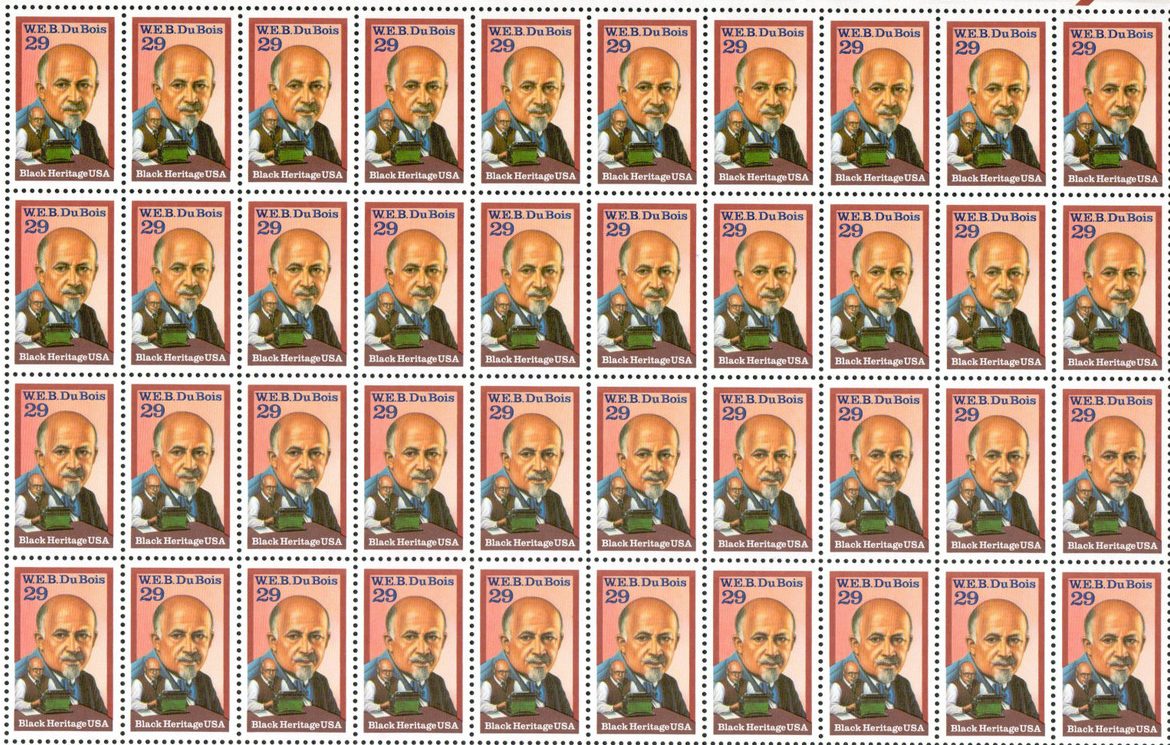
In July 1934, W.E.B. Du Bois received a letter from an Atlanta resident named Gus Reich. We are excited to share both Reich’s letter and Du Bois’s short reply below.
A lay theologian and self-styled monetary reformer, Reich in his letter proposes a spiritual plan for economic renewal. He urges Du Bois to support a vision of Christian financial reform led by the Black church. Condemning the interest-based banking system as “devilish,” Reich calls for a new kind of moral economy—one rooted not in gold or markets, but in collective virtue and spiritual confidence.
Du Bois responds with a single line: “The process of curing ills by printed money has been tried many times but never worked.”
It is a short exchange, but a revealing one. It surfaces a longstanding tension in American political life: Who gets to issue money—and under what terms? Reich’s proposal may seem eccentric, but it reflects something serious. It points toward an alternative to gold-backed or market-driven money, one where credit is issued as a public act, grounded in shared belief and moral purpose. In short, it imagines what many now call endogenous money—money that enters the world not from economic exchange or nature, but from institutional decisions and collective commitments.
But even imaginative ideas can carry baggage. Reich frames the Black church as a vessel for national redemption. In doing so, he risks casting Black communities not as equal participants in public life, but as moral stand-ins—invited to lead only when they can purify a broader system in crisis. In our reading, Du Bois’s response resists this framing. It is not necessarily a rejection of public credit itself (we hope), but of the burden placed on Black leadership to deliver redemption on someone else’s terms.
This moment makes more sense when seen through two overlapping histories. First, the legacy of Black-led fusionist coalitions after the Civil War. And second, the turmoil of Depression-era monetary reform.
In the decades after Reconstruction, Black Americans joined multiracial alliances across the South, including fusionist tickets that brought together Black Republicans and white populists like the Greenback and People’s Parties. These coalitions briefly held real power in states like North Carolina, pushing for land reform, public education, and voting rights. They were met with relentless opposition: not just Jim Crow laws and disenfranchisement, but racist violence like the 1898 Wilmington massacre. The memory of these movements, along with the political backlash they triggered, shaped how Black politics was perceived and enlisted in the decades that followed.
Fast forward to the 1930s: the U.S. had abandoned the gold standard at home and was experimenting with new forms of federal spending. But the role of money itself—how it’s created, who controls it—was still treated as a technical issue. Into that vacuum stepped a range of populist proposals. Some, like Reich’s, drew from moral and religious sources. Others, like those of Father Coughlin and Huey Long, veered into conspiracy and authoritarianism. Still others gestured toward the greenback tradition, but often fell back on old fears of inflation and dependency, sometimes thinly veiled in racial terms.
Reich’s letter reflects this tangle of influences. It combines spiritual populism with economic idealism, yet still relies on tropes about virtue, self-sufficiency, and moral rescue. Du Bois’s reply, we think, is not just about the feasibility of printed money. It is about the weight of these narratives—and who is expected to carry them.
That said, Du Bois’s position is not without its own limits. His skepticism about public credit reflects a broader intellectual tradition—especially among Marxists—that treats government-issued money as risky or false, especially when it is not directly tied to labor or production. While that tradition offers powerful critiques of capitalist violence, it also tends to echo Jacksonian suspicion of credit as unearned or parasitic. In doing so, it often misses how public credit has functioned historically: as a way to coordinate social life, not just to reflect economic output.
Du Bois, as always, is careful. But his reply reveals how even the most perceptive critics can find themselves caught between traditions—rejecting the burden of credit for an oppressor’s redemption without fully seeing the possibilities of credit as enfranchisement. Rather than dismiss his letter or take it at face value, we offer a reparative reading: one that holds Du Bois’s skepticism in tension with the deeper political insight his reply also contains. We interpret his response as shaped by a moral position grounded in historical experience—one that can, and should, be reincorporated into a renewed, critical monetary populism.
We share this exchange not to praise or dismiss Reich’s proposal, but to show why these questions still matter. At Money on the Left, we believe that reimagining how we provision public life is one of the central challenges of our time. That means taking bold monetary ideas seriously. But it also means paying attention to how those ideas are framed, and who is expected to redeem what.
Too often, communities already marginalized by economic crisis are recruited to fix it on someone else’s behalf. That is not enfranchisement, but deputization. And it risks reinforcing the very exclusions it seeks to overcome.
The same dynamics are resurfacing today. As Modern Monetary Theory (MMT) is metabolized across publics, its core insight—that money is issued into existence through political decisions—is being cautiously integrated across the ideological spectrum. But not all uses of this insight are emancipatory. Right-wing populists like Thomas Fazi, Tucker Carlson, and Marjorie Taylor Greene are already experimenting with expansionist monetary rhetoric to serve nationalist and exclusionary agendas. Their message is not that money is public. It is that public money belongs to “us,” not “them.”
This is why we argue that monetary politics needs to be contested from within. It is not enough to point out that the state can spend. We have to ask: for whom, through what institutions, and on what terms? The risk is not just bad spending. It is moralized and conditional spending—credit extended as a reward for loyalty and withdrawn as punishment for dissent. What could be more Trumpian?
In that light, the question is not whether we “support” endogenous money. All money is already issued endogenously before it is moralized as scarce commodities or white tax-dollars. The question is what kind of world it is made to sustain. Who is trusted to issue? Who is seen as creditworthy? Who gets invited in? And who gets blamed when the system cracks?
These are not idle questions. As Carlson and Greene turn toward Christian nationalism, using the state to draw lines between insiders and outsiders, they are improvising on old themes: using money to grant absolution to some and withhold care from others. The MAGA movement’s collapse—exacerbated by scandals like Trump’s attempt to shut down the Epstein scandal—has produced a frantic search for new conspiracies to stop the creeping sense of guilt and responsibility for Trump’s open cruelty. Monetary politics becomes one place to stage that search.
We have seen this play out before. In 1930s Germany, the Social Democrats rejected the WTB Plan for state-backed public credit, clinging to fiscal restraint. That created an opening the Nazis filled with their own vision of nationalist credit. Sound money did not save the Weimar Republic. It helped to end it.
If we want to avoid repeating those mistakes, we need to name what’s already happening. Public money is real. It is already shaping our lives. The only question is how—and for whom. We need credit infrastructures that are open, democratic, and resilient. Not credit as a judgment, but credit as a commitment. Not a test of worthiness, but a project of shared responsibility.
Letter from Gus Reich to W. E. B. Du Bois, July 4, 1934
Dr. W.E.B. Dubois
Editor, The Crisis
Dear Sir:
Enclosed I send you[r] clipping from the Epworth-High road, giving me your address & that of your organ The Crisis; when you find my answer correct, I suggest that you print it in the Crisis for the advancement of colored people & the benefit of all to the glory & honor of our Lord Jesus.
In that article Color Caste in the U.S. the writer adds up all the rights of the white man, which the negro lacks, but he offers no practical solution how to cure the dilemma with benefit to both & harm to none.
The white man in U.S., especially the Southern planter suffered loss indeed, when they gave up slave labor & the South feels its hardships yet to some degrees; however that was a blessing from the Lord which He gave to Abraham Lincoln & helped him put it through, for without it, our Declaration of Independence would have been a lie indeed & of no lasting power, but for the colored race, this blessing from the Lord brought upon them a new duty which means thankfulness & service; have they found Him today?
It is a fact that today the white man all over the world is in far greater distress than the negroes were at the time when the civil war started & nobody has offered a solution yet, faithful & true; when my following statements are found correct, I beg to remember that the truth comes from the Lord, thank Him & use it in His name.
Today’s depression which spreads over all countries, is not caused by nature; there is enough to eat & commodities for sale; scarce is only the money in people’s hands & the work with which they acquire it, & yet these people who lack this money today, are really the only ones who actually produce such value, with the work of their hands & the Lord’s blessing, while the other fellow, who keeps it today, has to get it from them first, to get hold of it; has to take eager care of it, that he might not loose it again & has to carefully tend to it, that they may not slowly work it off again & deprive him of it.
That is the character of our money-foundation, our banking & credit, our interest system; it is all selfish, devilish—the only cure ? make it faithfully truth, brotherly-loving.
It is alltogether ridiculous to expect such a change however from men, who are accustomed to have prospered under the old system; the Lord wouldn’t give truth to them; it has to come from men who know their Lord better, who are willing to serve Him & use Faith & Truth in all their work & give Him the glory & when I propose to the colored mrace today, to announce to the World repentence & reform, faithful & true, it is an opportunity given to them by the Lord to prove to their white brethren their equality & earn their thanks.
It is impossible to make our finances true, if we are not willing to be true Christians ourselves first; our various denominations do not honor our Saviour but mostly other men; even Martin Luther, though he pronounced his faith in one Holy Christian Church “was done more harm than honor they made that church lutheran.” To give glory to our Saviour, we must re-establish that Holy Christian Church” again, which the first Christians had & where they brought all they made & the church cared for them.
That is another item our church lacks today & doesn’t exercise control over our banks, to make them work straight-true, but that does not prevent, that we have to suffer today from the consequences of our neglect & that is the cause of our depression; the real cure, the only one, is to create a perfectly christian banking system, abandon all of the old one, it is devilish from A to Z & if the president & senate refuses, make it privately, it will be even more profitable & it is exceedingly simply, just use bank-cheques instead of gold & silver, accounts for currency; it will give everybody all the money he needs, make abnormal riches a burden instead of a privilege & will make crime & wars unnecessary & undesirable. Being given to me by the Lord, it will receive His blessings also & if put into action by the colored race, will certainly win them the admiration of their white brethren. President Roosevelt has asked already for criticism & suggestions, practically admitting his failure; only the Truth will last eternally & putting it into finances will change our whole life.
Settling the war-debt question, we should give up our demands for them; wouldn’t need them anymore, but demand from our allies that they in turn give up their colonies & make the world free. We gave up slaves, they must do the same, it is either Christ or the devil!
Further details & information gladly furnished when wanted.
Yours truly
Gus Reich
Letter from W. E. B. Du Bois to Gus Reich, July 10, 1934
Mr. Gustus Reich,
c/o Heywood Avenue, S.E.,
Atlanta, Georgia.
My dear Sir:
I thank you for your letter of July 4. I regret to say that I am no longer editor of The Crisis and therefore cannot publish your views. If I did, however, I would point out the process of curing ills by printed money has been tried many times but never worked.
Very sincerely yours