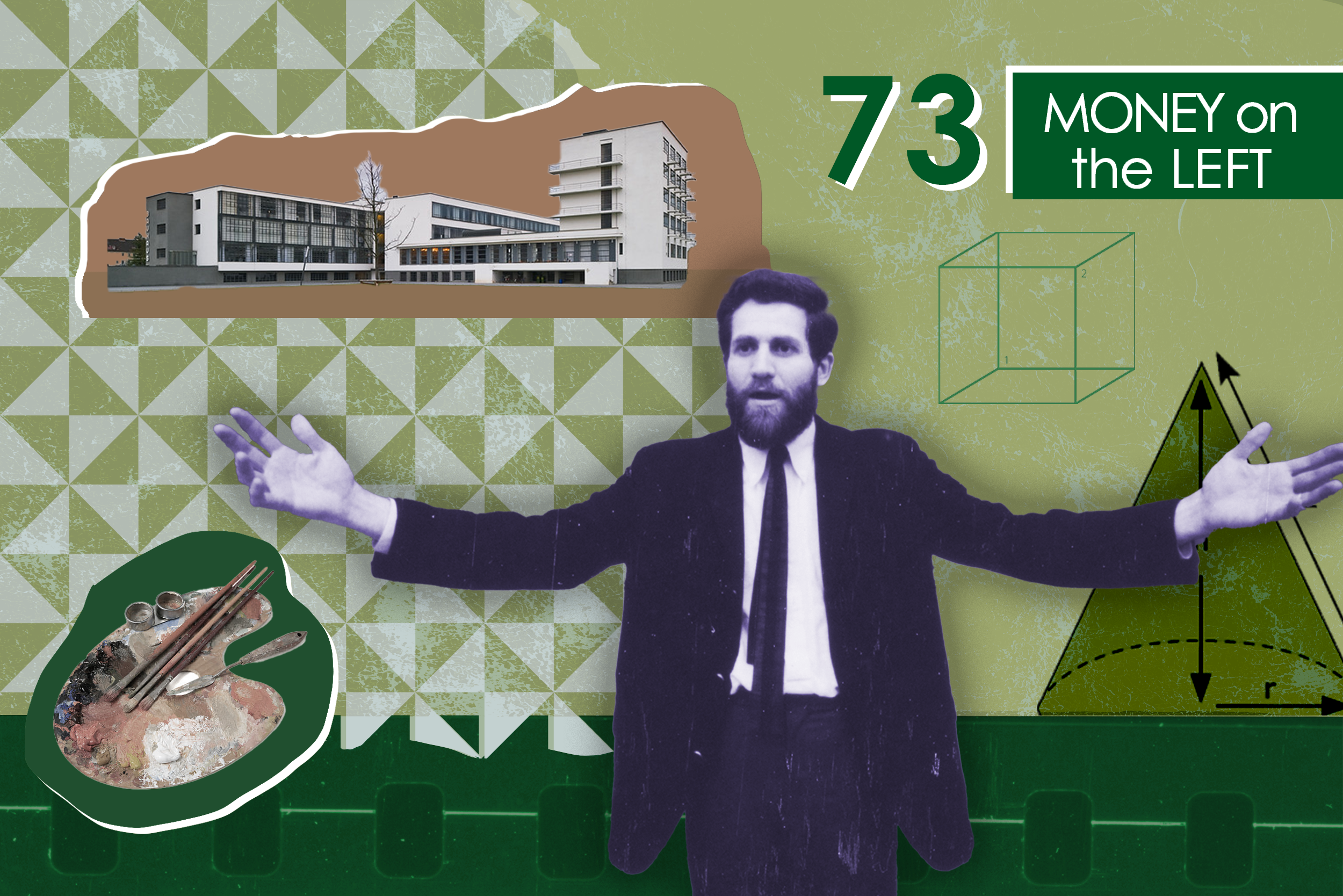
Artists in Academia with Tim Ridlen

We speak with Tim Ridlen about his new book, Intelligent Action: A History of Artistic Research, Aesthetic Experience, and Artists in Academia (Rutgers University Press, 2024). Ridlen holds a PhD in Art History from the University of California, San Diego and is currently Associate Teaching Professor in the Department of Film, Animation, and New Media at the University of Tampa. In Intelligent Action, Ridlen challenges dominant readings of mid-20th Century art preoccupied with critiques of the commodity form by shifting critical focus from the familiar spaces of the gallery & museum to the contested scenes of US higher education. 

Through archival research and analysis of artworks by Gyorgy Kepes, Allan Kaprow, Mel Bochner, and Suzanne Lacy, among others, Intelligent Action examines how these artists brought alternatives to dominant conceptions of research and knowledge production. The book is organized around specific institutional formations—artistic research centers, proposals, exhibitions on college campuses, and the establishment of new schools or pedagogic programs. Formal and social analysis demonstrate how artists responded to ideas of research, knowledge production, information, and pedagogy. Works discussed were produced between 1958 and 1975, a moment when boundaries between media were breaking down in response to technological, cultural, and generational change. In the context of academia, these artistic practices have taken up the look, feel, or language of various research and teaching practices. In some cases, artists bent to the demands of the cold war research university, while in others, artists developed new modes of practice and pedagogy. Reading these works through their institutional histories, Ridlen shows how artistic research practices and artistic subjectivity developed in the long 1960s within and alongside academia, transforming the role of artists in the process.

During our discussion, we consider the significance of Ridlen’s theorization of “intelligent action” for a democratic politics centered around public money, educational provisioning, and aesthetic experimentation. 

Visit our Patreon page here: https://www.patreon.com/MoLsuperstructure

Music by Nahneen Kula: www.nahneenkula.com

Transcript

Scott: Tim Ridlen, welcome to Money on the Left.

Tim Ridlen: Thank you. I’m really excited to be here. Thank you for having me.

Scott: We have invited you onto the podcast to discuss your brand new book from Rutgers University Press titled Intelligent Action, A History of Artistic Research, Aesthetic Experience, and Artists in Academia. Before we get into this book, what its arguments are, what its big stakes are, we’d like to invite you to tell our audience a little bit about yourself, something about your professional background, perhaps your personal background, and how you came to write this interesting and compelling new book. 

Tim Ridlen: Sure. I will start a little bit before my turn towards a more scholarly form of practice, because it’s relevant to the book. I went to an art school in Chicago, the School of the Art Institute. I was headed towards becoming an art practitioner. I went on to do an MFA. Then, I was working freelance in New York, trying to do the art thing, trying to make a go of it, while also doing things like freelance artist assisting, freelance art handling for galleries and things like that. An important detail: during that time, I worked for this organization called e-flux, to which I refer in the introduction of the book. We can talk a little bit about why that’s important later. But I was always academically minded, even as I was artistically focused. And I think the experience of living in New York and not knowing where my next paycheck was going to come from prompted me to look at options. That’s when I decided to go into a PhD program. The PhD program that I went into was one of the first programs that was specifically for art practice. The way that it was set up though, was through an existing art history PhD program. You do all the training of an art historian, and then they call it a “concentration in art practice.” This was at the University of California, San Diego. I thought, “Well, that fits.” I think I could get into that program, first of all, and it fits with how I see myself. I went into that program thinking that I was going to continue making art, being an artist, finding a way to reconcile that with my more academic interests. That is what happened to a degree. Then the book project proved to be a culmination of a successful transition to more academic scholarly modes of producing work. Though I haven’t really made a lot of art recently, I nevertheless continue to think of myself as an artist, occupying a weird split between writing and thinking about other people’s art and potentially creating my own.

I mention all that because that is relevant to the topic of the book, the book being about artists in academia. It really came out of the experience of going into this PhD program. It was a pretty new PhD program and a new idea that artists should even think about getting PhDs. I entered this very self-reflexive mode because there was a lot of conversation going on about PhDs for artists, even if that was more in Europe. As for this program in the U.S., it wasn’t really clear if it was going to take off. To be honest, I’m not really so sure if it has even now. You know, this was around 2011 that I went into that program. At that time, there were lots of conversations and conferences for the College Art Association about whether or not this was going to become the new terminal degree. That, of course, hasn’t really come to pass. What has come to pass, however, is that there’s a lot of interest in artistic research. I thought maybe this will be a trend  during this time that I was working on this project. And I wasn’t really sure if it would come back. But what certainly was also at play is that there was a lot of interest in artists and education, not just, how do we educate artists in colleges and universities or art schools, but educational structures as potential forms for art making and art exhibiting. So, maybe we’re getting into the territory of the book now. Coming back to this organization that I worked for, e-flux: They were a big part of that around 2008, 2009, when I started working there.

Around that time, as a result of this interest in Europe and PhD programs for artists and artistic research, in addition to certain events that were connected to the artists who run e-flux, people started to talk about an “educational turn” in art. Then when you talk to people who’ve been around a little bit longer, they’re like, “Oh, yeah, this always comes back every 10 years.” So, this is not really anything new. But at the time, it seemed like there was an interest in education and artistic research, and those things are connected, but not necessarily the same. That’s a longish answer to the question of how I came about it. And there’s a little bit more. I would like to share a little bit more about e-flux just because it explains where I was coming from when I started the project.

E-flux is this artist-run organization. It’s not a nonprofit, and it’s not just a gallery space or something. So, I always have a hard time describing exactly what it is. But people probably know it mostly because of their email announcement service. They send out email announcements for exhibitions, and museums pay them. Basically, it’s advertising. And this money funds all kinds of interesting projects. Now, it funds a very reputable and influential journal. Not an academic journal in the sense that it’s not peer reviewed; but it is leading a lot of intellectual conversations in the art world. A lot of that came out of the artists Anton Vidokle and Julieta Aranda, who were the artists behind e-flux. They started to use the revenue that they were generating to do some very interesting projects, one of which was the Martha Rosler Library. That’s the example that I open the book with. Martha Rosler is an artist who is best known for her work in the 1970’s as a conceptual artist. One of her best known pieces is this photo-conceptual piece called “The Bowery in two inadequate descriptive systems.” In that piece, Rosler is critiquing documentary photography, critiquing systems of language and the way that they construct our ideas of the social world. It’s a very 1970’s kind of piece.

So, Martha Rosler is this artist that the artists at e-flux were looking to as a source of inspiration and legacy. Their project, “Martha Rosler Library,” took all of Rosler’s books and put them on display. They rented a space in the Lower East Side of Manhattan, which just so happened to be exactly the neighborhood where, or blocks from the Bowery, where she had taken the images for the original project. And they exhibited her books. It was treated as an artwork at the same time that it was really just her personal library. And when you ask them about it, ask Martha Rosler or the artists at e-flux about it, they say: “Well, this started because she was looking for a place. She needed to move her books. She was looking for a space to store them. And they were like, let’s exhibit them.” It was a very successful project.

After its first exhibition in New York, it toured all over Europe. That was part of this educational turn–people were starting to get interested in thinking about artists as not just people that make paintings or do projects, but as people that study and research and read. What do they read? Let’s look at that. That became an interesting thing to actually exhibit as the artwork itself. Another other thing—although I don’t talk about this in the book–is there was at the time an exhibition called “Manifesta.” I mean, there still is. It’s a biennial exhibition. At the time, Anton Vidokle, the artist from e-flux, was invited to be one of the curators for this biennial. And the whole format for that biennial was they were going to run it like an art school. They were going to invite, they actually did, in fact, invite artists to apply. Then the idea was that they would come to Cyprus. They would come there and basically instead of an exhibition, it would be like a school. They would invite artists to teach classes and run seminars and that kind of thing. This was in the air when I started that project.

And that’s what interested me in approaching it and taking it on as a subject.

Billy: So in your research, like any good dissertation, it’s part biographical. Did you find that your turn to academe and your reasons for it were common among those artists that you looked into in the 60’s? Was it a way to bide time-slash subsidize your artwork?

Tim Ridlen: Yeah, I think that’s definitely it. Like I said, I was looking for institutional support. There’s all kinds of places you can get that kind of support. It’s not going into academia, but that was what I thought would work for me. And I think that definitely resonates with the artists that I was looking into.

People like Alan Kaprow, who is a major figure in the book, he’s got a great quote where he says something like, “You know, I used to think teaching was a way to buy the groceries. But, you know, now I’ve come to realize that it’s much, much more than that.” He admitted that at the beginning, it was a way to pay the bills. But then he starts to, throughout his career, engage more and more with academia as a site and a format that allows him to do more participatory kinds of work. So, I try to contest this narrative that art became more academic. That’s the standard line that you’ll get from people like Howard Singerman, who has a major book on the art schools and artists in universities.

He traces the history of the MFA degree. That book is very well-researched, I don’t disagree with anything that’s in it, but it tells the story of a tendency towards more academic development towards academia that culminates in the 70’s. I guess there’s truth to that; but I also try to point out that artists like Alan Kaprow were working in universities in the 1950’s, and not just working in universities, but making that a central component of their work. That actually starts much earlier. It has important consequences, especially for alternatives to engaging with ideas about research in academia.

Scott: One of the big claims for your whole project is putting pressure on a certain dominant reading of mid-late 20th century U.S. art that is pretty preoccupied with the problem of commodification, right? Could you talk about who’s behind those kinds of arguments? What are they really saying? And what does shifting the scene from the gallery or the museum to academia as a heterogeneous institution do to complicate this false story that’s out there?

Tim Ridlen: Yeah, I like that you call it a false story. It’s part of a larger position that in the book I also talk about. People like Boltanski and Chiappello have the idea that that the artistic protests of 1968 in France were somehow co-opted.

I do see this as part of a larger position out there. But to get to the question about who’s behind this idea of art as a critique of the commodity and what my response to that is, I mean, who’s not? Who’s not behind that idea in the sense that it’s a pretty mainstream way to understand the turn towards conceptual art? You could trace it all the way back to people like Clement Greenberg, to Abstract Expressionism and the idea of an autonomous work of art that is supposed to somehow be a refuge or a holdout from the commodification of everything else and every other part of our life.

So it starts with people like Greenberg, but of course, the big bête noire in the book is Benjamin Buchloh. Buchloh is a very respected art historian who has a famous seminal essay on conceptual art, where he critiques the turn towards language and information and what people had at the time called the “dematerialization” of art. Of course, there’s lots of questioning about whether art ever really dematerialized. In any case, Buchloh critiques conceptual art because he sees it as a breakdown between the role of the artist and the critic. He says there’s a separation of powers between people making art and people critiquing art and conceptual artists went too far in critiquing art. And he proposes that this is a dialectical process that began with Marcel Duchamp and Duchamp’s ready-mades. It then culminates in conceptual art. Buchloh thinks that the way out of this is a mode of art practice known as “institutional critique.” But what I’m trying to get at here is that Buchloh’s claim really functions to bring back into art practice some bounded form. Conceptual art broke the boundaries of what could be considered the artwork and what could be considered criticism, whereas institutional critique used the exhibition format or the institution itself as the container within which the artwork would be held so that it doesn’t spill over into some other role that I guess the critics are supposed to be in charge of.

Billy: Could you say something about the examples of that artist as critic? You mentioned Duchamp, but for listeners who may not have ready access, we’re talking about the toilet, right?

Tim Ridlen: Yeah, we’re talking about the toilet. We’re talking about “Fountain” (1917).

It’s starting with Duchamp, where he exhibits this urinal turned on its side. He gives it a title, calls it “Fountain,” submits it to this exhibition that was supposedly trying to be more open, trying to be more open to other kinds of work. And he does this under a false name, knowing that, of course, they will reject it because it’s ridiculous. Then writes about it, not revealing that he was actually the one that presented it.

He claims that it’s an artwork because the artist chose it. It’s an artwork because he gave it a title and that gives a new thought to the object. That’s the impulse that conceptual art runs with this idea that you can transform something into a work of art through the thought or, or through language. So conceptual artists starting in the mid-60’s start to really pick up on this idea that art can be an idea, that it doesn’t have to take a form or any one form, that art can be engaged with language.

There’s different flavors of conceptual art. There’s capital C conceptual art as a movement. And then there’s also conceptualisms and a lot of interest in talking about global conceptualisms. How did this turn in the 1960’s take place in different places? But by and large, conceptual art is an ontological break with how the artwork has been defined or how it has been contained. So, now you can have different iterations of artworks that are the exemplary materializations of the idea.

One of the figures I talk about in the book is a curator named Elayne Varian, who was at this college on the Upper East Side of New York. And she inadvertently was really important in developing conceptual art with the artist Mel Bochner. Mel Bochner is another seminal conceptual artist who is working with her on these exhibitions, sometimes as a co-curator, sometimes just as one of the exhibiting artists. They talk about this in “Art in Process” exhibition, this idea that artworks are just exemplary materializations of the idea. They make the point that the artwork is not just what you see on display, but somewhere else. And that’s why people say, well, it’s dematerializing, but of course, it always needs to take some form, I guess, in order to be exhibited. So, it’s not exactly correct to say that they’re dematerializing, but perhaps the idea that artworks take exemplary forms or exemplary materializations in different places at different times, and they can be, you know, fragmented or dispersed. The word that I use in the book is actually associated with the artist Mel Bochner. He talks about decentralized aesthetic experience, that the artwork can be decentralized. That’s one way to think about it.

Other conceptual artists were more invested in analytical philosophy. The idea that artwork was a proposition, that something like Duchamp’s “Fountain” was simply a proposition. This is an artwork, and therefore, it’s within the logic of analytical philosophy. But I think the other strains like Mel Bochner’s are more interesting because they don’t get lost in the instrumental logic of analytical philosophy.

Scott: To pick up on the latter part of my question, how would you say your shift of focus in this history to academic institutions and the figure of the artist as researcher in some more conformist and some more radical ways, how does that challenge the going fall story that’s perpetuated by a figure like Benjamin Buchloh about the decline of mid-century art.

Tim Ridlen: Yeah. Thank you for bringing me back to that, because that’s an important point. So in challenging the idea that the turn to conceptual art was a critique of the commodity, that wasn’t something that I set out to do. That was something that I came upon because I was looking at these artists who were working in academia. And what I started to see there is that if you think about what artists were doing as a response to what people in academia were doing, specifically, you know, Cold War researchers, you saw a development, you know, you could think about it as a, in some cases, as a critique of knowledge production, as opposed to the commodity fetish. So if there’s a critique to be had there, it was a, or, you know, intervention that these artists were making, it wasn’t just about the commodity formula.

It certainly was in some spaces, right? But when you turn your attention to the university and academia and what research was supposed to be at that time, you see something different. You just see a little bit more, you see a different understanding of what creativity is or what art making is about, what it’s meant to do. And you get a little bit away from the idea that art making is about producing objects. And you get closer to the idea that art making is a process of, I don’t want to say producing knowledge, but a little bit, that’s where it starts out. The expectation for artists in academia is that they would be producing knowledge. But in fact, what artists do often, the artists that I look at, at least, and the ones that I’m interested in, they don’t just focus on producing knowledge. They focus often on creating experiences, right? Aesthetic experience. And that doesn’t always look like producing knowledge the way that it did for other Cold War researchers, right?

What that leads to is a transformation of who the artist is. And the way I talk about it in the book is that it’s not really just about literally what were artists doing, but what does it mean to be an artist for society, for people outside of academia? What do they think of as the artist’s role or what an artist does? And what I observe and argue for in the book is that in the attempt on the part of these artists to engage with and challenge knowledge production, they end up reconfiguring the artist as somebody who is, you know, it moves away from this idea of the artist as creative genius and visionary sole author of this artwork and towards something where the artist is actually engaged in society, engaged in the world. And that doesn’t necessarily mean producing objects, but it means engaging in the social sphere. So it leads into socially engaged art practices and examples of that. I mean, Martha Rosler is an example of that. Somebody who starts out as a conceptual artist and then, you know, especially with some of her projects becomes more of a socially engaged artist where she’s doing things, projects in New York that are engaged with, you know, housing, the housing crisis in New York in the 80’s. So, the upshot of all this engagement with the university is not just a more academic art, but it is a socially engaged art where it moves from university to the wider polis. So for folks like Buchloh, conceptual art is a bridge too far.

Billy: So for folks like Buchloh, conceptual art is a bridge too far. For whatever else it is, it’s undermining the traditional, conventional infrastructures and institutions of art, capital A. And this is happening at a time where there’s thought to be all sorts of threats to tradition, convention and the moral foundation of, you know, in the context of the United States the U.S. polity, could you talk a little bit about how that may or may not have been coded or understood by folks like Buchloh or the concept the work of the conceptual artist might have been perceived by folks at the time and and since then as participating in some way in, you know, the great communist conspiracy or, on the other hand, the great CIA conspiracies of the time in the heat of the Cold War.

Tim Ridlen: I’m not sure if I can totally speak to what Buchloh, how Buchloh would have read these conceptual artists in the context of the Cold War.

But what I can say, I think what’s relevant to your question here is that there were some artists engaging. I mean, there’s, I’m trying to think here. The artists that I discuss in the book, conceptual artists are one group of artists that I discuss. They’re a stop along the way in this trajectory for artists in universities. And really, these artists in universities start out more pressured by the demands of the Cold War, which is to say that, We must produce, you know, we’re going to fund works that really produce basic research without necessarily knowing what that might lead to.

So, you know, Vannevar Bush’s statement on universities was that research is this endless frontier–some artists like György Kepes at MIT really bought into this idea that artists should try to be like researchers. He conformed to these expectations in ways that other artists did not. Artists that I look at who are at Rutgers University, Allan Kaprow and Robert Watts, and George Brecht who wasn’t teaching at Rutgers, but he was part of their milieu. They paid lip service to some of these demands that the universities should be helping to fight the Cold War through developing research. They paid lip service in some places to get money, but they were also very critical of this idea. They point out that basic research in the sciences really serves technology. You alluded to the space race and things like that, but it’s less clear what basic research in the arts leads to. They arrive at this answer that it leads to a reconfiguration of subjectivity, through what it looks like to be an artist, and that becomes a model for what it looks like for other people, for what the experience of life is like in this late 20th century.

Scott: It actually reminds me of an episode we did with a professor of dance, Colleen Hooper, years ago. I think it was during our first season. She conducted important research into the CETA programs under Nixon, which were poorly designed to address unemployment and had all kinds of stipulations attached to the public monies that were being allocated for this purpose. But a bunch of artists across fields and media, including dancers and dance choreographers, they were canny.They saw a chance to have financial and institutional support and to build up whatever they were doing.

They changed their identities and their rhetorical frames to gain access to this support. But then at the same time, they ended up variously challenging the power-structures-that-be, some in more radical ways than others. All that’s happening actually at the same time as the art researchers that you’re talking about.

This is not to excuse them, the ones that are more in line with the Cold War science research model that’s serving American militarized commercial imperialism around the globe. But it’s to say that there’s another lesson here in seizing an institution, seizing a funding opportunity and experimenting with that.

Tim Ridlen: Yeah, exactly. And that’s exactly the point that I try to make in the book is that these artists were engaging with what other scholars have called the knowledge-based polis. But my argument is they engage with this knowledge-based polis only then to expand that to the polis at large. That becomes this starting point. And the way that it happens is multifaceted.

I should say, Buchloh is a Marxist. I’m not sure if I made that clear, but he is influenced by Greenberg and Adorno and Frankfurt School thinking. So, what would he make of all this? How was he thinking about this in relation to the Cold War? He was just through and through a Frankfurt school art critic. So that bears pointing out and clarifying.

Scott: He’s not afraid of any communist conspiracies. He is the communist conspirator.

Tim Ridlen: Yeah, he’s not a traditionalist by any means. He’s thought of, he’s part of October, the leading art journal that is still probably today considered the most, you know, rigorous. He’s the most representative Frankfurt School person among October critics. But yeah, the October critics are not concerned about artists being communists.

Billy: Well, I mean, it’s happening in the context of all this. I guess, is all of this contest and debate and innovation happening somehow insulated from the broader politics of the time? I’m just trying to get a sense for how shaped it is by the Red Scare, essentially, in any way, shape, or form. 

Tim Ridlen: Conceptual art is a fulcrum. It’s a moment, it’s a particular turning point. And that’s not my argument. A lot of people make that argument. Peter Osborne, art historian, talks about how all contemporary art can be explained as conceptual art, that now that conceptual art was this particularly important turning point.

Buchloh is also engaging in that idea that conceptual art was a particular turning point, but for him, it was a misstep and it only gets reconciled because some of that turned into institutional critique. So in a way, the book is not only about conceptual art, but that is still a pivot point. I try to explain that as well. When people talk about conceptual art, sometimes they’ll say, well, we’ve actually got artists who are more associated with Fluxus in the early 1960’s, who were proto-conceptual artists. So oftentimes, some of the artists that I’m looking at, like Allan Kaprow and Robert Watts, are read as proto-conceptual artists.

Conceptual art before actual conceptual art became what it became. And there’s truth to that. For example, I write about Jack Burnham, who was also at MIT, but he had a big break with György Kepes. He was writing about what he called “systems aesthetics.” That was his name for what he saw happening with conceptual art. It was still connected to the kinds of Cold War research that was going on with things like cybernetics. But he was saying, “Well, look, this is the art that we’re seeing today in the 1960’s. This work is a lot more like systems rather than objects.” So, that kind of thing wasn’t called conceptual art, but it was certainly a precursor to conceptual art. So there is an important place for conceptual art in the book, But Scott’s right that it’s not just about conceptual art.

Research and artists working in the university started out doing things that looked like lectures or being invited to universities where they would give a talk and then do a Happening, which is what Kaprow was famous for. Then, they could have some discussion afterwards that might look like a seminar. The idea was that these forms of support that the university was providing enabled more participatory kinds of art and more things like that would eventually become conceptual art or be conceived and labeled conceptual art at a later point.

Scott: I’d like to invite you to explore some of these examples in greater detail. Maybe talk a little bit about Kaprow’s works, his lectures with some specificity?

Tim Ridlen: Sure. Like I said, Kaprow is a major figure in the book. He is most known for the Happening. A lot of people did Happenings, people like Carolee Schneemann and Claes Oldenburg. This is the 60’s. Sometimes Happenings have just been understood as performance art. It really comes out of the influence of John Cage.

Artists like Allan Kaprow and others such as George Brecht and Robert Watts, who are teaching and associated with Rutgers University, they take this class, this composition class with John Cage that’s happening at the New School in 1957 to 1959. They take the composition class and they try to apply the ideas and methods of chance composition that Cage is talking about to visual art. But what that ends up looking like is time-based performance type art that Kaprow calls a “Happening” and Fluxus artists start to conceive of as “Events.” There’s a number of different outgrowths from that class and that intersection with Cage. Kaprow is just one iteration of that.

He’s showing in galleries in New York, but he’s also doing some of these Happenings on campus at Rutgers University. One of the first ones that he does is a piece called “Communication,” which is essentially part of a series of lectures that he and Robert Watts had organized at Rutgers. It uses the lecture format to disrupt the idea that art communicates in any direct way. He’s standing on stage lighting matches. There’s this red light going off. There’s banners that are hanging from the balcony. There’s a recording that’s playing; that’s the part where he’s actually giving his speech about the idea of communication, which a lot of people were talking about who are associated with cybernetics research. 

He was critiquing this idea that art was about communicating directly in that recorded speech. There, he planted some people in the back of the room to start taking tin cans out of a bag so that it would be noisy in the audience. He’s doing this performance and that one looks more like a performance because he’s standing up at the lectern and performing these actions and you’re hearing this recorded speech. He continues to do things that look more and more participatory, more like rituals or something. He comes up with these ideas for activities that he and the students or other participants will do. And usually what that looks like is that he will give a lecture and explain the piece. Oftentimes, there’s a complicated score that shows what the different parts of the Happening are going to be. Then maybe the next day, everybody will come together and do that Happening. Not in all cases, but in some cases, there would be this discussion afterwards of what that was like.

So my reading of Kaprow’s trajectory is that he does lots of Happenings in the beginning that are more focused on him as a central actor. But he moves more and more towards participants being involved. It also starts to put explicitly in conflict things like his intention, which he tries to spell out in the score and in the lecture, and the experience of actually participating. So I think that part of what develops over the course of his career, in the 60’s at least, as he does more of these Happenings on college campuses is that his authorial control or imprint on the work kind of, it doesn’t go away, but it becomes joined by the actual experience of the participants, right? So he’s been, in some cases, critics have understood Kaprow’s approach to incorporating chance in his work as distinct from John Cage because Kaprow still tried to say, well, I am the artist. I am creating this. This is my project.

But I think that that might have been true at the very beginning, but I think that it’s a little bit more complicated than that. I think that in a way, as he goes on in his career, he starts to think, you know, include more participation and then start to think about the place of the artist in all of this work. And what we eventually come to in the book is that Kaprow starts to talk more and more about un-arting, about leaving art, right? About a transformation of the artist into something else, right?

And I think that’s his influence when he’s at CalArts, that’s when he starts to write these texts about un-arting and leaving the art profession or leaving the idea of being an artist. It intersects literally at CalArts with the Feminist Art Program. And so I think that’s where you start to see his political interest in participatory structures starts to have something in common with the Feminist Art Program, but also literally intersects with the Feminist Art Program at CalArts. So at CalArts, when Kaprow gets there, he is one of three major strains of influence at CalArts and the visual arts. There’s Kaprow, along with some other Fluxus artists like Allison Knowles.

So they’re one big influence on the artists at CalArts. Then there’s John Baldessari, who was brought up from University of California, San Diego, to teach at CalArts. And he is the West Coast conceptual artist that I discuss also in this chapter on CalArts. And then there’s the Feminist Art Program, which CalArts brings down from Fresno State University, and that’s run by Judy Chicago and Miriam Schapiro.

I discussed the intersection of those three strains at CalArts. And the artist Suzanne Lacey, who’s one of the students at CalArts at this time, is one of the artists who comes out of the Feminist Art Program. So she’s a student of Judy Chicago and Miriam Schapiro. And she starts to use consciousness-raising meetings as a starting point for some of her works. And that looks very much like the kinds of discussions that Kaprow is having before and after his happenings.

I don’t think it’s just a one-to-one, it’s not a question of influence, but it is a question of Kaprow, in his engagement with Suzanne Lacy, also starts to think of what he’s doing in these same terms as a mutual conversation that’s happening between them. And so in noticing that, I started to notice the latent political stakes of what Kaprow was doing much earlier in the late 50’s that culminates in the socially engaged art that Suzanne Lacy was doing. Her best known project “Three Weeks in May,” where she, it’s a multifaceted project where she gets data from the police, police data about rapes in the city. And she creates this map that shows where rapes have been happening around the city. And she also goes around the city and, you know, marks in different places where these rapes are occurring. All of that came out of consciousness raising groups that she was a part of where women were recognizing this shared experience. And she puts that into this project “Three Weeks in May” and really engages with public space to bring some of this to light, right? And so she’s engaged. That’s one of the examples where it’s like some of what we’re seeing here is artists who are taking on a new role, who are taking on a new understanding of what they can do, and then engaging in, you know, the wider world, engaging outside beyond the boundaries of the university or the campus itself.

Scott: Can you talk a little bit more about the Feminist Art Program and some of their productions and how they end up challenging a certain patriarchal male-centered approach to art and art pedagogy? 

Tim Ridlen: Yeah, the Feminist Art Program is really interesting. It starts in Fresno by Judy Chicago and Miriam Schapiro. It moves to CalArts in 1971. One of the first major projects that they do in CalArts is a project called Woman House, where they get access to this house, and they basically turn it into a studio, an art studio, and a place for installations and exhibitions and performance art, things like that. One of the goals of the Feminist Art Program that Judy Chicago talks about was really trying to break down the barriers of the male dominated art world. She talks about how she would see her male counterparts furiously taking notes when they’re in a sculpture class about how to set up the manual saw or something, because they know realistically that they’re going to run a studio of their own one day. And she thought that that was the kind of thing that was really lacking, that wasn’t really emphasized for female art students. And she said, we’re going to take this on by really giving students the professional skills that they need, right? Transform it. That means everything from fixing up the drywall, repairing things in the house, to putting on performances there that comment on the experience of being a woman in the 1970’s.

What ends up happening that’s interesting is that, although the goal for people like Judy Chicago was to professionalize these artists, people like Suzanne Lacy, who was one of the students, she doesn’t just become an artist in the mold of other artists at the time. All of the experience of doing this Woman House project, it transforms the possibilities or the imagined possibilities for what art can do, right? So it becomes more about socially engaged art that, maybe it’s also coming out of performance art and things like that so it has these interesting upshots that weren’t necessarily the the intention of of Judy Chicago. That there’s a lot more to it, it’s more complicated.

Scott: That’s great. If you have more to say, you can say it; but if not that’s great, too. 

Tim Ridlen: i mean the kinds of things that—one of the things that comes up a little bit in the book is that there are many artists who are part of this, not just Judy Chicago and Miriam Schapiro but the the students that were there as well. But one of the things that Miriam Schapiro’s work was doing, Miriam Schapiro was doing things that were more straightforward painting, although she was part of this Woman House project as well. But they start to explore what Miriam Shapiro called central core imagery, which is like trying to work on questions of representation, how feminine imagery is seen, to try to reconfigure it as not passive but active. And in some cases that looks like painting and in some cases that looks like these plays that Judy Chicago was doing called “Cock and Cunt Play” where they’re working with these props of, genitalia props and they’re doing these, they’re play acting these conversations between a man and a woman that are very over-the-top, ironic critiques of these gender roles.

And then she doesn’t just do that as a performance. She actually takes that around when she’s invited to college campuses and has students perform that play as a way to, maybe it’s crude or simplistic or something, but it’s effective as a way to, you know, draw attention to these gendered roles and gendered representation, in the way that those things get represented.

Scott: I want to give you an opportunity to talk about the theoretical framework for the book, which is encapsulated in the title, Intelligent Action.You take that title from John Dewey, the pragmatist philosopher, and you run with it in your own direction. Would you discuss what intelligent action means for you in this project?

Tim Ridlen: Yeah, you’re right. It comes from Dewey, and it’s not like Dewey had a theory of intelligent action. It’s really a phrase that he uses once or twice and that I run with. It also happens to be a phrase or at least variations on that phrase that Kaprow also uses. He talks about intelligent activity. And so starting with Dewey, I guess that’s the best place to start.

Dewey was an influence on some of these artists, but it’s not the only influence. To give you a quick brief on Dewey’s philosophy of art, he has this idea that when he talks about art, he’s really talking about aesthetic experience. So he’s talking about not just making art, but seeing art. And he’s also not just talking about art. He’s actually talking about any experience that you might consider aesthetic. And for him, he uses this metaphor of a stone rolling down a hill. And he says, you know, the stone rolls down the hill, not passively, but actively, right? Feeling all of the little bumps along the way. And an aesthetic experience can be considered aesthetic, not just everyday experience, when it is consummated in some way. He uses the word consummated. So that it has this quality of wholeness, that it comes to some moment of completion. And so some of these artists were influenced by that, and that’s how they understand things like their Happenings, but it wasn’t strictly like an application of Dewey. So for me, that’s why I tried to start there, but articulate this idea of intelligent action, where these artists, again, as a result of them being in the university, they start to think about other places, other parts of this aesthetic experience. So the aesthetic experience is not just what you see or what you experience somatically, but also there’s an inner dimension to it. What are you thinking about? So the language becomes a part of that and other systems of knowledge can become a part of that. And the idea of intelligent action is that is a little bit messier than what Dewey proposes. Dewey proposes this very nice idea of this whole consummated aesthetic experience. And he doesn’t really have in mind something that I bring to the table as well, which is that sometimes this experience has conflicts within it or tensions within it. I mean, Dewey was also concerned with democracy. And in a way, there’s a link here between his theories of aesthetic experience and his idea, his writing about education. Part of his critique, as I understand it, of education at the time, turn of the 20th century, he’s talking about how schools are missing this aesthetic dimension, right? They don’t bring this aesthetic dimension to learning. And that folds into his his critique or his ideas about democracy, that we need these moments of understanding the aesthetic dimension to learning and working together.

And I guess that involves recognizing this experiential dimension. But to return, I’m probably getting on a tangent there, to return to his idea of aesthetic experience. And the way that I try to supplement that is that I try to bring in or allow a bit more for this idea that within an aesthetic experience, sure, maybe there’s some conclusion or consummatory character, as Dewey calls it, but there’s also lots of room for tension and conflict to be staged within that. So the way that I talk about it with the work of these artists is that in some cases they are staging the conflict between, you know, language and vision and experience in the case of Kaprow where he, or even his intentions as the artist and the experience as the participant, that staging that conflict or that disconnect is part of what intelligent action is about.

The other thing that I borrow from Dewey, actually I’m borrowing it from a thinker named Hans Joas, and he’s writing about Dewey. He pulls out of Dewey this idea of “ends in view,” the idea that, you know, again, going back to this idea of the stone rolling down the hill, that action in the present or experience in the present is also guided by or informed by this end in view. And he distinguishes the end in view from a goal because it’s not just goal-oriented action, but it’s this way in which the action in the present has some end in mind and is informed by that end and moves towards that end.

And so it’s not just a matter of arriving at the end and reflecting back on the experience, right? That would be more maybe like the idea of contemplating a work of art. But it is about this aesthetic experience that is in creativity that is in action, right? Creativity that is in action. And for somebody like Joas, it’s not just the creativity of making art, it’s the creativity of social action. That’s also the link there.

The other important influences here on this idea of intelligent action are Donna Haraway and Gayatri Spivak, who both talk a lot about doubling, right? So Haraway’s idea of situated knowledge resonates with what Joas attributes to Dewey as situated creativity. And Haraway talks about this idea that there’s always at least two modes of knowing, right? That we’re always experiencing at least two kinds of knowledge or ways of knowing. Spivak in particular, who’s interested in a critique of enlightenment institutions from a post-colonial perspective, talks a lot about playing the “double bind.” That’s her phrase for talking about how does one work within these institutions that have these demands of, you know, whether it’s research or enlightenment reason, what does one do with that? And she talks about the role of the aesthetic as, again, this conflictual model that the aesthetic is that space for play. And the phrase, I mean, interestingly, the phrase playing the double bind, she’s getting that from Gregory Bateson and applying it in a different way. But basically it’s a way of saying like, well, what do you do with these competing demands? And play is a very interesting connection because people like Kaprow also talk about play. People like Joas in his reading of Dewey is also talking about this idea of situated creativity as play. But play is not just about open-ended, you know, messing around, but it actually is informed by some end in view, even if that end is not instrumental in the same way.

Billy: Could you reflect on what has happened to the artist as academic in the intervening years? The 60’s are a very active time, and a different time in a lot of ways. Of course, beginning in the 70’s and into the 80’s, we get the dawn of the neoliberal era and the imperatives of the university change, the experiences of academics and students change. So I’m not asking you to write a sequel, but if you did, what would it look like? What do you think you would pick up on as continuities and divergences? 

Tim Ridlen: Hmm, that’s a good question. 

Billy: It’s a bit speculative, but let’s riff. 

Tim Ridlen: Well, I’m thinking, I mean, initially I was going to answer your question by bringing us back to where we started in terms of things like relational aesthetics that artists start to engage with—sometimes that goes by socially engaged art or dialogical aesthetics. There’s all kinds of names for this work that actually begins with people like Suzanne Lacy in the 70’s, and then has this continuation today, this tradition that continues today. And that is joined by artistic research. And I think, I guess, that brings me back to where I started, where I said, you know, in the early 2000s, there’s this interest in artistic research, a lot of which comes from the Bologna process in Europe, which was a standardization framework.

Once the EU was in place, there was this attempt to standardize university education in Europe that was called the Bologna process. And that’s what led to the creation of PhDs for artists. So initially I was going to say, well, that’s part of the story, but I think there’s obviously a big gap in the middle there. There’s also a disconnect because that’s something that’s happening in Europe. And I’m talking about, I’m really just talking about US context. But I guess if I were going to start to think about what happens in universities, I think some of the big changes are, I mean, like, I don’t have a lot of this history of the university in the 80’s at my fingertips, but there are quite a lot of changes, like you mentioned, like the university is becoming more and more neoliberal throughout the 80’s and I think that that has some pretty dire consequences for the possibilities of artists working within those institutions. But I guess the way that I read it is that there’s this move from the university to the wider social sphere. So I guess that’s where you get artists who are doing things that look like socially engaged art or even look like education out in the public. And maybe in some cases they are supporting that work through university positions. It’s like in the late 70’s that the MFA degree becomes the terminal degree. So artists have a more secure position in the university. And that doesn’t always doesn’t translate into research-based art the way that it might have been pushed or impressed upon artists that they need to frame their work as research earlier in this history. But it did continue to give them security so that they wouldn’t necessarily have to be gallery selling artists. And then there are really good, I mean, there are really good texts out there about socially engaged art in the 1980’s, some of which takes pedagogic form.

So like Adair Rounthwaite’s book, Asking the Audience, in a way, there are parts of that book that could be sequels to what I’m talking about, because she’s talking about socially engaged art and how it engages in some of these pedagogic forms, not just in the university, but in other places. So that might be something to take up. I think in my next, thinking about a future project, It probably won’t be about the university per se, but it would potentially be about transformation of art away from, you know, medium specificity and objects to, you know, a transformed role for artists. 

Billy: And if I could maybe offer and see what you think about this, the university in the 60’s is, if nothing else, a lot cheaper, a lot more accessible in certain ways and a lot more exclusive in other ways. Today, of course, working at a university, as opposed to if you could get employment back in the 60’s, there are more and different positions, but a lot more precarity as well to distribute across ranks and things. Students are paying a lot more.

I guess I’m trying to think about, you know, the allure or the space that artists may feel today in academia, the invitation from your own experience, right, to have support for your work and to also think about that work. It seems like there’s different constraints, pressures today that artists in academe would feel, and then that it might be a more hostile, in some ways, place.

Tim Ridlen: Yeah, I mean, I think there’s definitely some truth to that. And I mean, you know, there are reasons to critique the MFA degree, as people have talked about it as, at worst, a Ponzi scheme, you know, like the idea that you’re going to take out a loan and go to an MFA program, which being somebody who’s in academia now, you can see a lot of times master’s programs, not necessarily MFA programs, but a lot of times master’s programs are like money-making devices for universities.

And so there’s definitely room for a critique there of the idea of getting an MFA, that it sells you this idea that you’re gonna make it as an artist if you get an MFA, and that’s not necessarily the case. I don’t think the PhD has become like that, at least not in the US. There might be a little bit different story in Europe.

So, yeah, I mean, I certainly, I guess in a way what I was, I’m aware of that critique, and I don’t think that it’s wrong, the critique of the university as this, there’s some problems there. I guess with the book, part of what I was trying to do was learn something. Well, I guess one of the things that I was concerned about was the way that that critique of the university and specifically getting an MFA or giving money to get an MFA that might not guarantee a career. I wanted to try to separate that very real critique from the persistent critique that going to school or going to a university as an artist is somehow taming the artist or somehow, you know, taking away the creative genius. I guess what I was interested in was to push back against that anti-academicism that I saw. It’s weird because at the same time I mentioned there was this educational turn, what seemed to immediately follow was this idea that MFA programs are ruined, and that really pushback against artistic research. Good things came out of it, like rethinking artistic research as artistic thought.

But I think also some of those critiques are easily bound, they easily return to this idea that the artist is some representative of a free-thinking individual that sounds naive or sounds naive at best or, at worst, perpetuates a neoliberal way of thinking that artists should be independent people, like freelancers with projects instead of people with institutional support. So, that was part of my concern and I definitely think that the university costs too much money. There’s a problem here with the way that students are asked to pay and then fund these programs. And that idea is that you need it, that you have to have it in order to be an artist. And that’s just not true. But at the same time, it too easily ends up becoming part of a logic that I think is also problematic. This logic that artists are meant to be like starving in an attic somewhere, because they’re brilliant, you know, something. Brilliant in a way that’s not academic. Brilliant in a way that’s somehow outside the bounds of intellectual activity or thinking, right? That it’s something else.

Billy: I’m reminded of how cultural critic and commentator, Mark Fisher, liked to talk about how the Beatles were on the dole for the production of some of their finest music. And I’m just thinking about that because there were, you know, different kinds of supports in Europe in the 60’s. Thinking about the remnants of the welfare state in the context of the 1960’s versus the complete wasteland of, you know, social support for that could fund somebody who wanted to just make art. It’s just not an option for most people.

Tim Ridlen: Yeah.

Billy: I think where we land with Money on the Left is like, we find lots redeeming, I think, in academia and share your critiques.

It would also be great if we had means and mechanisms in place at the level of policy to just pay artists, you know, more directly as artists who would then have, you know, more discretion about whether or not they would seek additional employment at a university, for example, where they might feel, you know, variously part of a system that tends to divert student energy in directions that they might not need to go and student resources and finances in ways that aren’t super helpful.

So I guess I’m saying, I don’t imagine you’d be opposed to a job guarantee for artists, but I wonder if you have any thoughts on what that might do for your history and maybe the future of the artist as an academic or as a researcher.

Tim Ridlen: That sounds great. And that is a little bit, I mean, that is a little bit the story of how I, of why I went into academia in the sense that I mean, it’s sort of funny to think about now that I thought it was a source of stability, that I thought it was going to be a more stable job than being an artist or trying to make a living in the art world as a freelance art handler or artist assistant.

Because, you know, now I can say this as somebody who works in academia, that it’s not any more stable. I mean, maybe a little bit more stable. But yeah, it was funny. But I also think that what you’re saying is also how I understood these artists, like I mentioned earlier, Kaprow, who did say, like, I started teaching to pay the bills, but then realized that there was a lot more to it. I mean, I think that echoes what you’re saying.

And yeah, the idea that some artists might still engage with the university is definitely true. I mean, I don’t think it’s in all cases that artists take jobs just to make money because a lot of artists, there are examples of artists who make tons of money in the gallery art world and they also take teaching jobs, you know? So there’s as many examples of ways to engage with academia or not, as there are artists out there. 

I’m gonna take us in another direction here because you mentioned, how does this book potentially fit with Money on the Left and, your project, which I know a little bit about from talking to Scott and reading Scott’s book and things like that. And I think one of the things that was, in addition to some of the projects that you guys have been involved with–the Uni, right? That’s really interesting way in which the university becomes this staging ground for something larger. 

Scott: Right. 

Tim Ridlen: And for me, that’s how I’m understanding transformation that’s happening from the late 50’s into the 70’s—that there’s a transformation that occurs in the way that people can imagine what artists do, right? And that it goes from thinking that artists are like people who make objects. And at the very best, according to somebody like Benjamin Buchloh, they can critique the commodity fetish through the kinds of objects that they produce. But part of what I’m saying here is that, well, what happens with artists in the university is that we start to see that artists can do something else. And, and that’s not just a transformation in artists’ roles, like, oh, artists can also be useful or something. Instead of just making paintings, they can also build bridges or something. It’s actually a transformation that happens because we start to imagine artists not as these beautiful souls with creative genius who are going to express something insightful about the world, but they’re actually more like researchers, but it’s not necessarily the research that produces new technologies or better television or better missiles.

There are researchers that actually stage aesthetic experiences that are intellectually informed, that are intelligently informed, intelligent action coming back around as the name that I apply, that I come up with for that. So I think that that’s my understanding of how the book might resonate with some of the interests of your podcast.

The other thing that I’ll say that I think is interesting, that I found really interesting in talking to Scott and learning a little bit about MMT, was that there’s a lot of the criticism from people like Buchloh that comes out of the Frankfurt School based on this idea that artworks work under the same logic as the commodity or the commodity fetish. Value is developed or, let’s say, deposited in the object, and then the object goes and gets exhibited, and it’s then withdrawn by the viewer, right?

So what was interesting to hear about and learn about was the idea that value doesn’t necessarily inhere in an object in that way, but has its origin somewhere else. 

Scott: Right. 

Tim Ridlen: And I think, Scott, you can put better words on this, but this idea of a fiat currency comes to mind, that understanding of value, where value in money comes from. And I guess,, that really, there’s other critiques of this commodity fetish that I think are also interesting. So there’s multiple ways to understand this.

But one of the things that I think the book does underneath the surface, maybe not always overtly, but one of the things that the book does and that I’m interested in continuing is rethinking how we understand art away from this idea that it somehow works the way that the commodity fetish works. Yeah. So those are my own thoughts on what my project might have to do with the things that you all are interested in here. But I don’t know if that’s accurate.

Scott: I think it’s accurate. I’m going to add one more twist. So in formulating your theory of intelligent action, you know, you’re starting with John Dewey, you’re moving through Spivak and multiple authors. One author that you haven’t mentioned on the podcast that you do cite is Paolo Freire, right? And, you know, radical pedagogue and pedagogical theorist. I was really taken with his critique of the hegemonic model of learning. And that hegemonic model assumes that the teacher is a kind of vat that’s filled up with stuff. In this case, it’s knowledge or data or whatever. And that the student or the class is empty and they come and get their heads filled up with this stuff. Right. And I agree with Freire that this traditional model of teaching and learning is garbage. It doesn’t work that way. And trying to pursue pedagogy as if it works that way is a big problem.

But what I found really interesting apropos of this conversation and thinking about connections between your project and money on the left is that Freire calls it the banking concept of teaching and learning. And from a Money on the Left point of view, what’s so fun and funny about that is that that’s not actually how banking works. Banking is not about having emptiness and fullness and moving, you know, bits of value from one place to another. Banking is an institution that is driven by multiple values and money is created ex nihilo as a function of its authority and its standing in a particular community.

This doesn’t make banks good. This doesn’t make the corporate private banking sector morally OK. But in terms of just thinking about, well, how do we understand, how do we contest, and how do we build otherwise? Banking doesn’t even work according to the banking concept of teaching and learning. So I think that there’s all kinds of sparks and resonances that can happen there between these two categories.

Tim Ridlen: Yeah, exactly. And the parallel that gets made actually by Grant Kester, he actually makes this similar comparison to Freire that, you know, it’s the parallel is that meaning gets deposited in the object to be taken out later. That’s the parallel that Kester makes. And yeah, that’s what’s being contested or, you know, what I’m trying to go around or think about in another way.

But yeah, you’re right. Freire is not interested in banking and getting that metaphor correct. But what he is interested, to riff on that a little bit, one of the things that comes up in the book is that some artists in the university, like György Kepes, are interested in creative problem solving. I had to think about this a little bit because Freire talks about problem posing versus problem solving. And I thought that was an interesting distinction because somebody like Kepes is interested in creative problem solving and making artists useful in this crude way. There’s more to his thinking than just that, because he also talks about aesthetic virtue. Well, he doesn’t talk about aesthetic virtue, but his way of thinking about what art does has been referred to, and I like this phrase, as cultivating aesthetic virtue among students.

So Kepes is a little bit more complicated, but he’s still thinking about creativity as part of this instrumental problem-solving. And Freire talks about problem posing. And I think that people like Henry Giroux also, he’s building on Freire, but pointing out the ways in which Freire’s idea of problem posing is not so instrumental. It’s not really intended to be this instrumental problem solving.

Scott: Tim, thanks so much for joining us on the podcast. Everybody should go out and buy Intelligent Action, a history of artistic research, aesthetic experience, and artists in academia. Thank you.

Tim Ridlen: Thank you for having me.

* Thanks to the Money on the Left production team: William Saas (audio editor), Billy Saas, Scott Ferguson & Tim Ridlen (transcription), & Robert Rusch (graphic art)

Direct Job Creation in America with Steven Attewell (New Transcript!)

This month we are re-publishing our conversation with Steven Attewell along with a new written transcript and episode graphic. Attewell is author of the incredible book, People Must Live by Work: Direct Job Creation in America from FDR to Reagan, published in 2018 by University of Pennsylvania Press. The book examines the history of job creation programs in the United States from the Great Depression to the Humphrey-Hawkins Act of 1978.

Unfortunately, Attwell passed away last spring. Yet his work endures as historically robust and eminently humane approach to public policy. We dedicate this re-publication to his legacy.

Visit our Patreon page here: https://www.patreon.com/MoLsuperstructure

Music by Nahneen Kula: www.nahneenkula.com

Transcript

Billy Saas:  Steven Attewell, welcome to Money on the Left.

Steven Attewell:  Thank you for having me.

Billy Saas:  Would you start off by telling us a little bit about your scholarly background and how you came to write People Must Live by Work?

Steven Attewell:  Sure. So I am a rare beast called a policy historian. I sort of got into it because I was interested in political history, but I didn’t want to do the history of great men. I wanted to look at how the government worked. I found that there was this subfield that did the kind of stuff I was interested in. So I started as an undergraduate history major at Columbia, and then there was a history PhD program at UCSB that had a large number of policy historians who I could learn from, as opposed to just one person. I came to write People Must Live by Work, I actually write a little bit about this in the introduction, I was inspired by my experience of reading Arthur Schlesinger’s description of the Civil Works Administration in his classic The Coming of the New Deal, which was like the first history of the New Deal after World War Two. At the same time, while I was watching the Democratic presidential primary debates in 2004. I was listening to all of these candidates talking about the need to create jobs, build jobs, grow jobs, etc, you know, touting their plans. And at the same time, I was reading Schlesinger’s account of how the US government had created more than 4 million jobs in less than three months, at a time at which the most advanced administrative technologies available were the rotary phone and the carbon copy. As a budding policy wonk, I went on to the websites of these, John Edwards, and John Kerry, and Dick Gephardt, and looked at what their plans were. They amounted to little more than these very small pots of money for small business loans or tax credits or stuff like that. The difference in ambition between the past and the present fascinated me. My question was, Why is nobody talking about the Civil Works Administration? Why did no one teach me this in school? Why did I have to stumble across it in the book? That’s what inspired me to start this project.

Maxx Seijo:  So as you’re just mentioning there in your book, you foreground what you call the politics of direct job creation, and you trace this throughout the 20th century. We’re wondering if you could perhaps talk about how this history and foregrounding it complicates our historical memory of what’s imaginable?

Steven Attewell:  Yeah, that’s a great question. So I think the main thing is we have a vision in our collective political imagination of the way our system of social and economic policy is supposed to work, right? This is social security. This is the welfare state. This is what the federal government does to manage the economy. And there’s this giant missing hole in terms of how everything was supposed to work. For example, one of the things that blew my mind when I started was that direct job creation was built into the Social Security Plan. It was always supposed to have this extra leg to the stool, this extra safety net under the safety net to catch everybody, and it’s not there. And the fact that it’s not there explains a lot. Of the problems in our welfare state, like why people slip through the cracks, why our system is not as generous as it ought to be. Likewise, on the economic policy side, why is it that the United States is,  even in its golden age of the 40s through the 70s in terms of the economy, why is it that we had higher unemployment than the rest of Europe, or the whole of Western Europe? It’s because there was this missing part. We had a plan for what the post-war world should look like, and then we didn’t execute it. And as a result, we have this huge vulnerability that when there’s a sudden downturn in the economy and mass unemployment, we have these very indirect tools to deal with it that take a while to go into effect. Whether or not you’ve put enough resources into them, it’s very uncertain. It’s missing this additional lever, and that really kind of complicates our understanding of what the state should look like. The next kind of thing that it complicates to me, which ties into this is, we have this popular conception that World War Two ended the Great Depression, and that the New Deal failed to end the Great Depression. That plays a big part in our historical imagination of, what is the possible? What can the government do and what can’t it do? Why do people say, Oh, the government can’t create jobs or the President can’t really, directly affect the economy. It’s because we have this false impression that we tried these programs and they failed. The reality is, they succeeded enormously. But that really complicates our understanding of the world, because what it gets at, fundamentally, is that unemployment is unnecessary, that we are a rich enough and powerful enough country, that we can have whatever unemployment rate we want. It’s just that for whatever reason, we have decided to just have high levels of unemployment.

Scott Ferguson:  So in the book, you trace four main moments in the history of direct job creation politics in the 20th century, the New Deal, the immediate post-World War Two era, the civil rights movement of the early 1960s, and the debate surrounding the Humphrey Hawkins Bill during the 1970s. Can you walk us through these moments? What defines each moment? What carries over from one to the next? What’s lost, what’s gained?

Steven Attewell:  Great question. So to start with the New Deal, I think it’s primarily sort of defined by experimentation. So you have this kind of unorthodox group of social workers, amateur social scientists, economists, civil engineers, who are coming up with a new way of doing things on the fly, because the old system has broken. We used to have this old sort of voluntary state and local system of poor relief, and it’s completely collapsed because it can’t handle the demand on it during the Great Depression. At the same time, they’re coming to this sort of more moral ideological position that says, people want work, they don’t want handouts, they don’t want charity. We have to give them what they want. It’s the right thing to do. So they come up with this program of direct job creation where they just say, look, let’s, let’s not worry about public works contracts. Let’s not worry about expanding the civil service or whatever. Let’s just directly hire people. Let’s just go out, give them paychecks, put them to work. Along the way, as they go from the Federal Emergency Relief Administration to the Civil Works Administration to the Works Progress Administration, they’re coming up with economic theories, with a policy regime and an ideology, and then a whole bunch of evidence about what works. Even though we’ve come to think of them as these sort of temporary emergency programs, almost from the beginning, they’re saying, this needs to be permanent. This has to be the way that the US government functions. One of the scholars whose work inspired me, Edwin Amenta, describes this as a jobs and assistance state, as opposed to a welfare state, that it wasn’t just a small program, it was this is fundamentally how you know citizens are going to interact with the government and how the government is going to interact with the economy. And it works for eight years that large numbers of people, big sections of the workforce are hired through these programs and are lifted out of destitution. The economy grows at a very fast pace. Unemployment drops dramatically, and by the end of it, the people who run these programs are absolutely convinced they have a successful experiment on their hands. Then you get this sort of disjuncture with World War Two. Not so much, because World War Two ended the Great Depression. I think it was over before the US entered World War Two. But, basically, the government shifts from directly employing people to build public works to directly employing people to smash fascism.

Scott Ferguson:  Can I ask you something about the New Deal moment? In the book, you suggest that there are at least two competing, let’s say, philosophies or schools, that then sort of compete for attention and resources. There’s the camp that’s interested in direct job creation, that is people oriented, and the goal of which, as I understand it, is to find people jobs first and foremost. Whereas the other camp is the traditional public works camp, which seems to privilege projects over people. Can you elaborate?

Steven Attewell:  Yeah, I would say it’s not just a competition between those two. It’s a competition between a lot of different ways of doing things, a lot of viewpoints. The New Deal, it wasn’t that it lacked ideology, it just had many, many ideologies that were all competing for control. So, during the Committee on Economic Security, you had a big fight between direct job creation folks and unemployment insurance advocates. Then you had a fight between the direct job creation folks and the Public Works folks. And there, what was really at stake was you have this old tradition since the Progressive Era, of being very suspicious about the fiscal state, that there was this fear that the government was inefficient, that it was corrupt, that it would waste money, that it couldn’t manage things efficiently. And so what you needed to do was, “run government like a business”. Use all of these mechanisms to ensure that the government is getting good value for money. This is our default when we think about public works today. It’s why, during the great recession, we were worried about shovel ready projects. This is where the whole fear about “boondoggles” comes from. What the direct job creation folks did was they sort of turned efficiency on its head. They said, rather than figuring out how much we can produce per person employed, which is the driving mentality for these kinds of very capital machinery intensive ways of doing public works. They said, let’s focus on creating the most number of jobs per dollar, and then see what we can do with that manpower, with that labor power. You had people both within and without the WPA who came to this conclusion. John Kenneth Galbraith, for example, writes a book called The Economic Effects of Public Works in 1943 in which he compares the Public Works Administration with the Works Progress Administration. He says, this DJC stuff is way more efficient when it comes to actually doing what we want it to do, which is produce enough jobs to bring down unemployment and that traditional Public Works has this limiting factor. It’s very slow to get off the ground. Because it’s indirect, because it’s working through these private contractors, you tend to create relatively few new jobs. There’s a lot more jobs going to people who are already working, and the private contractors are trying to make a profit, so they’re trying to keep as much money in their own hands as possible. Thankfully, in 1935, the WPA was able to out hustle the Public Works Administration on a bureaucratic level. They figure out that they’ve got the authority to run projects independently if they’re worth $25,000 or less, so what they do is they just take bigger projects and then subdivide them into $25,000 chunks, and all of a sudden they can just run the whole system by themselves. But they also attack on an intellectual level, and they make these interesting alliances with Keynesians, with people like Lauchlin Currie and Leon Henderson, Marriner Eccles. They’re all sort of saying, all these people who really care about how much consumer demand can we pump out into the economy, and they sort of say, hey, our program is a great way of shunting a lot of consumer demand into the bottom of the economy, the lowest paid people who will go out and spend it immediately. So help us. Help us get more budget, and we will do the work of Keynesianism. So that’s kind of how the conflict shakes out during the New Deal.

Maxx Seijo:  So then it sort of proceeds into the transition of World War Two, which I believe you were starting to articulate. Was wondering if you could talk more about that?

Steven Attewell:  Sure. So the major thing that happened during World War Two is that first of all, you have the US’s first and kind of only experience with real full employment, where unemployment is below 3% it’s hovering around 1-1.5%. This builds a certain kind of confidence within the government that they know how to do this now, and especially a confidence in a kind of economic planning. It’s very Keynesian. It’s very sort of technical. It’s about statistics and modeling. Then there’s this kind of utopian, good government vision that this will somehow move beyond political conflict. That these New Deal programs were broadly successful, but they involve political fights. You had to get appropriations through Congress. You had to make sure that there were projects in every single county in America, so that incumbents would fight for their districts. They thought, wouldn’t it be cleaner and better if we just allowed the executive branch and experts in the executive branch to do things like modulate tax withholding rates or modulate the budget without interference from Congress, and that that will allow us to have full employment without conflict. What you have happened is there’s this bill, originally the Full Employment bill. It eventually becomes the Maximum Employment bill, and eventually just the Employment Act, which is a plan to establish full employment as the economic policy of the United States. This is paralleled by bills that are happening, you know, across the rest of the Western world. But what they do is they got the enforcement mechanics. All the employment bill becomes is a vehicle for creating a presidential report, making recommendations to Congress that a special committee will look into. But there’s no teeth to it. What astonished me about this, when I dug into the archives, is its liberals doing this. It’s not conservatives killing the bill. It is people like Senator Robert Wagner of New York. The guy who wrote half of the New Deal, basically, and they’re coming out with these reports saying this is not going to be another WPA. We’re not going to have a literal right to a job. We are going to create enough job openings that people can have work, and we’re going to do this through this planning method. And so this sort of whole legacy of the New Deal gets ripped out. As a result, when the full employment bill gets watered down, and watered down, and watered down, what you have is this sort of general commitment that the federal government has a responsibility to make sure that unemployment doesn’t get too high, but no real direct mechanism for doing that. So when you then get to the War on Poverty…

Maxx Seijio:  Before you get there, I just wanted to ask about a specific point. As you probably know and familiar with, Alan Brinkley argues that the reason for this liberal support of watering down the New Deal and into the war, is that there starts to be a sort of mirror by which American liberals look across the pond into Europe and see Nazi fascism as a sort of State Employment Guarantee. So I was wondering what you thought of that, and if you thought that contributed to this sort of shift and transition away from rights based employment?

Steven Attewell:  I mean, I admire Alan Brinkley’s work, but I think he’s wrong on this point. So, for example, one of the great social Keynesians, Alvin Hansen, called the American Keynes, really wants Keynesianism to work through these big public investments, right? Healthcare, housing, education, science, public infrastructure, you name it. He comes up with a full employment plan himself. He’s very influential in advising the people drafting the Employment Act. But I’ve seen memos in which he basically says, You know what, why don’t we just gut all of this social, Keynesian stuff from the bill? He’s talking about eliminating his own work, and he’s not doing it because he says, Oh, I’m worried that we’ll become fascist. He says, Well, we can just do it later. What it really comes down to, for me, is this overconfidence in technical expertise within the executive branch, that all they thought they needed to get right was the process, and then they could take over and do the rest later. Once you had the Council of Economic Advisors up and running, they would come out with the correct social Keynesian plan, so it didn’t need to be spelled out in the bill. Lo and behold, when the bill passes and the Council of Economic Advisers gets going, there’s no way to actually get the social Keynesian thing that they wanted. In some ways, they’d voluntarily disarmed because they thought they’d already won.

Billy Saas:  Then you take us into the civil rights movement, what happened then?

Steven Attewell:  This is where the “what is lost and what is gained and what is carried over?” is really important. In the 1960s, the federal government was relearning this from scratch, the New Deal agencies were gone. There’s no transmission of information to the future. What you instead have is that memory is preserved within the sort of social democratic wing of the civil rights movement, people like Philip Randolph, Bayard Rustin. It’s not a coincidence that when they’re putting together the freedom budget, they’re working very closely with Leon Keyserling, who was a young New Dealer. He was the guy who wrote most of Wagner’s legislation and helped to write the Employment Act of 1946. He’s sort of come around a little bit on direct job creation, although he’s more of an old school social Keynesian. The problem is, there’s no synthesis between these two groups. In the Labor Department under Willard Wirtz, you’ve got people who are starting to work their way towards this idea that job training isn’t enough. We have a very discriminatory labor market. The federal government’s gonna need to give Black people jobs to bring down the racial gap in unemployment. Likewise, in the Office of Economic Opportunity, the War on Poverty agency, where they initially are very gung ho on the idea of: the problem with the poor is that they’re politically disempowered, so we’ll create these community action programs, and that will mobilize the poor to demand a fair share, and that’s how they stop being poor. Well, shit, that’s very politically controversial. Stop that. Don’t want to do that anymore. Then they also have this idea that the problem with the poor is that they are culturally deprived, or educationally deprived, or that they lack skills. So we’ll just give them a huge amount of job training programs and education programs to equalize this, and they run into a couple big problems. One of which is, they’re training people, and then there’s no jobs on the end of it, or they’re providing a lot of education. But the problem is, education takes decades to show any effect, right? You start Head Start. It’s a great program, right? But you’re not going to know whether you know that’s going to make a real difference in someone’s life 10-15 years later. So they’re starting to come around on this idea that there’s this thing called the poverty gap. It’s how much money would you need to give the poor of America to bring them above the poverty line? So now they’re really starting to think fighting poverty requires redistribution of material resources. And one of the things that they end up with, the OEO, is they say, let’s just create a jobs program. But those two agencies never have a synthesis with the folks in the civil rights movement who’ve already worked this out decades earlier and are trying to get them to do this thing. Then, as you start to get into the mid to late 60s, you start to get a problem, which is inflation. That Keynesians had gained control of the levers of power in the 1960s by demonstrating that they had mastery of the economy. They’d done the tax cut, the tax cut had worked, the economy boomed. But now, between the domestic boom and Vietnam, you’ve got overheating of the economy, you’ve got inflation, and that means you can’t have more spending, right? Because that’s going to fight against your attempts to keep inflation in check. It also means that the Keynesians switch from wanting a tax cut to wanting a tax increase, because they want to cool down domestic demand, and they know that the quid pro quo from Congress is going to be: you want us to raise taxes? You’re gonna have to cut the War on Poverty spending. So the problem with the 60s, the way that I think about this moment, is that there is this disjuncture between the policy learning that’s going on and the realm of political possibility. That there is this window from, really, 1964 to 1966, or really, maybe just late 65 but anyway, before the midterm elections of 1966, where you could perhaps do something on direct job creation, and by the time that they figured out that’s what they want to do, the moment is lost. They don’t have a working majority in Congress anymore. The support that they might have had out there for jobs has been squandered by anti-Vietnam sentiment and a backlash against the New Left and the civil rights movement. You hit a wall in the late 60s, especially because once Nixon becomes president, you’re not going to go anywhere. And that’s what leads us to the 70s.

Scott Ferguson:  So a lot of your narrative, which is very rich and informative, a lot of your narrative is about sort of the inner policy circles and fractures and fights. But I wonder if you could trace back through some of this history and shine a bit more light on social movements and calls for or the lack of calls for, direct job creation from the 30s into the late 1960s and maybe highlight a few important moments along the way. Like, I think our listeners might like to hear a little bit more about something you mentioned in passing, the Freedom Budget.

Steven Attewell:  Sure. So starting with the 30s, the person who’s really done the best work on sort of social movements and jobs in the 30s, is Chad Alan Goldberg, who looks at left wing social movements of the unemployed in the 1930s, some of which were associated with the Communist Party, some of which were associated with the Socialist Party, some of which were associated with the CIO unions. They were a very strong presence for direct job creation. They wanted jobs. They made protests in favor of jobs. What’s interesting in the 30s is that you get this kind of inside, outside politics. So for example, direct job creation workers, like WPA workers, were organized into unions. There were two of them. In fact, there was one called the Workers Alliance, which was a popular front, communist-socialist party, joint. Then there was the UAW, which organized its own New Deal Workers Union, because so many of their members get laid off from the auto industry and then go to work for the WPA. So they just sort of follow them into the WPA. You get this interesting dynamic where these unions and social movements will protest. They say, We want higher wages, we want more jobs. This isn’t good enough. And then agency officials like Aubrey Williams, for example, will come out and say, You’re right. Help us lobby Congress to get more money so that we can do those things. There’s a useful collaboration going on, but at the same time, it is at somewhat arm’s length. The New Deal doesn’t formally recognize these unions, informally it will. There’s a lot of going back and forth on prevailing wages is something that they’re always negotiating with the labor movement. Then when you get to the 60s, direct job creation is seen by the civil rights movement, or I should say, by many sections of the civil rights movement, as necessary for a whole bunch of reasons. One, it’s necessary for achieving the material ambitions of the civil rights movement. Martin Luther King has this great statement where he says, people have to be able to buy the sandwich at the lunch counter that they’ve just won the right to sit down at. One of the things that is being fought for by the civil rights movement is jobs and higher wages. It’s the reason why, in the March on Washington in 1963 the title of the March is a March for Jobs and Freedom. Because even, as you know, there’s a good economy in the 60s, rates of unemployment for African Americans were way higher than for whites. It’s also seen as important for breaking the triangle of segregation, the triangle of jobs, housing, and education. Even if you now legally, de jure, can buy a house in a white neighborhood, you can’t afford it because your job isn’t good enough. And your job isn’t good enough because you don’t have the formal qualifications to get a good job. But in order to get the formal qualifications, I need to go to a good school. Well, the good schools are good because they’re in high property value neighborhoods that are putting more money into schools. So the idea is, well, jobs is one of the ways that you can break that triangle. That you can give people good paying jobs, then not only will their neighborhoods get better, but maybe they can move into better neighborhoods and get a better education for their kids and so on and so forth. And then finally, it’s seen as important for building across racial working class coalition because a lot of people in the civil rights movement, even before the trouble signs in the economy are really visible, realize that if there’s going to be a conflict between white workers and Black workers over a limited pool of jobs, then white workers are going to go and vote for the racists. So the idea is, if we can use direct job creation to create enough jobs for everybody, and this is the vision of the Freedom Budget, that if there’s enough jobs for everybody, then you can have fair employment without anybody losing. You can have affirmative action, that you can help all of these people who’ve been kept out of the labor market and kept out of good jobs without freaking out white working class voters who are like, clinging to their toehold on the on the national economy, and getting them to go vote for George Wallace.

Billy Saas:  Help us put going to the 70s off as long as possible. Sort of circle back a little bit and ask you to comment on a little bit more about the role of, like, political economic orthodoxy and kind of shaping the decisions of these policymakers and these people in the positions of making decisions about direct job creation. Keynesianism, neoclassical economics, institutionalism, what’s going on?

Steven Attewell:  So one of the things that’s really interesting when I was looking at direct job creation is that it was very mutable as an economic philosophy, mutable in political economic terms. They could speak the language of Keynesians. They could say Hey, we’re all about demand. We understand that the problem with the economy is deficient consumption. Our program has the best marginal propensity to consume, and blah, blah, blah, blah, blah, right? And try to get their support. But they could also go over to the Institutionalists and say, Hey, man, you talk about administered prices and monopoly. What about monopsony? Right? That we’ve got these massive corporations that are depressing wages because they control whether or not you get a job. So if the public sector can break open that monopsony and restore competition for wages, then all of a sudden, you’re gonna get enough demand out there for these overly rigid prices. By the way, they could even flirt with the production for use people in the 1930s, the quasi-socialists, and say, Hey, we employ all of these people. Who says, it all has to be public works? Why can’t we make clothes for people? Why can’t we can food and distribute it to people? Why can’t we build housing? They have this sort of mutability. But then, if you look from the 30s to the 70s, Keynesianism especially plays a changing role. That in the 1930s the two groups are simpatico, right? Because Keynesians are all about pushing more spending, and this is a great vehicle for pushing more spending. Then, in the 1940s, they got very confident and thought, we don’t need these people anymore. We can just do this directly through manipulating the budget, manipulating the tax code. So they sort of kick them to the curb. And then in the 60s, you know, because they’re doing their own thing, they start to see them as hostile, like you’re screwing up our budgets, you’re screwing up our tax plans. Then, the real thing is in the 70s. Because the 70s is when the centerpiece of the neoclassical synthesis of Keynesianism and neoclassical economics, the Phillips Curve, breaks down. There’s no longer a stable relationship between inflation and unemployment that would allow a government to just pick a point and adjust interest rates, and you’d get the sort of hands free economic planning that you wanted. They’re increasingly in the 70s, under threat from neoconservative economists like Milton Friedman, who are saying you can’t do any of this, right? There is this thing called NAIRU. It means that you can’t have full employment, that any kind of government activism is going to fail. Because he had, “predicted” the breakdown of the Phillips Curve, had “predicted” stagflation, these Keynesians are really unsure. They lose their confidence. So what you see in the 1970s, especially in these hearings over the Humphrey Hawkins Act, is that Keynesians kind of Splinter as an expert community. You have some of them who say, the Humphrey Hawkins Act is what we need, inflation is not that big a deal, unemployment is more important. You’ve got other people who say any attempt to bring down unemployment is going to cause hyperinflation. We can’t rock the boat. We don’t know what’s going to happen. So just back away from full employment as an objective. As a result, the Humphrey Hawkins Act was not passed in 1976. Now, it was going to get vetoed by Gerald Ford anyway, but it sort of interrupted the process of consensus building around this piece of legislation. Then, unfortunately, one of the biggest kinds of “right wing Keynesians”, this guy called Charles Schultz, becomes Carter’s head of the CEA. When the Carter administration has to deal with the Humphrey Hawkins act, he’s the lead negotiator, and he’s like, totally in opposition.

Scott Ferguson:  So you’ve walked us back to Humphrey Hawkins. So what I’d like us to do now is to sort of take a wider shot and tell our listeners, who are less familiar with the Humphrey Hawkins bill and the fight and the gutting of the bill, what is this? What is this legislation? Where did it come from? How did it transform over time? Go.

Steven Attewell:  Great. The broader context is that in 1973 you had the worst recession since the Great Depression, right? It lasts from ’73-’75, unemployment goes up to like 10%, 11%, everyone’s freaking out. One of the responses to this is the creation of CETA, the Comprehensive Employment and Training Act, which creates about three quarters of a million jobs. So direct job creation now, once again, is in power. It’s in the government. It is the biggest function of the Labor Department. So now, it’s not just some people in the civil rights movement or a few wonks in a few agencies. This is the biggest thing that the Labor Department does is employ people directly. That is the context for the Humphrey Hawkins Act because now that they’ve built this capacity, they want to go further and create a right to a job to actually deal with the mass unemployment, because 750,000 jobs is not bad, but there’s 7 million people who are unemployed. It’s not dealing with the bulk of the problem. So the Humphrey Hawkins Act is a compromise between two different perspectives. One of them is from Congressman Augustus Hawkins, who is the founder of the Congressional Black Caucus. He is an old school, New Deal Democrat from South Central Los Angeles, and his version of this is based on Scandinavian social democracy. That envisions a system in which people have a legal right to a job. The way that is enforced is that you have local planning councils who come up with a shelf of programs. Then you have what’s called a job guarantee office, which replaces the unemployment office. If you don’t have a job, you go into this, and you apply for a job, and they’re then coordinating with the Labor Department and the executive and say, Okay, we have this many unemployed people. We need projects that will put them to work. So they take projects off the shelf, and they send people to what’s called the standby Job Corps, which is like a new WPA, basically. So it’s this kind of nice little tripartite system, but it’s very statist, right? All of this is happening pretty much on the public side, and it’s like very militantly backed by the right to sue the government. That if you need a job and the government won’t give you a job, you can go in and sue the federal government, and the courts will force them to give you a job. The other version of this is Hubert Humphrey. Hubert Humphrey had run for president in 1968. He’d lost, but he’s still a senator, or he gets back into the Senate, I should say, because he’d been the vice president. He starts working with our old friend, Leon Keyserling, who’s still around, who had been a major supporter of his in 1968. He had written a lot of speeches for him. What Humphrey wants to do is to amend the 1946 Employment Act and put numerical teeth into it to say it’s not enough that the President transmits a report to Congress about the economy. It’s not enough that we have a Council of Economic Advisors. You have to transmit a budget to the Congress that says that unemployment will be brought down to 3% or less. So they merge these two bills. Keyserling isn’t as much into the direct job creation stuff. He wants Hawkins to accept more of this kind of Keynesian economic planning stuff, but he accepts there’s going to be some role for direct job creation. They get into a big fight with Keynesians in 1976 where Hubert Humphrey and Hawkins are pushing this bill through the Congress, Keyserling is testifying before Congress, and he’s getting into a bunch of fights with economists who are saying we got to be worried about inflation. Keyserling has this very interesting perspective where he says, it’s not that full employment causes inflation; unemployment causes inflation because if you don’t have full utilization of the economy, then you’ve got bottlenecks and increasing prices for parts and raw materials and stuff like that, and that increases the prices of manufactured goods. So if you have full, full employment, prices will actually decrease, because those inputs will be cheaper. But this is like a big fight that you know they don’t agree with. So after the 1976 elections, they think they’re in a good position, that the Humphrey Hawkins Act was endorsed in the Democratic platform of 1976. Tip O’Neill likes and he’s running the house. They even get Jimmy Carter to sign on to it, even though it’s very tepid. And then the weirdest thing happens. This is a very similar story to what happens with healthcare under Carter, which is Carter having endorsed this stuff now says “I have my own plan”, and since he’s the president, everyone sort of stops and lets him do his plan. His plan is called the Program for Better Jobs and Income, PBJI. It’s not a great acronym. PBJI tries to do everything. It tries to say, Okay, we want to deal with poverty, we want to deal with unemployment, and we want to deal with welfare all in one go. So what it would do is, if you were unemployed and were able to work, there would be direct job creation. If you were employed but still poor, there would basically be a guaranteed above poverty wage through an expansion of the earned income tax credit. And if you were poor and couldn’t work, they would create a national welfare benefit. This is a very tortuous process. It goes on for nine months where you have people in the Department of Health, Education and Welfare who are only interested in the welfare side of things. You have people in the Labor Department who are only interested in the jobs side of things. Then you’ve got all of the economic departments, the CEA, the Treasury, Commerce, the Fed, who are like, this is terrible. We don’t want any of this. And Charles Schultz goes to Carter to say, Hey, remember how you also promise not to raise the deficit? And Carter says, Okay, fine. Give me a version of the PBJI that doesn’t increase spending. The people running it say that’s impossible. You can’t deal with unemployment, poverty, welfare and not spend any new money. So the plan cracks up. It goes nowhere in Congress. Everyone involved hates it, but it’s delayed dealing with the Humphrey Hawkins act for nine months, and then they start negotiating. The Carter administration starts negotiating with Senator Humphrey and Congressman Hawkins over the Humphrey Hawkins act, and Carter, in his infinite wisdom, appoints Charles Schultz to be the lead negotiator. This guy testified against the bill in 1976. Schultz fights this thing tooth and nail. He goes round and round and round. Ironically, on political economy. He’s like, No, but inflation, Phillips curve, this stuff I believe in, I’m gonna fight for it. I don’t want binding targets for unemployment. I don’t want direct job creation. What I found in the archives, is that at the same time that he’s grinding this whole thing to a halt, he’s also going to people in Congress and saying, hey, I want you to sabotage this bill. He’s literally stabbing them in the back. Almost a year goes by. This is why the Humphrey Hawkins act gets passed in late 78 instead of immediately, and by this point, it’s been cut to ribbons. What astonishes me is even after they have completely defanged this bill to the point where it’s essentially a paper tiger, just like the Employment Act of 1946, even after that, you’ve still got people in the Carter administration figuring out ways to not enforce this. They’re soliciting opinions from the Office of Legal Counsel, saying, can we ignore this law? Can we not enforce it? This contributes to this sort of breakup between Carter and the left of the Democratic Party. That culminates in Teddy Kennedy running against him in 1980 and Carter losing the presidency in 1980.

Maxx Seijo:  That’s a whirlwind of the history of this breakup of the last real bill that we’ve seen to raise the potential of a jobs guarantee in this country. I was wondering, because you do cite in your description of Humphrey Hawkins, one of the main problems is that Jimmy Carter sort of tried to smash all these things together into one bill that preceded Humphrey Hawkins on the debate schedule, and one of the principal issues was that he didn’t want to raise spending. That sort of made me think, because we are the Money on the Left Podcast, I was wondering if you could talk about at what point in this project you arrived or came to MMT, and how that informs the way you think about these moments.

Steven Attewell:  Ah, it’s a great question. So I came to MMT sometime in graduate school. I was reading a lot of political economy, fairly widely. I was reading Vickrey, I was reading a lot of Minsky, and then I ran across, where is it I actually have my copy on my desk? Yeah, I ran across Understanding Modern Money by L. Randall Wray. It kind of made me rethink a lot of stuff. Because in addition to writing this book, I had been doing a lot of blogging about direct job creation and trying to come up with my own plan, and trying to figure out how much it would cost, and how would you pay for it. I had been working on this kind of dodge where I said, Look, because I had noticed, during the Great Recession, the Federal Reserve had just created $7 trillion out of nowhere, and it didn’t create hyperinflation. I was like, Huh, why don’t we set up a system where, like, we’ll have direct job creation fund that’ll be financed with a payroll tax or something like that, but it can borrow from the Fed, so that when you have a recession, instead of having to support itself with its own revenue, it can take out a theoretically infinite zero interest loan from the Fed and then eventually pay it back. Then I read L. Randall Wray, and I was like, Oh, I’ve kind of backdoored my way into this. Or we could just tell the Fed to write the government a check. That would be a simpler way to do this. It kind of changed my thinking about this. I mean, I’m still fairly new to MMT. I’m still trying to sort of work my way through some questions about, Okay, how do we figure out how much money we can create relative to the real productive capacity of the economy? How do you operationalize that? To what extent are back doors useful if credit is all about faith, right? How do you work the magic of convincing people that money is real and liberate this power for public good? Because that’s the thing that L. Randall Wray’s work, and then, later, when I’ve read more MMT, have really gotten me to think about is this enormous power that is monetary power that we only use for the interest of a very powerful, but small industry, right? We created $7 trillion for the financial sector. We didn’t create $7 trillion for people whose houses were getting foreclosed on, or people who are going unemployed, or people who didn’t have health insurance. I was like, why don’t we use this power for everybody, not just for the people who are actually doing the best.

Billy Saas:  So one of the more exciting developments coming out of the MMT world now is the talk about not just a jobs guarantee, but a Green New Deal. There’s heavy borrowing from the rhetoric around the New Deal that you cover throughout your book. Could you maybe talk about and comment on or just join us in wonder at the Sunrise Movement and the call for the Green New Deal?

Steven Attewell:  Yeah, so I’m absolutely fascinated by the Green New Deal. I think it’s like one of the smartest things that the left has come up with since Medicare for All. It’s not so much that it’s incredibly technically complicated on its own, although it will be, but just the way of thinking about it, right? When I was talking about, how do you sell people on the faith of this, on the dream of this? What really got to me about the Green New Deal is, I wrote about this at Lawyers, Guns and Money, is it’s a way of doing everything that the left cares about. It’s about job guarantee. It’s about education and training. It’s about the fight for 15. It’s about environmental justice, it’s about racial justice, it’s about universal health care. It’s about child care, it’s about unions, but it’s in one vision that we can then talk to people about. It’s not a 50 point plan for every single issue. It is the vehicle through which everything else flows. And I think it’s goddamn brilliant. It’s one of those things that people really, really like. If you pull people on the Green New Deal, they like it. It’s even more popular than job guarantee, full stop, because it combines everything that people like about the job guarantee with all of the stuff that they care about on a whole host of other issues.

Billy Saas:  It’s got a much better ring than PBJI.

Steven Attewell:  Oh, absolutely, absolutely. Let us never follow the Carter administration on anything having to do with branding and public relations, please,

Billy Saas:  Or fiscal policy, or much else.

Scott Ferguson:  So from the point of view of your new book, what are the key lessons that we should be drawing for not just the fight for a job guarantee, but more expansively, this Green New Deal?

Steven Attewell:  So, yeah, this is something I was thinking about recently, and I’m actually working on a paper, hopefully that’ll be co written between myself and Phil Harvey, about what are these lessons? At the moment, I think there are three main ones. I don’t know if everyone’s going to agree on this, but this is what I’ve come to the conclusion on. Number one, I think methods of organization really matter. That it matters that direct job creation is public and not private. I don’t think it’s going to work if we try to do this through things like tax credits and subsidies to private employers, right? That’s the Ro Khanna model. It matters that it’s federal and not state or local. This is where I actually differ from people like the CBP’s plan, and the Levy Institute’s plan, so Wray and Sandy Darity, and also Cory Booker’s proposal, which is, if you look through the whole history of like American social and economic policy, one of the key flaws that we’ve always had to deal with is federalism. That anytime you introduce a role for the states, you introduce this enormous capacity for regional variation. That is a polite way of saying racial discrimination. The best example of this is the Affordable Care Act, right? If it hadn’t been for Justice Roberts saying that the Medicaid expansion was voluntary, there would be millions of people in Texas and Florida and all throughout the deep South who would have health insurance right now. The reason they don’t is because those states are fundamentally opposed to the idea of Black people getting any help from the government. The same thing will happen with the job guarantee. We can see this from the civil rights movement and the War on Poverty. The War on Poverty was deeply disliked in the South because it gave poor Black people an alternative to the white controlled labor market. In Mississippi, that was absolutely hated. So I think the federal government needs to run this. It’s not that the state and local governments and NGOs can’t be like sponsors, can’t propose projects and help out with money and give people a place to slot into, but the federal government has to be in the driver’s seat. Second thing, scale and scope matters. Direct job creation has to be large enough in relation to the size of the problem to have a real impact. So for example, the Cory Booker experimental model, I don’t think it’ll work now. Granted, right now, unemployment is super low, but it’s not going to stay that way forever. So in the future, if we need DJC to actually step up and bring unemployment rates down, it’s got to be big enough to do that. It’s got to have a big enough impact on the economy. The second part of that is how you organize the work matters. Like, what kind of stuff are you doing? We’ve already talked about the way that the greenness really matters, because it energizes people who really care about climate change, and the fact that this planet is going to be unlivable in 12 years if we don’t do something, that if we don’t do anything in the next 12 years, the world will become unlivable. But also things like, for example, light versus heavy construction. If we’re going to build stuff, do we rely on a model that says, let’s buy or rent as many cranes and backhoes and steamrollers as is possible to bring down the number of workers we need to the smallest number. Or do we say, we’ve got a lot of unemployed people, their labor is valuable. Let’s give them tools and put them to work. Let’s be labor intensive. That’s a good thing, not a bad thing. Finally, under that point, the mix of infrastructure and services matters. One of the things that people have been worried about is that if all of this work is in construction, it’s going to be very heavily tilted towards men and leave a lot of women behind, or just people who aren’t suited to construction work, like people with disabilities, like myself. So in the 1970s like one of the real advances, CETA had a lot of problems, but one of the things it did right was it created what was called public service employment jobs. There’s all kinds of services that people need, whether it’s healthcare, whether it’s childcare, whether it’s education, whether it’s elder care or whether it’s just making the rest of the government work more efficiently. Put enough people into the DMV that the line takes five minutes. It’s that kind of stuff that legitimately touches people. The third thing is, there’s gonna be conflict within the broader left slash center left, like the Democratic Party, family, whatever you want to call it, and we need to be ready for it. On the one hand, direct job creation scares the hell out of some people for a couple different reasons. It is more statist. It is the government employing people. It involves more spending. It bypasses a lot of traditional stakeholders, like private contractors, state and local governments. Although, you know, as I said, I think there’s a role for state and local governments. It also challenges powerful, sometimes semi-conscious ideas about the necessity of unemployment and the worth of unemployed workers, that there’s this assumption that people who are unemployed are non-productive, are not worthwhile, are lazy or stupid or whatever, and so they have no value. The reality is, unemployed workers have this enormous value that is constantly being lost, right? There’s no way of preserving the labor power of someone who’s not working. Another thing is that given that direct job creation is only going to happen if and when Democrats control all three branches of government, one of the biggest problems we’re gonna have to deal with is not so much the right. They’re gonna hate this idea, but either we beat them or it never happens. But it’s people on the left to center left. We’re gonna have to deal with budget hawks. We’re gonna have to deal with other centrists who are crazy worried about deficits, and we’re also going to have to deal with other leftists, like universal basic income enthusiasts, who see direct job creation as a competitor for budget dollars and political oxygen. Then the fourth thing I’ll say is that visibility really matters. I think one of the ways that we kind of missed a trick when it came to the American Recovery and Reinvestment Act of 2009 is that we tried to make things hidden. I think the best example of this is the payroll tax credit that no one realized they got. I was thinking back to when the Bush tax cuts happened, and they sent out mail to everyone in America with a picture of George Bush’s face and saying, Hey, we got you a tax cut. We should do stuff like that. The WPA had these big red, white and blue posters on all of their job sites, so that everyone knew where the WPA project in their community was. When it came to ARRA, there were these kinds of ugly orange signs. But unless you were driving, you couldn’t really see them. There needs to be a mix of projects, and we have to be a little bit crassly political about this. We need to make sure that there are projects in every congressional district in America, and we need to make them very, very visible. My thing that I’m nuts about is I believe very strongly in giving people cards. You get a social security card, right? That’s something in your wallet that you can look at, and it’s a tangible connection between you and the government. If it were up to me, I would say, okay, Green New Deal, awesome. The job guarantee part of it, or the income guarantee part of it, or the living wage part of it. Everyone needs a card in their wallet, a laminated piece of plastic that they can sort of say, even if it’s only a symbolic function, to say this is something you have from the government. This is a right that you now have, that you can exercise. You have a protection that you don’t have already.

Maxx Seijo:  Well with that Stephen Attewell, thank you so much for coming on Money on the Left.

Steven Attewell:  My pleasure. Thank you very much for having me. If you’re interested in this stuff, Public at Work is available through the University of Pennsylvania Press or on Amazon.com.

Maxx Seijo:  Perfect.

* Thanks to the Money on the Left production team: William Saas (audio editor), Mike Lewis (transcription), & Robert Rusch (graphic art)

Tribal Nations & Eco-Feminist Provisioning with Josefina Li

We speak with Josefina Li, Assistant Director of the International Program Center at Bemidji State University and doctoral candidate at University of Missouri, Kansas City. Josefina’s dissertation research brings feminist and ecological economic traditions into conversation with Modern Monetary Theory. We first encountered Li’s work at the inaugural “Money on the Left” conference, which was held at University of South Florida in Spring 2018. At that conference, Li delivered a paper that explored the prospects of developing community currencies and implementing job guarantee programs in tribal nations. We were thrilled to finally speak with Li on the podcast and to learn more about her ongoing project of envisioning a jobs guarantee program for an ecofeminist future.

Visit our Patreon page here: https://www.patreon.com/MoLsuperstructure

Music by Nahneen Kula: www.nahneenkula.com

Transcript

Billy Saas:  Josefina Li, welcome to Money on the Left.

Josefina Li:  Thank you. Thanks for having me.

Scott Ferguson:  Well, it’s our pleasure. We met you many moons ago in 2018 when a few of us held a conference at the University of South Florida that we titled Money on the Left, and you came and presented your work at the time on tribal nations and the prospect of starting a job guarantee on reservations, and we were very taken by this work, and we immediately turned around and started a podcast called Money on the Left, and we invited you onto this podcast, I think, within the first year, but you were more of a beginning PhD student at the time and you wanted more time to develop your ideas. Which is fair enough, and we’ve reached out to you again, and you’ve agreed to share some of your more mature thoughts on this and other issues such as eco-feminist theorizations and developments of Modern Monetary Theory and the job guarantee. But for our listeners who likely don’t know much about you, maybe you can tell them a little bit about yourself and your training, your background and some of your professional interests, yeah, well, thank

Josefina Li:  Yeah, well thank you, Scott, for that background story of how I came to this podcast. I went to the University of Missouri Kansas City for my undergraduate and my graduate program. I’m a UMKC home breed. I was an undergraduate research assistant for Dr Mathew Forstater, and just stayed on with them for the PhD program. When I presented at the conference this idea of a tribal job guarantee, I was living and teaching in Minnesota. At the time, I was working at the University of Minnesota Duluth, but I lived in Bemidji. Bemidji is a city, and for listeners who might think Bemidji, the name sounds a little different than an English word, you would be correct. It is not English. It’s Ojibwe. So a language spoken by the tribal nations there. In Ojibwe, Bemidji means water flows through land. So Bemidji is also known as the first city on the Mississippi. It’s just about 45 minutes from the headwater of the Mississippi, and it’s located in the center of a triangle marked by three tribal nations and so as a PhD student studying at UMKC, I was exposed to the literature of MMT, of job guarantee, and some of the newer theoretician in the field have started to feel a little bit of frustration, given the gridlock of Washington, DC, it’s really hard to pass a federal level job guarantee. So we’re looking for grassroot ways to organize at the community level, ways to mobilize underutilized resources. So community currency, this is certainly not new. It has existed for many, many years, in response to a crisis, basically whenever a community does not have enough money, it seeks to create some more. So that community currency field is not new. However, very few people in that literature have also read MMT, so there seemed to be a bridge that needed to be made at the same time. We also know, you know, from the legal perspective that the federal government does not want competition with US dollars, so there’s a lot of restriction around who can issue currency for circulation. And these three tribal nations surrounding religion, Red Lake Tribal Nation, for example, is an entirely close tribal nation in the US, and they have sovereignty. So the thought that came to mind as well, if you are a sovereign nation, what is, what marks, what represents sovereignty better than having your currency? And that’s kind of the few reasons that led to the idea of a tribal job guarantee funded by what I call Junia, which is the Ojibwe word for money. I realize I’m supposed to be introducing myself, but I kind of went a little bit into the work presented in 2018 Yeah, and I currently work at Bemidji State University as the Assistant Director of the International Program Center. So I also work with international students and US students studying abroad. I came to the US as an extreme student when I was 17. So that work feels a little bit like a circle, coming to a full circle.

Billy Saas:  Let’s talk about the Zhooniyaa, can you walk us through that project?

Josefina Li:  I think what prompted me to do this, other than the few things I’ve mentioned, is just the geographic location with the Native nations. Also, we were seeing socio-economic problems in Bemidji, we are keenly aware of the socio economic problems that face the Indian countries and intensifies in Indian countries. We’re keenly aware of the unemployment, poverty, lack of meaningful economic opportunities on the reservation, and all of these we know from research also contribute to other social problems. We know the Bureau of Indian Affairs, they try to track data and reports, and they do have some grants to support the Indian countries, but a story that we often heard is they would apply for some federal grants, they would set up a project, and by the time the money runs out, everything shuts down. You go back to square one. We have a Walmart located just off the highway here, and this pattern, whenever welfare checks are released, you will see a lot of people go in there shopping. And we know as economists that when you spend at a local business, a higher percent of that cash stays in the community and continues in circulation. Versus if you spend at Walmart or national chain, Big Box Company, a lot of that ends up leaving the community. Murray in 2018, using county level data, sampled five reservations, and they show that the one big reason for the decline in retail services was because earnings were flowing out of the reservation rather than coming in, to be more exact, of $6 million annually. So that’s a big, serious outflow of earning problems. At the same time, the Indian countries also face problems of lack of capital, financial capital, lack of human capital, and means to develop it. And that also goes back to my example of when the grants run out. If you don’t have the capital to maintain the infrastructure, then the operation can just come to a sudden halt. There’s also poor, mismanaged natural resources, competition from the non-native or non-Indian markets. Knowing these socio-economic problems, my thoughts are, I also feel like Indian nations have often been presented with these ideas. Like, oh, this can solve your problem. That can and to some degree, they feel or I feel a little resistance from them on, accepting sort of outsider proposals and solutions. So that goes a little bit into the political development of me trying to present and talk to some of the community members about this idea. One other practical problem with working with the Indian nations is it’s no different than working with any other governing bodies. There’s turnovers in the government. So if the current leader is interested in your project. That might go on for a little bit, but then, if there is a change at the leadership level, that idea could also come to a halt. At the time, the Zhooniyaa idea I proposed was for the tribal government to start by imposing a household civic tax. Certainly the idea came from MMT’s tax driven money idea. One of my critique to the existing community currencies, alternative currencies out there, was that if they understood that taxes were not there to finance spending, but rather to create demand for the currency, then they would understand that there needs to be some sort of, not necessarily tax per se, but some sort of universal obligation placed on the currency users so that they would continue to use the currency. And tribal government is a governing body, and they have the ability to impose a household civic tax, which would be universal  within the boundaries of the tribal nations. Also, the three tribal nations could engage in some sort of internal trading. We would also target businesses with products of higher local components. And that goes again to the idea of the more money stays in the community, the more circulations, then you would put the money supply and demand would be higher. The one other component I wanted to throw in there to create even more demand for the currency was energy. So Red Lake Nation, for example, started a project of solar power production. That gets into some other complicated utility company related issues. But the thought is, everyone needs to use electricity, right? It’s a universal demand. If the tribal government could also be producing solar power, producing utility and energy, and if they would accept Junior as a currency to pay for the utility that would create additional demand and help with the circulation in the community. The funds, I kind of build on the idea of solar Commons. The funds can be generated by a solar Commons. That helps with setting up the system to promote circulation and use. I would then say, what sort of shifted my research focus away from that was a conversation actually attending another conference. This was organized at Salem State, just outside of Portland, Oregon. It was a group of MMT related people talking about or envisioning possibilities of using public banking for social provisioning. At that conference, I met a couple of people from, I think, the Osage Nation. There was also some legal experts. So we had some conversation about the legality of a tribe issuing their own currency. So the research I had found, or literature I have found at the time states that their sovereignty would include currency issuing. But they brought to my attention, and I only know a little bit about that, some treaty language which would prevent the tribal nations from marshaling resources for war. So there’s some language in the treaty regarding if you were to issue currency, then you could be raising resources that potentially engage in warfares with the states, and that’s certainly not allowed. Now, ultimately, which way or how it would go would have to be fought out in the court. As an economist, I am here to envision what our future society would like. I think of myself as a dreamer, also as a mother. We like to envision what kind of world we want our children to live in. So I’m envisioning but I also know there are some challenges regarding the legality of the currency, and that what has to be determined in the courtroom, not in the sphere of economics.

Billy Saas:  In the MMT community, I think on this podcast, and more broadly, we understand our ambition to be in the service of democracy and equity and justice. So I’d be interested to know how that factored into or would factor into conversations you might have in approaching tribal nations about something like the Junia.

Josefina Li:  I mean, full disclosure, I have not approached the tribal governments themselves, so I have talked with nonprofit that works on the tribal land with various things and just different stakeholders that have worked with them, but I have not brought the idea to the tribal leader themselves, so I don’t know exactly how they would react. I would like to get back to that idea someday just to see if there’s any possibility of implementation. But I certainly agree, and you’ve also given me a great idea on sort of the angle to pivot the idea. One of the benefits of the community currency is the participatory democracy aspect. When the currency is issued at the federal level, a lot of the decisions in the monetary system are so far removed from the everyday concern at the local level. So a lot of the proponents of community currency are citing the reason as sort of an insulation of the regional economy and also bringing the decision making process back to the community. Those two being really important to the design of the currency and the reason for using alternative currency. So I do know that the tribal nations very much value having that decision making right at the tribal level in a way that also respects their tradition and way of life and their values. So, yeah, I really appreciate that, that angle.

Billy Saas:  I feel like it’s a sort of default or de facto angle for a lot of MMTers. So less like an angle, more like an assumption.

Scott Ferguson:  Yeah, as opposed to just a technocratic economist who comes in and consults and advises and tells people what to do and disrupts…

Billy Saas:  This isn’t micro loans, in other words. On the question of community currency and legality, I think that there’s something interesting going on here between your conversation with legal scholars and the folks from the Osage Nation and what happens in, say, Western Massachusetts with the Berkshares program. It’s my understanding that complementary currency, itself, exists in a kind of gray area, legally, broadly, something like Berkshires or other community complementary currencies. They could be taken out or subject to some kind of enforcement against them, but they’re not. They don’t tend to be. I wonder if I have some thoughts, if that same kind of leeway or flexibility would apply if it were introduced into a tribal nation context where there are treaties like that. Certainly nobody’s making the argument that the Berkshares are getting ready to militarize, or the Berkshires. It’s interesting that there is a kind of gray area, but it doesn’t stop in certain directions, but it seems like an obstacle that might present differently in the context of tribal nations. I wonder if you have any thoughts along those lines around the history of complementary currency and the kind of free pass that seems to be given for lots of those projects and experiments.

Josefina Li:  Yeah. When I brought the idea up to the Osage people from legal backgrounds, I got the sense that it was dead on arrival, just no, but looking at the history is how the court has made decisions regarding what is deemed as a currency that comes in competition with the US dollar and what is not. I think that’s probably an area for further research. There also might be a forthcoming paper (in the American Review of Political Economy) by Ely Fair from Knox college, attacks the history of complementary currency and how it’s been thought out in the courtrooms, and seems like how much it resembles US dollars is used for primarily exchanges, circulations or use value, the level, the scale of acceptability, and the geographic location, distribution of the trade. These are all factors that play into whether something is legal or not. Ultimately, the judging factor is the federal government does not want currency to be replacing the US dollars and in competition with it. It’s also the emission of the currency, which also means some gray area and room for digital currency. We’re talking about new developments, the development of digital currency and a new way to keep track of the ledger. It’s definitely something communities can look into as a way around some of the constitutional restrictions on local state entities or other organizations issuing currency. This is certainly something I can circle back to and bring it back to the local nations here to see if it’s possible. Yeah, I feel like there’s still room. Again. I’m just not a legal scholar who wants to challenge that in one way or another.

Scott Ferguson:  Yeah, that makes sense. I do think it’s worth stating aloud some of the tacit assumptions that structure these contests and these decisions and the precedents, right? So obviously, we’re talking about a history of racism and settler colonialism that’s structuring the language of these treaties and this legal language, right? As opposed to, I mean, let’s take a radical counter example. You know, what was it? A week or so ago, Donald Trump promised if he wins the election to establish a strategic Bitcoin reserve or something like this. Bitcoin, along this logic, would be competition with the dollar. But here we have a former President of the United States saying that he would establish this at the federal level. So I recognize that what your project is to think about a more democratic economic design for peoples who are struggling and have suffered from oppression, and these legal structures are real obstacles. But I think right, obviously the broader framework and the broader historical politics are pretty glaringly racist and sort of arbitrary or hypocritical, right? What counts as a form of credit that threatens the dollar is not an objective, neutral question?

Josefina Li:  Yeah, absolutely. And just to add on, on top of that, I think the reason we’re calling for local currency for the tribal nations or any community needing to have an alternative currency is because their needs are not met by the federal dollars. And the Berkshare is a great and relatively long lasting system, but a closer examination will reveal that the incentive for participants to engage with this dual, it’s essentially a dual currency system and to deal with the annoyance of exchanging, keeping track of that is that discount. So they, I think it’s a 90 cents on $1 or 95 cents on $1 discount for using the Berkshare. It’s used predominantly in the farmers market for produce. So the community currency, in that sense, also at a freely exchangeable or convertible to the US dollars, really limits that currency’s ability to mobilize underutilized resources. You’re not really issuing or putting more money supply into the economy, if anyone is free to exchange it back to the dollars, at a one to one ratio. Also, for those that have read the MMT literature, would know this free, convertible currency is essentially like a foreign government that has their currency pegged to US dollars. So they’re not really monopoly issuers of that currency, which means they do not have both the fiscal and monetary tools at their disposal. If they are not free to issue their currency, instead it is pegged, they’re limited by the supply of US dollars. That also means they have to import whatever monetary policy that the US is implementing, and that essentially means the community is importing whatever macro economic policy at the federal level. That, in a sense, kind of defeats the purpose of implementing a local currency, because the community has underemployment and capacity for human resources. So, legally, a local money that succeeds at becoming the term they use in the legal sentencing was, not sure if sentencing is the right word, is “ordinary”. So if the currency becomes ordinary, it becomes legal. But for a local currency to be successful at its economic goals, it needs to be ordinary. We want it to be circulating for that Keynesian multiplier effect to kick in. So a local money which succeeds at becoming ordinary may also succeed at being illegal. I think that just adds a level of kind of irony to all of this.

Billy Saas:  I wonder if it’s not the emission so much or the fact of the currency existing, a complimentary or community currency, for example, again, the Berkshares. That’s not the threat, the fact that it exists, and circulates and is emitted and used in exchange, but that perhaps in the context, the very reason that you are critiquing those currencies for their ignorance of or unawareness of tax driven money. The fact that money tends to derive its value from being tax driven. In the context of tribal nations, if they were to roll out something like this currency, it would not actually rise to the level of threat or noteworthy competition until it was collected back in taxes by that local government. That may be the missing ingredient, why complementary currencies have been sort of untroubled or not very notably challenged is because of that ignorance. Because once there become two sovereigns who are collecting taxes, that’s where the threat comes from. That’s the real competition. Because otherwise, like you say, it’s a parallel currency that is always going to be sort of redeemed in dollars, but if you don’t have to redeem it in dollars, then maybe that’s the source of competition. What do you think?

Josefina Li:  Yeah, I mean, if you don’t have to redeem for dollars, then it certainly is a competitive force. I would also add, when I use the word tax, many remind me that for everyday people, who do not think in the framework of tax driven money, there’s a negative connotation associated with tax. It is something to take away from the people, and in a community that is so impoverished, to think that there could be even more added on to what they’ve already been asked for, seems like a really hard starting point. I do think pivoting and highlighting the part of the participatory democracy aspect could be more appealing. We’re avoiding the use of the term tax. We know it’s not tax, it’s that obligation, it’s that debt relation. It’s knowing that you can ultimately settle some sort of obligation with this money or thing or zhooniya. That’s what makes people want to accept it. So getting past and understanding that could be a game changer.

Scott Ferguson:  This is probably a good time to pivot to some of your more recent work in your dissertation project, where you’re trying to bring ideas from Ecological Economics and feminist economics into a kind of synthetic dialog with Modern Monetary Theory and adjacent heterodox thinking. Maybe you can walk us through how you came to these ideas, and why they’re so important for you.

Josefina Li:  I’ve been sort of stewed and raised out of the job guarantee and MMT tradition, having had key people like Stephanie Kelton, Randy Wray and Mathew Forstater as my teachers. Dr Forstater pointed me in the right direction. The names are Donatella Alessandrini. I became aware of this political Italian feminist group and their writing, including Sylvia Federici and others. I have learned some ecofeminism in grad school. I have come to another, in an earlier chapter of my dissertation, outline this fundamental incompatibility between the capitalist mode of production and sustainability and ecofeminism is kind of shared this, this fundamental principle that capitalism is built or necessarily requires the exploitation of nature and women and slavery, the colonial. All of that is how capitalism came to be. Federici’s work in Caliban and the Witch should kind of track the historical transition from feudalism to capitalism to show this exploitation and situating an ecofeminism is double exploitation of the environment and of women. Having been a woman who has engaged in the role of social reproduction, the more I engage with their literature, the more I could relate and appreciate the way that the care economy is theorized in their framework. Because oftentimes when we think of the feminist movement, we think of increasing female labor force participation rates. We think of incorporating females into the market economy. Even, you know, in the context of the care work, how can we do so much? How can we do that? It just tracks the last 100 years. It’s this massive market type of commodification of work that is produced in the home front. You know, as the family grows to a dual income family, a lot of time, we become time poor. The concept of time poverty is real, and so therefore you have to make up the time lost by saving it somewhere else. And so that’s when packaged food, frozen meals, you know, childcare, all of these become available and commodified. The industrialized food production system is at the backbone of modern dual income family households. As I’m living through this myself, I’m constantly struggling between, do I save the time and whip a meal together with something that’s easily off the pulled off the shelf from a store, but the same time I value so much of getting down on my knees and gardening, picking off the excess tomato leaves, growing a garden, and then preparing the meal that is from the land and table. This constant pull of how the time is spent between production in the market economy and reproduction in the household front. When I engaged with the Italian political feminist work, it all made sense. This divide between the sphere of social reproduction and production was not so much of a divide before the Industrial Revolution. In my work, I started with a little bit of history of economic thought. So I thought it was important to trace back to the classical political writers and see how wage is seen in the work of Adam Smith, David Ricardo, and even Marx himself. So I write a little bit on wages as a social reproduction, because when you’re writing in the context of classes, you have labor, capital, and a landlord. You have these classes that are essentially competing for the outputs, each making a claim of the output based on their property ownership. Do you own labor power? You earn a wage? Do you own land? You earn rents. You are a property owner, then you earn profits or claim. Everyone can make a claim. Even though we know from the writings of mainly classical political writers with a labor theory of value, they would say that labor is the primary creation or source of profit and economic output. But because of the framework of this class struggle, wage is a result of this power dynamic and struggle amongst the classes and Smith was very clear that the Capitalists have the upper hand in this struggle. They are more likely to hold out for much longer than the labor and I mean, also a plug. This is why we need to have a labor union. Even though the capitalist class would try to squeeze Labor Wages as low as possible, they understand that, at the very minimum, there needs to be a level to allow the social reproduction of the laboring population. Which is also why I have situated my research and my thinking in the concept of social provisioning. So economics is not a study of scarce resources among competing ends, but rather a study of social provisioning, that is how society organized themselves for social provision, and that includes social reproduction. For so many women, and through the division of labor and market economy, the work that used to be done and still needs to be done, the social reproduction still needs to be done, became something outside of the market. If economists are only studying market activities or market production, we’re overlooking an entire sector, so huge, such a sector in the economy. So the more I engage with the feminist literature, the more I’m thinking how can the job guarantee and MMT literature also serve some of these concerns in the feminist writing? Some of the feminist including Alessandrini, as also they were aware of the job guarantee proposal. Their one critique was the job guarantee is saying, everyone who’s willing and able to work shows up and gets paid a going wage. But we all know that wage as an institution post the classical political writers, it became a prize that is set in the labor market through competitive forces. So wages are part of this capitalist market production system. It comes with everything else that comes with commodification of work, of female or women’s work. So they have that critique of wage institutions as the backbone of job guarantee. So I am thinking to myself, job guarantee has so many other benefits, including it being, if it’s implemented at the government level, which has non capitalist social objectives, they do not have to be profit driven. Does that create space for recognizing the alternative livelihood, recognizing, not valuation, using the word valorization of women’s work and where, how does community currency fit in? How does community production fit in? That’s kind of how it all started, because they do fit together.

Billy Saas:  What have you discovered, and what do you make of the prospects of this project in this liminal moment?

Josefina Li:  Yeah, that’s a great question. I really appreciate that question. I feel really optimistic with this synthesizing work of job guarantee, MMT, feminist economics, the sustainability aspect. I do think that a community powered job guarantee can be a vehicle to achieve social justice and sustainability. I think we can start from, starting from the basics. For the listeners who are maybe not as familiar with the job guarantee idea, I’m going to reiterate its non capitalist mode of production that came from Abba Lerner’s functional finance tradition. In functional financing, the key being the functional, it opens up a whole space of thinking about financing, thinking about money. Because if we’re allowed to pursue other social and environmental objectives, and we also know from a variety of writers, including Jakob Feinig, who presented on the same panel as me back at the conference, glad to see that his book is out, had demonstrated to readers that money as a social institution is shaped by social and political forces. It represents power relations and also gender hierarchy, but it’s also malleable. It is a social technology that can be redesigned and produced, and I’m glad to hear, Billy, that you have your students engaging in that exact exercise in the classroom. Understanding. MMT means that we have a new way of thinking of money and to design it in a way to accomplish the things we want to accomplish. A job guarantee in the same long train of thoughts. In designing the program, there’s space to reinvent the meaning of work and employment. Jobs could be created to address justice and sustainability. Going back to the tribal proposal, there’s a lot of gap of community needs that could be fulfilled by a community currency powered job guarantee. There’s a lot of trails that could be updated. We know there are a lot of community needs which are not fulfilled by private markets. Because there’s no profits to be generated. It does not mean they do not function. They do not provide important social functioning or environmental sustainability. Tying it back to the feminist perspective, I think I’m being really optimistic, because just the simple fact that we are bringing to light this whole sphere of social reproduction, and that it creates value, and not just to think of it as non market activities, or think of it as the care economy or the Love economy that women engage with because they love. Let’s do the right thing, to valorize the work so that we could finally rediscover what love means. If anything we learned from the global pandemic is when there is a gap in the social reproduction, someone needs to step in and fill that gap. And oftentimes we see it’s women, where migrant workers, or intersectionality is real. It’s migrant women, immigrant women, women of color doing, performing those jobs. It also means the traditional idea of incorporating women into the capitalist market production will somehow solve all the problems. Well, no, it would just follow this path of least resistance, if you will, right? So, yes, you incorporate the white women into the market economy, but then all the social reproduction just gets pushed onto the women of color, black women. So that was some of the other critiques that black feminist writers had early on to feminist writing in general. Not to mention, the traditional benefits that come with job guarantee, which I’m sure many of your audience are familiar with: it being a buffer stock that sets the floor of pricing for labor skills, maintenance and being complementary to the private sector. Perhaps we need to address the feminist issue, their critique of wage being in what they call the wage institution. So maybe calling it a social provisioning gift. But it’s not just what we call it. The work that we’re doing at home, I’m just going to give food production as an example. Food production is such a window that allows us to just look at all of the non-market activities, how it’s been overlooked, from growing food from the garden or preparing a meal, meal prepping, freezing, or foraging food. There’s so much that goes into food production that shows love, but also it is the bedrock of the neighboring population being able to perform their productive work in the market economy. So essentially, the rest of the economy, the capitalist system, rests on the work of social reproduction that is not recognized. We’re not just paying them a wage, but also recognizing their contribution to our social provision. Yeah, so if a woman wants to be a girl power and as a CEO of a company, that’s great. But if they just want to provide healthy meals to their family, that work also needs to be recognized. I think a community currency powered job guarantee would allow for this alternative valorization of a different livelihood. One of the sociologists used the term “radical homemaking”. I love that idea of radicalizing just in the kitchen.

Scott Ferguson:  This is one of the first things that became clear to me and the most exciting to me when I first came to Modern Monetary Theory and heterodox understandings of money and credit. Once I unlearned the idea that money was simply just an expression of a private market economy and simply an expression of the capitalist mode of production, it precisely opened up alternative frameworks, like what you’re calling the social provisioning framework, and allowed us to think that we can do lots of different things with money that isn’t just about exploitative wage labor. I also was very compelled of what this meant for feminist causes and impulses, intersectional feminist impulses, precisely for socializing care work. So I really, really appreciate this work that you’re doing. I think I have a comment and then a question. One comment is, I think one of the many reasons we like to invite people like you onto our podcast to discuss your work is because, I think in the larger culture, MMT has some recognition, but it’s often treated as sort of one technocratic explanation for how things work and what we can do, as against another one. I don’t blame the MMT messaging for that, I think that’s the context that we’re in. I think somebody like Stephanie Kelton has to bring a certain kind of technical expertise to the table and fight toe to toe with people like Jason Furman or Larry Summers, and there’s a gendered element there as well. But I think so often MMT ends up needing to defend itself on technocratic grounds that what gets lost in the broader public is all the sort of rich not just potential of of the framework, but all the rich work that’s going on pedagogically in institutions like UMKC and people asking more and more questions, right? It’s not over. MMT isn’t done. It’s an ongoing project. So I just really like talking to and platforming you and your work and others just to honor that kind of creativity and problem solving that keeps going on. So that’s my comment. My question is, do you have thoughts in your work about specific programs, right? So you know one option is just to offer wages for housework, and that could come in the form of welfare benefits or care benefits. It could be a kind of laissez faire approach which just says here is access to money, to credit, in thanks for the work that you do in your home. And there’s probably a place for that. But what about socializing and restructuring feminized and racialized care work? What kinds of programs, public programs, whether it’s at the community level or at larger scales. Do you find yourself thinking about, meditating on, maybe developing ideas about?

Josefina Li:  In my free time, what very little I have, that’s what I meditate on and focus on. I mean, I love the concept of sociological imagination. I think we all need a little imagination. And so also, I was just at Dr Forstater’s recent workshop where he had shared some alternative methodology, and Adolf Lowe being the one of the people he had cited his instrumentalism, which essentially says, you start with the vision, your goal, where do you want to get to? Then you work backwards. So that’s a little bit kind of how I’m thinking this through. I know the end result is we want to have some sort of post capitalist society that’s socially just and environmentally sustainable. We know that the current capitalist mode of production is destroying that. So what do we need to have in between, to work backwards so we can get to that, to that goal? I certainly think there is still a place for the work that Kelton is doing at the federal level. We’re still going to be pushing for a Green New Deal, job guarantee. But there’s also so much power in the idea of Commoning, and I think we can accomplish that Commoning idea at The community level. In my survey of different community complementary currencies that existed, Bristol pounds being one that is linked to a municipal tax. So there has been a kind of a renewed, maybe a resurgence, of the thinking of designing community currency with a tax component, so working with municipal or county level governments for the implementation of this community currency, because their tax base is also really wide and the services they provide are all community based. My kids pay the cities for their swimming lessons. We use the State Park and the city skate park extensively. They also provide a lot of youth program campaigns. So these are all services that could be settled in the currency. So, calling it wages or not, recognizing the work that’s done in the social reproduction sphere would mean that for women who are growing a garden or a foraging mushrooms to put on the table that are never sold in the market economy, that work can now be recognized, and I don’t know if compensated is the right…or enumerated, recognized for their contribution in this currency. The currency has an emphasis on a really strong local emphasis. If it’s local, borrowing some of the lessons from community currencies that are “LETS” which stands for Local Exchange Trade System to boost more local exchanges so that the production here where the money is to value. Let me organize my thoughts here.

Scott Ferguson:  No problem. 

Josefina Li:  Money is circulated, issued, produced to recognize the use value rather than the exchange value, so much as the dollars. To quote someone, I can’t remember who recently I read, we’re using improved means to achieve unimproved ends. If we’re realizing the end is a just, sustainable society where I know the name of the farmers that raised the cow that’s sitting on my table, and I know those kinds of production, local production, also has a much lower ecological footprints. By valuing and encouraging these local production, social production, in providing the currency to facilitate that exchange, it has the benefit of both ecological sustainability as well as the gender conscientiousness, recognizing the value of the work in caring and loving. I don’t know if I’m answering your question on designing this currency. I know there has to be a tax component, and the more additional sort of add on demand there is, the stronger this currency will be. So again, I would revisit two things, food and energy. That is, two things that we cannot live without. As I also mentioned, Local production of food and energy also have much lower, again, ecological footprints. So if energy could be locally sourced with solar production, and if food can be locally produced and purchased, exchanged, if you consider those as you know the debt relation when you use or buy or consume those things. If that debt can be settled with the community currency, that also broadens the base of the demand. Yeah, I certainly invite everyone to join me in a little re-envisioning, or envisioning.

Scott Ferguson:  All of that makes a lot of sense to me, and all that is very exciting. I was also imagining, rather than individual homemakers foraging by themselves, there could be a foraging cooperative and a foraging bank and a seed bank. Not that these things don’t exist. They do exist, but not everywhere. I guess I was just interested in some ideas for organizations, groups, facilitations that would do the work of more than just offering a basic income, right? Say, you’re doing this work at home. We know it’s hard. Here’s some welfare benefits for it. And for some people that might be what they need. But I also think we all share a desire to not just remunerate the work that is done in the home, but rather transform it and make it less of a burden, socialize it, transform it, make it more joyous.

Josefina Li:  Yeah, that’s, that’s, that’s really the million dollar question here. I don’t pretend to have the answer. I think the entity, and there’s also a lot of legal questions and how to set this up with the city or the county trustee to a bank that then issues and monitors and tracks the digital ledger of the currency that could be one way. Keep in mind, this is a job guarantee, so it’s not just providing an income to stay at home moms for foraging and cooking. But also anyone who is unemployed and has skills and ways to contribute or wants to do, I know local nonprofits are under a lot of pressure to provide a lot of resources to much needed community, and they’re also kind of in competition with one another on a limited pool of volunteers in the community.

Scott Ferguson:  And grants.

Josefina Li:  Right? So the currency could also, I’m just now again, adding another demand employee were essentially as a bonus wage to people who are performing volunteer or civic duties in the community. Again, there has been much literature written on the different green jobs, maybe perhaps more labor intensive but environmentally sustainable jobs that could be performed by the job guarantee population. There is one idea by Ely Fair. In this proposal, they said the city would impose this Civic tax. It has to also be readily available for people to get a hold of this currency. So if you’re not participating in this job guarantee program, you’re not working for the city, or you’re not foraging right, or preparing a meal, you can also buy it from the city at $20 US dollars. That, again, sets a floor of wage offering, effectively driving up the real wages in the private sector. So there’s a lot of different ideas we’re getting into the practical nitty gritties, details of designing the currency. Again, I don’t have all of the answers. I hope my contribution is really for us to, first of all, a community currency, redesigning it, we have to add a tax driven component to it, and broaden the base to bring in food and energy production. The higher the acceptability. It should not be designed as a system of free convertibility to the US dollars. That, we do know. I don’t have the answer for you. I’m sorry.

Billy Saas:  You’ve got the vision, though, and we’re very much into the visioning. On that note, you mentioned a couple times part of that vision being post capitalist, but I think for some listeners and for some readers of MMT and adjacent literatures, you say post capitalist, they might presume or often, in Marxist literature particularly, post capitalist means post money. Or it implicates or implies post money. But that’s not what we’re talking about here. Money will continue to play. In fact, we’ll have a central role in this post capitalist imaginary that we that you’re providing us with.

Josefina Li:  Yeah, I really appreciate that comment. Absolutely. You know, as we all know, in the understanding of money as a debt relation, it’s a set of relationships. In fact, one other benefit I don’t know if I’ve mentioned with community or local currency, is through this network of trading, you’re also strengthening community networks and these community local relationships. For someone who is cooking a meal at home, or someone else might have the skills of growing just the best tomatoes in their garden, we have a lot of forests here, so lots of woodworkers. They can make nice cabinetry. I might know a handful of people that I trade with, but without the local currency, that trade will be very limited to a very small circle. The idea of a local currency is –and recognizing money as, again, the debt relation–will facilitate and encourage reciprocity exchanging the community so that someone maybe I’ve never met, I could purchase a meal at her home and try some authentic frying taco and someone else could do you know, my driveway in exchange for this doesn’t have to be trading, right? It’s not bartering anymore thanks to the existence of a digital, modernized local currency. So post capitalist definitely does not mean post money. In fact, money as a debt relation has long existed before. It probably has existed as long as written language or any writing system.

Scott Ferguson:  Jo Li, thanks so much for joining us on Money on the Left. We really appreciated your visit with us.

Josefina Li:  Thank you so much for having me. I’ve also learned a lot, and you’ve also given me some great insights and ideas for further studies.

* Thanks to the Money on the Left production team: William Saas (audio editor), Mike Lewis (transcription), & Robert Rusch (graphic art)

Make America Laugh Again with Maggie Hennefeld

Hosts Will Beaman (@agoingaccount) and Scott Ferguson (@videotroph) welcome Maggie Hennefeld (@magshenny) to the Superstructure podcast to discuss her essay, “Make America Laugh Again,” published in Minneapolis’s Star Tribune. Previously ridiculed, Kamala Harris’s signature laughter has emerged as an electrifying rallying cry for her last-minute candidacy for President of the United States. “Harris’ laughter has become a national symbol of collective healing,” Hennefeld argues, “affirming the powers of contagious joy to unite community across the bitter divisions of culture and identity. … [L]aughter is a lifeline for resistance against the global onslaught of authoritarian hate and fearmongering.” Analyzing the carnivalesque slogans and memes surrounding the Harris campaign, our conversation draws surprising parallels between feminist laughter in fin-de-siècle cinema and in contemporary online cultures. 

Maggie Hennefeld is a feminist scholar of silent cinema and professor in the Cultural Studies and Comparative Literature Department at the University of Minnesota, Twin Cities. She is the author of Death by Laughter: Female Hysteria and Early Cinema (Columbia University Press, 2024) and Specters of Slapstick and Silent Film Comediennes (Columbia University Press, 2018). She is also co-curator of the four-disc DVD/Blu-ray set Cinema’s First Nasty Women

Music: “Yum” from “This Would Be Funny If It Were Happening to Anyone but Me” EP by flirting.
flirtingfullstop.bandcamp.com/
Twitter: @actualflirting


Money, Modernism & Inflation in The Great Gatsby

Rob Hawkes (@robbhawkes) and Scott Ferguson (@videotroph) kick off a new Superstructure series about money, modernism, and inflation by revisiting F. Scott Fitzgerald’s widely-read novel, The Great Gatsby (1925).  

In this first episode of the series, Rob and Scott complicate orthodox notions of inflation that treat economic crises past and present as mechanical results of excess money printing. They do so by reconsidering modernist art and literature’s fraught relations with notions of austerity and excess. While inflation has been associated, by modernist writers and scholars alike, with a crisis of faith in representation, Rob and Scott problematize reductive narratives that link economic, literary, and aesthetic exuberance to the relativization and loss of all value, offering limitation and privation as the only routes to sustainable creativity. Such narratives, they argue, not only mischaracterize the generativity of modernist experimentation, but also dangerously undermine modernism’s transformative challenges to unjust social orders, including hierarchies of race, class, gender and sexuality.  

Working out a heterodox alternative, Rob and Scott turn to Fitzgerald’s The Great Gatsby, well-known for holding the exuberance of the jazz age and the relativising effects of its cubist narrative in tension with the deflationary impacts of the various crashes the novel thematizes and attempts to contain. In the past, scholars and critics have interpreted Gatsby as a cautionary tale, one that apparently warns against the extravagances of the Roaring Twenties and even foretells the coming Wall Street crash of 1929 and ensuing Great Depression. In Rob and Scott’s account, by contrast, Fitzgerald’s text unleashes rich experimental energies that point beyond the rigid austerity/excess binary through which it is frequently framed. They acknowledge how the book’s preoccupation with private persons and desires can abet “monetary silencing,” Jakob Feinig’s term for the repression of monetary knowledge and participation. At the same time, however, Rob and Scott contend that the way Gatsby implicitly connects credit issuance to social critique and creativity harbors urgent lessons for contemporary debates about money, inflation and culture. 

Click here for the second installment in this series. 

Music: “Yum” from “This Would Be Funny If It Were Happening to Anyone but Me” EP by flirting.
flirtingfullstop.bandcamp.com/
Twitter: @actualflirting

Democracy in Power with Sandeep Vaheesan

We speak with Sandeep Vaheesan, legal director at the Open Markets Institute, about his forthcoming book, Democracy in Power: A History of Electrification in the United States (University of Chicago Press, 2024). Democracy in Power is a highly detailed work of political and institutional history that recounts the struggle over electric power generation in the United States. It is also an agile experiment in heterodox economic and legal theory, which treats both political and electric power as contestable and malleable public goods. 

For Vaheesan, historical battles over electrification in the U.S. remind us that today’s green transition presents new opportunities for democratic participation and institution building. “Elected and other public officials in the United States who express a commitment to combating climate change … face a choice,” he writes, “decarbonize and maintain oligarchy or decarbonize and build democracy. Even as the net-­zero pledge has become a rallying cry in the fight against climate change, it should raise concerns for those committed to democracy.” 

During our conversation, Vaheesan lays bare the tragedy of “dirty power,” the concentration of inordinate powers to shape the global climate into increasingly fewer and usually unaccountable private hands. At the same time, he charts a clear and hopeful path for a just and democratic transition powered by clean and green energy. 

What is vital for this project, Vaheesan insists, is to expressly politicize and reshape the present monetary order in a manner that serves democratic rather than oligarchic control and interests. 

Please preorder Democracy in Power today through the University of Chicago Press website.

For more on this topic, see our previous interview with Vaheesan on the Superstructure podcast.

Visit our Patreon page here: https://www.patreon.com/MoLsuperstructure

Music by Nahneen Kula: www.nahneenkula.com

Transcript

Billy Saas:  Sandeep Vaheesan welcome to Money on the Left.

Sandeep Vaheesan:  Thanks so much for having me.

Billy Saas:  Now, this is not your first time in our podcast feed. You were previously on Superstructure talking about some of your work with Scott Ferguson. But this is your first time on Money on the Left. And we’re excited to have you on the day of the publication of your piece in The New Republic, titled “The Best Way To Fight Heat Waves and Outages is to Green the Grid.” We’re here also to talk about your exciting book that is due out in December. But before we get into that, and I think this piece you have in The New Republic, today is a great way to get into that. Let’s contextualize our conversation. It’s probably the hottest summer on record. Thousands of people across the globe are dying as you outline and make so vivid in your piece for today. We need to green the grid. This piece that you have out today, what’s its argument and how did you come to write it?

Sandeep Vaheesan:  Yeah, so as you say, we are living through the hottest summer on record, I believe, certainly in the northern hemisphere and 1000s have died around the world. Heat waves have rolled across the country. I feel like here in Washington, DC we’re in our third heatwave right now. It was 101 degrees yesterday, which even by our standards is very hot. This is a sign of global climate change. Heat waves aren’t new, but they’re certainly getting more frequent and more intense. It’s just a reminder that we need to take climate change seriously and view it as not just a threat but an existential threat to humanity everywhere. One critical front in the fight against climate change is decarbonizing the power sector, which in most countries around the world is either the biggest or second biggest emitter of greenhouse gasses. Because coal, natural gas, and oil are burned to generate electricity. That means a lot of carbon dioxide and other greenhouse gasses. Not only is the power sector contributing to the problem, it’s actually being hurt by the problem. If you look at what’s happened in the Gulf Coast, you have a very early arrival of hurricane Beryl. Usually we don’t see such storms until late this month, or August. That’s another sign of accelerating climate change. The power system in Houston was hit rather hard by the storm. There are a number of reasons to believe that the utility was underprepared despite ample warning that it wouldn’t be able to handle such a storm, which is certainly not a big storm by standards of the Gulf Coast, but nonetheless a powerful storm. Then if you look outside across the West, you have large reservoirs like Lake Mead that have lower water levels than they did 30 or 40 years ago because of warmer temperatures, less precipitation. So the power sector is contributing to the problem, and then also being hurt by it. Decarbonizing power is one of the most important things we have to do here in the United States and around the world. And we’re taking steps toward it. The Congress passed the inflation Reduction Act in 2022 that might ultimately result in about a trillion dollars in spending on clean energy and energy efficiency and system hardening projects. It’s a substantial outlay. But nonetheless an insufficient outlay. Careful modelers of the energy system have found that, yes, the IRA is better than the status quo, but it still will not get us to net zero, let alone carbon zero. So in my piece, I argue that we need to think more ambitiously, think more radically. Instead of trying to cajole and bribe the private sector, into building more wind, solar, and other zero carbon power, we should look to our historical past precedents, like public power, and actually just do it ourselves. Why not have our elected government build large scale clean energy projects, much like how it did in the 30s, 40s, and 50s by constructing hydroelectric dams on rivers like the Columbia, the Tennessee? The project had limitations, serious shortcomings, but it’s a template on which we can build.

Scott Ferguson:  This is actually a great time to pivot to your book. But before we do so, maybe you can tell our listeners who are not familiar with you and your work a little bit about your professional background? What are your areas of training and expertise, and where are you currently working and things like that?

Sandeep Vaheesan:  Yeah, so I’m the Legal Director at the Open Markets Institute, which is an anti-monopoly research and advocacy group based in Washington DC. As my title suggests, I’m a lawyer by training. Before coming to the Open Markets Institute, I worked at the Consumer Financial Protection Bureau, but most of my work has been focused on antitrust and public utility regulation. I use the term anti-monopoly and people wonder, well, what does that mean? I think it’s certainly more than just the latest rebrand of antitrust. It’s more than just progressive antitrust. It also encompasses fields like public utility regulation, consumer protection, and corporate governance. Certainly the aspiration of my colleagues and I and historical anti monopolists was to build a more fair and democratic economy where power is exercised by the multiracial many, rather than the overwhelmingly white and male few.

Scott Ferguson:  Do you have an origin story of how you became specifically as an antitrust legal expert and lawyer, how you became specifically interested in questions of power?

Sandeep Vaheesan:  Ah, it’s been a long and often slow process of, I would say, steady radicalization. So I was in law school in 2008, when the Global Financial Crisis happened. The collapse of Lehman Brothers was September 15, 2008. I had just started my second year in law school, and I do view that fall as a kind of turning point in my intellectual and political trajectory. My law school assembled this group of experts to tell us curious, but mostly uninformed students what’s going on, what’s going to happen next. They brought together an economist, a business school professor, and a law professor to talk about why Lehman collapsed, why we were in the midst of this greatest crisis since the 1930s. I remember being struck at the time by how utterly out of his depth the economist was. The economist was at a loss for words. Like “I don’t understand what’s happening, this doesn’t really fit within any of my models. I don’t know what to say.” He kind of hand-waived at maybe irresponsible promotion of homeownership by the federal government, maybe people had tricked banks into giving them credit that they couldn’t afford to repay. The standard right wing explanation of the crisis. The Business School professor, by contrast, was somewhat more informed and did have a sense of the predation  that had happened in the mortgage industry in the prior five years. The law professor had a clearer sense of why Lehman collapsed, and why we were in the midst of this great crisis, that we have this thing called mortgage backed securities, we have a system where banks want to originate and package and sell as many mortgages as possible, that produced a wave of speculative and irresponsible lending. People got mortgages that they couldn’t repay. And once you have a critical mass of homeowners who can’t repay their loans, you have a crisis. And so for me, that was very much a turning point where I realized the economics I had been taught as an undergrad actually had very little correspondence to how the world worked. It was a very sanitized and impoverished view of the world, really no engagement with the institutional details. As you’ve mentioned, no understanding or awareness of the idea that there is power in the world, that certain actors or individuals make important decisions, and, in a sense, make the rest of us objects of their wishes. So for me, 2008 was really a turning point. After that, I realized, as a lawyer, I’m actually equipped with some of the intellectual skills to understand the world because if you look at many lawyers, they have a deep intellectual inferiority complex. Especially with respect to economists. They feel like economists know math, they know how to crunch numbers. They seem really prestigious. lawyers aren’t that. But after 2008, I realized, okay, actually the lawyers have a better sense of what’s going on, because we actually, at least imperfectly, know the rules of the game, and their problems. I had the good fortune of having a few very good professors during my three years of law school who brought a critical perspective, a legal realist perspective. Today, we might call it an LPE perspective. They  said very early on, law in large measure is politics by other means, and we shouldn’t lose sight of that.

Scott Ferguson:  So you answered the question in terms of our understanding of power as in political power, which is totally legitimate. But I was actually asking how you got interested in electricity, right? Yeah, that’s great. I mean, because in your work, both, both understandings of power are always resonant in multiple ways. And one can’t think about the electric grid, for example, and its history and its contestation and its future without thinking about political power. So what turned you toward the electric grid, the history and politics of the electric grid?

Sandeep Vaheesan:  Yeah, so sorry for that long winded answer to that distinct question.

Scott Ferguson:  No, it’s great.

Sandeep Vaheesan:  Yeah, I feel fortunate to have been exposed to the power industry and relevant regulatory and governance questions at a very young age. My first job out of college was working at an economic consulting firm here in DC that provided regulatory and litigation support to federal, state agencies, as well as some private corporations involved in antitrust litigation, involving rake cases, involved in mergers and acquisitions. I’ll be honest, sometimes this firm was on the right side of things. And other times we were helping further consolidate the power sector. But it was a very educational experience. Most of the work I did involved, this is going back way in time, the California electricity crisis in 2000 and 2001, where infamously Enron as well as a number of power companies, rigged the market, created an artificial shortage of electricity in California, that led to sky high rates and rolling blackouts across the state. That crisis spawned a series of regulatory proceedings before the Federal Energy Regulatory Commission to claw back some of that money that had been illegally obtained by Enron and firms like AES, Dynegy and Mirant. If you’re a power sector follower, those will be familiar names to you. And I realized this was a sector that was not only essential, can’t imagine modern life without reliable, affordable electricity, but it was also in the midst of great institutional restructuring. So traditionally, power has been a classic natural monopoly provided by a vertically integrated firm. Starting in the late 1970s, neoliberals thought, why don’t we try to make the power sector or at least portions of it competitive. And so I got to be involved in some of these matters up close and appreciate the changes that were happening. And that instilled in me, sort of lasting interest in the sector. How do we design the market or governance system in a way that we have reliable, affordable, and of course, clean power, and ever since then, I’ve had the good fortune of working on our industry questions off and on. Sometimes going a few years without touching it, but invariably coming back to it in some capacity or another. And I’m not an engineer, I have no background in engineering. And I realized this was an area where the debates are dominated by neoclassical economists and electrical engineers. It makes sense that the engineers are involved like this is a complex system. I still don’t fully understand the physics, but you want to have technicians involved in designing the power industry. The neoclassical economist’s role, that’s more debatable, arguably contributed some useful ideas, but they’ve also produced a lot of very questionable ideas that have been implemented to our collective detriment. After about five or 10 years, I think I had the intellectual sort of self confidence to understand that okay, maybe as a lawyer, I have something to add here. Yes. I don’t know physics as well as engineers do. I don’t know the models that economists do. But I do know, and I’m very curious about the institutional arrangements here. And that gives me a comparative advantage. I know how to interpret a statute or regulation and read legislative history. Those are things that most economists and engineers either don’t do or are not interested in doing.

Billy Saas:  There are a bunch of places in the book, which we’ve had the pleasure of previewing. The name of that book, again, is Democracy in Power: A History of Electrification in the United States. But the power power, electricity and electrification, energy and, and political power overlap. There’s a metaphor of dirty power, right, the continued dominance of dirty power. I would like to get your meeting on that and see if that’s a playful place. So dirty power as in the power industry that we have today, the private utilities that prevail in the United States are notoriously committed to in most if not all cases, means of energy production that are harmful to the environment. They also come by this power in some not so straightforward ways that might be considered dirty. Is this dirty power that is enjoyed and continues to dominate by the majority of power companies, is this come by honestly, in your estimation, or is it a story of corruption?

Sandeep Vaheesan:  Both, I would say. Something I should have mentioned at the outset is in the United States, we actually have extraordinary institutional diversity in the power sector. So most people in this country are served by what are called investor-owned utilities. So these are private power companies that distribute power, they own the power lines and the poles that run through our homes. In many cases, they also own and operate the high voltage transmission system. These are the tall steel pylons that you probably see on a fairly regular basis. And then going further back also, the power plants that generate power, whether using coal or zero carbon means like wind and solar. So these investor-owned utilities are, at least in part regulated by state and federal agencies. They are classic public utilities, they have to serve all comers. They have to offer just and reasonable rates, but in exchange, they’re granted either de jure or de facto exclusivity over a territory. There’s a recognition that the technical features of this industry favor scale. Conventional business competition is not going to protect the public, it actually won’t allow the businesses to persist as going concerns, so we’re going to have this basic bargain where the firms get a monopoly. In exchange, they have a duty to serve everyone in charge only just and reasonable rates. Most of us, about 70 to 75% of us, get our power from one of these companies, investor owned utilities or IOUs. The remaining 25% get their electricity from publicly owned utilities. So the city of Los Angeles is served by a public agency called the Los Angeles Department of Water and Power. There are 1000s of publicly owned utilities like LADWP. LADWP happens to be the largest one. They serve about 10% to 12% of the population and the remainder are served by rural electric cooperatives, which are nonprofit institutions that are owned and controlled by the customers that they serve. My book looks at how we get this type of institutional diversity? What is the origin story? Because I suspect most people don’t realize that public and corporate ownership models are so common. To the extent that the thing about public ownership, it’s often considered some foreign novelty. It’s like Scandinavia has some public ownership. Other parts of Western Europe have a little bit but, here in the capitalist United States, that’s not our thing. But actually, if you look at the power sector, public and cooperative ownership are really important. Getting to the question of dirty power. How did we get a grid that is still heavily dependent on fossil fuels? Some of it is through underhanded means. The power sector has been instrumental in sowing doubt about climate science, funding research that says, well, global warming is not the product of human activity, it’s part of the long climatic cycle where the earth cools for a period and warms for a period that has nothing to do with what we are collectively doing. So they’ve funded some of that research. They’ve bought regulatory and legislative attempts to restrict greenhouse gas emissions restrict the use of fossil fuels quite aggressively. Big oil gets a lot of the attention, but power companies have also been key players in sowing doubt about climate science, and then second, fighting public attempts to do anything about it. That’s the sort of dirty side of it. But if you look further back, much of the 20th century progressive project was about electrifying society, making electricity cheap, abundant, and reliable. Oftentimes, that meant public support for fossil fuel extraction and consumption. The view that, well, we have a lot of coal, we can burn it to produce cheap electricity that will help us make electricity truly universal. So some of it does involve classic corporate skullduggery, but a lot of it also reflects a public commitment to electrify living in the United States. For much of the 20th century, that meant not just building hydroelectric dams that produce electricity without generating greenhouse gasses, but also supporting fossil fuel generated power.

Scott Ferguson:  I’d like to give our listeners a little bit of a sense of the ambitious structure and scope of the book, at least as I’ve been tracking it and as I’ve been working through the preview copy that you made available to us, very generously. There’s three parts to this book that you’ve titled, “Past”, “Present”, and “Promise”. I like “promise” rather than “future”.

Sandeep Vaheesan:  It’s alliterative.

Scott Ferguson:  Yes, right. It’s alliterative. Before we started recording, I called your book a tour de force. I think it’s a tour de force for a number of reasons. But I think one of the reasons is because it’s very clearly written, it’s very straightforwardly written, very accessible, but you do switch between what we might think of as rhetorical genres, or even disciplinary modes of writing. So in the first part of your book, you’re really in the weeds and really telling us about the rise of electrification in the first half of the 20th century, really concentrating on the 20s and the 30s and the 40s, and really highlighting a lot of the contestation that starts in the 20s and really heats up, so to speak, during the New Deal. You take that on with painstaking detail, and I’d like to get into some of that. But then at the same time, this is also a work of legal theory, arguably political theory, also even monetary theory, and it’s a proposal. It’s a proposal for how do we move forward? And how do we structure our governance? How do we structure our infrastructures? How do we legally put together a regime that’s going to usher in a green transition that isn’t just private, for profit, and unjust but is actually serving democracy at the same time. So that’s my pitch for your whole book, and I think everybody should go out and buy it. Pre-order it now. But maybe we can, from that kind of larger macro picture. If you want to comment on that, if I’ve gotten something off, you can let me know. But maybe we can pivot from that macro picture into a little taste of the history that you outline in the first few chapters. What’s the state of the country in the teens and the 20s? And when it comes to electrification, what are the needs? What are some of the fault lines of contestation?

Sandeep Vaheesan:  First, I should say that’s a very accurate and generous overview of the book. So the first third is traditional history, admittedly not written by a historian but a historically-curious lawyer. The middle third is really critique looking at the institutional arrangements we have right now, doing my best to honestly assess what works well, what doesn’t work so well. The last third is theory and construction; my attempt to build castles in the sky and say, this is what a small-d democratic and green power system should look like. So let’s start with the first third. So chapter one opens with life in the United States in the 1920s, especially life in the countryside. This might be new to many of your listeners, but at the time, the United States was approximately 50% urban 50% rural. I think the 1920 census was the first time that more Americans lived in cities than in rural areas. It was something like 53%-47%. So roughly split, which is very different from today, where I believe more than 85% or even 90% of people live in metropolitan areas, or other built up communities. At the time, there was a major economic, social, and technological divide between cities and rural areas. Maybe the single most visible manifestation of that was in cities, especially by the mid 1920s. Most people, not just wealthy people, had electricity in their homes. So they have lights, they have a radio, they might have had a few small appliances. They didn’t necessarily have the appliances we take for granted today. In the words of people like Ronald Toby and Jay Brigham, they had electrified homes they did not have electrically modernized homes. That’s an important distinction, which we can revisit in a bit. So there’s electricity in cities. The countryside, by contrast, most people did not have power. So in the mid 1920s, fewer than one in 10 farmers in the United States had electricity. So in many ways, life in the countryside was pre modern. No electricity meant no running water, no indoor plumbing, no toilets, no refrigerators, no washing machines, no electric lights. People relied on things like privies, washing clothes by hand, which was a backbreaking, laborious exercise done almost exclusively by women, and relied on kerosene lamps and candles for lighting. So there was a profound difference between life on a farm, or most farms, and working in middle class life in cities. This was a major political cause at the time. People were asking well, how do we bring electricity to the countryside? There was this Jeffersonian vision informing a lot of the politics, the idea that we needed a healthy countryside not just for instrumental reasons. We need abundant and affordable food, but there’s something noble and virtuous about farming and country life. So this was a, broadly speaking, bipartisan political concern both progressives, moderates and conservatives. I guess that three groups, not two, recognized this as a serious political problem and something had to be done about it. Part of making rural life attractive was extending electric service to everyone who lives in the countryside. There was a real fear that if this technological backwardness continued that everyone living in the countryside would move to the cities, and you’d see rapid depopulation of the countryside. That ultimately did happen, but for other reasons. There’s belief that to really maintain the American character we needed to ensure the vibrancy and dynamism of life in rural areas. So that brings me to the question of why weren’t these places being served by power companies? The reason shouldn’t come as a surprise. So compared to cities, rural areas tend to be fairly sparsely populated. So if a power company built a one mile distribution line in the city, they might be able to serve 400 or 500 customers. In a suburban area, they might be able to serve 30 or 40 customers. But if you go out into the countryside, they might be able to serve three or fewer customers. So rural electrification meant substantial upfront costs to serve fairly few people. Second, there was a deep skepticism that people living in rural areas would actually use electricity, there was a sense of elitism that rural Americans were just hopelessly backward. They wouldn’t actually use modern technologies. That’s not actually true. Cars were actually more common in the countryside than in cities for much of the 1920s. So there was a ready adoption of new technology on their terms. But when it came to electricity, power companies and their executives thought there’s just no demand for power. We’re not going to focus on them. Instead, we’re going to focus most of our efforts on the cities and especially on industrial customers. So a lot of industries are switching over from steam to electric power, because they feel electricity is cleaner, it doesn’t generate any smoke or pollution, where it’s consumed and offers a lot more operational flexibility than steam engines do. So what many people, including in Congress, are saying is that we actually need a greater system of public provisioning of power. Private power is motivated by profit considerations. They’re only going to serve customers in markets that are likely to offer near term payoffs. Capital is impatient, so to speak. We can talk a little bit more about this. At the time, the private power industry was dominated by these large holding companies that had been formed by various financiers and executives, and these holding companies were very much rooted in the idea that this system exists to make money, make lots of money very quickly, using the magic of debt and leverage. So this short term financial orientation was in clear conflict with a recognized public and social need to extend affordable universal power service to everyone.

Billy Saas:  Really quickly right there, would it be fair to draw an analogy with contemporary efforts to bring broadband to rural communities? How much does that sort of movement or effort resemble what you’re talking about here? The recognition nationally, federally, that it’s important that we have reliable internet connection for folks in rural communities, but you also have the actors who are like, well, where’s the money in that? Is that a fair kind of comparison?

Sandeep Vaheesan:  Yeah, I think the parallels are quite strong. At the time, electricity was becoming a necessity. It was hard to participate in modern life without electricity. I think we’re certainly at that stage with broadband today. But the relevant private actors, as you note, don’t view enough short term private potential to do the necessary work upfront. Extend fiber optic network into rural areas. Today, we built distribution lines into the countryside 100 years ago.

Billy Saas:  And sometimes the bigger companies like Google will take on pet projects and abandon them mid-stream, right?

Sandeep Vaheesan:  Right. That’s a good example. So you’ll see companies try to position themselves as more responsible by saying, oh, here’s Google Fiber, we’re extending it into this low income neighborhood or extending it into, I don’t know if they’ve actually done this, but extending it into more sparsely populated areas. Similarly, 100 years ago, you had some private power companies pursuing these model projects. They’ll extend electric service into a village or town and say, look at what we’re doing. We’re teaching farmers how to use power. We’ve undertaken all these demonstration projects. And to be honest, they did something. The rates of rural electrification did go up a little bit in the 1920s. Richard Hirsch wrote a book, I believe in 2022, about this. I think he overcorrects, I think he gives them too much credit for what they did. But there were some attempts to build power lines to serve farmers. But the progress was very modest, and there were estimates saying that if we continue at this trajectory, it might take another 50 or 100 years to serve even half the population of the countryside. So it was happening at a glacial pace. So a number of people, ordinary people, elected officials, ultimately, the President himself in Franklin D. Roosevelt said, we can’t trust private capital to build power systems to serve everyone. So we will need a system of aggressive public provisioning to make electricity affordable and universal. A lot of these fights actually started in the 1920s. We commonly see this tendency among even informed lawyers and scholars to treat the New Deal as happening on a blank slate. So Roosevelt’s elected in 1932, and they just go on this orgy of experimentation. There was a great deal of experimentation, to be sure, but a lot of ideas had been developed in previous decades. As bleak and conservative as the 1920s were, in many ways, supporters of public power did make important advances. For example, Congress authorized the construction of the Hoover Dam in 1927, which at the time was the largest hydroelectric project, and I believe the tallest dam in the world. This happened during the Coolidge administration, Calvin Coolidge famous for his commitment to fiscal austerity, a minimalist national government. In spite of that, he signed this bill into law in 1927. The federal government started building this giant dam on the Colorado River. So you had a number of precedents established already in the 1920s. So the New Dealers weren’t really building from scratch, but rather expanding and improving what had been done in prior decades.

Billy Saas:  So it strikes me that there were ideas and proposals on hand in the 1920s that became, as you’re describing, became activated or empowered later. In your book, I want to do some more of this history. But I’m very excited about the promise portion. Specifically, we’re now in the 2020s. You have some ideas about how we might remedy things. Is the idea here to have some proposals on hand until such time that we’re ready to activate them? Or do you feel like you are intervening with this book into discourses and into a political scene where some of these actions could be taken, and maybe are already being taken now?

Sandeep Vaheesan:  I’d say both. So part of this book is trying to sketch out a different and better view of organizing the power system, drawing on institutional models we already have in parts of the country. I don’t have any illusions about our present political moment. I can’t imagine anyone reading the last third of my book in Congress and just say, we’re going to make this law. I imagined there are a few people in Congress who would be interested and intrigued by it. But I can’t imagine this becoming national legislation in the near future. So there is a certain utopian aspect to what I’m saying. At the same time, public power is experiencing a bit of a renaissance. There is energy and excitement around public power. Last November, the state of Maine had a referendum on whether to take over its two investor owned utilities and operate them as consumer run utilities. The referendum failed. I think the final vote was something like 70% to 30% against a public takeover. But the fact that this even got on the ballot is a testament to discontent with the status quo and a real desire to do something very different. Maine isn’t an aberration. We’ve seen similar public power fights in cities across the country. Boulder, Colorado spent about 10 years trying to take over its investor owned utility. As in Maine, it wasn’t successful. Minneapolis had a similar fight. Not successful with that as well. So there’s interest and there are people on the ground organizing and fighting for public ownership and operation of power systems. All the fights haven’t been defeats. That’s one thing I should say. So in 2023, the New York legislature, as part of the budget deal, gave the state owned New York Power Authority the ability to build utility scale, renewable power projects. It’s called the Build Public Renewables Act or BPRA. The New York Power Authority has been in existence for almost 100 years. It was formed when FDR was governor of the state, but it didn’t have the power to build large wind farms or large solar arrays. Now it does have that, and that’s a significant advance. That’s a big win for public power. You have the state agency that has the power now to build large wind farms and help the state meet its climate goals. I think that’s something that could be replicated in other states. Texas and South Carolina also have similar publicly owned power generation companies. I’m less hopeful about BPRA in those two places, but that’s something that could happen in the next five or 10 years. The Inflation Reduction Act, which is very much a mixed bag, does have a pot of money for publicly owned and cooperative utilities. The BPRA partly succeeded because its sponsors in New York could tell their more skeptical or agnostic colleagues that they have a new pot of federal money available that is just sitting there waiting to be spent, and we can either take advantage of that, or we can continue to sit on our hands. So I think the IRA will actually help some of these public power fights going forward. We’re still in the very early stages. But I think we could be on the cusp of, by my estimate, the third big wave of public power in the United States.

Scott Ferguson:  You also point out that some of these fights, even if they fail to municipalize or enact a full public takeover of these private plants, nevertheless, put a kind of pressure on the private industry. You’ve suggested that the franchise agreements that come out of some of these fights are shorter, and that there are more demands for public accountability that have arisen as a result of these contests.

Sandeep Vaheesan:  That’s right. So even unsuccessful public takeovers can put the fear of God in some of these utilities and pressure them to do better on reliability rates and decarbonisation. That’s what we saw in Boulder. So the investor owned utility there, just called Xcel Energy, won the fight. They defeated the 10-year campaign for public power. But their new franchise agreement has far more conditions around decarbonisation than their old franchise agreement did and gives the city the authority to launch another public takeover attempt if they fail to meet these conditions. That’s a really critical aspect. Even unsuccessful public takeovers can have real social value and this goes back to an interesting historical point. Two months before he was elected in November of 1932, FDR made a campaign stop in Portland, Oregon to talk about his approach to the power sector. He had, in his characteristic style, been somewhat non committal on what he would do in general, but including on the power sector. He had done some nice things when he was governor, but his allies wanted him to make some firm commitments. Like what are you actually going to do if you become president? He talked about the value of yardstick competition where we have institutional rivalry between public and private and where public actors are constantly pressuring private actors to do better. At a bare minimum minimum, there’s a sort of publicity function where people who live in a community served by an investor owned utility might look at a neighboring town served by a municipal power agency and say, hey, the muni seems to be offering lower rates, better service and a greater commitment to energy efficiency and conservation. Why can we do that? So that publicity alone might spur the investor owned utility to do better. But FDR, to his credit, said pure publicity may not be enough in all cases. Some of these IOUs might just be so short sighted and arrogant, that no level of naming and shaming will get them to do better. He said, “under those circumstances, what we need is,” in his words, “a birch rod in the cupboard”, he used this old metaphor of corporal punishment to say that, yeah, some of these utilities are just so beyond redemption that the only thing we can do is to take them over and run them as public agencies. Having a credible threat is really an important part of regulating private power companies. They should always be looking over their shoulder and ask themselves, are we doing good enough to avoid a public takeover? If not, what do we need to do better in the coming year to mitigate that threat?

Billy Saas:  In your book, you say Congress should make the birch rod an effective option for communities across the nation. I’m picturing, you know, local elected councils with sticks chasing utility barons around the streets. I’m interested because it seems like another key thread of the history of your book is, like any good legal scholar, you tarry in definition, right, and travel in some good definitions. I think the definition and the history of the corporation and private property is salient in the story that you’re telling. I’m thinking about the birch rod, the public utility or the municipal utility competing against a private utility, and how much that is so much performance of a division that isn’t really real or isn’t really there between public and private utilities and corporations. I’m getting at specifically, what I think one of the things that your book does really well is raise the veil a bit on what a corporation is, and has been, and could be, again. The idea that originally, early on, corporations were sort of delegated by the state to perform certain functions. Over time that public mandate or publicity of the corporation disappeared and was suppressed. It seems to me like in those municipal private contests, that’s part of the performance and sustaining of that sort of Kabuki performance of private-public.

Sandeep Vaheesan:  Right.

Billy Saas:  So I’m just really, I guess, appreciating what you’re doing here and want to wind up in sort of asking you Do you think that the kind of franchise agreements that places like Boulder Colorado have ultimately arrived at and settled on after years of throwing money at the corporations who are in bad faith just stalling, stalling, stalling? The franchise agreement, is it sort of an end run back into getting charters back in the center of the corporate form of the investor owned utilities?

Sandeep Vaheesan:  Yeah, so I think the franchise is one of those powerful, latent regulatory instruments that’s the setting out there waiting to be picked up and used and used well. It’s related but somewhat distinct from the corporate charter question. The franchise is something any operator of social infrastructure needs. The power company digs up and buries power lines, or runs power lines along our public roads and highways. Without a franchise, that’s a large-scale trespass. They cannot do that without authority from the relevant local government. So they got these franchises that say, okay, you’re paying for rights of way to build and operate this infrastructure there. They’re getting an important privilege here, ordinary corporations can’t do that. Which should raise the question, Well, okay, we’re giving them a public privilege of great value, what are we getting forward in return? If you look at the early history of power service in the United States, you saw cities and towns trying to use the franchise as a regulatory instrument. They’ll say, Okay, we’re giving you a franchise, you can build power lines, operate power lines on our roads and sidewalks for the next 15 years, but in exchange for that, you can only charge Y cents per kilowatt hour, and you have to meet certain reliability measures. If you don’t do that, we can take legal action against you, including revoking the franchise and awarding it to someone else or revoking the franchise and converting the existing physical assets into public assets. One thing you learn quickly by studying the history of the power industry, it’s very hard to remain a believer in fictions like private versus public, economics versus political, market versus states. They’re just hopelessly intertwined. So in my book, I hope in the first four chapters, the reader comes away thinking, okay, the Econ 101 view of the world where there’s a clear separation between public and private, state and market doesn’t actually make any sense. The power industry shatters those fictions. Just to be safe, I have a whole chapter explaining why it’s really state construction all the way down. There is no such thing as private property without the state, maintaining the land record system, telling someone, you own the plot of land, and we’re ready to enforce your entitlement to that plot of land through coercive force. We will send the police to evict someone who’s trespassing. Same story with respect to contracts: there are no binding contracts without a court system that stands ready to enforce contractual promises. The corporation is its own special creation, given all these unique powers that were historically paired with public responsibilities and duties. But since the late 19th century, the privileges have remained, but they’ve been stripped of the duties of the responsibilities. This is a book in which I drew on the work of so many legal scholars, historians, political theorists, and I should shout out David Ciepley’s excellent work on the corporation, and how we need to rediscover the traditional understanding of the corporation because all those privileges are still there. The privatization of the corporation has succeeded as a rhetorical and political matter, but as a legal matter, corporations have important public benefits, and it’s critical to pair those with public duties and responsibilities again. Despite the law and econ takeover of this field, Ciepley has been saying no, no, no, we need to think about the corporation as an institution that is wholly dependent on state action. So I cite him, my work was very much enriched by his scholarship.

Billy Saas:  You talk about William Roy and the privatization of the corporate.

Sandeep Vaheesan:  Yes, William Roy was another influential scholar, in shaping my thinking and ultimately, this book. For listeners who aren’t familiar with it, Roy traces the history of the corporation from around the late 18th century until the early 20th century. He examines how corporations went from quasi-public instruments that were chartered for very particular ends, building a bridge or building a road. That was the dominant understanding till about the 1850s-1860s. But thanks to Andrew Jackson, in part, thanks to clever corporate lawyers, the corporation became perceived as a private institution existing apart from the state. It’s also a function of our Federalist system where states compete against each other to attract corporations. So everyone knows about Delaware today being home to an insanely large fraction of fortune 500 corporations. But if you go back 100 years, New Jersey was the original Delaware. They unleashed this race to the bottom where states competed to attract corporations to charter there. So, for example, New Jersey persuaded the Standard Oil Company to give up its relatively restrictive Ohio charter and reincorporate in New Jersey under a more liberal charter, liberal from the perspective of the shareholders of the managers. At the time, corporate charters were actually an important source of revenue for state governments, so they had short term fiscal reasons for engaging in this ruinous competition. Which maybe will get us to another topic of shared interests, which is money.

Billy Saas:  Yeah!

Scott Ferguson:  I think one of the deep implications of this analysis in your book that you that I think is there, implicitly, but I’d like to tease out and kind of hear what your response is, you know, I’m always interested in the ways that Modern Monetary Theory can not only help us get over our zero sum thinking about federal spending, and open up our imagination for public provisioning, all the things that we all really like about it. But I’m also interested in what Modern Monetary Theory can do in terms of systemic analysis, systemic analysis of history, and historical crises. I think the way that you lay out, leaning on other people, but the way you lay out the history of the rise of both the actuality but more of the ideology of the private hierarchical corporation is actually a great case study for MMT because, as you point out, the US Constitution de-democratizes money creation, and enforces austerity, at the sub federal level, at the level of states and municipalities, because the Constitution forbids those sub-federal entities from creating money, it makes them reliant on revenue. That becomes the underlying motivation and condition for wanting to lure corporations to franchise anew under less restrictive rules in one state, right? So if you just take for granted that well, all entities need to earn revenue in order to spend and so well, it’s just too bad. Once the law made it possible, too bad. There’s a race to the bottom and we can lament it. But I think the way you lay out all the pieces of this puzzle, it helps us to see the ways that a constitutional structure of de-democratization and austerity for some federal governance incentivizes the rise of the modern private corporation and its inordinate powers, which it constantly abuses.

Sandeep Vaheesan:  That’s right. Yeah, so in the late 19th century, you had states struggling to collect enough revenue to engage in social spending, public investment, and as you mentioned, they cannot issue their own money so they ultimately have to engage in taxation, borrowing or other revenue generating activity. And one easy and fairly straightforward way of raising money at the time was issuing corporate charters. You grant a firm a charter with the sort of privileges. They, in exchange, pay either an upfront or recurring fee to hold that charter. With the growth of regional and ultimately national companies, you saw businesses starting to play states off against each other and signal quite explicitly: we don’t need to be incorporated in Ohio, you have all these restrictive conditions on what we can do. Today, we take limited liability for granted but many states didn’t allow for limited liability at the time. Shareholders could be on the hook for a corporation’s debts above and beyond their initial investment. Some savvy, you could call them savvy states, like New Jersey recognized an untapped revenue potential. They said, we can actually offer you a much more liberal charter, you’ll get limited liability, you won’t have any regulatory restrictions in the charter. So for example, the charter in the 19th century was often used as a quasi antitrust instrument. Businesses couldn’t engage in certain types of competitive activity without running afoul of their charter. New Jersey said: forget that, you’ll have a broad permissive charter. Come re-incorporate in New Jersey, pay us a lump sum, and escape the regulatory obligations that you’re facing in Ohio, or Pennsylvania or somewhere else. So you’re right, this is very much a condition of monetary scarcity at the state level. States aren’t monetary sovereigns, so they had to figure out other ways of raising money. This meant sometimes undertaking very socially destructive activities and the state rivalry kind of set the stage for the modern corporation, where states have this very attractive bundle of privileges without any corresponding responsibilities.

Scott Ferguson:  I think from here, I’d like to circle back to the history that you outline, and have you talk a little bit more about what happens in the New Deal. I mean, one of the things that I guess I shouldn’t have been surprised, but I guess I was slightly surprised by, is how intense the contestation was around power and the public provisioning of power, throughout the New Deal. I mean, at no point in your story, is it “Ah, we did it, and this was a good idea,” right? I mean, for some people, right? But I mean, the skullduggery continues, and you actually have some pretty amazing stories about campaigns of the private power industry, moving into schools and community centers and producing all kinds of propaganda and fake telegrams, staging some kind of totally false populist support of private power. But anyway, if you can just take us into some of the major events that happen around the New Deal, that’d be really helpful.

Sandeep Vaheesan:  Yeah, so I should start by saying, in the 1920s, private power was fairly close to hegemonic power, probably the single most powerful industry in the United States. But they were aware of the threats. They were aware of the threats of stronger public regulation, of greater public ownership, and really pulled out all the stops to prevent the growth of the Public Power Movement. The FTC did a great study that looked at some of the propaganda campaigns and tricks that they undertook and concluded that there had never been a propaganda campaign, outside of governments in wartime on par with what private power undertook in the 1920s. That was a paraphrase not a verbatim quote, but yeah, it was a full court press to contain and ultimately defeat public power. But they were successful, in part because the crash happened in 1929. And the United States entered the Great Depression. And these over leveraged holding companies that dominated the power industry, many of them collapsed. Debt’s great during boom times, but becomes a profound source of vulnerability when things go south. So a number of these holding companies went bankrupt. Famously, Samuel Insull’s holding company group, Middle West Utilities, went under. So the crisis created this new opening. Private power, in a sense, had been dethroned. The men who are the top of American industry were now in disgrace, and Roosevelt ran in part on reforming the power sector. He gave this nice, rather scholarly speech in Portland in September of 1932. He took office in March of 1933, and immediately started reforming the power sector. So one of the laws passed during his 100 days was the Tennessee Valley Authority Act, which creates a federal corporation to build and operate multipurpose dams on the Tennessee River and its tributaries. By multipurpose dams, I mean dams that were built to do multiple things, including control floods, support navigation, and then, of course, generate electricity. So the TVA is set up in the first 100 days, not just to build dams, but is also given the power to really serve as a regional development agency. So at that time, the Tennessee Valley was one of the poorest parts of the country. So there’s a real belief that absent strong federal investment and federal reform, this backwardness would persist over time. Ultimately, the TVA was much more of a power company than a Regional Development Agency, but there were these competing visions for the TVA from its inception. The government replicates this in one form or another across most of the country. Dams are built in the Pacific Northwest, Congress funds the construction of the Bonneville Dam near Portland, and then the much larger Grand Coulee Dam in eastern Washington, you see similar dams on the Sacramento River. The government undertook a dam construction program that probably hasn’t been matched anywhere else, maybe in China in recent times. But it really was an extraordinary program of public investment. One of the aims was to generate large quantities of low cost electricity that would serve both cities and then also people living in the countryside. That was really the first pillar of the New Deal Power Program. The second pillar was rural electrification. As we discussed earlier, only about one in ten farmers had electricity in the early 1930s. This was seen as a social, political and economic problem. By the 30s, there was a recognition that unless the government steps in and either directly builds lines to serve farmers or funds the construction of lines to serve farmers, this isn’t going to happen. Private capital is moving too slowly. We can’t wait another 50 years, 100 years to electrify the countryside. The New Dealers set up an agency called a Rural Electrification Administration to serve as a lending agency. They were given the power to offer low cost, long term loans to rural electrification projects. So that’s the second component. The third component is reforming the holding companies. This was probably one of the fiercest fights of the 1930s. So in early 1935, the Public Utility Holding Company Act was introduced in Congress, and this bill proposes to regulate and break up the holding companies that dominated the industry at the time. So we should think of holding companies really as creatures of the financial sector, devices meant to concentrate control in the hands of a few well connected financiers and promoters. Congress set about reforming these corporate behemoths, breaking them up, making them more conducive to state and local regulation. FDR was determined to break up the holding companies. He actually talked about it in the State of the Union address in 1935. But the fight wasn’t easy. It took almost six months to get this law through. Ultimately, it wasn’t quite what he or the biggest opponents of the holding companies wanted, but they passed PUHCA, Public Utility Holding Company Act, in August of 1935, charged the SEC with both breaking up these holding companies. Some of these holding companies, from a strictly operational perspective, made absolutely no sense. They would have a few utility systems in New England, a few in Florida, a few on the West Coast. There was no engineering rationale for this system of organizations. So Congress told the SEC, break up these non-integrated systems and tightly regulate them going forward to prevent some of the financial chicanery that had happened in the 1920s. So it’s really a three part program of public provisioning, low cost credit for rural electrification, and much tighter and stronger regulation of private power. The New Dealers, they didn’t really go all in on public power, but they expanded it qualitatively with respect to where it was previously.

Scott Ferguson:  Can you talk about the rise of cooperatives during this time?

Sandeep Vaheesan:  Sure. So Congress creates the Rural Electrification Administration, and the REA, at first, doesn’t know how to go about electrifying the countryside. They’re actually quite open to the idea of giving low cost credit to private power to build rural distribution systems. But they quickly realize, okay, there’s no appetite here. They’re going to borrow a lot of money to provide service to relatively few people. Then they turn to public agencies, they look at municipal utilities and talk with them and gauge their interest and realize, okay, they want to serve their cities, and in many cases don’t actually have the legal power to build rural lines. So they have charters saying you will only serve the city of Los Angeles, for example. And so they’re forced to look to this new, relatively new institutional form, the Rural Electric Cooperative. At the time, the mid 1930s, there might have been 10 or 20 Rural Electric Cooperatives in the entire country. So this was a largely untested form of business enterprise. The REA realized, though, we can either look to the cooperative, fund cooperatives, or electrification is not going to happen. There’s a lot of skepticism at first about Rural Electric Cooperatives. Yes, cooperatives have a long history in the United States, especially in the Midwest and the South. You have a lot of food and agricultural cooperatives that do things like collectively market livestock, collectively, market grains, in some cases, even engage in collective manufacturing. Some of the familiar brands at the grocery store like Land O’Lakes and Sunkist, they’re actually cooperatives. Agricultural cooperatives were a thing, but electric cooperatives were largely unknown and unproven. You had people asking themselves, can we actually trust a group of farmers to build and operate power systems? This requires real skill to construct, real skill and knowledge to maintain. This seems questionable, how are we going to get it done? So what ends up happening is the REA, which was originally set up to be a lending agency, becomes not just a lender, but a technical assistant. They realize they actually have to supply a lot of the technical engineering know how if these electric cooperatives are going to be successful. So they went about providing really essential service for these early electric cooperatives. I’ll highlight two things they did. This goes back to the money question. Congress, in setting up the REA, explicitly said it will not award grants. The REA could only award loans to quote unquote “self-liquidating projects”. By self-liquidating I mean projects that will generate enough revenue over time to repay the REA on the original terms. Rural electrification would have to be done in the sense on a profitable basis. There would need to be enough money to repay principal and interest to the REA. So the REA has this public mandate to help electrify the countryside, but then also has, in a sense, a banker mandate to only extend credit that can be repaid. So the REA realizes, okay, we can’t just indiscriminately extend credit because a lot of these projects are not going to be successful. Congress has charged us with only funding self-liquidating projects, that limits our latitude. But in a sense, it forced them to be creative. So they do two things. First, they identify uses of electricity in country homes and in farms. They figured out ways that farming operations can be electrified, they identify new uses of power and farm homes, and they actually organize a traveling tour to show farmers and their families how they can use electricity. It was called a “big tent”, it traveled throughout the South and the Midwest demonstrating use of power. This is was very much with an eye toward selling enough power to repay the loans. It was motivated by conventional financial considerations. So that’s one thing they did. Second, they also realized power systems are costly to build. Building lines, at the time private power had said we’ll have to spend anywhere from $1000 to $2,000 per mile of line extension. From their view, the numbers just didn’t work. They would spend a lot of money up front and over time not sell enough power to make the undertaking worthwhile. REA recognizes okay, there are probably ways we can make line construction and line designs more effective. So they actually work with manufacturers to figure out ways to reduce the cost of line construction. For instance, they said okay, if we use certain materials for wires and poles, we don’t have to place the pole so closely together, we can save money on wooden poles. Secondly, they determined that the line designs used by private power were often too ornate and complicated. So they develop simpler line designs that would save money. By the late 1930s, REA funded projects were building lines in some places for as little as $400 a mile. So substantially less than what private power had said just a few years earlier. The REA funds, and helps set up these rural electric cooperatives, ultimately sets up close to 1000 electric cooperatives, principally in the Midwest and the South. If you look at a map in 1935, I mentioned about one in ten farmers had electricity, but there’s a lot of regional variation. On the west coast in California and Washington, about one and two farmers had electricity. By contrast, in the South and Mississippi, I think the number was something like one and fifty or one in one hundred. So the role of the need for electrification was a lot more acute in the South and to a lesser degree the Midwest than it was in the northeast and the west coast. A lot of money through the REA is flowing into the Midwest and the South. It’s really this development project, if you step back from it, a lot of low cost credit going into these areas. By the mid 1950s, you had rural electrification rates of 9 in 10. Nationally, even in places like Mississippi are up to about 85%. It’s worth remembering this whole project was interrupted by World War Two. Starting in 1941, the government put a hold on most civilian investment projects to divert resources into directly fighting the war, and then also supporting the war effort of the allies. Between ’41 and ’45, there’s not a lot of rural electrification going on. The project is put on hold, and then really picks up after the war. Within about 10 years, from 1945 to 1955, we went from 50% to 90% of farmers having electricity. It’s a really dramatic change. Not only getting power, but there’s a substantial improvement in their living standards. They now have indoor plumbing, they have indoor toilets, they have refrigerators. Life in the American countryside was transformed. Having grown up in a period of what I think of as neoliberal stagnation, it’s really hard to imagine both the depth and the breadth of change that happened in the United States. There was also a similar, if not quite as significant change in cities with electric modernization, and we can talk a little bit more about that.

Billy Saas:  So what will it take? It’s hard to fathom… Yeah, I agree. The scale of action and the kind of sense of determination that you just outlined there. But you’d have some ideas in the “Promise” portion of the book toward the end. Yeah, what do you think needs to happen? What are the conditions you think need to be in place? Are they in place? And then where do you find the most promise moving forward for a green transition, a just green transition and a democratic green transition?

Sandeep Vaheesan:  There’s a lot that needs to happen. I think there’s at least one half of the political spectrum, a recognition that climate change is a serious problem that requires national and preferably international action. But, the United States is still the second largest contributor to annual greenhouse gas emissions. If you look at greenhouse gas emissions since 1850, the United States is the largest contributor to that stock of gasses in the atmosphere. The US can do a lot. But should ideally do it in concert with other countries. I think that’s the good news. I think the bad news is, there’s still a common assumption, you see it a lot in kind of centrist central left climate spaces, that this is just a technical problem. We need to improve the efficiency of wind turbines, we need to develop new energy storage technologies. I certainly don’t mean to minimize any of those challenges. They’re important. We’ve made a lot of progress, but there’s a lot of progress that remains. But I think simply reducing it to a techno-scientific question doesn’t do justice to the problem, because it’s also a political economic problem of who’s causing it or who’s disproportionately causing it? Who’s bearing the burdens within the United States, then, of course, around the world? Who’s making the decisions? There are many potential paths to a zero carbon future, some of which are much more just and equitable than others. Who is making those choices? Right now, the bulk of those choices are made by executives at utilities, executives in oil and gas companies, of course, Wall Street.

Billy Saas:  So those executives have to refer to their investors in their fiduciary responsibility, and there’s this perverse… Ultimately, accountability is just completely displaced.

Sandeep Vaheesan:  It’s completely displaced, right. We can have a green transition that’s very oligarchic. So far, I think that’s the path we’re on. I mean, look at the tech companies. They have positioned themselves to lead the transition. Google, Amazon, Facebook, use a lot of energy, have data centers scattered across the country, and they’ve gone to renewable energy developers, Amazon’s now talking to nuclear power developers, as well, and saying, we’re willing to purchase this power using long term power purchase agreements. It certainly has benefits, they’re helping decarbonize, but they are doing this in a way that’s best for them. They are not consulting the public. They are not doing this based on some broader social or public imperative. They’re doing this based on their private considerations. So as of now, I think we are on a trajectory of both insufficient decarbonisation. The IRA is not going to get us to where we need to be. And then a transition that’s fundamentally unjust. In some ways, even if we’re successful, even if the energy modelers understated the benefits of the IRA, we’re going to be in a place where our oligarchic arrangements are still largely intact, which should alarm everyone. We don’t want to perpetuate poverty, precarity, and inequality and then simply just strip out the carbon. Yes, decarbonisation is necessary, but it’s not sufficient. So we need to be thinking about the political economic aspect of our power system and really our broader society. My book is just focused on power, but we could have similar discussions around housing and transportation, just to name a few other examples. To qualify that pessimism a little bit, I think there are some early signs that people are starting to recognize that we need to pick a different path with the fact that the Green New Deal drew so much attention is positive. There are organizers and advocates on the ground across the country doing really critical community outreach, developing ideas, plans based on small-d democratic input. But that local energy and activism, in my view, needs to be paired with a national program. That the federal government is not just a monetary sovereign, it is kind of the singular monetary sovereign in the entire world. We need to be putting that special power to use, instead of using the monetary privilege to fund the military industrial complex, we should be using it to decarbonize and build a democratic economy.

Scott Ferguson:  One of the rhetorical tropes that disgusts me so much that comes out of this kind of oligarchic transition language is, as you suggested, it’s really a technical problem. We need R&D in order to solve the technical problem. What the technical problem will do is bring down costs, right? It’ll make it more affordable, right? But this takes so much for granted. Right? From a public, endogenous, MMT point of view, that’s and that’s a nonsense justification. I guess, before we go, I’d like to have you stipulate some of the details that you outline in your book for moving forward. You have all kinds of ideas about board representation and composition, grants rather than relying on the kind of punitive loan structure that hindered rural electrification during the New Deal. Can you walk us through some of the nitty gritty of how you imagine a democratic just transition?

Billy Saas:  We can leave some mystery. What do you feel are the most critical components of your solution?

Sandeep Vaheesan:  Yeah, so as a lawyer, I’m probably inclined to overstate the importance of law, but institutional details matter. New Deal public and cooperative power has often fallen short because they got institutional details wrong, or they simply didn’t consider the institutional details.

Scott Ferguson:  Or they were racists.

Sandeep Vaheesan:  Or they were racists. Yeah, that’s another important reason. So if we want democratic power, good governance has to be in a sense hard coded. We need to establish a certain baseline around regular elections, on public participation in utility decision making, limits on boards and managers discretion. We don’t want public power to have the freedom to invest in coal power. So the institutional details matter a lot. To offer a partial defense of the New Dealers, I do think they were doing this all very quickly under a great deal of stress and opposition from not just private power, but just reactionary interests in general. That, I think, explains, in part, some of the institutional neglect that happened. For example, why are electrification laws in this country so sparse? Why don’t they require, for example, annual elections? Why is that left up to the board’s discretion? My view is they were just trying to get these institutions up and running, they didn’t necessarily think about long term governance. They wanted to get electricity to the countryside, and they wanted to do it fast enough that private power couldn’t crush the Rural Electric Cooperative babies in the cradle. Not an entire defense, but a partial dependence. But now we’ve learned. We have almost 100 years of experience. We have to think more about the legal architecture this time around. That’s critical. Second, returning to the topic of monetary sovereignty. The New Deal Power Program reflected the monetary conservatism of Roosevelt and many of his allies. Jakob Feinig has an excellent book about this very topic, Moral Economies of Money. That austerity mindset is one of the legacies of the New Deal. It has some good legacies, but also has other bad legacies. Obviously racism, but then also the notion of austerity, the idea that money is scarce for a monetary sovereign like the federal government. We have to overcome that. Especially in recent years, debt has really impeded both autonomy and democratic governance in many of these Rural Electric Cooperatives. They have substantial loans that they have to repay to the federal government, so their boards and managers are always just thinking about how do we sell more power, we have debt to service. Maybe we should try to attract a Google data center to our service territory. That’ll increase our revenue 10% annually going forward. That’s a function of debt financing. This time around, we should unabashedly, proudly embrace grant financing. If we have the technical means to do something, we can afford it. I don’t know who said that. But I often think about that line. So money is not the constraint here.

Billy Saas:  Keynes.

Sandeep Vaheesan:  Was it? Keynes, okay. The master himself. And you see that logic at work. There’s never a lack of money for defense spending. Nobody ever talks about deficits when it comes to the annual defense budget. But when it comes to spending on good things, it’s like, well, what about the deficit? We need to confidently reject that and those of us on the left should be willing to energetically make the case for public spending for the public good.

Billy Saas:  I think it’s a great place to end it. Sandeep Vaheesan, thank you so much for joining us on Money on the Left.

Sandeep Vaheesan:  It’s been my pleasure. Great time chatting with you both.

* Thanks to the Money on the Left production team: William Saas (audio editor), Mike Lewis (transcription), & Robert Rusch (graphic art)

Housing for All with Chris Martin

Money on the Left is joined by Dr. Chris Martin to discuss Modern Monetary Theory’s vital importance for the struggle to provide adequate housing for all. A Senior Research Fellow at the City Futures Research Centre at the University of New South Wales, Martin is a long-time tenant’s rights advocate in Australia with scholarly training in law and heterodox political economy. He is closely familiar with the rhetorical machinations–or “contrivances,” as he calls them–that attenuate the effectiveness of national housing policy in Australia and beyond. In 2023, Martin and his team of co-authors (including Julie Lawsome, Vivienne Milligan, Chris Hartley, Hal Paswon, and Jago Dodson) published a report that argued the government can and should provide adequate housing for everyone in Australia. Titled “Towards an Australian Housing and Homelessness Strategy: Understanding National Approaches in Contemporary Policy,” the report makes several noteworthy contributions to housing-for-all discourse, including figuring social housing as an integral part of a nation’s infrastructure. We speak with Martin about this report and its reception in Australian housing policy debates. We also ruminate about what housing-for-all movements in Australia, the US, and across the world stand to learn from each other. 

Visit our Patreon page here: https://www.patreon.com/MoLsuperstructure

Music by Nahneen Kula: www.nahneenkula.com

Transcript

The following was transcribed by Mike Lewis and has been lightly edited for clarity.

Scott Ferguson:  Chris Martin, welcome to Money on the Left.

Chris Martin:  Good day, Scott. Good day, Billy.

Scott Ferguson:  We’ve invited you onto our show to talk to us primarily about this co-authored report that you published, along with many co authors, titled “Towards an Australian Housing and Homelessness Strategy”, in which among many things, you offer a strategy to address the multifaceted crises of homelessness through a public money, or MMT lens or framework. Before we get started in our discussion about this report, I was wondering if you could tell our audience a little bit about yourself, about your background, about your training, about your professional work and what brought you to this topic?

Chris Martin:  Well, I’m coming to you today from my home in Dharawal country. I’m in the southern edge of Sydney, New South Wales, Australia. The Dharawal are the traditional owners of this part of the world. So I pay my respects to that community who never ceded the property here and never ceded their sovereignty, like other indigenous people throughout Australia who have never ceded their sovereignty or property. At the other end of Dharawal country, I grew up in a town a couple of hours down the coast from Sydney, where my parents owned our house, and it was a comfortable, unremarkable upbringing. I came to Sydney after high school to study a law degree at University and also a political economy degree. Coming out of that I had a bit of an exposure to heterodox economics. That’s a slightly notorious degree, the Sydney Uni political economy degree. Occasionally, you find other people who have done it, and you give them the secret handshake. Through that degree, and through my law degree, I was getting interested in housing. Also having moved to Sydney and I just had a couple of housing scrapes and lived in crummy houses as people do. That becomes a bit of a dinner party story, but I was also conscious that there’s a bit of survivor bias in that. There’d be young people who experience crummy housing and move out of home who don’t want to talk about it at dinner parties or who aren’t getting invited to the dinner parties. So I was getting interested in housing, and after law, my first proper job after uni was as a tenant advocate. I’ll tell you a bit more about this particular sector of tenant advice and advocacy services that we have in New South Wales. I was a tenant advocate at a local tenants advice service in Sydney. I was representing tenants in the tribunal and giving them advice. After a couple of years, I went to the tenants union of New South Wales, which is the peak tenant organization for the state. I was their policy and law reform officer for 13 years. It was in that time that I did my PhD which led to the academic job I have now, but also that’s where I was starting to reread again political economy and particularly after the Global Financial Crisis (GFC) and started looking again for a framework that cohered and put some of those little bits of heterodox thinking and literature that I picked up along the way and made it cohere. It was in that early 2010s blogosphere space that I found I was reading New Economic Perspectives. There was Bill Mitchell’s blog, so I started to read about modern money, and that’s when so many of those little bits that I picked up along the way from uni and other places started to cohere. This conception of money as a system of credit that is governed by states, and can be governed for democratic, public good purposes. I was at the tenants union when I was starting to frame some of my advocacy around this. Then, subsequently nine years ago, I got my current appointment at the University of New South Wales at the City Futures Research Centre. I continue to work on researching housing and advocating for housing reform that does justice, particularly for people who don’t own their housing, particularly for renters.

Billy Saas:  So you came to heterodox economics before the GFC. Any recollection of sort of what drew you to that esoteric direction?

Chris Martin:  That was a bit of a fluke, really.iI hadn’t done economics in high school, so I didn’t have the prerequisites to get into the standard economics courses at university. So, I did the Political Economy course as part of this combined degree with law, which is what you do in Australia. If you do a law degree, you do another degree. It was a little bit of a fluke, but it was an introduction to things like social surplus approaches to economics and we had some of the proper Keynesian and post Keynesian lectures, as well as some, some Marxism and Neo Marxism and monopoly studies and things like that training. I majored in things that were to the side, I majored in urban history. I was getting into housing, in that respect, but I came out of that without a really complete or coherent worldview or operating system for economics, and sort of had a an idea of the intellectual history and the different ways in which economic problems had been thought of over time and the different configurations or problematization of economics that has a way of thinking about the progress of policy in different areas, including in housing. But in terms of having something that was a more connected and coherent scheme for understanding the contemporary economy and for proposing reforms. It was really through reading those blogs and also the research literature around that, and particularly around modern money, and some of the fellow travelers as well. So I remember after the GFC, I needed to read about Keynes, and there was hardly anything on the shelves at that point. And I ended up with Robert Skidelsky’s biography and read that instead. So, I think just in terms of the proponents of modern money and also those other nearby neighboring voices or fellow travelers, if you like, like another Australian, Steve Keen, was quite a prominent commentator and helped get a more critical public discussion going around economics and money. The level of the public conversation is a lot better than where it was pre GFC.

Billy Saas:  If you’d gone the economics route, you would have probably learned lots about macro and micro, but you took political economy. It sounds like with the heterodox-specific education, you learned how to sharpen your knives a bit. I feel like a lot of the heterodox econ literature and pedagogy is oriented toward a critique of the mainstream. So if nothing else that helps you to become more skeptical and a better critic. I think, to that extent, it’s no surprise that when you find the Billy blog, I think it was called at the time, alongside New Economic Perspectives, that you have an openness to it.

Scott Ferguson:  My question is about the reception of your work in your field. I see that you collaborate with all kinds of people, whether directly or through convening interviews and surveys. I’m curious, because I think a lot of us run up against real barriers in our own disciplines and areas, either full-on hostility, or a kind of “I don’t know what you’re talking about. It’s weird to me, and I really don’t want to have any part of it.” But it seems like you’ve made some friends. I’m curious to hear about how that process has gone for you?

Chris Martin:  Sure. Well, I think we’re now talking about this report that came out last year “Towards an Australian Housing and Homelessness Strategy” report. That’s a report that some colleagues and I wrote, which was commissioned by an agency called the Australian Housing and Urban Research Institute, and they fund a lot of housing research in Australia. I think it’s safe to say that the first AHUR report to mention modern money. I’d slipped a few of the ideas into some previous AHUR reports on social housing as infrastructure. That was a report talking about the value of investing in social housing, and in particular this, it was a little bit of a rhetorical idea at that time. Can we frame it as infrastructure? Governments love infrastructure. Can we frame social housing as a type of infrastructure? So that was also a prior piece of research in which I got to rehearse the modern money stuff without speaking its name. But yeah, you’re right. There is still a disreputable quality about it, which is unfortunate, but I think the fact that my five colleagues on this were prepared to tolerate my modern money speculations in this report says something about the the preparedness of researchers and hopefully of policy makers, because that’s a big constituency for research like this, to rethink the conventional wisdom about money and finance. To be a little more open about the Rethinking because we’ve seen so many instances of this rethinking and a reform of practice happen, particularly in response to the COVID shock, particularly that early period of lockdowns and the income shock that followed. Some really quite extraordinary government operations around money and supporting, on the one hand the incomes of households, but also supporting the wealth, the assets of financial institutions in that shock. That involved a big and quick rethinking and re practice, reform of money by a government. So it does happen, and I think we can, as researchers, and as advocates for housing policy reform, we can help inform a redirection of governments as they rediscover their power in relation to public finance, to be productive and that advance housing justice in particular. I’m thinking back to when I worked for the tenants union, so in the non government sector, in the community sector, where you’re making proposals to the government for policy reform, in particular, for housing policy reform. This will be familiar to American listeners. Like the US, our the Australian public housing sector, the social housing sector, is this tiny residualized sector of housing that used to be bigger and accommodate a bigger market share, the biggest share of the housing sector, and housed more people and was for more people a basis for them getting into homeownership, in many cases, but also for having a stable place where they put down roots and flourished a bit. That’s been residualized, minimized, and so few people realize the benefits of social housing now. So investment in social housing, getting our social housing sector growing again. I say social housing, to clarify, in Australia, we talk about social housing being the umbrella term for public housing, which is the state owned, and managed rental housing stock. We’ve also got this sector of community housing, which is owned by non government organizations that provide on a fairly similar basis, which is affordable rental housing for low income people. Those two things together are social housing. So we need to get our social housing stock growing in line with community needs for affordable housing. It’s been on a starvation ration for decades. The advocacy for it is all about the government being prepared to spend to build the houses and also to subsidize the ongoing rental operation of those houses so they continue to provide a decent standard accommodation for people on low incomes, if their ability to pay falls short of what it costs to run the system. Those two big basic claims for housing reform in Australia: capital grants to grow our social housing stock and to properly backdoor social housing providers that their operating costs will be met. That’s been the mainstay of housing advocacy and you have to make this proposition for governments to spend again on social housing. Too often, there’s been this feeling that we need to balance the budget in order to do that, and how are we going to pay for it? That’s been the constant refrain that I’ve heard from tenants union days and through to today. Policymakers or politicians, how are we going to pay for it? The simple answer to that is that it gets paid for by government spending. Modern Money is a useful framework for backing up the claim that you can just decide to pay for this. On the other hand, there are aspects of housing policy that also don’t involve government spending. I think modern money also helps us think through these other aspects of housing policy and in particular, how governments can shape or intervene for the public good. I’m thinking in particular of housing finance. Although our social housing sector is starved of money, other parts of our housing system, the problem is, to put it boldly, too much money. There’s too much money being borrowed and thrown by households, principally at bad housing. We should be talking about the taxation of housing. But not in this, how do we pay for what we want to spend on social housing. But instead to think about taxation of housing in a way that shapes behavior and how do we get the sort of behavior outcomes that we want from a public policy perspective? So less speculative borrowing and spending on housing as an asset to hoard. And how do we get more…well, there might be more opportunities for first-time buyers relative to households already wealthy in housing, advancing their position, buying more housing, as rent goes up. How do we shape our housing investment settings to bring on the new housing supply that we need? The additional housing being built, that a population like Australia’s needs, which grows every year. So I think modern money helps us also think through those other aspects of housing policy that aren’t about government spending, are in fact about governments either taxing or about the way they regulate the provision of credit for investment in housing.

Scott Ferguson:  This is something I really appreciated about the work of yours that I’ve been reading recently in preparation for discussion today is that you and your co authors are very attentive to not just problems that need fixing and that fixing requires public money to be spent. But the problems are multifaceted, cut across different categories and domains, and very often it’s the legal construction of the monetary system in the private sector which is creating all kinds of negative feedback loops with the public sector and vice versa. I sense in your analysis, what sometimes in the MMT world we think of as being a consolidated balance sheet or a consolidated fiscal analysis in which it’s all part of the same system is just a question, how is that system designed? And what kinds of pro social effects are there? And what kinds of perverse effects are there, and how are those things related to one another?

Chris Martin:  The report that we’re talking about, this particular piece of work that we’re talking about is titled, “Towards an Australian Housing and Homelessness Strategy: Understanding National Approaches”. This has been a bit of a theme for our current federal government here in Australia. We had a change in government two years ago, and a new government, led by Anthony Albanese, and his labour party, came to power and they promised a national housing and homelessness plan. We were in the process of doing this research when the Albanese government came to office, and made this commitment to a national housing homelessness plan. There is a commitment, at least, by the government to having this more strategic approach where previously Australia, we actually haven’t had a national strategy as regards housing. As we detail in the report, the way housing strategy gets done, it’s really fragmented by different government agencies, and working in their own spheres, across different levels of government. Like the US, we’re a federation. States and territories in Australia have constitutional responsibilities in relation to housing, as well. As you say Scott, that makes it a complex field for policy making. Despite that complexity, we have lacked an overarching strategy for bringing it all together. One of the areas that I think we should be thinking of as housing policymaking and an institution of housing policy, are our financial regulators. They make housing policy, they conduct housing policy, I’m talking about our reserve bank, the Reserve Bank of Australia, and the Australian Prudential Regulatory Authority, which is the supervisory institution that regulates banks from a financial stability perspective. Those two institutions wouldn’t call it a housing policy, but they run a housing policy and they are independent. Those two institutions insist on their independence and the government of the day always says they’re independent institutions, despite them being established by an act of parliament, and ultimately they should be regarded as part of the array of institutions that a democracy operates through, and governs through. They run a housing policy. In particular, before the COVID financial crisis, we had a situation where, coming in the years after the GFC, we had quite a boom in Australia, especially in investment in apartments. We had lots of apartment buildings and we had lots of people borrowing to spend on apartments, particularly as landlords. We had government reviews into the financial stability concerns that this boom in apartment investment was posing risks to financial stability according to the reviewers. From the late 20-teens APRA introduced macro prudential tools that, for the first time in decades, effectively discriminated between borrowers for owner occupied housing and borrowers for investors and had the effect of increasing interest rates for investors. Also decreasing competition amongst our banks for housing investment. The RBA also took care to say that it wasn’t targeting housing prices, but it did say that it was concerned about housing prices. Its monetary policy was setting interest rates at a higher level than other circumstances might have indicated in its usual ways of thinking because it had a concern that our house price growth was threatening the effectiveness of monetary policy responses. That if house prices kept growing the way they did, then the RBA’s ability to fine tune the economy through interest rate adjustments would be put at risk because the tuning wouldn’t be fine. If the debt got too big, there would be a risk of trying to fine tune and you’re getting this outsized response. So that was the RBA thinking. But all of these things operate through housing markets and housing costs. It’s a housing policy. It’s something that isn’t governed and isn’t part of a coherent national strategy. We were making the case for exactly that: a coherent national strategy around housing and homelessness. The current government is preparing what it calls its national housing and homelessness plan. All of the indications so far from the consultation exercises that have run, the issues paper that it put out. All of those indicators are that it’s shaping up to be a very, very narrow plan. A plan that doesn’t encompass all of these diverse areas of policy. We had an issue paper that didn’t mention tax, and it didn’t mention finance. It says that’s not the coherent, ambitious strategy that Australia needs to tackle its housing problems. We’ve now got, coming out of that report, a bit of activism taking place around trying to promote the idea of legislating a basis and a requirement for a national housing plan. We’re calling on parliamentarians, calling on the government in the first place, but other parliamentarians, to legislate for a national housing plan. To have a to require that the government of the day will have a plan, and that it will be a plan that meets certain broad objectives. That has, as its overarching objective, the realization of the human right to housing that everyone should have adequate housing. We’re proposing institutional arrangements for informing that plan and keeping the government of the day accountable to that plan. That piece of legislation, that framework we’re proposing doesn’t run on modern money. But I think you can legislate for a national housing plan without subscribing to the modern money view of the world. I think it’s a way of setting up for the government a much more ambitious and ultimately effective housing policy, a housing and homelessness strategy that encompasses all of the policy areas touched by housing. I think that sort of ambition in public policy is something that the conversation about modern money is also helping to support. It’s another way of encouraging governments to be properly seized of their power to marshal financial resources and real resources in the economy to to create public goods and public projects for positive ends.

Billy Saas:  Another thing that modern money theory can do for anyone who investigates it is to help you to come into contact with the question of, do the politicians, do the legislators know this stuff and act as if they don’t? Or do they not? Is it ignorance or is it evil? I know that you’re invested in ongoing policy-crafting deliberation. But it’s hard not to, from my perspective in the US, look at decisions that are made around significant social issues and conclude that even if they did recognize that we could pay for it, that it wasn’t about balancing the budget, that there are interests that are invested in keeping it just so. Keeping things the way they are. What’s your read of the situation politically, economically, in Australia, in terms of the odds of this activist-initiated push for a more coherent national housing and homelessness strategy being taken up? Or are the forces arrayed against it in terms of people who are invested in the system as it is so entrenched that they might be an obstacle to overcome?

Chris Martin:  It’s tricky. So in briefing MPs on the need for a national housing and homelessness plan, and to be ambitious about it, we do encounter a lot of MPs and their policy makers who I think are really on board. That we’ve got big problems in our housing system. Housing policy has been in the media and in the public discussion in a way that hasn’t been just over the last few years in Australia as house prices really took off after the pandemic, but in particular, there’s been a welcome focus on our problems in the in the rental sector where we’ve had extraordinarily rapid and large rate increases in Australia over the last couple of years. Also, there’s a real sense of people missing out on, despairing of the opportunities and the sort of choices that previous generations had in relation to housing. I think that is really quite keenly felt amongst MPs and policymakers. When it comes to questions about growing the social housing sector again, that is also something that I think we’ve made important ground on the necessity of doing that. Unfortunately, we still get this question of how to pay for it and some weird contrivances, especially in housing. So I said we had this new government come to power two years ago. As well as proposing a national housing and homelessness plan, it also said it wanted to increase investment in social housing. Good. And it said that it will do so through the establishment of what’s called the Housing Australia Future Fund. Instead of just paying the housing authority or making available a system of grants to the community housing providers, the government instead established the Housing Australia Future Fund, which means not paying for housing, it means going out and buying a whole lot of financial assets, and the returns on these financial assets will be distributed to social housing providers to make good the operating deficit that I told you about earlier.

Scott Ferguson:  Government becomes the ultimate entrepreneur, speculator.

Billy Saas:  Government as well as property investor subjectivity.

Chris Martin:  Well, it’s not even buying houses, that’s the trouble. It’s going and buying a whole lot of shares and bonds and things. We’ve got a bit of practice doing it. It’s sort of that sovereign wealth model. We’ve got a bunch of these. That’s not the first one. We’ve got a bunch of future funds in Australia that have been set up by governments over time, that go and buy financial assets from various financial assets from the private sector, and the returns on those are dedicated to funding various purposes. It might be medical research, or it might be social housing subsidies, none of which should turn on the returns that particular financial assets are being realized in these funds. We’ve gotten that contrivance. It’s reflective of that continued thinking of, well, where do we get the money for this? Where do we get the money for these public projects like social housing? We have to get it from chaps in suits. Through investments in finance.

Billy Saas:  We have to earn it, right? It must be earned.

Chris Martin:  Instead, we could do without that contrivance and we could have a properly planned expenditure on state and territory housing authorities. We could go directly to community housing providers, and expenditure on properly assessed housing needs in different communities, in different parts of the country, for them to make their investments in housing and run their housing businesses. We could spend that money. Not to raise money for that purpose, but because we want different sorts of conduct happening in our housing system, we could be reforming our taxation arrangements, particularly around land value taxation. We’ve got land value taxes throughout Australia, but we exempt all owner occupiers and we also exempt a whole lot of landlords as well. We could have a different taxation, particularly of land, as a way of discouraging speculative hoarding of land, encouraging underutilized land to be brought to the market for development as housing, whether that’s as owner occupied housing or as, hopefully, social rental housing. We could have a properly considered policy around lending and credit conditions for different sorts of housing investment, whether they’re owner occupiers or people or firms who want to invest in rental housing. That’s the sort of thing that a wide-ranging housing policy would contemplate, and instead, at the moment, we’re still not talking properly about tax, not talking about finance, insisting that that’s an independent thing that we need to leave to the RBA to sort out itself. We get these weird contrivances around funding for social housing. We can and should be a lot more ambitious and clear on what governments can do. Just being a little optimistic about it. As we’ve mentioned in the report, there is some thinking around governments making big plans and the advocacy around a Green New Deal from a few years ago, I think, made gains in terms of government’s preparedness to think about big plans. I think the work that Mariana Mazzucato is doing on public investment missions or mission-oriented investment and mission-oriented public policy. That’s finding an audience amongst policymakers. The Australian treasurer has had meetings with Mariana Mazzucato, and she’s got quite a following. So there’s ways in. I do think politicians and policymakers are hearing and are interested in these calls for big plans, for missions, for governments being possessed with their ability to prosecute big projects for the public good, and increasingly to be possessed of their powers as the issuer of the currency, as well.

Scott Ferguson:  So I’d like us to jump into the report a little bit more. There’s all kinds of wide ranging analyses and consequences in this report. Maybe one place to start would be to get you to talk a little bit about the survey of other national homeless strategies, specifically from Canada and Finland, I believe, and Scotland. Did I get that right?

Chris Martin:  Yeah, one of my colleagues, Julie Lawson, she’s sort of Australia’s international, roving housing policy correspondent. She’s based in Europe, and this is very much a thing. Canada is an interesting case because, like the US and like Australia, it’s a Federation. So they also have this complexity in their governance of housing policy. Like Australia, its federal government had largely been absent from housing policies for some time, and it came back into housing policy a few years ago, in 2017, with a national housing strategy. So that was something we had a look at. There’s lessons for Australia and other countries from the Canadian experience, good and bad. I think that the good lesson is having a legislative basis for a housing strategy because that has put some obligations on the federal government and the housing minister to report on the progress of their strategy. It’s given out a profile that housing hasn’t previously had there. It has started to build up some institutions that can inform policy making in Canada in a way that hadn’t happened previously. The bad lesson is that too much of this strategy is narrowly focused. Again, it largely misses taxation and finance questions. It’s about the subsidies and operating arrangements of their affordable rental housing sector, largely. It has helped in restoring expiring subsidies to some of that sector, but it has ended up being quite a narrowly focused plan. That said, it’s on the agenda in a newly prominent way in Canada, and hopefully, some of those institutional foundations and the legislative requirement for a plan will mean that better, more ambitious, and more comprehensive plans are made in the future. And really, that’s where we’re at in Australia, as well. That’s why we’re advocating for a National Housing and Homelessness Plan Act that sets up some accountability and policy governance measures and sets up some new institutions that can keep informing government and improving its policy performance, as regards to housing, instead of leaving it to be this fragmented and ineffective business that it currently is. Looking further, Julie’s work shows, particularly a couple of European examples, where countries have gotten their housing systems in order, relatively, and have a coherent structure to their housing system, and to the delivery of subsidies to parts of the system that work for low and moderate income households, particularly rental households. Austria is a great example of that. They’ve such a long standing model of what’s called limited profit rental housing provision with a dedicated subsidy that funds the limited profit housing companies that build and operate rental housing there. Finland’s another example where there’s these long standing housing institutions, government institutions, that provide a consistent and coherent subsidized housing development pipeline. They have done that for a couple of decades. We mentioned Scotland in the report, too, because that’s an example of a country where there’s an unusually dedicated tradition of reviewing housing policies and criticizing housing performance. I know in the US there have been some moves to big plans around housing. I’ve picked up that there’s an expansion of the Low Income Housing Tax Credit that underpins affordable rental housing provision in the US. I understand, too, that a Renters Bill of Rights was on the agenda, as well. It does seem to be a time for making big plans in housing. I don’t think the US is any closer to having a coherent national strategy than Australia is.

Billy Saas:  No, we’re probably taking notes and offering our own contrivances. What do you regard as your most important contributions or innovations to developing for Australia, but then potentially a place like the US a coherent national housing strategy? What are the two takeaways that you would like policymakers to walk away ready to go tell their constituents about?

Chris Martin:  Okay, well I guess the main takeaway from that report is, we need a plan. Housing and homelessness are complex in that they’re issues that run across different policy areas, and across different levels of government. Housing affects everyone and touches people’s lives in a really basic way. It’s also a key dimension of our economies. I mean, it’s a $10 billion asset class as well as a fundamental human right. So it’s a complicated area in which to make policy and so you need a plan. The second point would be that we need to be ambitious about it. Let’s have at the center of it the right of everyone to have an adequate home. We can call that a mission, if you like, a mission for governments to ensure that everyone has an adequate home. There’ll be a bunch of subsidiary missions that governments need to prosecute, to make sure that core mission is achieved, as well. Just getting a coherent strategy, a coherent framework for all of the different policy reforms that are needed, whether that’s in funding social housing properly, or regulating properly the lending for housing investment by the private sector, or getting our taxation arrangements so that we have less inducement for people to hoard land unproductively and to instead bring land and housing to the market. Residential Tenancy law, my spectral subject, is something that needs more of a plan and more coordination than we’re currently seeing because in this moment of increased interest in housing policy and increased critical attention particularly on how renters are doing, how renters are suffering in the current circumstances. There’s been lots of interest by governments, state and country and also our federal government in reforming residential tenancy law, and it’s still a little bit all over the place at the moment. I can do a whole podcast on tenancy law, but talking about some of the similarities and parallels to what’s happening in the US, as well, where there seems to be a parallel in some rising activism and rising tenant movements that are demanding reform. Just from observing social media, that seems to be happening in the US and it’s happening here as well. Governments are making some movements to respond to that, but it lacks coordination. There are still problems with a real reform agenda in Australia. That’s another area of policymaking where we could just be getting our act together and being a lot more coordinated and really getting some crucial reforms implemented on the statute books.

Billy Saas:  I would submit that another one of your critical contributions you alluded to earlier, and that’s the contribution of the idea of social housing as infrastructure, right? Changing the conversation, shaping the conversation that way. In the report, you have a selection here it says: housing, or more specifically, social housing can justifiably be framed as infrastructure. That is an asset that generates a social good, not as a residual problem resulting from a malfunctioning system.” What I like about that is a couple of things. One, infrastructure, I think, is broadly an appealing term. It’s legible to multiple audiences as something that people could get excited about investing in. It’s not the conventional way of thinking about it. That’s a benefit fit, as well. But I think the other thing is that last part, not as a residual problem resulting from a malfunctioning system. There’s an agency there that I think gets lost in the chicanary that comes with it, the contrivances as you put it. These evermore complex solutions to a problem that is just there to solve. So I wonder if, alongside infrastructure, or do you agree that that is a critical contribution, an important, essential contribution to this report? And are there any other kinds of rhetorical innovations that you’re up to here or in other work where you feel like, if we do need to educate or re-educate folks on how the fiscal and financial systems work at the federal level, here’s one way that we could approach talking about things differently?

Chris Martin:  I have mixed feelings about social housing as infrastructure rhetoric. Not mixed feelings about that report, which is terrific, and everyone should read it. But it really was a rhetorical maneuver. Not just by us, I mean, we were responding to this maneuver that housing advocates, and to be honest, housing policymakers were themselves making. We’ve had this problem of social housing being on this starvation ration for years, but we do have social housing agencies, and we have social housing policymakers, and they do from time to time make the case to the central agencies, of the Treasury, for a greater investment in their business. They thought, all of these infrastructure agencies are the talk of the town, can we pitch ourselves as infrastructure as well? And so we had a bit of a wave of advocacy and research for that matter about thinking about housing more broadly as infrastructure and social housing as infrastructure. I think that’s productive, exercising in getting people to think through the myriad contributions that housing makes to living well, and for individuals and households and neighborhoods and cities and national economies. But on the other hand, getting housing on the infrastructure agenda was also a rhetorical maneuver. To be honest, infrastructure itself is a bit of a sticky wicket. That enthusiasm for infrastructure that governments embraced in the 2000s and afterwards 2010. That turn to infrastructure was also going to be privately financed and there were so many contrivances or the infrastructure investment supposedly for the public good that were really about a privately financed investment and shoring up returns to the private sector owners of these assets. So we’ve had a bit of an investigation and honestly it becomes a stumbling block, this idea that how do we get big financial institutions to invest in social housing? We don’t need them to. The answer should be the most straightforward one. Well, how do we, in the first place, assess the community’s need for a particular form of infrastructure or additional infrastructure in the form of housing or whatever it is? And how do we mobilize resources towards attending to that need, in the context of all of the other needs that communities have for the fixed capital assets that make life possible and more enjoyable? And not about how we get the chaps in suits to buy housing that is going to be rented at less than what they could otherwise get in the private market. So that’s why I have a mixed feeling about that rhetorical maneuver of how social housing is infrastructure. It may be that infrastructure as a policy area isn’t actually a whole lot more friendly to social housing policymakers. Getting on that agenda may not actually be a great alternative to simply making the case that this is something that governments should be investing more resources into, because it makes life better for so many people.

Scott Ferguson:  Some of your research has been into the constructions of subjectivity around the private speculating housing market. You shared with us this one really great article titled Clever Odysseus Narratives, and Strategies of Rental Property Investor Subjectivity in Australia, in which you look at this industry of seminars and books and social media accounts and websites, and analyze through a critical lens, but nevertheless, through the lens of Joseph Campbell’s monomyth of the hero’s journey, and I’m wondering if you could tell our listeners a little bit about your analysis and your conclusions.

Chris Martin:  Scott, this is probably as close as I’ll get to your area of expertise. So the genre of the property investment seminar. Yeah, that was a project that was a couple of years ago. It was part of a bigger project on who’s investing in rental housing. In that late 2010s apartment boom in Australia. We were investigating who’s investing, and I was looking at all of these property seminars and sources of advice for the individual investors. I’ll do quotes around investors because that’s a very conscious terminology that’s used here. Like the United States, Australia’s private rental sector is similar in size. A bit more than a quarter of the population rents privately. It’s mostly owned by other households by so-called mums and dads. The difference here being that it’s almost all owned by — you’ve got some significant sector of corporate landlords and corporate landlords have only just got a toehold in Australia recently. So our rental housing is almost entirely owned by the household sector, by mums and dads. They variously call themselves mums and dads or investors. They do not like being called landlords, although that’s what our Residential Tenancies Act calls them. A good thing too, because that word landlord, it’s a gift from our history, and we should cherish it, and not give it away. But as we’ve got this industry that produces a particular genre of property investment advice, I went to a bunch of these seminars and took it all in and identified this common theme, or trope, which makes this genre particularly legible to people. As you said, it very directly references the hero’s journey where you’re in the dreary workaday world. The way this genre talks about work is quite particular, as being this horrible slog that people go through, and you wouldn’t want to do it if you didn’t have to. So you, the investor, who seizes your opportunities and who develops your own capabilities, who chooses a sound mentor, the investment guru, who’s selling you the CDs, and the books and boot camps and all the rest of it? They’re the Obi Wan to your Luke Skywalker as you set off on your property investment journey. In a way, it’s a very legible text, and it’s a way of getting people to quickly switch on to what they’re selling in these seminars. So it’s flattering to think of yourself as this heroic figure who’s breaking out of the workaday world into financial freedom. Really, that’s the endpoint of the investment journey: you become financially free. You don’t have to work anymore and you create this legacy for your children. Not just the legacy of the rental properties that you might give to them as a beneficent, heroic hero, but also the lessons imparted about making your way in the world. As well as just this sort of flattering, heroic figure that people might like to identify with it. Those seminars offered particular ways of thinking about approaching rental investment and ideas about money, ideas about debt. There’s a real theme in these books and seminars and things around a rethinking, I think, of traditional caution about debt. They often use the figure of other people’s money. Which is interesting, because as I understand it, that particular phrase, other people’s money, was originally a bit of a caution against irresponsibility. But in these property investment seminars, you’re enjoined to use other people’s money. It’s other people’s money, and it’s there for you to use, and if you can grab it, and that is to say, borrow it, and accumulate housing assets, that’s you getting ahead. It also works to get past or to minimize, or to put down anxieties about debt, because it’s other people’s money, it’s not your money. That’s one. There is a rethinking of debt that goes on in these property seminars that I think is really interesting. The other figure, or way of thinking that keeps coming up is around thinking strategically, and having a strategy. I’m conscious that I’ve just been talking about the government having a strategy and being coherent about this, but the strategic thinking of the property seminar is a bit different. It’s about being attentive to how an investment properties’ rental income is going, and also its capital growth, encouraging you to be a very active participant in your investments. Not necessarily to do a whole lot of property flipping, but to be mindful of when the market has risen. That’s your opportunity not to flip the property, but to go back to the bank and refinance and set up a line of credit that becomes a deposit for your next property investment. So it’s attentive and ties into this rethinking and reorientation towards debt as something that you want to take on debt, it’s other people’s money, you want that and you want to keep working to expand and to grow your property empire. There is something significant going on in those seminars and books and they leak into mainstream media. In our mainstream media, a big part of their historic business model was real estate advertisements, and the real estate parts of the businesses are spun out and become even bigger than the media parts. But they still carry these little stories, these little vignettes about people who invested who have gone on the journey. They all talk about going on the journey. These ways of thinking spread.

Scott Ferguson:  You point out that there’s even somebody who got churned up and spat out and wrote about it from a critical point of view, but she, too, still tells it according to the framework of a journey.

Chris Martin:  Yeah, that’s right. She went on her own particular sort of journey. That’s the power of that framework, isn’t it? I read just a couple of weeks ago, another take on the property investment genre. I thought it was a terrific insight into how gendered it is. There’s another article out now about property investment texts, particularly for women, and instead of the hero’s journey, which is implicitly a masculine trope, instead, there’s this genre that uses the feminine trope of the makeover. So a financial makeover through rental property investment, so there is a gendered aspect to this as well. For aficionados of property investment genres, there is a gendered reading as well, which is around the makeover. In terms of how this spills ,they’re into a wider politics about money. In the property investment discourse, and outside of it, there’s this really cynical and disparaging take on work, which is interesting. But there is also a really bleak depiction of post-work life. So your life in retirement, if you don’t have rental property assets, is depicted as being very grim indeed. There’s a real disparagement of the pension in Australia. Our social security, we have a state social security system. This is an instance where we’ve dispensed with the contrivance that the United States has. We don’t have a notion of an insurance fund that pays the state pension here. It’s just paid out of the government. But the age pension is a big part of retirement incomes for people post-work. There is all this speculation in the property investment literature, and frankly, outside of it as well, about the future where the pension doesn’t exist, or governments will run out of money and they won’t be able to afford the pension. There’ll be too many old people, they won’t be able to afford the pension if you don’t have a rental property, you’re cactus. That’s something that people outside of the property investment literature also participate in that discourse, that the age pension it’s somehow unsustainable. Again, no, we should be saying pensions are great. The pension, a publicly paid pension, is the democratic way of ensuring that people who are no longer producing goods and services, how they get a decent share of society is production. That’s what state pensions do, and they’re good and they’re democratic, and they’re absolutely not unsustainable. So that’s another argument where modern money can hopefully help win the day.

Scott Ferguson:  Meanwhile, having a de facto macro housing policy that is predicated on a hero’s journey toward passive income is going to undercut the productivity of the society and eventually or in aggregate, undercut what any pension might be able to pay for.

Chris Martin:  Yeah, exactly. In this telling of the story as the population ages, we have this increasing body of post-work people to sustain. Yeah, the other part of the conventional story is, ah well, those working aged people who have to sustain this growing, non-working population, we’re going to have to tax them even more to pay for the incomes and the health care and everything for that older group. Again, no, what we should be saying in response is: now, what we really need to be doing is making the productivity enhancing investments, that means that the working group, that their efforts go so much further, and produce so much more. That means investing in productivity enhancing investments or assets or capital. And that means making investments and not taxing people.

Scott Ferguson:  I’ll ask one more question. We didn’t really get to speak much about the multi dimensional political vectors that this report takes up. It’s not taking up housing in a narrow sense, but it’s connecting the politics of housing to any number of political questions and problems and contestation. There’s a discussion of indigenous homelessness and indigenous politics, there are questions of disability, and health, incarceration, and also ecology and environmental justice. I was wondering if you’d want to speak to some of those dimensions of the report?

Chris Martin:  Sure, okay. That’s the complexity of housing policy, that it does cross over into so many of these areas. The last point you made first, there’s a big issue about the environmental performance, especially the energy inefficiency of so much of our housing stock, and so there is a need for not just building better into the future, but so much of our future housing stock already exists and needs to do better in the future. Investments in retrofitting. We’ve got lots of little bits and pieces of sorts of programs, but that’s still an area where a lot more strategic work needs to be done. Here in Australia, within disability policy we’ve made, in the last 15 years, a concerted national effort at reforming disability service provision, and we do have a national disability policy and a new institution set up on insurance lines for funding disability services. And a different conception of how those services should be funded by funding packages for individual people with disability and then they go and buy their disability services in the Disability Service marketplace. That’s an area where we have made some big national reforms, but we’ve done so without a lead agency for steering those reforms, and also the interface between disability and housing is also something that is still underdeveloped. We’re still not building new properties in New South Wales, new properties that are going to be accessible for people with disabilities. We’ve got a criminal justice system that is closely tied into homelessness and housing instability in that most people who leave prisons in Australia don’t know where they’re going to be living when they leave. At the other end, we have so many people entering prison from homelessness, as well. So that connection between incarceration and homelessness is something that’s very costly in terms of services, services in inverted commas, but also just the human misery that goes with incarceration and victimization, as well. Again, we’ve had commitments to not exit into homelessness, but that doesn’t happen. It’s still regular, it’s still standard that a person will exit prison, and not know where they’re going, so it’ll be homelessness or some sort of temporary accommodation. Investment in housing can achieve savings and beneficial outcomes in the criminal justice area. Without this holistic or comprehensive view of housing policy, we don’t see those benefits, and housing policy makers don’t really get the credit and don’t get to make the claim for investment, because it’s a criminal justice payoff that housing investment can make. All of those things that you said, Scott, are aspects of the complexity of housing and homelessness policy. That’s why, to get on top of that complexity, we should have a strategy and it needs to be ambitious and have at the center of it adequate housing for everyone. That human right to housing is, I think from the research we’ve done and the conversations we’ve had, a great starting place for getting policymakers together. And also to make the case to the public that a government has ambitious plans for making housing better for the general public.

Billy Saas:  Chris Martin, thank you so much for joining us on Money on the Left.

Chris Martin:  No worries. I’m very happy to join you. Thanks a lot for having me.

* Thanks to the Money on the Left production team: William Saas (audio editor), Mike Lewis (transcription), & Robert Rusch (graphic art)

The Black University Concept with Andrew J. Douglas

Andrew J. Douglas, political theorist and professor of political science at Morehouse College, joins Money on the Left to discuss his latest article, “Modern Money and the Black University Concept,” published April 19, 2024, in Money on the Left: History, Theory, Practice. 

In the article as in the interview, Andrew stages critical encounters between the little-studied but tremendously potent concept of the Black University–an alternative vision for higher education oriented to Pan-African research and community development–and recent public money-driven proposals, like the Uni Currency Project, that aim to activate colleges and universities as sites for radical public provisioning and meaningful political participation. Proponents of both projects, Andrew argues, stand to gain much through collaboration and close study of each other’s work, with the prospective outcome of a revitalized 21st-century public money-driven Black University movement lingering just within reach. 

Toward the end of the conversation we discuss Andrew’s planned participation in a symposium on the cooperative university that was to be held later in the month at Columbia University. In solidarity with campus protestors at Columbia and across the world, Andrew withdrew in advance from that event.

Andrew J. Douglas is author of three books, including (with Jared Loggins) Prophet of Discontent: Martin Luther King Jr. and the Critique of Racial Capitalism (2021); W.E.B. Du Bois and the Critique of the Competitive Society (2019); and In the Spirit of Critique: Thinking Politically in the Dialectical Tradition (2013).

Visit our Patreon page here: https://www.patreon.com/MoLsuperstructure

Music by Nahneen Kula: www.nahneenkula.com

Transcript

The following was transcribed by Mike Lewis and has been lightly edited for clarity.

Billy Saas: Andrew Douglas, thank you so much for joining us on Money on the Left.

Andrew Douglas: Thanks for having me. It’s a real treat.

Billy Saas: We’re excited to have you here and to celebrate the publication and to discuss the substance of your piece for Money in the Left: History, Theory, Practice titled, “Modern Money and the Black University Concept.” Before we get into that, or maybe as a way to get into that, could you talk to us a little bit about how you found yourself at this project? What is your research background and what brought you to be interested in the Black university concept?

Andrew Douglas: I’m a political theorist, and have fairly recently come to money and the philosophy of money. Most of my work over the past decade or so has been focused on histories of Black radicalism, Black Marxism. My two most recent books have dealt with critiques of racial capitalism in the works of DuBois and Martin Luther King, and Walter Rodney and others. I’ve taught for the past 13 years at Morehouse College, the historically Black liberal arts college in Atlanta. The “Black university concept,” which I think we’ll have an opportunity to talk about in some depth as the conversation unfolds, that’s something I’ve been thinking about for a long time. But I haven’t really been thinking about this in relation to money and finance until fairly recently. A few years ago, I started teaching a class on debt at Morehouse, and I was prompted for whatever reason to get on Twitter, as part of this new class that I was teaching. I had, for years, sort of avoided all forms of social media, but finally in 2021, I decided to get on Twitter to expose myself to some new things and try to learn some new things. One of the things I was exposed to was Money on the Left, and some thinking about money and modern monetary theory. Gradually, I began to incorporate some of that into my teaching. When y’all put out the piece that you did for the AAUP, I think it was Scott, and maybe Benjamin Wilson were the authors of that one. That piece really got me thinking about monetary experimentation and philosophy of money in the context of what I had been thinking about for quite some time in the Black university concept and movement. I started thinking about doing a historical piece, where I could put some of this new thinking about money in conversation with some of the history of Black radical institution building. My sense is that there’s some real overlap with what you all are trying to do with the ‘Uni’ currency project, and what the theorists of the Black university in the mid 20th century were trying to do. I just wrote this piece to kind of draw out some of those connections, and also try to think through some of the tensions between those two. But that’s kind of how I got here.

Billy Saas: Like you said, you have a background in political science, you have previously written on racial capitalism. The introduction of Twitter into one’s life can be a radically changing experience. Is there a through line that you can identify through your own research that if you were asked by say, tenure review committee, how to make sense of your research, how did you end up here, do you think that you could draw that through line pretty clearly?

Andrew Douglas: Yeah, I could draw that throughline without Twitter, for sure. I’ve been thinking for a long time about political economy, critical theories of capitalism, and I was trained in a kind of Marxist, European Critical Theory tradition, and pretty quickly after graduate school became more firmly rooted in Black radicalism, Black Marxist, Black sort of radical variations on Marxist critical theory. Political economy and thinking critically about capitalism has always been central to my work. I think the turn to money, in particular, even if that was kind of prompted by some things I was exposed to on Twitter, it’s all organically connected to thinking broadly about political economy and how we organize institutions within capitalist societies to try to mitigate some of the worst possible outcomes of market, commercial society. 

Scott Ferguson: If you were to introduce our listeners out there, who might only have a vague sense of the Black radical tradition, Black Marxisms of all kinds, what would you tell them are some of the key tenets of those traditions? And maybe, tell us a little bit more about what some of your previous books have offered those traditions?

Andrew Douglas: In 2019, I published a book on Du Bois. It’s called W.E.B. Du Bois and the Critique of the Competitive Society. It looks at his work in the 1930s, which was a period of transition for Du Bois. This was a period in which it became more distinctive. He had always been a critic of capitalism and empire. But in the 1930s, he became far more disillusioned with liberalism, broadly understood. I use the framework of what I call the “competitive society” as a way of articulating the distinctiveness of Du Bois’ critique of Western European modernity in the 1930s in a way that I think speaks to our neoliberal present now. This was a time period in the 1930s, when the term neoliberalism was coined, when market reformers were trying to promote competitive market relations and use the apparatus of the state to promote competitive market relations. Du Bois at this time was someone who was deeply worried about what our celebration of competitive market principles would mean for Black people and for race relations. He was concerned with the kind of mainline civil rights buy-in to this idea that we just need to give people the freedom to compete, and that would resolve racial conflict and tension and racial injustice and inequity. He saw early on that that kind of approach was just going to exacerbate racist animosities. So the book I wrote in 2019 deals with some of those questions. Then, the more recent one I did on Martin Luther King with my colleague, Jared Loggins at Amherst College, tries to use contemporary discourse on racial capitalism to reconstruct Martin Luther King’s critique of capitalist society. We argue there that King, widely understood to be a critic of capitalism, we try to reconstruct the critical theory of capitalist society that is there in King, but not always fully articulated. We use contemporary discourse on racial capitalism to do that.  

Scott Ferguson: Great, well, maybe we can plunge into the article you wrote for the Money on the Left journal, and start with the, I think, first and most appropriate question, what is this “Black university concept” as you understand it?

Andrew Douglas: The concept, as I indicated in the paper, is not well studied, well known. I should qualify that a little bit. We at Morehouse where I teach, an HBCU [Historically Black Colleges and University], we had a roundtable discussion on it last semester. There are quite a few folks in the orbit here who are familiar with this tradition and this concept, but outside of HBCU communities, it’s certainly not well-studied or well known, and it doesn’t really have a definitive or singular genealogy. Du Bois’ writings in the 30s are a key reference point. As he was becoming more radical in this period, he had some writings on the Black University where he begins to articulate what becomes known in the 1960s as the Black university concept. But the concept really does come to maturity in the 60s, in the throes of the Black Studies movement, in the throes of anti colonial liberation struggle worldwide. If there’s one essay that I would recommend on the Black university, the idea of the Black university, it would probably be Vincent Harding’s 1970 piece in Ebony Magazine. I think it’s called “Toward the Black University.” He’s got this great line there that I repeat all the time: “Dark copies of dying whiteness are no longer needed.” This really kind of captures the essence of the Black university vision. The idea is that white civilization, European modernity, is unsustainable, unjust, unworthy of efforts to try to redeem it. Conventional universities, whether predominately white institutions, or what we call HBCUs, have long been kind of in service of this white world project. This is language that really comes from Du Bois. Du Bois had a notion of a white world, and a Black world. The white world was the European modernity that we all know. It’s property ownership, it’s capitalism, its empire, it’s anti-Black violence. The Black World is this alternative that has yet to manifest itself. But it cannot simply be a copy of this whiteness. So, the Black university vision is an idea of an institution that can hasten the demise of white world principles and practices and experiment with and imagine and build Black world alternatives. So, in the paper, I leaned on Adom Getachew’s notion of a “Black Worldmaking agenda.” I think the Black university project is part of a Black Worldmaking agenda, where it’s about building a new, more sustainable world that transcends this kind of violent, inequitable, racist white world that we know. I should stress that it should be clear, based on what I’ve said already, that I’m not talking about existing HBCUs, or Historically Black Colleges and Universities. HBCUs are integrated into the capitalist, imperialist project, from the very beginning. I think they’ve evolved accordingly to the point where today, they’re really run like neoliberal universities, just like any other. The Black university as a concept is really more of an aspirational ideal. There was always some question of whether or not that ideal could take root within established HBCUs. This was Du Bois’ struggle. He was ultimately pushed out of what was then Atlanta University, an HBCU in the 40s, because it was just not an environment that could nurture his vision. This was the struggle of Vincent Harding and so many others in the 1960s, who were trying to imagine and build the Black university as well. Harding, for example, was chair of the History Department at Spelman College in the mid-60s. He, of course, was well known for authoring Martin Luther King’s 1967 anti-Vietnam War speech, “A Time to Break Silence.” Then, when King was assassinated, Harding was called upon to lead a library as part of the King Memorial Center. Coretta Scott King called upon him to build a library and a scholarly apparatus in the King legacy. But even that, he felt, was too tied to white philanthropy, in ways that would not allow him to kind of carry on his vision for a space of Black study and Black radicalism, and pan-African scholarship and research and community building in the way that he wanted to do. He broke off and founded the Institute of the Black World in the early 1970s. My co-author, Jared Loggins, and I have written about this. If anyone’s interested, we’ve got a short, very accessible piece in The Boston Review thinking about how some of the theorists of the Black university in the mid-60s were compelled to break off and try to build institutional spaces for Black study and Black learning and Black scholarship that were not rooted in established HBCUs. For a long time, I’ve been really interested in trying to revitalize, renew, and recommit to this idea of the Black university concept and vision and think about whether or not there’s any potential to build something like this from within established HBCUs. I think that’s really what brought me to this question of money and finance: how do we materially support the building of this kind of institution?

Billy Saas: I’d like to explore your work and the trajectory of your work on the Black University concept and your engagement with the history of the Black radical tradition. I’d like to know if you think it’s a competing vision or a complementary vision, but an alternate vision as articulated in the work of Fred Moten, and Stefano Harney, which is their project on The Undercommons: Fugitive Planning and Black Study, which you don’t engage in this piece, but I presume you have factored into your argument and advocacy. What do you have to say about their work visa vie your own?

Andrew Douglas: This is definitely something that Jared Loggins and I discussed both in the concluding chapter to our book on King and in the spin off piece that we did for Boston Review, “The Lost Promise of Black Study,” taking that term “Black Study” from Harney and Moten, and now others who have taken up that term, like Joshua Myers, and so forth. The reason why the concept of the undercommons doesn’t surface in the paper that I’ve written for Money on the Left is because I think the idea of the undercommons is born out of a notion that the university is a capitalist, imperialist, largely white supremacist institution, that is unreformable and that liberatory education, what Harney and Moten call Black study is relegated to what they call the undercommons. It’s not in your formal classes, in your for credit, accredited course of study, that you really get the real education. It’s what happens in the hallways, after class, in the dorm rooms, on weekends, in your on campus activism, a disruption of a speaker coming to campus and the conversations and the reading groups that you put together in anticipation of that sort of work, that’s sort of the undercommons of the university where the real work goes on. The reason why that notion doesn’t really appear in the piece that I’ve written for Money on the Left is because in some ways, I’m trying to imagine whether or not a different approach to university finance can move us beyond this notion that the real good work in the university has to be relegated to the undercommons. Is it possible that we can transform the university in ways that make what Harney and Moten called the undercommons more of the commons proper. I’m certainly attracted, generally, to this idea of the undercommons. I experience it in my own work on campus. It often does feel like what we’re compelled to do by our accreditation bodies, and by our deans and all the rest is the least genuine, educational work and experience that we can be a part of. And that the real work happens when students who are not formally in your class come in and ask you a question about Fanon or something.

Scott Ferguson: Can “learning outcomes” be radical?

Andrew Douglas: Right, exactly. Yeah. You know, maybe here and there on the margins, but it certainly cannot be the core curriculum.

Billy Saas: The topic of money: Your approach is radically different from from Harney and Moten where they have the chapter on debt. They’re participating in and extending a tradition of a kind of utopian, post-money vision. Whereas yours is coming at it from a different tack. I’m not suggesting they’re incompatible. It just seems like that’s where the projects might diverge.

Andrew Douglas: Yeah. Some of the questions that I do raise in the end and some of the work that I’m trying to do now that doesn’t factor into this particular essay, do push on some questions that are emerging from Black Studies literature that I think do raise some kind of challenging questions that I’m sympathetic to about the kind of promise of public or what I call “counter public money” or modern money as a kind of means to building transformative institutions.

Scott Ferguson: I’d like you to walk us through your rather nuanced, even if cursory, genealogy of the Black university concept and the thoughts about money and about financing, that sometimes in that discourse, you do find openings, you do find possibilities, but other times, and very often, you find dead ends, stop gaps, cul de sacs. You have a sophisticated and subtle way of approaching this discourse and this conversation that I’d like you to spell out for our listeners a little bit, if you can.

Andrew Douglas: Theorists of the Black university imagined an institution dedicated entirely to Pan African study, and to Black community development. They were very good on the curriculum and the pedagogy side of things. They laid out brilliant, and really inspiring visions of what curriculum and programming would look like anchored in liberatory pedagogy, African-centered pedagogy. But they weren’t so good when it came to thinking about how the institution could serve as an engine of sustainable community development. This was really crucial. They wanted an institution that wasn’t just an ivory tower or a space for theory, but it was really, practically transformative for the communities that they were serving in which they were rooted. So the question was: How could the institution materially function within a hostile world, within a capitalist, imperialist, white supremacist world? And they kept running into dead ends. All the funding proposals were essentially calls to redistribute private wealth. It was either about calling on the government to tax and then give them money, redistribute through tax and spend. They weren’t confident that taxpayers and the state were going to support this kind of investment in a Black radical institution, or they thought it was going to have to come through philanthropy. They didn’t think that was particularly viable, or the money would have to come through tuition. But given the communities that they were trying to serve, and what they were trying to do that was, of course, extremely limited. This the 1960s is when I’m focusing on the theorists and the writers who were trying to imagine this. There was an important conference at Howard University in 1968, called “Toward the Black University,” where folks from a range of disciplines got together and tried to hash out different visions for how this might work. They were working from what I call a “private money” paradigm. I suspect most, if not all, listeners will be familiar with this kind of classical orthodoxy. This idea that money comes from the private sector and needs to be captured and redistributed. Obviously, a “public money” approach opens up all sorts of new opportunities here for our thinking–in particular, if we begin to think of the university as a site of monetary experimentation. What the theorists of the Black university wanted to do was use the university as a kind of anchor or centralized node to mobilize resources in more locally accountable and locally productive ways. The labor power was there, they just didn’t have the means to mobilize it. This is where I think we might introduce monetary experimentation as a means of realizing what the Black university concept was meant to do. If the university, as a kind of governing authority within a particular community, can establish itself as a currency issuing institution, can establish a demand for its currency, can use that currency arrangement to determine investment priorities and mobilize labor, all of this is like an organic extension of the Black university concept. It’s just they didn’t have the language or conceptual resources to articulate it. They were subjected to the sort of “monetary silencing” that Jakob Feinig, whom you’ve had on the show, talks about in his great book. In the 1960s, the theorists of the Black university had been subjected to this orthodox view of money as a means of exchange that emerges organically from the private activity of market actors, and it needs to be raised or captured and redistributed, as opposed to thinking of how public or communities that are hierarchically or centrally organized, can use money creation as a means of mobilizing resources. What I argue in the paper is that this new way of thinking about money is a kind of organic extension of what the theorists of the Black university were doing. They kept running into dead ends, because they were thinking through this private money paradigm. But this public money paradigm, what I call a “Black counterpublic money paradigm”–and I want to flesh that distinction out a little bit–really opens the door, frees them to realize the vision of the Black university in a lot of ways.

Scott Ferguson: I’m endlessly fascinated by the ways that the private money paradigm licenses, naturalizes, reifies all kinds of other systemic and justices, including racism. In the broader Modern Monetary Rheory community, there’s a well understood critique of the taxpayer paradigm, as a racialized one, based on any number of our colleagues’ contributions. White people have been provisioned to earn more money in a white supremacist society, and if we have a private money paradigm in which money can only be gotten through revenue or through recycling it through taxes or through bond sales, then money is de facto white money, and its whiteness has to be redistributed to non-whiteness.

Andrew Douglas: Yep.

Scott Ferguson: Your genealogy here, I think, is expanding that work and showing us this in another situation and in a particular place in time in the 60s, in this Black radical tradition surrounding universities trying to reimagine and radicalize what the university can be. The racialization of money, even despite their best efforts to push against racism, is pushing against some of the very radicals who would like to undermine it. Because of monetary silencing, they don’t necessarily have the tools to do so.

Billy Saas: It’s a conception that is reinforced by, in most radical traditions, the Marxist rejection and negative orientation to the money form. So, you have the double punch, neoclassical Orthodoxy in the mainstream in your economics courses, and the critical historical background of Marxist anti-money positions. There’s so many good reasons, I think, to imagine, or to help us understand why this sort of thinking wasn’t operative and wasn’t active in those conversations that they were having. You mentioned that you have and will continue, I would imagine, to participate in conversations around the Black university around cooperation and different modes of operating differently to the existing structures that are in place because of the private money paradigm. How has or how do you anticipate that this work on the Uni and the counterpublic money approach that you’re proposing for the Black university concept– How will that be? Or how has that been received by your colleagues and other folks who are currently interested in something like the Black university concept?

Andrew Douglas: Well, I’m hopeful that I’ll be able to contribute to expanding folks’ imaginations around money. It can be such a heavy lift to try to get people to think about money in these sorts of heterodox ways. It requires more than just a casual conversation more than just a 15 minute paper presentation at a conference.

Scott Ferguson: We hear you.

Andrew Douglas: I will say this: A year or so ago, when I was writing the first draft of this paper, I actually taught a class here at Morehouse. It was modern political thought was the umbrella title of the class, but it was really a special topics course on modern money in the Black university concept. Over the course of the semester, we got to the point where the 25 or so students who were taking that class were really intrigued by thinking about the possibilities here. But that required quite a bit of exposure to monetary theory, to both Orthodox and heterodox ideas about money, to you how the university is governed and structured, and how University finance exists now, in order to think about how it might be changed to function differently. That took a whole semester to really adequately introduce to folks. It does take some conversations. I’ll just add, I’ve got a piece that just came out in the AAUP journal on Du Bois. It’s trying to think about the university as a cooperative and to try thinking about the academic labor movement as part of a broader cooperative movement. Even though that piece doesn’t introduce the money stuff, I think there is room for the academic labor movement to think seriously about the legal structure of our institutions. I think that can and should include thinking about money as a creature of the law as part of that process. There’s a great new book out–it doesn’t deal with money, but it’s a fascinating book–and I think there is a connection here with the Uni currency idea and this thinking about money as a creature of the law. This book by Timothy Kaufman Osbourne called the Autocratic Academy traces over time how the North American University has come to be structured legally as a property corporation, where absentee governing boards have unilateral governing authority over the institution as property. They’re entrusted with carrying out the will of donors and protecting the asset value of the institution as property. The takeaway of that book is that we can fight for shared governance, we can even organize into collective bargaining units, but at the end of the day, because of the way the university is legally chartered, governing boards hold unilateral governing authority. They can do what they want, or they’re conscripted into governing the institution according to the dictates of the competitive accumulative logic of the property corporation. The takeaway from that book is that the only real solution is to dissolve the corporate structure of the university and recharter the university as a member cooperative. I think there is a broad interest in trying to imagine the university as a cooperative, that is governed as a cooperative.

Scott Ferguson: And legally designated as such.

Andrew Douglas: Yeah, exactly. Bernard Harcourt up at Columbia, in a couple of weeks I’m going to participate in a conversation with him about the cooperative university. I’m going to try to introduce some thinking about finance and money and credit creation and complementary currencies. Insofar as we’re thinking here about money as a creature of the law, we’re thinking about universities as creatures of the law. We’re thinking about how legal reforms, or public popular agency over these legal institutions, it’s all kind of connected. If we’re going to push the academic labor movement to think more radically about the need to recharter our institutions and to build momentum toward that outcome, then thinking about how we legally organize our monetary arrangements can and has to be part of that.

Billy Saas: It’s interesting to think about how that notion of the cooperative university is so out of alignment with the day to day operation of the current university structure.

Andrew Douglas: Right, totally.

Billy Saas: However, at the same time, I think that is the image that is very actively cultivated by universities, as these places of yes, sharing of knowledge, as cooperative spaces where professors and students work together to discover the technologies and thinking of the future. So what you’re asking for is ultimately calling universities to be the things that they’re pretending and presenting themselves.

Andrew Douglas: Right. Don’t promote your community service, while simultaneously buying up property and gentrifying the neighborhood.

Billy Saas: Exactly. I’m excited that you brought up the class that you taught, because I remember when you shared your syllabus on Twitter. I was preparing to teach a class when you posted that syllabus, and I was motivated and inspired by the way you were directly going for it in a way that I am not used to, to do it more myself and to foreground the money question more often, instead of coming eventually to it.

Andrew Douglas: One of the most generative ideas that came out of that class was the idea that all 105, or however many HBCUs there are, joined together in a kind of monetary union and issue of currency that has receivability across campuses to sort of expand the scope of currency as currency. I think that’s intriguing. I have this crazy aspiration: I’m on the AAUP’s committee on historically Black institutions. Part of the reason why I accepted that appointment was this lofty idea that I could get all the HBCUs together, and we could really think radically about complementary currencies and radical approaches to university finance and really pioneer some new projects and experiments. I don’t know, maybe it’s possible. We’ll see.

Scott Ferguson: The thing about our Uni currency project is that it’s really adaptable to all kinds of circumstances, and it can be as bottom up and grassroots as one would want to pursue it. It can also build capacity by incorporating multiple institutions across scales. I think for us, the big picture, the end game would be to, essentially, force the US government at the federal level, to formally and legally grant credit-issuing power to a host of public institutions for a public purpose, essentially breaking the extremely exploitative and austere, private monopoly of the finance franchise, in which this country is essentially founded. Although this country has a history of monetary experimentation that is still going on today, for the most part the macro structure is that we have a federal government, which gives itself the right to create currency, and then we have a franchise system that says private banks and private financial firms on and offshore can create dollars according to certain requirements. And all of our other public institutions–our states, our municipalities, our counties, our cities, our school systems K-12, our universities–you all have to pretend to recycle all the money that’s created by these narrow channels. There’s something incredibly anti-democratic and austere and unjust about the very structure and foundations of this system. The Uni provides, I think, an important political, rhetorical, imaginative problem-space from which to begin to contest that status quo and to bring it out into the light. Who knows where this might lead in terms of political results? But I think for us, first and foremost, it’s about ending the monetary silencing about the structure that we have and saying: Wait a minute, is it not just unjust, but actually inefficient to only give a finance franchise to these private actors for private purposes, for the purpose of private profit and exploitation, and actively deny it to these major public institutions, let alone new institutions along new cooperative models that we might create along the way? To me, I always like to separate this question from the question of optimism versus pessimism. Will this go anywhere? Is this the revolution or is it not? Is it just going to be co opted or is it not? There is something critically important politically about challenging the silencing around the structure that we have. That goes further than only critiquing capitalism as if capitalism. This opens up political contestation to a wholly different framework.

Andrew Douglas: Yeah, agreed.

Scott Ferguson: Maybe we can talk about your idea of the Black counterpublic, especially around the university.

Andrew Douglas: The basic public money, private money contrast is familiar to most listeners here. My concern is thinking about Black history, Black struggle, thinking about Black institution building, thinking about the way in which the state, and the official public sphere have been set up to control and exploit and underdeveloped Black people and communities. I’m interested in how those communities have established or how they might establish alternatives, or what I call “counterpublic” institutions. My sense is basically, certainly within the United States, but I think this applies more broadly in an anti-Black global context, that Black people, Black communities are relegated to a counterpublic space, insofar as formal public or state institutions or international institutions that are dominated by imperial powers are just not set up to work for them. This is really the concept of Black counterpublic money is what I’m trying to introduce in this paper. Using the Black university as a case study, or a site for how the Black counterpublic as a space of monetary experimentation might play out. My thinking is that this might be a basis for a larger project, a book project that I’m imagining, tentatively, titled Black Counterpublic Money: Monetary Experimentation in the Black Radical Tradition. Thinking about how Black counterpublics have sought to organize institutional frameworks, over and against the kind of formal institutions of the formal public sphere. Thinking very specifically about what monetary arrangements or monetary institutions, as part of a Black counterpublic agenda, has looked like or might be made to look like. Again, I think a big part of this is about to lean into Jakob Feinig’s framework of monetary silencing and democratizing moral economies of money. Trying to think about that in the context of the Black radical critique of the state, Black radical critique of Global capitalism and empire. I think there is a risk that in the shift from Orthodox private money thinking to public money, there is a tendency to not pay sufficient attention to the extent to which public money, by itself, may not work for Black people. That certain public money approaches or initiatives may actually exacerbate the problems for Black communities, whether in the United States or, you know, in different sort of parts of the global supply chain. That’s what I’m trying to think through. I think we need to further complicate the shift from a private money to a public money framework to try to think through both some of the possibilities for what I call Black counterpublic money, but also some of the sort of challenges that exist there. Again, this piece that I’ve written is just a first stab at this using the Black university as a kind of case study or a canvas on which to sketch out some of these concerns and questions.

Scott Ferguson: A lot of these concerns and questions, I think, take shape around a complex treatment of sovereignty, monetary sovereignty and sovereignty in the latter part of your piece. Would you mind exploring that with us a bit here. 

Andrew Douglas: Yeah, sure. I mean, I’ve got to admit, I’m a little hesitant here. Sovereignty is a foundational concept in my field of Political Theory, so I should be like a total expert on this. It’s one of those things where I know enough about the literature in the debates on sovereignty to know that I probably shouldn’t be talking about it.

Billy Saas: Just start with Bodin and get us going.

Andrew Douglas: There’s some great work coming out in real time. It seems like sovereignty, maybe it’s always been the tip of the iceberg in my field, and I just haven’t been privy to it, and I now am. There’s some really great work, just to flag a couple of really good books that have come out in the last year. My political theory colleague, Inés Valdez, has a new book out thinking about sovereignty in the context of the Black radical tradition. David Timmons has a great new book out thinking about this through North American indigenous thought. But I’ll just say a couple of things. One, the notion of monetary sovereignty is, of course, central to Modern Money Theory, this notion that people must have some sovereign control over the monetary system. I’m drawing, Scott to your suggestion, that we might introduce some alternative language here. So instead of thinking about sovereignty, with its, you know, invocation of borders and security and insiders and outsiders, and this really absurd notion that the sovereign inside is somehow independent of everything on the outside. Instead of invoking these familiar Western conceits, maybe we ought to think about interdependency, and responsibility in our collective capacity to use money to do things, specifically to nurture interdependency and responsibility, rather than kind of disavow it. I’m attracted to the way in which you all have sought to kind of complicate and in some ways move beyond the framework and the language of sovereignty in your thinking about modern money. I try to run with some of that and in the paper, but I do so very specifically, by leaning on a particular figure who is integral to the Black university movement, and that is the economist Robert S. Browne. I was up at the Schomburg looking through his papers in January while I was revising this paper, and I came across just a really interesting passage. For those who aren’t familiar, Robert Span Browne was initially a program officer with USAID and its predecessor in the late 50s, but quickly became an outspoken critic of US foreign policy in Southeast Asia. He was a founder of the Black economics research center in Harlem, directed that for many, many years, was a founding editor of the Review of Black Political Economy, which is a journal that is still running. He passed away, I’m not sure entirely when. [2004] In the mid 60s, he was integral in those conversations around the Black university concept. He attended that famous conference at Howard in 1968. As a trained economist, he was someone that many of the participants in those conversations really look to for help on the financing question, the funding question. As a figure of his time, he was very constrained by this private money orthodoxy and didn’t really have the conceptual tools to think beyond it. When I was up at the Schomburg, I came across this passage from a piece he published in 1975, where he’s thinking more broadly about Black institutions, not just the university, but Black control of Black finance institutions. Maybe I’ll just read this passage, it speaks to this question of sovereignty in ways that I think are potentially rather generative. So here’s a quote he says, “We need a range of soundly conceived, Black-financed and therefore Black-controlled institutions, which can carry on the struggle on our behalf, much as sovereign governments carry on the struggle for their national constituencies. But since we lack sovereignty, our institutions must in effect become our government. That is why they must be Black. That is why they must be funded by the Black community and accountable to it. Our contributions should be seen by us as an obligatory tax, whose enforcement agent is not the IRS, but our personal commitment to Black survival. My brothers and sisters, let us get on with the serious business of freeing ourselves from domestic colonialism and move ahead with the business of self government. If we can successfully build such institutions, meanwhile, resisting the external pressures to divide us from one another, I have every confidence that our beloved Black community can survive, prosper, and illuminate the way for others yet to come.” There’s a lot going on here, but this idea that he’s acknowledging that since we lack sovereignty, I think what I’m particularly interested in here is this idea that the absence of sovereignty conventionally understood is not perhaps a deficit or something to be overcome, but perhaps a kind of asset to how we imagine monetary arrangements beyond the paradigm. In the paper, I speak a little bit about how this critique and suspicion of sovereignty has long been integral to the Black radical tradition. If you look at one of the key spokespersons of theorists of that tradition, Cedric Robinson, his first book really goes after sovereignty as one of the kind of founding core constitutive principles of white European civilization and really has to be challenged and problematized. It’s a concept that I think sits problematically at the heart of Modern Money Theory, and that we need to complicate for reasons, Scott, that I think you’ve been particularly articulate in expressing. My thought here, again, is that we see the seeds of a critique of sovereignty that can be extended to a critique of monetary sovereignty in the work of a figure like Robert S. Browne in the early 70s. Once again, I think there are ways in which we can put new thinking about money, new heterodox thinking about money and monetary experimentation into conversation with this history of Black radical institution building in ways that are really quite generative. I think some of this stuff on sovereignty, there’s just some really generative lessons to be teased out here.

Scott Ferguson: I noticed that in the quote you read, even though I imagine that Browne is probably working with a money recycling paradigm, I noticed in the quote that you read us, there is no talk of redistribution. So that quote actually lends itself to what MMT would call a tax driven money.

Andrew Douglas: Exactly. Absolutely. Thanks for bringing that out. I mean, that’s the other reason why I quoted this passage and why I was so happy to find it in this unpublished manuscript in the Schomburg because I think you’re absolutely right. It’s about using taxation to create a demand for a currency, and that’s it. That’s all he says about.

Scott Ferguson: And it doesn’t have to be foundationally coercive. It doesn’t have to be backed by the “man with the gun.”

Andrew Douglas: Yeah, exactly right. It’s understood here and articulated here as an obligation based on a responsibility to one’s community.

Billy Saas: That’s beautiful. Another interesting thing about this is that, I think it might be fair to say that without the Modern Money Theory perspective, this quote when you found in the Schomburg might not have read so interestingly, but at the same time as it kind of activates this new lens, you’re using that new lens to turn it back and critique MMT. It’s just a beautiful movement there. I guess, on that note, one of the ways that one’s mind might go in encountering this quote, without the kind of public money or counterpublic money perspective would be: Yes, we need to bank Black. We need to patronize Black businesses. I think that would be the conventional, liberal neoliberal lens that would be brought to this text. Do you think that’s going too far?

Scott Ferguson: Or the “Black capitalism” lens.

Andrew Douglas: Yeah, I need to do a little bit more work on Browne to really be able to sort of tether this to his thinking in any way. But these were the kinds of questions that he was absolutely thinking through. He was a critic of capitalism, but largely working from this kind of private money framework trying to think about how to pool resources and all that sort of stuff.

Billy Saas: But he’s thinking bigger. He’s not saying we need Black banks. 

Andrew Douglas: No, absolutely. The passage that I read is absolutely part of a much more imaginative envisioning of monetary arrangements for radical transformation. How can we use monetary design, new approaches to public finance, to liberate communities from the constraints of capitalist logic?

Scott Ferguson: You end this piece with a word of caution or a cautioning question that has been hovering over our conversation for quite a while. I want to read this question or this series of questions. “Does the public banking movement, even if made to incorporate Black colleges and universities, as licensed community development banks, with the power to issue credit, nevertheless, reflect a dead end-integration into the nation’s finance franchise as a kind of acceptance into the deracinating arms of the mother country?” And that’s a quote. You’re quoting somebody else there. “What would a more radical or more decolonizing politicization of money entail? And how, if at all, might a shift toward what I have dubbed Black counterpublic money help to build and sustain institutions that could advance that effort?” So at the end, you’re suggesting maybe using the conventional language of sovereignty, what might it mean to give up on a certain kind of autonomy or a certain kind of self-standing Black project? Are there not dangers of simply capitulating to a system of entrenched white supremacy that’s baked into the very institutions, even if it’s in the name of something that might appear to be better? And I’m wondering, do you have more thoughts about that, since you’ve penned these lines?

Andrew Douglas: You all saw an earlier version, a pre-R&R version of this article, which tried to articulate some of these questions a little more fully. I’ve scaled much of all of that back and saved it for another occasion, another paper. I think the readers were right, that this paper wasn’t the place to really flesh out some of that stuff. I’m not sure that I’m fully prepared to really do that now. Trying to think about racial capitalism and empire and the geopolitics of global supply chains, trying to think about the limits of monetary reform as a means of denaturalizing capitalism. Can we use money to fundamentally transform modes and relations of production? I think that some of this gets at my ambivalence with at least some of what flies under the banner of MMT. I’m not sure, you know. But if we use money to mobilize labor, we’re still commodifying labor power, we’re still compelling market actors to sell their labor power in order to survive. We’re still subjecting market actors to the impersonal domination of market society. Given the sheer power of capital to control markets, I think given the complexity of today’s global supply chains, I just wonder about the extent to which any sovereign country, we introduced the language of sovereignty, but any country, any more local complementary currency project, could really unravel or supplant the pitfalls of commercial civil society. And I just don’t know. Are we running up against a world that has been so thoroughly shaped and dominated by the logic and the materiality of capital that it’s become a force that no amount of tinkering with money can really undo. Or put differently, I think this was really the nature of Marx’s contention, that monetary reform is not really going to undo the demand for commodified labor and the capitalist value form and that we’re still going to be endlessly sort of wrestling with the impersonal domination of the market, so long as we use money as a means of mobilizing commodified labor. So these are some of the questions I’m trying to think through. I think there is room, and this is a paper that I’m trying to write now, to kind of bring some of Marx’s criticisms to bear on Modern Money theory. I think some of the criticisms of Marx from MMT are apt but I think he has some things about commodification of labor and the capitalist value form that we still need to sit with. Another figure I’m trying to think we have here is Fanon. This idea that we need to stretch Marxist analysis to deal with questions of empire and race and colonialism. I’m interested in what Fanon says about racial fetishism as a kind of corrective to Marx on the money fetish. This idea of whiteness as money or whiteness as credit and credibility. I mean, if we’re interested in not simply reducing calculations of creditworthiness to a logic of return on investment, are we nevertheless finding ourselves shaped and constrained by a more fundamental logic of anti-Blackness that shapes our understanding of credit worthiness? There’s some recent work in Black Studies scholarship that raises some of these questions, trying to think about whiteness as credibility, Blackness as unpayable debt. I want to think through some of this, so it’s premature for me to flesh out any substantive claims here, but just to kind of maybe bring the conversation full circle, if monetary experimentation in the Black radical tradition is and has been relegated to counterpublic spaces, appeal to public money by itself does not necessarily resolve that, and may even exacerbate. Those are some of the questions that I’m still trying to think through.

Scott Ferguson: Those are all really helpful and helpful challenges. I guess what I would say as a response, is that I have no optimism about an immediate dethroning of entrenched power that has been enfranchised by global legal systems and imperial structures. But I would still insist that it is those legal structures that condition, and that mediate that power in the first place. And that if you want to attack that power, you need to attack their conditions of possibility in that way. I would also raise the question: What would a genuinely democratic, cooperative grassroots Uni project mean for the Marxist critique of the “value-form”? Is it even fair to use the same language or analytical vocabulary to talk about it? tthis is not an example of what I just said, but Billy was talking about his own classroom currencies and the conversations about what should we mobilize this currency to do? There was an ongoing conversation about particular needs that were identified by students who are parts of the community. They are  on the ground and they live these lives, they see where the lacks are, they see where the deficiencies are. I have a really hard time appealing to the language of commodification, or a kind of external imposition, or alienation of labor, when we’re really stretching the bounds of what monetary experimentation can be. I think that Marx is often thinking about money as a circulation problem even if it even if it conditions production, production is still somehow logically first, just to give a sort of push in the other direction. I hear your concerns, but I also wonder how these kinds of radical monetary experiments can really challenge these logics, whether or not they’re taking down multinational capitalist power structures, immediately or not.

Andrew Douglas: Yeah, I mean, and I think Marx’s own life work may be instructive here in so far as he never gave up on efforts at monetary reform. He just thought they weren’t necessarily going to ultimately solve the problem as he understood it. So regardless of where am I thinking, which is still very much in progress and not settled lands on this question of monetary reform and monetary experimentation as a kind of means of denaturalize, wherever that sort of lands, we got to try. I think the Uni currency project is a worthy effort at getting us started and introducing more folks to the concerns of, again, using Feinig’s language monetary silencing, and the possibilities of trying to claim and forge agency over monies design and opening up new possibilities for how our communities or publics or counterpublics can use money as a kind of utility to achieve outcomes that they would not be able to otherwise. So I’m on board with all that.

Billy Saas: I think it’s a wonderful place to start wrapping it up. By the time this is published, you will have participated in that conversation you mentioned at Columbia University. We’re anticipating it now. What are you looking forward to talking about there? And where can people who are listening now turn to find out more?

Andrew Douglas: Yeah, Bernard Hardcourt. I’m not sure how many folks are familiar with his work. He’s a legal theorist, political theorist at Columbia. He’s got a new work out on cooperation, and he’s doing a series of conversations around cooperation and cooperative movements. The 13th and final is on the cooperative university, and that’s what I’ve been asked to participate in. I think they’re all recorded and posted on YouTube, so folks can see them there. There’s also some resources on the website. Maybe we can in the show notes link to some of that. I hope to introduce and plan to introduce some conversation around money and finance which I think is sort of a missing piece for some of the discussions they’ve been having around cooperatives and cooperative movement building. I think there’s a real opportunity to expand both that project and the money side of things by sort of bringing these two discourse communities together. So I’ll try to do that, focusing again on the university as a kind of concrete site at which some of this might play out. So I’m excited about it.

Billy Saas: Excellent. Is there anything else you’d like to share that you’re working on?

Andrew Douglas: Yeah, we’ve been talking quite a bit about Du Bois. So I’ll just do a quick plug for a new volume that a few other colleagues and I have in the works. It’s an edited collection of Du Bois’ writings on political economy. So hopefully that’ll be out within the next year or so. There’s some previously unpublished work if you can imagine that. There’s still unpublished material from Du Bois out there. So we’re excited about that. I’ve been searching in vain for some creative heterodox thinking about money in Du Bois and I have not found it, which is fine. So that’s a project and then, I don’t know where this kind of larger book that I’m imagining on this notion of Black counterpublic money, where that’s going, but that’s what I’m going to be working on for the foreseeable future.

Scott Ferguson: Keep us posted.

Billy Saas: Andrew Douglas, thank you so much for joining us on Money on the Left.Andrew Douglas: Thank you, I really appreciate it.

* Thanks to the Money on the Left production teamWilliam Saas (audio editor), Mike Lewis (transcription), & Robert Rusch (graphic art)
Aesthetics after Autonomy with Grant Kester

Money on the Left is joined by Grant Kester, professor of Art History at University of California, San Diego. We speak with Kester about his multi-decade career, researching and teaching the history of socially engaged art. 

Kester’s scholarship underscores the limits and contradictions of the dominant modern Western tradition of aesthetics. Such aesthetics value “autonomy,” insisting that the artist, the artistic medium, or art as an institution ought to stand alone and outside of society and its corrupting influences. Paradoxically, autonomy in this tradition is supposed to secure art’s political dimension by blunting and often deferring any claims to immediate social efficacy. Kester, by contrast, affirms what is variously called dialogical aesthetics or socially engaged art, a collaborative sensuous practice in public space, which aims to transform thought and action by forging complex relationships among artists and publics.

Here, we focus on Kester’s two recent books published by Duke University Press. In The Sovereign Self: Aesthetic Autonomy from the Enlightenment to the Avant-Garde (August 2023), Kester examines the evolving discourse of aesthetic autonomy from its origins in the Enlightenment through avant-garde projects and movements in the nineteenth and twentieth centuries. In Beyond the Sovereign Self Aesthetic Autonomy from the Avant-Garde to Socially Engaged Art (December 2023), Kester then shows how socially engaged art provides an alternative aesthetic with greater possibilities for critical practice. Instead of grounding art in its distance from the social, Kester demonstrates how socially engaged art, developed in conjunction with forms of social or political resistance, encourages the creative capacity required for collective political transformation. 

Throughout our conversation, we tease out affinities between Kester’s scholarship and heterodox theories of public money and provisioning. Problematizing unquestioned desires to cordon off aesthetics from political economy, we call on artists and activists to contest, reconstruct, and build anew the forms of mediation that heterogeneously shape a shared sensuous life. 

Visit our Patreon page here: https://www.patreon.com/MoLsuperstructure

Music by Nahneen Kula: www.nahneenkula.com

Transcript

The following was transcribed by Mike Lewis and has been lightly edited for clarity.

Scott Ferguson:  Grant Kester, welcome to Money on the Left.

Grant Kester:  Why thank you, Scott and Billy, happy to be here.

Scott Ferguson:  So we’ve brought you on the show today to give you an opportunity to talk to us about your two new books from Duke University Press, which as you were telling us before we started recording, were actually part of one larger book project that got split into two. The first one is called The Sovereign Self: Aesthetic Autonomy from the Enlightenment to the Avant-Garde, and the second book is called Beyond the Sovereign Self: Aesthetic Autonomy from the Avant-Garde to Socially Engaged Art. But before we jump into this discussion about the two texts, we want to give you an opportunity to tell our listenership a little bit about your professional and perhaps personal background.

Grant Kester:  Very good. Happy to give you a little brief rundown. I’ll make this brief, because it’s probably not very interesting. But I grew up in Kansas City, and then moved to Washington DC for high school, and went to community college outside of DC, dropped out of community college, moved to Atlanta to work in commercial photography. When I was there, I got interested in photography in general, and I’d go to the galleries and so on. So that kind of drew me into art a little bit, really, for the first time, because I didn’t have much exposure to it before then. My mom used to like to decoupage old master paintings onto wastebaskets and stuff, which is kind of awesome. But nobody I knew that I grew up with was like, I’m gonna go to art school or anything like that. So that got me interested. And then I started to be interested in writing about it at that time. I published my first review probably in 1982 or so for Atlanta Art Papers. All that led to a shift, and I ended up going to art school in Baltimore, at the Maryland Institute College of Art in Baltimore, which is very old fashioned, but also not old fashioned in terms of conservative but just they’ve been around a long time. So art classes back then you had to sit there and draw from casts from Greek and Roman sculpture, that sort of a thing. But this is the 1980s, I think I was there for ‘84 through ‘86. So it was the height of postmodernism, and a lot of photo appropriation going on. So I did that kind of work. But also at the same time, because of my writing, I got interested in broader issues outside the arts. A lot of my early research is on reform culture, and reform movements in the United States, going back to the progressive era. History as a social documentary and the visual culture of political reform movements, and so on. When I was at the Maryland Institute, I curated an exhibition along with a faculty member named Diane Fessler, on activist forms of photography, basically. It was called “Expanding Commitment: Diverse Approaches to Socially Engaged Photography”. And that was in 1986. I was doing my art practice at the same time, but then I was shifting and finding it more interesting to deal with the kind of historical and theoretical issues. That led me to eventually get a job for an art magazine called The New Art Examiner. That was published in DC, so I ran their DC office. At that time, this was the middle of the “Culture Wars” of the 1980s. So we were in DC, I would talk to people at the endowment (National Endowment for the Arts) and I worked at the Washington Project for the Arts and the Corcoran at the same time, when the Robert Mapplethorpe show was canceled, and there were protests and so on. So I kind of got to see firsthand the turbulence of Culture Wars with Jesse Helms and all the rest of it at that time. That made an impression on me, I think in terms of the politics of culture. After that, I got another job as an editor at a journal called Afterimage in upstate New York, in Rochester. That would have been about 1990 or so. That’s a journal associated with media criticism, photography, video and so on, but it always had a pretty strong political orientation in terms of the editors before me, Catherine Lord or David Trend, who had an interest in the cultural politics of media. I had, at the same time, started a graduate program part time at the University of Rochester because at that point, I was like, Okay, I think I’m going to keep doing this writing research thing. Maybe I better actually get a degree. I was going to school part time and working as an editor full time, at Afterimage. I had a couple of essays at that point where I was, I think, segue-ing from the visual politics of photography and documentary into art more generally. One of them was “Rhetorical Questions,” which is an analysis of the ways in which certain kinds of art practices in the 1980s: appearing in galleries and museums would often be staged as these kinds of provocations and attacks on the viewer. I called the essay “Rhetorical Questions” because my experience was consistently that the people that were going to see the exhibits did not think they were the targets of the attacks. I realized there was a kind of recursive loop going on there where somebody’s being lectured or attacked, but the people that the work is being presented to see that as a hypothetical person. I realized that there’s a rhetorical discourse underneath this work, which has to do with evoking a certain kind of audience, the actual audience that shows up and consumes it. And I was interested in those disconnections in that essay. Then I did another essay, around 1995 called “Aesthetic Evangelists,” which was, on the other side of the coin, a critique of community based art practices at the time.

Scott Ferguson:  You were critiquing community based art practices at the time?

Grant Kester:  I was, yeah. There was a project called “Soul Shadows: Urban Warrior Myths” done by an artist from New Orleans. She’d had the experience of getting mugged in the French Quarter. This is an artist who was white, and she realized she was carrying along a lot of this kind of residual fear of Black men, which is a very positive reflective thing to be self aware of. To deal with that she decided to develop this open ended collaborative project with some young Black men in New Orleans who were…one of them might have been incarcerated, but they were associated with gang activity. And it turned into these large photos, where they dressed up a certain persona and so on and so forth, and became an installation. So the installation then traveled to places like Baltimore, and elsewhere, and it was used in conjunction with what at the time would have been kind of neo-conservative cultural and social policy initiatives to “scared straight”, and “Oh, see what happens with the gang members when they express contrition.” The whole thing felt kind of unseemly to me because it failed to problematize the nature of poverty and racism very clearly. It was being used in conjunction with these public agencies that were pushing a particular argument about Black poverty as being in some ways, there’s a whole series of these conservative arguments that go way back about “culture of poverty”, and it’s “Black poverty is the result of the lack of father in the home”, and Daniel Moynihan, and all of these really pernicious arguments that are what William Ryan called back in the day “blaming the victim”. So I saw this work being employed in that context. That led to a broader reflection on the problematics of middle class reform movements, and community based art practice. I think it was me just exploring the politics of two different domains, so to speak. Yeah. After Afterimage, I finished my dissertation, which was primarily on aesthetic philosophy and the 18th century, because I just got interested through my coursework in issues of the aesthetic and the politics of the aesthetic. I worked in the philosophy area and so the dissertation looks at the concept of possessive individualism, the idea of a certain kind of a self who sees their identity as caught up with their ability to impose their will on the world and appropriate it to their needs. The kind of thing you see in John Locke and early modern philosophers of that nature. I was looking at that in connection to early evangelical Christianity and the concept of harvesting souls, figures like William Wilberforce and a lot of the Methodists and so on. They’re really the pre-history of what we think of as evangelical Christianity in the 18th century and landscape gardens. Landscape gardens are a great example because they’re large gardens in England that were created by wealthy landowners and intended as a kind of Thorstein Veblen expression of their wealth and power, that they could have this much land that they’re not cultivating. There was this obsession with trying to make your landscape garden look larger than it really is. I got fascinated by the aesthetics of that and how the garden designers would try to design the gardens to look both natural and in some ways, completely natural, but were also completely manufactured. All of these were ways, I suppose for myself, that I was working through notions of the aesthetic in my dissertation. After that, I had a series of teaching jobs, Cranbrook Academy of Art, Washington State, Arizona State the usual schlep that one does. Then, I finally ended up at UCSD. So that’s the prehistory, anyway.

Scott Ferguson:  So am I right to see you making a linkage back then between a kind of not just a Lockean sense of self possession and world mastery, but there’s a Lockean version of the labor theory of value. The idea that the pre-social individual mixes their labor with nature and then whatever results is a kind of extension of that sovereign, that autonomous selfhood. Are you saying that the garden, the English Garden, becomes a way for a wealthy bourgeoisie or maybe nobility to project that kind of sense of labor and expression into a cultivated natural scape?

Grant Kester:  Yeah, that’s exactly right. I think it was Stowe, one of the landscape gardens, Stowe or Rousham. Before that was the Dutch style or the French style, which is very geometrical and rigid. It’s as though they get it from Versailles, that the sovereign ruler has to impose his will on nature and bend it to his needs. In England, they wanted it to look like nature naturally conformed to the desire to be possessed, which is very central to Kantian aesthetics, as well. So yes, it’s this idea, I suppose, of the bourgeoisie wanting to see its own worldview, that it’s uniquely equipped to master and tame and organize the natural world, and to extract resources from it, and creating almost like a virtual reality bubble that they can wander. They would have little perambulations around the gardens and so on. I actually link it to the development of early suburbs outside of London like Clapham Common because that landscaped garden as a kind of spatial container migrates into early suburban design in England and the Georgian era in the late 18th century. So yeah, for sure, and that’s so central to figures like Locke because they all want to make the argument that defining the self through the possession of nature is a kind of intrinsic condition of the human self as opposed to prior aristocratic models. This is the true nature of the self and it evolves naturally it is an artificially imposed, so that’s why it’s so important for them to the gardens still look like they’re just natural, even though there were massive amounts of human labor involved to create the gardens, to move Earth and create hills and lakes and stuff. It had to look like…

Scott Ferguson:  Not by the bourgeois themselves.

Grant Kester:  Exactly, yeah. They’d hire unemployed workers to pose as shepherds in hermitages. The whole thing was like a Disneyland of bourgeois perception. And so I think that interested me, and for me, that’s an aesthetic question, because it’s how do you organize the sensory world to confirm your own self image. For me, it ran all the way up to gated communities and so on. In the suburbs of Detroit when I was teaching at Cranbrook were these huge lawns and this isolation of the bourgeoisie from the broader world so that they can kind of indulge in a fantasy that they’re all self made, as opposed to dependent in a sense, yeah.

Billy Saas:  Reminded of an episode we had way back where we talked about the Franciscan monks who were so utterly opposed and disgusted by money that they would pay people to carry the money and sacks behind them, so they wouldn’t have to touch it. Just yeah, that the lengths people will go to, to preserve an image.

Grant Kester:  Yeah, that’s really interesting. Yeah, absolutely.

Scott Ferguson:  Much of your writing, as a professional academic, has been dedicated to and often controversially dedicated to exploring what is variously called socially engaged art, social practice art, a kind of dialogic aesthetic, I think you’ve called it. So I’m wondering if you could tell our listeners a little bit about — for those who are following along and have little sense of what this is, where it comes from, what it means what, what it’s related to what it’s not related to — what’s up with this socially engaged art scene that you’ve been caught up in and theorizing for a long time?

Grant Kester:  Okay, so this is an interesting question. That term “socially engaged art” emerges, I would say, in the 1980s. In conjunction with a body of work that was pretty marginal to the mainstream art world. Remember that during the 1980s the two big trends were Neo-Expressionist painting, which is kind of big, oil painted canvases by people like Julian Schnabel and Sandro Chia, and Francesco Clemente, and lots of oil paints being spread around. They looked a lot like expressionistic canvases from the 1920s, but 20 times as big. They were very much a throwback to earlier art practices. Then, there was this whole body of postmodern, appropriation based off and photo based work: Cindy Sherman, Sherry Levine and Richard Prince, figures like that. There was also, however, this adjacent body of work pretty localized in the US and Europe. But there were some people working that were building on activist art traditions that came out of the 60s and the 70s. Frankly, building on earlier precedents, that came together. There were multiple terms for it, people would say it’s activist art, socially engaged is just one of them. It’s an imperfect term. It’s problematic in many ways, because all artists, social. All are engaged with something or the other. But what differentiated this kind of work for me is that the engagement implied a reciprocal, in a way, responsibility to site or the audience that involved a kind of a feedback loop, if you will, in which the work wasn’t simply imposed onto a site. Think of Richard Serra’s famous Tilted Arc sculpture, which was a big controversy around that time. In a government plaza in New York City, a big corten steel sculpture put in the middle of the GSA (Government Services Administration) Plaza in Manhattan. And that is how conventional art would operate in a public space. You’d say, Okay, I’m going to come up with an idea in my studio, and I’m going to plop it down in the middle of a public space. Serra actually talks about that work as having a behavioral quality. I always found that interesting, because behavioralism is something we associate with well, in a way, like training animals and things like that. So there was the sense that the artist has that their job is to intervene in the public space, and to variously awaken or enlighten the public to alter their consciousness, which is, you know, all well and good. It’s what art does, but there was not a sense that Serra needed to actually consult with the people who would come into contact with the work ahead of time. He kind of knows. In a sense, the assumption is that the artist has already experienced an epiphany or an enlightenment of some kind, and that their job is to communicate that heightened sense of awareness to the viewer who was a priori assumed to have not achieved that level of insight. So if Tilted Arc represented one model for how the artist relates to the broader public outside of a museum or a gallery space, the works that I got interested in at the time tended to not carry forward the same presumption that artists didn’t have something to learn from the site. I guess that’s how I’d phrase it. Serra, and I don’t want to ventriloquize Serra, who just recently passed away, but I don’t think he would have seen his job as learning in detail about the site, at the complex micro political level. He would see the site and be aware of it as a kind of symbolic container in a Federal Plaza, with government workers and so on. But that would be about it. I was interested in practices that involve actually opening yourself up to the unexpected insights, that the artist might in some way learn from, be transformed by, the specific conditions of site, and public and space and community in ways that maybe would problematize all of those terms. That’s, for me, the engagement is an engagement that implies this reciprocal or dialogical, back and forth where the artist learns from, and is transformed by as well as exercising and effect on a particular site, or public. So that socially engaged concept gets carried forward into the 80s and the 90s. Again, along with lots of other terms, it gets confusing. I think the lack of a single terminology is probably fine. It’s a good thing, it suggests just how varied this practice is. The other thing that started to happen was these practices, which is what I’ve suggested, often tended to be collaborative, or collective, or participatory in some way. They often tended to be long in terms of duration, they might extend for quite a long period of time. They often involve the artist, and again, these are artists that are working outside the institutional art world, various forms of interaction with social movements, activist groups, and so on. So that term socially engaged, for me, has that particular resonance. What happened is that by the 80s, and the 90s, this kind of work was going on in lots of places, not just in the US or Europe. More and more networks of communication opened up in the 90s, and the early 2000s. A lot of these groups start to become aware of each other. It becomes more networked. Not coherent, necessarily, but a broader community of practitioners who are learning about each other’s work and so on. That is all proceeding, at the same time, the institutional art world occasionally will draw some of this work in for exhibitions, and biennials and so on. But generally, most of the work that I was looking at was not being produced with any direct connection to the institutional art world, or very little direct connection.

Scott Ferguson:  As a follow up, can you give us a preliminary counter example to the Serra’s work you mentioned? What is, for you, a quintessential exemplar of socially engaged practice?

Grant Kester:  Yeah, that’s a great question. And here’s an example. I mean, there’s lots of examples in that time period. But here’s one that I got to talk about in Conversation Pieces, which is my first book. That’s a project developed by a group called Wochenklausur, which is an Austrian collective whose name means “weeks of closure”. Their approach was to identify a site and over a period of several weeks to develop a project there, and they were invited to do a project in Zurich. They just they ended up wanting to do a project on the condition of sex workers in Zurich. Zurich had a very kind of whatever Calvinist, Puritanical attitude towards sex workers. They existed, there was a whole economy, but there was very little recognition or support. In many cases, they would struggle with housing issues and so on. Their goal was to try to get support from the city government to build basically a boarding house or “pensione” for sex workers in Zurich, which would have seemed impossible because of the political polarization among conservatives and so on in Zurich at that time, to even publicly admit that sex work is going on. And then to have the support or imprimatur of the government, and providing these people with a place to live, would seemed inconceivable. So they developed these “boat talks,” and they would take individual members of the different parties and government agencies and different stakeholders, activists, and so on, and they go out and Lake Zurich on this pleasure boat, and they didn’t record anything. They didn’t allow the media. And so a lot of people whose opinions about this question would have immediately in a more mediated space than politicized, like, I’m not allowed to say this because people will attack me, and so could communicate and reach a consensus to support this boarding house. Of course, this took weeks and it was accompanied by all sorts of complex machinations. But at the end of the day, they had that support, and they were able to actually get the boarding house built. Now, look, there’s all kinds of issues with a project of that nature that you can criticize. But what interested me more than just the other thing actually got done, which seems kind of miraculous. What interested me is the process of doing it, and that speaks to a very different relationship to site. They didn’t go into the site a priori, assuming here’s what needs to happen. They went into the site saying, Oh, this is a problem, that would be great if it could be resolved in some way. And instead of imposing a solution, they literally invited the people that were in the position to create a solution to talk. It’s such a simple and elegant thing. And of course, it won’t always work. We can’t always settle our differences by conversation. But it intrigued me and it was presented as an art practice. That raised questions for me about well, what is it about this that makes it an art practice? It was the antipode to Serra’s sovereign, if you will, consciousness, creating an image in the studio and putting it into the site, that’s all fine. That’s how most art is made. But I wasn’t really attracted to this other approach. And so I’d say Wochenklausur’s Boat Talks project is probably a good example.

Scott Ferguson:  To a lot of our listeners, they’re probably interested in what they’re hearing. They’re thinking, Oh, well, you know, there’s different kinds of ways of making art and, maybe, each their own. As we’ve said, you’ve been rather controversial, because the Serra practice is not just Serra. It is the dominant practice. There is a dominant going back centuries, as you show in your work, and as others have shown, a whole epistemology of art, a whole understanding of what art is, and what our isn’t, what the limits of art are, that are dedicated to this idea of autonomy, or this idea of sovereignty. That’s what you really take up in the first of your two volumes, and I’m wondering if you can tell us a little bit about how that came to be? Why is modern art so invested in sovereignty? And what are the limits and problems with that?

Grant Kester:  Yeah, so you know, I think the books came out of a gradual process because I’ve written Conversation Pieces and then I wrote The One and the Many which picks up on some of those questions. Throughout this, really going back to the 80s and before you know, I’ve lost track of how many times I would have these conversations where I might present the work and somebody saying: Why is this art? That’s not art, because X, Y, and Z. The work would be often criticized by critics associated with conventional approaches, as being un-aesthetic. That was very common “It’s not aesthetic” in some way. It often wasn’t just that this is an art, this isn’t “We don’t like it as art” it’s that it literally can’t be art. I felt that the practice was, I guess, in some ways, threatening some pretty deep ontological questions about what art is. It intrigued me because the projects I’ve looked at are all being produced by artists or not just artists, but artists working on people and being presented by them as art. I felt that it was important to learn and listen to what artists are saying they’re doing, and see if there’s something there that is being missed. Part of that led me to this question of rethinking the nature of the aesthetic, and this is where the two books come from. I couldn’t really come up with an aesthetic analysis of engaged art without settling accounts with the conventional aesthetic paradigm. That’s the one that supports the notion of the Artist as a kind of a sovereign intelligence. Yes, the first part of the book goes back and tries to trace the history of the aesthetic and sovereignty to figure out where that comes from. For me, it was important, a sovereignty, autonomy, because I felt that the aesthetic was often being collapsed into notions of autonomy, or sovereignty, unproblematically. That there was something in the history of the aesthetic that was being lost in that. Oh, it’s just a matter of the artist has to be absolutely free. Their consciousness is a model for the rest of us to follow. I felt there was something important about the aesthetic that was being lost, that had to do with the aesthetic from its original meaning, right. It’s “aisthesis” in Greek, which means sense-based knowledge. Something about the way the knowledge we get through our senses is legitimate, that our sensory experience of the world generates important insight. Of course, in certain versions of the aesthetic, the knowledge of the body is subordinated to the mind, or the intelligence, or sentiment, and emotion, subordinated to reason. That kind of gets baked into certain accounts of the aesthetic, almost unselfconsciously. So I felt like there was something lost in collapsing the aesthetic into notions of autonomy, about the status of somatic or bodily experience. The other thing that interested me about the aesthetic was that the aesthetic and its earliest versions has to do with how consciousness is transformed. The critique of judgment is all about how people learn to experience their selfhood differently. It’s about the relationship between transformations and individual consciousness or self awareness, and broader trends, social, maybe even political transformation. How does having my consciousness transformed relate to broader social and political change, is what I drew out in that. That whole complex set of issues was getting lost. Instead, you so often find this kind of routine invocation of autonomy and sovereignty. You can’t make art that goes outside the art world because it will be collapsed into or appropriated by these impure forces. There’s a whole kind of problematic binary opposition that I wanted to try to work through a little bit and break down some of these things like mind over body, or pure and impure or artworld and impure social and political world and so on.

Billy Saas:  Would ‘individual’ and ‘collective’ be another one of those kinds of divisions that could play into that?

Grant Kester:  Absolutely. That’s why I write about the “washing the flag” or Lava la Bandera performances in Peru in 2000, which were a series of, of actions that were developed by a collective, the CSC or Civil Society Collective, composed of artists and activists and it developed a performance based practice at the moment that Alberto Fujimori was attempting to stay in power by limiting the freedom of the press and stage a kind of…He was already in power, but kind of keep himself in power and elections were kind of soft coup or something along those lines, right? By repressing the election process. This group came together and they started these actions, as a collective, of washing the Peruvian flag in the main plaza outside of the government buildings in Lima. And it fascinated me because it was such an innocuous gesture like they’re just washing…It was just a few of them at first, just a few individuals washing the flag. Okay, who cares? But the government realized that it was dangerous. They weren’t throwing rocks or anything. They were just washing the flag and hanging it up to dry. Like performance art, it looked like something from the 70s. Right, like performance art. But the government reacted really strongly and saw that symbolic gesture as a threat. What happened was, it started to spread. It became collective. It went from a handful of people washing some flags. Well that wouldn’t really pose much of a threat. But all of a sudden, you had 500 or 1000 people in this plaza every weekend. Then you started to see people doing the same gesture in towns and villages across Peru. The effect of that wasn’t simply Oh, well, then that led to the ouster of Fujimori. But it gave people a sense of the strength of solidarity in Peru at the time against Fujimori, because there was a sense of hopelessness. Like he’s going to do it again, he’s going to stay in power, and there’s no hope, there aren’t enough of us. All of a sudden, the viral contagion of that gesture made people feel a sense of agency that they have not felt before or encouraged them to do so. So yes, that’s the key connection to me because conventional art is all about transforming consciousness. Richard Serra’s Tilted Arc was supposed to make the government workers see this huge barrier, and say, Ah, the barriers a symbol or metaphor for the constraint of government bureaucracies. And I see I’m an apparatchik that’s employed by this entire oppressive system, I get it. Right. So conventional art is all about transformation of consciousness, but it always has to be limited to the individual. There’s never an understanding of how that might expand or become scalable. Things like Lava la Bandera and the Escrache in Argentina that I talked about, and Saba Zavarei’s work in Iran, of singing in public, all of these gain their power by their proliferation, as opposed to their constraint and limitation to the individual. That goes back to this idea of the aesthetic which is in Kant the sensus communis, common sense, in the aesthetic is what happens when we as individuals intuit our connection to a larger social whole. But it can only unfold in the individual consciousness. That idea, that linkage, actualized was really interesting to me in these practices. So yeah, Billy, absolutely. From individual to collective. That’s the key movement, I think.

Scott Ferguson:  To develop that a little bit more, you know, one of the things I really appreciate about the genealogy or the genealogies that you lay out of both autonomous art and socially engaged art and thinking about them, is that you’re often de-familiarizing really well known histories and well known figures and bringing out the limits of them, and in doing so, you’re not just critiquing them, you’re also drawing out tension. Forgive me for using such hamfisted terms, but a villain in your first book can turn out to actually have seeds of heroism in your second book. Friedrich Schiller is the beginning of a problem in book one, but in book two, the play drive has this possibility that can outstrip Schiller, and I’m wondering, maybe you can talk a little bit about Schiller, you have also a very complicated relationship to Marx’s significance in this history. Also Leninism and the historical avant-garde. Just get into some of these details that I find absolutely fascinating.

Grant Kester:  Of course. Yeah, I like your point about the complexity of it. I think there’s a tendency, I don’t know how widespread but I have encountered it, to a certain notion of, you’ve encountered this a lot in art criticism, of purity. That is a particular theory and particular practice is either completely, irredeemably corrupt and co-opted, or it can’t be questioned. And I think there’s almost like a theological underpinning to a lot of that in art criticism where we get identified with these positions. You see it in the debates over ethics versus aesthetics and so on and in art criticism going back 10 or 15 years. You see a version of this in, I suppose, certain forms of left political theory, which is that, and I talk about this in the second book, that the only legitimate form of political change is something that effectively reproduces the convulsive overturnings of the Russian Revolution in 1917. If it doesn’t seem like a revolution that completely clears away everything that came before and rebuilt from scratch, anything that is partial or incremental, fails. Which has always struck me as problematic. For one thing, it’s not as though the Bolshevik Revolution was reinvented. Autocracy continued on in Russia quite nicely with a different set of names attached to it than Czarist names. So there is never an absolute overturning like that. It doesn’t exist in human history. I always felt that, in the same way with particular theorists, that there’s almost always with human complexity, and there are resources that are for me, for what I’m interested in doing that are productive and generative, and others that aren’t. Schiller is a good example of that. Schiller’s analysis of the kind of early modernity and the soul destroying effect of modern life. And this is a guy that’s writing in pre-unification Germany. It’s a bunch of duchies and principalities, one of the more backwards parts of Europe, in a way, in terms of what modernity looks like. Yeah, England was different, but Germany, not so much. Yet, he could see how damaging to the human self, certain forms of modernization were. The instrumentalization of other people in the natural world, and so on. So there’s a lot of important stuff. I’ve got on my wall cover of AIZ, workers illustrated newspaper. And that’s this Life magazine for German workers, basically, from the 20s and early 30s. John Heartfield, the photo montage artist, did their covers. And I’ve got a cover that he did that’s basically an Nazi propaganda minister on the occasion of Schiller’s 175th birthday and he’s saying, “who is this guy, I don’t believe anything he says. I’d arrest him if he was alive today.” The Nazis really didn’t like Schiller, because he critiqued modernization, and he critiqued it from a kind of spiritual perspective that it was soul destroying. He said, You need to rise up against authoritarianism. There’s always these mixed…it’s like the Enlightenment in relation to colonial expansion that I talk about in the second book. There’s robust anti imperialist discourse in the enlightenment of all places. So anyway, that’s just a way to say, I think the way I think tends to avoid too many of these binary oppositions of pure and impure and so on. It doesn’t mean you don’t circle back around and say, yeah, there’s problems with Schiller, and so on. But it’s important to think, well, in a more dialogical manner, right? There’s a back and forth that goes on, and you extract those elements that are productive, and then don’t worry about the others. So these ideas also come up in the way that I understand the Marxist tradition. Here I want to focus briefly on the Leninist tradition. In many ways, there’s a tension in modern political history and the Marxist tradition. There’s a tension between revolutionary change, and what I talked about in the book as prefigurative forms of experience of various kinds. Revolutions have always, in the Marxist tradition, in pursuit of a society that would be defined by Liberty, Fraternity and Equality. 1789 in the French Revolution, those are the watchwords. Of course, the Marxist critique of 1789 is that it’s a bourgeois revolution. The promise of liberty, freedom, and equality was never realized fully for everyone, including colonial subjects, including women, including the working class never got there. Every revolution failed in some sense, until we got to 1917. We ended that cycle in the French tradition with the Paris Commune. The Paris Commune is an extremely complicated moment in French history and is a failure yet again. Lenin famously celebrates when the Bolshevik Revolution survives longer than the Paris Commune did before it was destroyed. He does a little dance and so on, like, Yes, we did it where he finally had the right kind of revolution. What he learned, what he takes away from the commune is you cannot prematurely de-sublimate utopian values. What does that mean? It means you look at the commune, you look at Courbet’s work in the commune. There’s all sorts of reinvention of what life could be in a commune: the police force is done away with and schools are open and free and galleries, the Louvre is open to the public. We eliminate a lot of the bureaucratic positions and so on. There’s this euphoric kind of moment. It’s kind of like Russia after the Bolshevik Revolution, the Civil War. You find this euphoria of potential. Wow, we had a revolution. Now we get to actually have liberty, equality and fraternity and freedom, real freedom for everyone. That’s a really poignant moment. And so Lenin looks at the commune and says the reason the commune failed is because they celebrated too soon. What they needed to do was be hard-nosed revolutionaries. It shows that we can’t rely on the working class, to have the hard-nosed, disciplined mentality of a bourgeois intellectual, which is what the party is right? He talks about Karl Kautsky, the German Marxist’s famous remark about Communism having to be brought to the masses from outside from bourgeois intellectuals, or alienated bourgeois intellectuals. Lenin’s lesson is that revolution has to be an utterly hard nosed unyieldingly hierarchical process. And yes, the dictatorship of the proletariat, there is no appeal to justice. If the party says you are an enemy, you go to jail or you’re executed. It’s like the elements of the terror all over again. So I was interested in that image of what revolution can be that gets carried forward. Of course, a version of it that migrates into the avant-garde is the idea that art’s role is to attack and assault the viewer. That becomes a symbolic and displaced expression of the role of violent political revolution at the cognitive level, in a sense. But there were other voices in the Bolshevik party, including Alexander Bogdanov, who was an early founder of the Bolsheviks, right, and Bogdanov says, No, the idea that the party should have absolute and unyielding control, and we have to impose this hierarchical discipline on society and set up the Cheka and police state and all the rest, which begins to happen under Lenin, the Cheka is created under Lenin’s watch, says no, if your revolution looks like that, then it’s likely going to reproduce that same level of authoritarianism after it’s over, whenever that comes. So my feeling from just my own reading of history is that revolutions that are predicated on such a complete disavowal of the prefigurative emancipatory and utopian elements of human sociality, are unlikely to end up producing anything more than more inequality and injustice. That puts me athwart of a strong Marxist tradition, which I still find figures like Zizek wanting there to be another Leninist revolution or Badiou who’s like a big fan of the Chinese Cultural Revolution because it got all the nasty bourgeois Chinese people out of the way or, I mean Badiou was celebrating the Khmer Rouge for crying out loud until like a decade ago, still. That is not my experience and understanding of the history of communist revolution. That led to my interest and practices of political social change that incorporate within themselves these prefigurative elements. New social architectures, new forms of being together, new forms of decision making. Now, of course, there has to be a tactical dimension to any change. But that tactical dimension, the instrumental element of change, like we have to do this and produce that effect and attack this agency of government or whatever has to, for me exists in it in a relationship with these other elements, or you end up reproducing the very thing you thought you were fighting against. I know that for many that’s liberal humanist claptrap, and not sufficiently and all the rest. But, it’s just based on my reading of history, in my experience on this planet, that that’s more likely to produce a decent kind of life after the revolution occurs. Frankly, what does revolution even look like? I think of the United States today, where we’ve got these really insane Christian Nationalist ideas being promulgated, at all levels of society. Dramatic restrictions on abortion, and attacks on immigration and so on, that represent the belief systems of a fairly small part of the public. Really, I mean it’s scary how many people believe these things, but still, it’s maybe 30%. The only reason the Supreme Court has six ideologues bought and purchased ideologues on it, is because the Federalist Society has been working for 30 years to do that, like right wing, Neo fascist groups, white supremacists have been working for decades to infiltrate school boards, and they have a very mobilized base. So you have these belief systems, which the vast majority of the American public disagree with, that are being imposed on us. And that’s what a revolution would look like, wow. If Trump gets reelected, that will look like a revolution. But how did it happen? It took three decades, you know, you can go back and look at the history of neoconservatism and Aryan Nations and KKK and trace that genealogy, it was a slow patient work. And on the left, there’s often not a recognition of how important that kind of work is. Can you imagine a parallel version of that, that was actually devoted to progressive, enlightened ideas about how society should operate that had been going on for 30 years, that was supported by, you know, 75% of the American people. But we don’t have that so much. So anyway, that’s all a long winded way of saying that, for me, that prefigurative and the tactical element of the political need to be conjoined. To take it back to engaged art, that’s what I see happening on an experiential level and along with the practices that I write about, it’s just one space. It’s not like the only place this work has been done. I’ve talked about that Black Lives Matter and the Cleveland Convening in the book, because it’s such a great example of this. That wasn’t an engaged art project project. But what occurred is the Cleveland Convening, when they they blocked the arrest of a young Black man, was fascinating, because it was a moment at which there were all of these schisms within the group, the Black Lives Matter group, in the convention center, that were threatening to drive them apart into camps and so on. And they instantly reconnected into a collective that could peacefully prevent the arrest of this young man. So it’s, it’s a passage from one of the books that I described. Anyway, this kind of work is happening in lots of places. It’s obviously not just in the arts or engaged art. I think it’s part of a broader shift in how we are conceptualizing social and political change.

Billy Saas:  I suppose I have the cynical and the optimistic path to pursue. But let’s end with the optimistic and tarry in the cynical for a moment. It seems to me a lot of–even left progressive circles–a lot of this investment in autonomy, and the aesthetic and modern art is about generating and preserving value. It’s about ownership. It’s about persona, it’s about cults of personality, and ultimately a need to have a job and to make a buck. Right. I think that that would be kind of a self defense, I could anticipate coming from somebody who is espousing the views that you’re critical of, and why they might be defensive. Well, at the end, I have a house of kids, I got it, I gotta do this, right. This is the paradigm we’re in. How do we get over that or through that, or do you have some examples or models that you think we can look to or point to share with our comrades and colleagues and say, No. Another way lies this misdirection?

Grant Kester:  Well, let me say a couple of things. One, there’s this tension between a kind of spontaneous all encompassing revolution and gradual. I don’t want to overstate that. But I would say that even in the case of Russia, Lenin didn’t expect the Russian Revolution. He famously said I’d be happy for a bourgeois revolution. We’re like the most backwards in terms of this Hegelian version of capitalism that he would have believed in, was in an unlikely place to have it. So we’re often being surprised even by people that we imagined to have a privileged access to the truth. So things can happen. Entirely possible that it happens all the time, frankly. Rosa Parks sits down in a bus, and certain events, performances happen that trigger not maybe revolutionary change, but pretty big and important change. But I also would say that the precondition for those events like the Russian Revolution, or the civil rights movement was decades of work that is more subterranean. So the subterranean work, the thankless daily work that people do to foment social changes. That’s the ground on which any of those, as Badiou would say, evental changes occurs? They don’t come from the consciousness of the individual theorist or Vanguard leader, they come from human Praxis in a myriad of ways. Yes, people have to survive. I mean, I teach art history for a living. We’re all flawed and imperfect revolutionaries, for sure. But there is, I suppose, at the end of the day, and look, Billy, I’m completely with you. I can be completely cynical about all of this, because you just look at it…Yeah, and so what? Things are actually getting worse. Doesn’t matter how many art collectors do how many things that’s not really moving the needle in any significant way. That’s all true. It’s not hard at all to kind of be a little despondent about that. But I also look around at a world that’s changed dramatically in the last five or 10 years, that’s changed because a whole crap ton of really mean evil people have been working to make it change for a long time. They didn’t give up. Right? They didn’t get despondent. This goes back to Goldwater and before right. It goes back to Father Coughlin in the 1930s. They didn’t give up. So there is a need, I suppose for what Gramsci says, “Pessimism of the intellect, optimism of the will.” That is, you’re right, and I can completely see…I myself feel like things are hopeless, and why am I writing about these little projects that didn’t really do as much as they might have done, but there also has to be, for me at least, a capacity for hope. I think you mentioned the art world. Part of what drew me to this question of autonomy is this odd disconnect in left circles around what art can be and in some ways, it really unreconstructed notion of avant-garde autonomy. There’s a history of this kind of lack of a kind of awareness of how artistic practice has begun to change. Goes back to like Clement Greenberg writing for partisan review, setting the mold for a kind of a formalist notion of art in the midst of revolution. He famously says in “Avant-Garde and Kitsch”, this essay he wrote in 1939 I want to say, that the only hope to preserve revolutionary consciousness lies in these isolated avant-garde experiments that artists are doing in the privacy of their studios.

Scott Ferguson:  Paid for by the bourgeoisie. He says it explicitly, yeah. And Kitsch is when the bourgeoisie stops paying for the autonomist artists.

Grant Kester:  Exactly, he calls it the umbilical cord of gold.

Scott Ferguson:  He does, yes, he did.

Grant Kester:  I wrote for The Nation back in the 90s. I used to write reviews for them, and I can remember that their art critic was Arthur Danto. God bless Arthur Danto. He’s a great philosopher, but the last thing you’d find him writing about would have been activist art practices. There’s an insecurity on the left, that they’ll appear as Zhadnovites or something. They’ll appear like they’re supporters of the most vulgar forms of Stalinist social realism if they don’t go out of their way to embrace so called advanced avant-garde art. It all went to Verso Press as it is sometimes because they have this relationship to October, the journal October. There’s been a failure, from my perspective on left associated cultural platforms, to really come to terms with how art has changed in the last 20 years. Now, if you look at theorists, you’ll look at Rodrigo Nunes “Neither Vertical Nor Horizontal” or Asad Haider or Hamed Hosseini figures like that. You find political theorists going yay, yeah, we need to combine the vertical and the horizontal as Nunes calls it. But the art side, the people that see themselves as invested in art criticism and so on, still remains quite hidebound in my perspective in terms of the kinds of art that are recognized and accepted and constructs quite astoundingly odd arguments to me. There’s a guy Nicholas Brown who wrote a book Autonomy: The Social Ontology of Art under Capitalism. A lot of this is neo-Adornoian, that is Adorno, Theodor Adorno, Frankfurt School critic, famously, very critical, like Greenberg of mass culture, or popular culture, and very supportive of art as having to be opaque, hard to understand, isolated, can’t find an audience because everybody is too benumbed by consumer culture to even be aware enough to understand it, but that’s okay. It’s like a message in a bottle to a future generation that might wake up enough to actually have a revolution. All of these arguments get carried forward and in his book, Brown develops this whole argument about how any art that relates itself in any way to political change immediately becomes what he calls a consumable sign of opposition. Rancière, Jacques Rancière, says something like this. He says once art collapses into political mobilization, it disappears. So the very figures you think you would turn to on the left to write intelligently about art often feel invested in this very conservative model of what art can be. Now, Brown, to his credit, writes about popular culture, but the argument he makes comes out of Frederic Jameson and Adorno, which is that art preserves its radicality, not by getting on the art world and engaging with actual political and social change, but remaining in. It only has meaning in the institutional art world, and its meaning that it only occurs as it pushes off against or critiques certain generic rules and norms and compositional norms, and so on, specific to art media, which is kind of a Greenberg argument. It can’t overtly address the political. As soon as it does that, it’s lost. It disappeared as art. In Brown’s book, he actually makes this argument that based on that argument, that art becomes political by critiquing certain ideas and compositional structures that are unique to particular art media, like painting, or film, or television. He makes this whole argument that progressive political cultural production is associated with the original version of The Office, as opposed to the US version. He has this whole argument about how the original version, the UK version of The Office, was real, critical, because it engaged and subverted the generic conventions of comedy, in a way that the US version did not. Or The Terminator was authentically in a way avant-garde work that carried forward really kind of a prototypical revolutionary awareness, whereas Avatar was not because it did not destabilize the generic conventions of film in the way that The Terminator did. People end up tying themselves in knots to make the argument that this work is political in a meaningful way, and that’s okay, I don’t object to that. Look, I would say maybe you need to work a little harder to come up with the argument because it doesn’t, for me, seem very convincing. But I appreciate that that’s what most art criticism wants to do. The part that bothers me is the parallel argument therefore any artists that don’t work that way, that operate outside the institutional art world, or reduce political resistance to “I’m going to challenge the norms of filmmaking in some formalist manner” have stopped making art. That is not true for me. I think that they are making a different kind of art. It saddens me that it’s so hard to find critics and theorists associated with this arguably on the left side of the spectrum, if you will, that don’t want to accept that. So I do. I guess I’ll say that’s where I come down and say, Yes, it is art, but it’s a kind of an art that requires you to rethink your definition of art and to rethink your definition of autonomy, because autonomy is the basis for a lot of these arguments in Rancière and Nicholas Brown and Walter Benn Michaels and a number of these critics.

Billy Saas:  It seems like one way to put it would be like overtly political art obviates the need for the critic. And so the critics are somehow invested in and preserving their aura and prestige of interpretation from the inimitable genius.

Grant Kester:  One, Adorno literally will say this in aesthetic theory, that is he’s not really convinced there is anybody that looks at Beckett plays or Schoenberg compositions and really grasps them. The only person that does is the critic, and that’s okay. He talks about the artist as a deputy, working on behalf of the kind of revolutionary consciousness the working class should exhibit but does not yet. It’s like Lukacs talks about the “imputed consciousness” of the word proletariat in history, class consciousness, it’s what the working class…the whole argument of Marxism is that they will spontaneously evolve class consciousness through the oppression of the capitalist system and industrialization. But they failed to do so. So somebody else must have to experience it for them. And that somebody else is the Vanguard theorist, it’s going to be the artists for Adorno, and so on. They become a kind of a repository, or a talisman, or something, a vessel, that carries revolutionary consciousness forward in a non-revolutionary period. All of those vessels are basically ending up as commodified elements within bourgeois cultural productions in galleries and museums, and Beckett retrospectives and everything else. For me, it’s like, I get the argument, I just don’t find it very compelling. I do think that the work that is going on, that engages with the political and social, doesn’t, and this is typical, like, “well, this is what Rancière says.” “Well, it’s nothing new. It’s just protest banners and things like that. It’s just making political demands in a very social realist manner.” Part of why I spend so much time in my book talking in detail about things like the “escrache” tradition in Argentina, or Lava la Bandera, or Saba Zavarei and various public performances in Iran, is precisely to challenge this idea that all political art or activist art is crude and simplistic, and relies on crude versions of representation. Like its worker posters from the 1930s. It’s just not true. This work for me is incredibly complex in terms of how it relates to representation, in terms of how it understands the subject position of the artist, and in terms of how it relates, challenges, stands in some relationship of tension with political transformation. It’s a very complicated body of work, if you look at it, and you’re willing to see it. I guess, that’s kind of been my commitment to try to see what’s actually going on in the practice. Then, to bring what I see back through the traditions of the aesthetic and just say, Okay, you want to say this other work is aesthetic, that’s fine. I get that, I can see why. This work also draws on that tradition, but it draws a different set of lessons. That’s all. It’s just a different set of lessons.

Scott Ferguson:  Can you tell us a little bit more about the Escrache experiments? Maybe in a little bit more detail, and maybe work through some of their complexities. And also, I want to say, you know, let’s not knock work or posters in the 30s. You know, they’re probably pretty cool and interesting, too.

Grant Kester:  I would not disagree with that. Yeah, I was reaching. I didn’t want to talk about Zhdanov and Soviet policy. So I was trying to think of something that would be…but yes, absolutely. Socialist Realism can actually be quite interesting, some of it’s quite interesting and complex.

Scott Ferguson:  Yeah, some people argue that Socialist Realism is one breed of modernism.

Grant Kester:  Indeed, there is indeed that argument and I wouldn’t disagree. I have a particular interest in the history of woodcuts, and I’ve been researching woodcuts in the May 4th Movement in China. We usually think of woodcuts is, again, one of these crude folk forms, but they can be in the same manner…One of my interests going forward is to write on realism, because there is such a truncated version of what realism means that comes out of the work that you see going on in the 20s and 30s. It’s far more complex than a lot of traditional histories allow. So yeah, I completely agree with that. The Escraches emerge in around 2000 or so, maybe a little bit earlier, in Argentina, and escrache means to scratch or reveal something. It has the implication of revealing something hidden. So they built out of HIJOS (the sons and daughters of the disappeared), which is a collective of, a lot of it was the mothers of young people who were murdered or imprisoned by the military junta that ruled Argentina that took power in the 1970s. You’re probably familiar with and listeners will be familiar with that kind of awful history of 1000s of people. They’d been taken to these isolated camps and tortured and drugged and then dropped into the Rio de la Plata River, from helicopters and all the rest. After the military leadership of the country lost power, after the Falklands War, this whole history kind of disappeared in Argentinian public life. Early on, there were some laws. Oh, you can’t get a job in the government, again, if you are part of the military regime, and so on, but eventually those kinds of things get suspended. There was never a public accounting for the fact that there were hundreds, if not 1000s, of people walking freely around Argentina who’d been responsible for killing your son, or your cousin, or your brother, or your parents. So there’s a generation of young Argentinians that came of age in the late 90s, early 2000s, that came out of this historical amnesia. HIJOS, this collective of survivors, had begun to do legal research, and so on, to try to identify who some of these people were, that were walking around with complete impunity, because they were, of course, not going to announce their role. But yet they would have lives and get jobs in the government and so on and so forth. They worked with some art collectives; Grupo Etcetera, which is one of them, kind of a performance based collective of artists; Grupo de Arte Callejero, which is the group of street artists, to develop these performances now. Performances would be staged outside their homes once they identified, oh, this is the guy that ran the secret camp at the naval facility outside Buenos Aires. He ran the secret detention center, where they raped women and then gave the babies to members of the Junta and then killed the mothers. He was that guy that ran that center. HIJOS would originally protest outside the houses, but that wasn’t as effective as they wanted it to be. Police would come and so on. They started much more elaborate performances, where this collective would go to the neighborhood where they were going to do an intervention months ahead of time, and they would talk to the people. They’d set up a center and they’d research the history of the neighborhood and let people know oh, by the way, the person that lives in this apartment building right over here is– this is who it is because you didn’t know. They call it the pre-escrache. It’s a research phase. It is an organizational phase. Then the escrache itself was a public performance. They would have what they call Murga bands, which are bands with trombones and drums and accordions or violins that have a particular tradition in Argentina. They’d marched through the street to the home. They would do these performances where they act out the crimes of the person that they’re targeting. But in a very kind of Commedia dell’arte manner. They were very over the top hyperbolic, almost silly. Google them on YouTube, and you’ll find them there. They’re almost meant to be humorous in the way and absurd and over the top. They do the performances, and the police would come and try to prevent them from getting near the house. Because the penultimate gesture was to then throw balloons with red paint that signified the blood of the people they’ve murdered onto the walls to mark the home. So the performances evolved in part to distract the police so that the people with the balloons could have a clear line of fire. There was a tactical dimension to the performances, but it also had the effect of teaching the people in the neighborhood, restaging the crimes because people didn’t always know what the person had done. These would be recorded. So they’d throw the bones at the end of the performance, and then the home would be marked for a significant amount of time, at least, from this blood red paint. These still go on today, the whole escrache tradition, again, has expanded and gone into other realms, You find it taken up in other parts of Latin America, as well. What interested me, there’s a lot of things to be said about the complexity of that work. Oh, I should mention the Grupo de Arte Callejero (GAC) would also put signs up as part of the pre-escrache that look like actual road signs in the vicinity of the home, but they would say things like 200 meters to the home of a genocidal torturer or something like that. So you’d be driving down the street, and it looks like an actual sign. So the whole streetscape would be restaged in a sense to facilitate this performance. But what interested me is that nine times out of 10, from what I can understand from talking to people involved with them, the person was not home when they were staging their performance. It really wasn’t this cathartic assault, they would know because they’d be aware that people were meeting and there was talk going on. They wouldn’t even be home, but they didn’t need to be home because that person was…Yeah, it would have been gratifying to yell and spit in their face or whatever you killed my relative. But what mattered more, I think, was the sense of solidarity and agency that was provided by the people that were involved in the action itself, and the viral proliferation of the recordings. It’s not simply a matter of political art reduced to screaming at somebody to believe something different. And this goes back to the prefigurative, that there was a solidarity enhancement, a pedagogical dimension to this work that had to do with expanding the awareness of the Argentinian public of the nature of these crimes. In fact, eventually, the result was a shift of laws in Argentina that cracked down on the impurity of the elements of people that were associated with the junta. So I thought that reception of the work was really interesting, because for me, and again, it kind of collapses some of these ideas that activists and political art is always this kind of crude, simplistic gesture. That representational repertoire of their performances called on all kinds of theatrical traditions in the kinds of ways that the modes of address were quite complicated. Same thing in the Lava la Bandera. So those are both examples of work that is political and engaged in political and social change, but cannot be reduced to a kind of crude caricature, at least for me. Yeah.

Scott Ferguson:  Yeah, that’s wonderful to hear about, and especially once you start talking about the rich details of the construction, the preparation, the playing out of these events, to speak back to the cynical concerns, the Ah well, but what does it amount to? I guess when I hear about these kinds of movements, I think to myself, Wow, this is incredibly meaningful, and it’s even more meaningful that there were legal results, but I would say that it’s the actions, the activities, the aesthetic experiences themselves are already meaningful. It’s wonderful that those meanings are paying dividends, so to speak, and creating more change. But even if it hadn’t, it still seems like it already created change. If anything, I would say in response to criticisms that this is not enough. It’s not because they’re not autonomous enough, it’s because there aren’t enough of these experiments going on constantly all the time. It’s not, Oh, we should have less because they’re not overturning right wing forces around the world completely. Let’s have more, and the more we have, the better luck we’re gonna have to overturn right wing forces around the world completely.

Grant Kester:  I agree, it kind of seems common sense to me. Guess what, the Fourth International does not exist right now. There is no global, networked, oppositional movement that is poised to take control. How do you get to the point of having more power to change things? It only begins this way locally, and situationally, and to dismiss it all as Oh, it’s just reformist. And all that’s doing is validating the existing system of domination because they can point to these singular gestures and say, See how tolerant we are. I mean, yeah, that’s true, and that can be disabling. Also, I don’t know how else you get to broader forms of systemic change, except through the hard work, the piecemeal work of operating at this level. That’s why in the book I talk about broader projects like Lava la Bandera that contributed to Fujimori’s overthrow or Laurie Jo Reynolds Tamms Year Ten project that led to the closing of a supermax prison in Illinois, but also very localized work like Saba Zavarei’s work. She’s an Iranian artist that left Iran after the Green Revolution, and had come back for a visit and was in quite a well known mosque in Isfahan. She recorded herself singing a love song to Iran, which again, is like, okay, but actually you’re not allowed to do that. It’s not against the law, but it’s against the guidelines of what women can do in public. She posted it on our website, it just says I was moved by this beautiful space, and I sang. She got, like, 1000s of women responding to her, and then doing it themselves, and posting their own public scene performances. There’s this whole body of public dancing, which if your Hijab is not adjusted properly, you can end up dead as we saw not so long ago in Iran. Because of the Basij and the policing of the streets by the morality police and so on. That work was just her in this mosque, her consciousness transformed. But again, it became scalar. And now it was 100 women and 1000 women. I’m not saying Oh, and because of that the protest movements in Iran developed later. But that is one piece of the precondition for broader changes. I talk about the offering of mind in a project in Myanmar, that was done in 2005 in The One and the Many, Chu Yuan. The military regime in Myanmar had driven any Western groups out of the country, the Red Cross, and so on. There are very few artists working there. Chu Yuan and her partner Jay Koh from Singapore. So they were kind of tolerated. She did a project based on this Theravadic Buddhist tradition. And in Theravada Buddhism, you make prayers and give contributions at a temple for the temples that have more gold leaf put on it or what have you. By doing that you buy yourself good will for your next incarnation. You make sacrifices now so that when you’re reborn, you’ll be at a higher level. It’s an argument that’s made in Myanmar society that the political leadership and so on is there because they were so good in their previous lives, they deserve that authority. Chu Yuan came up with this idea where she had young people, just people she knew in Myanmar, come up with their own wishes for what they wanted to change about Myanmar society. Created with them, these little chicken wire stupa head pieces, and they put their wishes on scrolls, because they’d write them on scrolls and the headpiece acting out, again, at a very limited individual level. She did this with a fairly small number of people. She took pictures of them, and she documented them. One was on the cover of that book. They had to be extremely careful just walking down the streets of Rangoon like this, because that could attract attention. That’s why they’re all photographed from behind, so you can’t see their faces, because they could have gotten arrested. Because the assumption is their wishes might have been things like Gosh, I wish our country wasn’t run by a military dictatorship or something along those lines, we don’t know. So again, very small changes in consciousness. I want to argue, I make this argument in the book, that there is a capillarity relationship between those incremental and small. This goes back to the aesthetic. Individual consciousness transformed, how does that become scalable? How does that proliferate and extend and build? And yes, it can feel hopeless. But again, like you’ve all said, I don’t know how else we get to the broader forms of resistance except through this hard work.

Billy Saas:  I guess there’s a pretty clear analogy between, I think, what we’re up to, and why we’re interested in talking to you at Money on the Left. It’s as much for us I think about a project of recovery and discovery of these incremental, sometimes spontaneous practices and experiments over time and across the world, in public provisioning for the public good. There’s also a critique of sovereignty at the center of, I think, what we’re up to. So I guess one last question for me, for you, is if you have any sense about how best to go about the curation or collection, or dare I say, organization, the process of bringing all these things together without finding oneself again, and kind of like that critical priesthood position. It’s like, this is how I see the lay of the land, and here’s the project. This is what it is. And now we’re moving forward with this. And without my particular genius, and assembling these recovered pieces, you wouldn’t be able to see it, so you gotta buy my book. Right? Yeah. How do we do it carefully, respectfully, and in a way, or is it even important to do it?

Grant Kester:  I had looked a little bit and I’m not obviously knowledgeable about economics, but I looked a little bit into modern monetary theory. It looks like, and I’d want to learn from both of you, maybe somewhat connected to David Graeber’s work on debt and so on. So I was like, Oh, what are the commonalities here? I thought, oh, yeah, because Graeber is trying to challenge the notion that the a priori condition of the human self is this possessing an individualistic drive, that then gets normalized in economics in so many different ways, including austerity discourse. Like we’re bad people, and we have to sacrifice, economically, which is kind of antithetical to the reality of the way capitalism has worked in the 20th century and the 21st century. I mean, the thing that led the United States out of the depression was military industrial spending by the government, and debt. So the weird moralizing around debt. It’s become so transparent recently, within the Republican Party, I think how completely and utterly indifferent they are to actual debt. It was always just an excuse. It’s never intended as anything other than a bludgeon to justify dismantling 100 years of social policy and provision that had been hard won going back to the 1880s, 1890s. Honestly, I don’t know how it was not ever obvious to anybody all along, that that was the game, but for sure it is now. So I think, to the extent to which that leaks in with the tendency broadly to normalize, I don’t know what to call them. Bourgeois notions of the self, I see where it comes into my work, I guess one way would be: one, in looking at projects that appeal to this different version of the self. It’s what I call the dialogical model of the self in the second book. It’s more open, permeable, less committed to I’m a self that must master and dominate and instrumentalize. Not the Odyssean self that Adorno and Horkheimer critique in Dialectic of Enlightenment, but a self that actually is open to the shape and influence of the other. That that is important work at the level of the subjectivity of the individual person, and that that’s what’s being worked out, rehearsed, performed in various ways in a lot of these practices. And that there is a tendency for me and I’d be interested to hear what both of you have to say about this, but there has been a tendency to normalize that version of the self on the left as well. This is my criticism of Leninism, which is Gorky’s famous quote about Lenin, he’s like a cold blooded aristocrat. He’s a product of his class background. The proletariat are the “iron ore” that he’s going to hammer into the ideal form. I mean, that is to me so self-evidently an extension of this possessive…Yes, of course it’s on behalf of world revolution, I get all that. But there’s an utter lack of self reflection on how problematic it is to carry that forward sometimes. My sense is that that’s one of the places where there’s a productive alliance or overlap with what you guys are up to as well with this modern monetary theory. I was gonna ask you, How do you understand the relationship between Oh, it’s economic theory, what does that have to do with other things and art and culture? I’d be interested to hear you talk about that. I’d like to learn from you.

Scott Ferguson:  Yeah, we’ll need maybe 10 more podcasts to do that. But I can weigh in a little bit here and talk a little bit about more convergences that I see between our project and yours. So yes, we are aligned with David Graeber’s work in Debt, although we would say that we complicate Graber and that modern monetary theory does too, in the sense that we tend to be more interested in just recasting re-understanding money in the first place is not bound to that private, possessive labor theory of value in the first place. That it is not about private exploitation, private property and private exchange, that money is essentially a kind of public utility that belongs to all of us. And that as much as it works through debt, the other side of debt, which Graber doesn’t really talk about in his giant volume, is credit and credit is a kind of granting, a kind of creativity, a kind of you could say artistic practice. We want to recover that positive dimension, and not just at the individual level, but at the mezzo and macro level and modern monetary theory and certain adjacent heterodox left legal scholarship, that we’re in dialogue with, too, will argue again, and again, that money is a political and legal design. It is a construction that can be constructed in all kinds of ways. So it just so happens that this modern Euro-American bourgeois, now globalized, monetary system is organized around this private, possessive, mastering individual, predicated on the exploitation of others. But in a sense, that’s a lie. And that money doesn’t have to be organized in that way. In fact, it often doesn’t actually work the way that the dominant ideology says it does. So another way in which I think our work really converges, in my own particular publications, I’ve been very critical of what I call the dialectic between money and aesthetics, or art and the market, that has structured this whole dialectic of autonomy and heteronomy that you’ve published on so extensively and so informatively. So I want to claim that this is all predicated on a very big L Liberal, very problematic reduction of money to private labor, private exploitation, private property, that then the bourgeoisie themselves in their philosophy, express an intense ambivalence about, and then they want an escape valve, right? They’ve constructed a world of monetary economy that they assume must be inherently alienating. They need to theorize and practice this sensuous sphere of expansive communion with nature and others. The Marxist tradition to its credit will come along and say, Ah, you hypocritical bourgeoisie, we should be having this aesthetic project realized in our everyday lives. We at Money on the Left would agree, but where we break with the Marxist tradition is because we say, we can do that, and we need to do that through money as a public project that is a democratic, sensuous project. Not throw out the baby with the bathwater, and just take the bourgeoisie’s word for it. That oh, indeed, money is sin, and everything’s gonna be okay, once we stop counting things, once we stop provisioning using numbers.

Grant Kester:  That’s really helpful, Scott. Thank you for that. That makes so much sense. Yeah, what you’re describing in terms of the aesthetic for the bourgeoisie, I mean, this is very much connected, and maybe, almost identical to the idea of the false transcendence that the aesthetic is meant to provide for the bourgeois subject. Schiller talks about this experience that you have, when you have an aesthetic encounter in which you step back from your unselfconscious immersion in the external world and pay attention to– he gets it from Kant in Critique of Judgment. Pay attention to the operations of parts of your mind or consciousness, the kind of the form giving drive and the sensuous drive and so on. That in that moment, you have an intuition of something different than what it is. That something different is a world in which you can conjoin sensuous pleasure and joy, and the form giving drive is the controlling drive and the masking drive that those things can be synthesized and not held apart. But of course, for Schiller, that can only happen in the realm of what he called ‘semblance’ that can only be a representation in art. You can’t try to make it happen in the real world of monetary policy, for example.

Scott Ferguson:  Right, it has to be disinterested, no interest, because interest can only be bourgeois interests, right? It can’t be about collective or democratic interests.

Grant Kester:  Absolutely. You know, and think about the way this interest is structured in the enlightenment. It’s always going to involve this emptying out of the self. To get to the disinterested self, you have to go back to this free, Schiller will talk about this, the self before any external determination. So you empty out the entire contents of what it is to be a subject to become disinterested, because all the rest of it are accumulated experiences. Being human is completely invalid and irrelevant.

Billy Saas:  You pay someone to carry your interests in a sack.

Scott Ferguson:  I mean, I’m pretty preoccupied with the Franciscan roots of modernity, and that kind of kenotic self emptying. They didn’t invent it, but they were very much a part of that. This very zero sum sense that, in order to have a transcendent connection with God, I have to empty myself of all, of interest in any kind of possession, any kind of mediation in institutions, etc, etc.

Grant Kester:  It’s a lot like German Pietism, which is an important influence on quite a number of German aesthetic philosophers who were informed by that same tradition. In the Pietist tradition, it’s the same argument about the emptying of the self and so on to achieve transcendence and everything else. Yeah, because the self here and now is always impure, always contaminated, and incapable of utopian thought, incapable of indulging in joy or sensuality without being corrupted in some manner. Yeah, it’s very interesting.

Scott Ferguson:  Right. So we just would say that, I mean, there are very corrupt monetary designs. There are very, very evil fiscal policies. There are very, very terrible, terrible ways in which money is privatized and used for exploitative purposes. But at the same time, we are obliged to imagine alternatives and alternatives that don’t escape from the problem but embrace it and transform it. I’m interested in all of your wonderful examples and money touches everything, but I’m especially interested in the examples that seem to be more conventional, overtly taking up this role of democratic public provisioning. In my own work I’ve written about Mierle Laderman Ukeles who you touch on too, right? She’s working with the New York Sanitation Department to this very day. She’s not just staging events, calling attention to care work and maintenance work, but she’s using the public purse to provision aesthetic collective practices, and I find that extremely inspiring.

Grant Kester:  Well, you’re probably familiar with this work already, but Helen and Newton Harrison’s work, Newton passed away just recently, but they worked for decades on environmental policy issues that were in some cases, they were in dialogue in their projects in Europe and elsewhere with public agencies to implement solutions, responses to particular environmental situations, that were intensely problematic, or to envision a replanning a form of planning at the regional or broader scale that governments would need to be part of that would be much, much more healthy, productive, less destructive. Their entire life is dedicated to that matrix between their individual practice and public policy. You see the same thing and Suzanne Lacy’s work as well, in her relationship to work in the criminal justice system and working in Oakland in the 90s. Those are really interesting examples. Yeah, I can see now, the connection.

Scott Ferguson:  Well, we’re gonna stop here, but this seems like the beginning of a much longer conversation, Grant. Thanks so much for coming on Money on the Left and speaking with us.Grant Kester:  It was my pleasure. I learned so much from both of you, and I really enjoyed it. I really did. So thank you for the invitation.

* Thanks to the Money on the Left production teamWilliam Saas (audio editor), Mike Lewis (transcription), & Robert Rusch (graphic art)

Modern Money & the Black University Concept

Money on the Left: History, Theory, Practice
Vol. 1, No. 1 (2024)

ISSN 2833-051X

Modern Money & the Black University Concept
By Andrew J. Douglas

Abstract

Recent efforts to rethink the university as a site of monetary experimentation share several affinities with the “Black University” movement of the mid-twentieth century. Today’s “Uni” currency project, one of the more edifying policy visions to emerge from recent work in modern money theory, reimagines the university as a currency-issuing institution, a kind of public or community bank that can create money as a means of provisioning itself and mobilizing campus resources in more democratically accountable ways. The Black University movement—which, during its heyday in the late 1960s, sought to pioneer a new model of the university, one dedicated entirely to Pan-African research and community development—likewise sought to move beyond conceits of capitalist finance in order to leverage the campus community in service of cooperative and sustainable investment initiatives. In exposing their understanding of money and finance, I show how theorists of the Black University provided a rich critique of an orthodox or private money paradigm but did not have the language or conceptual tools to think beyond it, even if implicitly they imagined something like a public or modern money framework— what I call a Black counterpublic money—as fundamental to a broader Black worldmaking agenda. An appreciation of modern money theory and the potential of endogenous credit creation may help to renew the Black University movement in our time. Still, Black radical concerns about empire and racist state violence, key impetuses of the Black University, pose challenging questions for any philosophy of money rooted in the history and conceptual apparatus of European modernity.

Andrew J. Douglas is a professor of political science at Morehouse College. As a political theorist, Douglas focuses on theories and histories of Black radicalism, capitalism, money, labor, and debt. Douglas is the author of several articles and three books, including W.E.B. Du Bois and the Critique of the Competitive Society (2019) and, with Jared Loggins, Prophet of Discontent: Martin Luther King Jr. and the Critique of Racial Capitalism (2021).