Touch Grass, Touchscreens, and Public Design

By Will Beaman

A small design story from May 2025 has been making the rounds on my newsfeed, about how car manufacturers are re-embracing physical buttons after years of migrating controls onto touchscreens. The given reason is practical, not nostalgic: glass-only interfaces increase cognitive load and reduce safety, and safety-rating criteria are beginning to incentivize tactile controls for core functions.

Yet I have to admit that when I read stories like this, I feel an outsized sense of relief that crosses over into something like political—or at least civic—joy. It’s the same thing I feel about any number of public backlashes to certain “inevitable” tech rollouts: growing skepticism toward forcing AI into every workplace, Gen Z consumer trends toward embracing analog technologies, and the more general sense that defaults no longer carry the same aura of inevitability. These reversals feel, to me, like a small rehearsal of democratic renewal. They hint at a shift from being treated primarily as users—actors managed through prompts, defaults, and friction—to being treated as citizens, for whom the design of coordination is a legitimate object of argument. There is no “market” that knows what we want better than we do.

Thinking this way about recent design reversals opens onto a broader question: how design itself is made to appear either inevitable or contestable, not just in technology, but in the institutions that organize its production and collective life more broadly.

Design as disappearance

In the dominant UX paradigm of the past 15 years, touchscreens did not merely replace buttons; they advanced a phenomenological claim about interaction itself. The ideal interface, we were told, is frictionless, general, infinitely adaptable, and ultimately invisible. One surface, endlessly reprogrammable, organizing every possible action.

A clear illustration of how design gains authority by disappearing itself can be found in the history of the UX language of “affordance.”

In design discourse, “affordances” are often treated as a neutral vocabulary for what objects and environments allow us to do, as if interaction simply presents itself to perception. But in their feminist historiography of the concept, Erica Robles-Anderson and Scott Ferguson show that this apparent common sense has a history—and that the history is not only conceptual, but institutional and gendered. They return to Eleanor Gibson, a central figure in the perceptual psychology from which affordance theory emerges, and show how her work and position were constitutively obscured in the way “affordance” later gets cited, simplified, and naturalized. Part of the story is explicitly institutional: in the mid-century university setting that shaped the Gibsons’ careers, rules and norms governing married women’s employment and professional legitimacy made it easier for a shared intellectual project to be remembered as the achievement of a single author-function. The result is not only an injustice in credit. It is a mechanism by which the concept itself comes to feel self-grounding.

The canonization of “affordance” required a specific kind of disappearance: the erasure of Eleanor Gibson’s institutional exclusion and intellectual labor helped “affordance” travel as common sense—stripped of the institutional conditions under which it was produced, and therefore easier to treat as a neutral description of how interaction simply presents itself. Neoliberal design aesthetics rely on the same operation. Interfaces and institutions present themselves as natural, frictionless, or inevitable by concealing the work that sustains them—maintenance, care, calibration, enforcement, repair, and the slow labor of keeping systems usable. Because these categories of work have been historically feminized, the disappearance of design is also the disappearance of feminized labor. What reads as neutrality or inevitability is produced through a systematic refusal to see its conditions of possibility.

The same logic governs the turn toward “smart” systems and generalized AI: intelligence as background condition rather than public instrument; decision-making as automation rather than judgment; design presented as destiny rather than choice. Survey research suggests the public’s stance is not simply enthusiasm or fear, but a demand for boundaries and control over where AI is inserted into daily life.

A key political effect of all this is not that interfaces disappear, but that the location of discretion is obscured. Complexity is absorbed elsewhere—into software updates, platform governance, subscription tiers, data extraction, and opaque model behavior—while users are trained to treat adaptation as the only mature posture. That same aesthetic reappears in institutional life, where “constraints” do similar work.

Design as “there is no alternative”

Neoliberal institutions follow the same design logic as dominant UX paradigms: they treat political choices as constraints and make the site of discretion difficult to see. In the United States, the clearest example is the ubiquitous appeal to “balancing the budget” as the baseline of responsibility. This is not simply an economic preference; it is a design principle. For most people, the phrase arrives preloaded with a household analogy: if a family must live within its means, then public authorities must do the same. That analogy quietly determines how public problems are allowed to appear. Needs must be translated into costs; proposals must arrive already paired with offsets; public programs must be justified as deviations from an assumed condition of scarcity.

This logic is not confined to rhetoric. At the state and local level, it is built directly into governance through balanced-budget requirements and administrative routines that treat public capacity as suspect until it is proven “affordable” within a given accounting schema of costs and assets. When public authorities are required to behave as if they were revenue-constrained in the same way as households—raising taxes, cutting services, or borrowing on terms dictated elsewhere—the design does its work. Discretion does not disappear, but it becomes harder to locate. Decisions come to appear as outputs of “the budget,” “the bond market,” or “technical constraints,” rather than as judgments about whose participation will be supported, deferred, or denied.

Central bank independence belongs to this same family of design choices. Whatever one thinks of its merits (we at Money on the Left are not fans), “independence” functions rhetorically as an insulation of monetary decision-making from contestation. It reinforces a familiar division of labor: monetary authorities act, while fiscal authorities are told to justify themselves. In practice, this trains the public to imagine that major questions about inflation, employment, and investment are handled by a separate apparatus not meaningfully available to democratic argument. Objectivity is promised through withdrawn legibility.

In both domains, design does not eliminate coordination; it obscures it. Responsibility is displaced upward and outward, while publics are trained to adapt.

It is worth noting that this withdrawal of legibility is often reinforced by a reflex on the left: treating design itself as synonymous with technocracy, as if naming design were already a concession to managerial rule.

Decoupling technocracy from design

One reason institutional design is so difficult to contest is that, for many people on the left, design talk already sounds like a technocratic trap. The worry is familiar: once politics is framed in terms of institutions, procedures, and constraints, democratic deliberation seems displaced by expertise, and movements risk becoming recruitment projects for a better class of managers.

This anxiety is playing out in real time within UK Green Party politics, where questions of monetary and fiscal capacity have become unusually explicit. In late 2025, the party’s leader, Zack Polanski, called for a more expansive economic vision, opening a live debate about whether Modern Monetary Theory should have a place in Green Party thinking. In this context, MMT matters less as a set of slogans than as a way of forcing institutional questions into the open: who is authorized to issue public credit, under what conditions, toward which ends, and with what forms of accountability? In that sense, it functions as a discourse about institutional design.

Grace Blakeley’s critique of MMT articulates the opposing reflex clearly. While she grants that MMT largely describes the operations of fiscal and monetary policy correctly, she frames the case for MMT as essentially technocratic—an argument about improving performance within existing constraints rather than altering the distribution of power that determines what the state does with its capacities. On this view, institutional argument itself risks narrowing politics into technique.

The problem is that treating design as necessarily technocratic quietly accepts one of neoliberalism’s central achievements: the identification of institutional architecture with a domain that is not publicly negotiable. If design names what experts do elsewhere, democratic politics can only appear as refusal, protest, or redistribution within fixed forms. Design becomes something to ignore or endure, but not to argue about.

The emergence of the Verdant think tank, positioned to keep MMT out of Green Party politics in the name of “credibility,” sharpens this dilemma. Whatever its stated intentions, the effect is to situate class politics within a flat design frame where the architecture itself—its authorization rules and monetary arrangements—cannot be challenged, only managed.

Rob Hawkes’ argument for Democratic Public Finance clarifies what is at stake. The point is not to replace democratic struggle with institutional fine-tuning, but to recognize that monetary and fiscal arrangements are already designed and continuously redesigned—typically in ways insulated from scrutiny. As Hawkes puts it, orthodoxy places money beyond the reach of democratic design, even though “the books” belong to a system we have designed and can design differently. The wager is that institutional design must be treated as a site of democratic struggle rather than as the technocrats’ backstage.

Beyond analog romance

It is crucial not to misread this moment as a simple return to the analog. Part of what makes the present shift tempting to narrate is that a familiar press story is already waiting: Gen Z is “bringing back the analog,” and analog media become a refuge from screens, algorithms, and AI saturation. In this telling, the appeal of older formats is not just practical; it is moral. Analog stands for authenticity, presence, and a reclaiming of agency from a digital world that has become too smooth to trust.

At the same time, not all contemporary interest in print or “analog” media takes this form. Some of the most compelling arguments for returning to bounded formats are explicitly political rather than nostalgic. Matt Seybold’s provocation that print functions as a kind of rent strike, and Cory Doctorow’s sustained critique of platform enshittification, both frame form as a site of contestation—an object of refusal and redesign rather than a refuge from mediation. In these accounts, the point is not that analog media are more real, but that digital infrastructures have been deliberately designed to extract rents, degrade public capacity, and foreclose alternatives. Amy Rust’s account of “analog nostalgia” helps clarify what is at stake in the contrast: the yearning for props, practical effects, and vintage objects is not a simple return to pre-digital life so much as a way of contracting distinctly digital demands into tactile forms that promise reassurance, even when the underlying media ecology remains thoroughly hybrid.

There is also a deeper theoretical inheritance shaping the more romantic version of this story. In a strand of post-structuralist thought associated with figures like Brian Massumi and Alexander Galloway, the analog is often affirmed as a privileged site of process, flux, or embodied immediacy beneath the rigidity of digital representation. Read critically, this move treats “the analog” as what might be called an exculpatory medium: a substrate that secures difference or vitality in advance, prior to institutional design or public negotiation.

What is striking, though, is that this romance of analogicity often ends up affirming many of the same design ideals that neoliberal tech has spent the past two decades promoting. The overlap is easy to miss because it operates through a denial of design rather than explicit design language. Analog media are rarely praised as immersive or seamless; they are praised as real, as life itself rather than as media at all—go outside, touch grass, be present.

But the qualities being affirmed are still familiar ones: touch, immediacy, continuity, flow, the sense that experience unfolds without interruption or formal mediation. These are also the values that organize dominant UX paradigms. Where digital systems promise to disappear into responsiveness and background automation, analog romance promises to disappear design altogether, recoding it as nature.

In both cases, the ideal is not a form open to debate, but an experience that presents itself as simply how things are. 

Coordination without sameness

What makes these disputes intelligible across domains is that coordination does not depend on identity—perfect equivalence, balanced books, or one-to-one representation—but on analogical alignment: the capacity to relate heterogeneous claims, contributions, and obligations through shared but non-identical reference. Accounting works not because everything is the same, but because unlike things can be held together without being collapsed.

Seen this way, abstractions are democratic tools: a way of organizing shared reference at scale. The question is whether that tool is treated as an open design space, governed and revised in public, or as a background condition that can only be endured.

Money offers a clear case. Its horizon is not failed representation or commodification, but coordination through shared reference. It works because it can relate unlike claims without forcing them into identity or abandoning them to isolation. When money is treated analogically, it becomes legible as infrastructure rather than destiny.

The same is true of interfaces and institutions. The political task is not to eliminate design or abstraction, but to insist that the forms coordinating collective life can accommodate difference without erasing it, and remain open to contestation.

The return of public design

The current return of analog form—buttons, print, bounded interfaces, explicit commitments—is not mere nostalgia. It reflects a weakening of inevitability narratives that have long aligned technical sophistication with political foreclosure.

The examples that open this essay are not incidental. They signal that inevitability narratives are becoming harder to sustain. When people push back on touchscreen-only controls, compulsory AI integration, or the endless revision of the terms of competence, they are not rejecting technology. They are contesting the premise that the terms of coordination should be redesigned over their heads and then received as simply how things are.

That contestability does not guarantee democratic outcomes. Public backlash can lead to reaction as easily as collective experimentation. But once defaults are perceived as designed—once they are heard as choices—argument becomes possible again.

That weakening is not confined to one country or one sector. Across very different political contexts, the same question is now being argued about in public: whether the rules of the game are fixed background conditions that politics must accept, or whether they are themselves part of democratic life and therefore open to redesign.

Once design is revealed as design—as choice rather than destiny—democracy becomes possible again.

In the United States, even the most conventional political vocabularies are saturated with design language: constitutions, checks and balances, amendments, jurisdiction, representation, rights. The question is never simply whether the framers were wise technicians. It is whether constitutionalism is treated as a closed inheritance administered by guardians, or as a democratic design space that can be renewed in response to new demands for participation. In a moment of tenuous authoritarianism and the possibility of democratic renewal, the stakes of institutional design are not secondary to politics. They are one of its most publicly legible forms.

One Battle After Another

In this episode of the Superstructure podcast, Scott Ferguson is joined by independent film scholar Jonathan Haynes to discuss Paul Thomas Anderson’s acclaimed new film, One Battle After Another. The conversation centers on the film’s contribution to popular political cinema under the authoritarian violence of the second Trump administration. Scott and Jonathan affirm One Battle’s unapologetically leftist perspective as a breath of fresh air within a current political climate of despair–a feeling emblematized by films such as Ari Aster’s Eddington. Specifically, the episode examines how One Battle, which draws loose inspiration from Thomas Pynchon’s 1990 novel Vineland, deliberately removes specific historical markers to place the story in an ambiguous present of ongoing revolution and counter-revolution. The hosts evaluate One Battle’s controversial representation of leftist violence, highlighting the film’s focus on countervailing infrastructures in addition to punctuated actions. They also speculate about the meaning of the film’s rich aesthetic choices, including the mobile telephoto lenses that transform a conventional car chase into a dizzying allegory of an American culture unclear about its driving motivations and aims. Finally, Scott and Jonathan consider the complex, racialized eroticism between the revolutionary mother and the white-supremacist commander (played by Teyana Taylor and Sean Penn), which gives rise to the central character, Willa (Chase Infinity). Willa, they argue, embodies the entangled, embattled, and yet still hopeful left politics that the film ultimately celebrates.

Music: “Yum” from “This Would Be Funny If It Were Happening to Anyone but Me” EP by flirting.
flirtingfullstop.bandcamp.com/
Twitter: @actualflirting

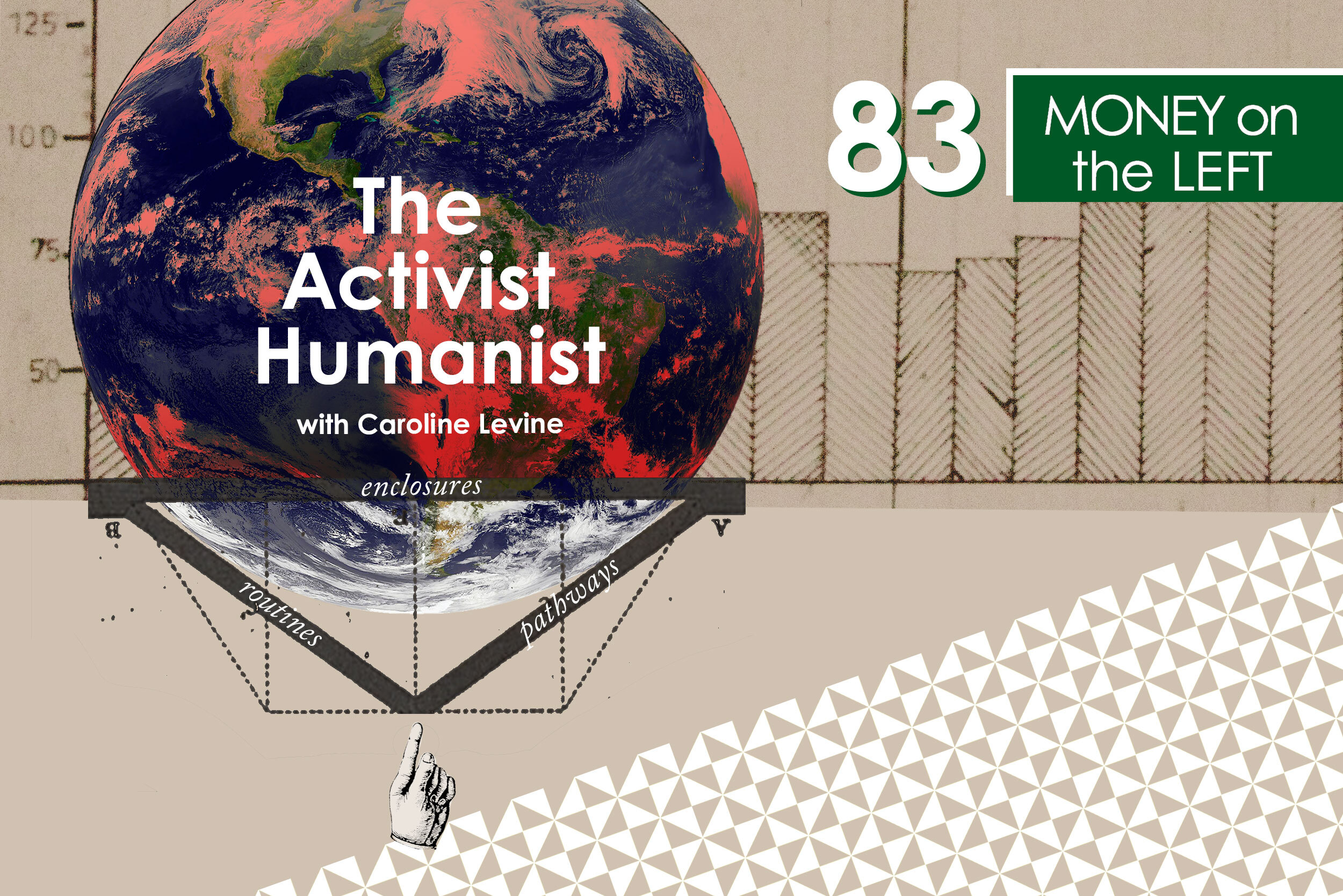
The Activist Humanist with Caroline Levine

We speak with Caroline Levine, Ryan Professor of the Humanities in the Department of Literatures in English at Cornell University, about her important book The Activist Humanist: Form and Method in the Climate Crisis (Princeton University Press, 2023). Building on the theory developed in her award-winning book, Forms: Whole, Rhythm, Hierarchy, Network, Levine’s The Activist Humanist redirects the critical capacities of formalist literary study to discover and mobilize the democratic potential of political forms thought by many on the left to be irredeemably exclusive, violent, and anti-democratic. Countering scholars in the environmental humanities who embrace only “modest gestures of care”—and who seem to have moved directly to “mourning” our inevitable environmental losses—Levine argues that large-scale, practical environmental activism should be integral to humanists’ work. For Levine, humanists have the tools–and the responsibility–to mobilize political power to tackle climate change. We speak with Levine at length about this project in an effort to move beyond critical gestures of dissolution and toward an activist formalism that moves constructively between politics and aesthetics.

See the Doughnut Economics Action Lab website for more information about the upcoming screening of Finding the Money mentioned in the audio introduction.

Visit our Patreon page here: https://www.patreon.com/MoLsuperstructure

Music by Nahneen Kula: www.nahneenkula.com

Transcript

This transcript has been edited for readability.

William Saas

Caroline Levine, welcome to Money on the Left.

Caroline Levine

So great to be here.

Scott Ferguson

We invited you to speak with us today about some of your recent work, about the social potentials of form across aesthetic and political registers. Maybe to set up this conversation, you can tell us a little bit about yourself, maybe your intellectual background, your training, and how you came to your more recent ideas and arguments.

Caroline Levine

Sure. I’d love to do that. I feel like my intellectual life is a little bit of a history of my discipline, or it’s a story about the discipline. I studied literary studies as an undergraduate in the late 1980s and early 1990s when deconstruction was all the rage. We were looking for gaps, which we called aporia, like watching language disintegrate and collide with itself. Everything was coming apart.

Then I went to graduate school at the University of London in England, where just about everybody was a Marxist of some stripe or other. So, I wasn’t doing this in order, but I was going from deconstruction to Marxism. I think I was particularly shaped by Birmingham School of Marxism. That’s people like Stuart Hall and Raymond Williams, who think about ordinary people as processing culture in interesting ways, as making cultural meanings, not just passive dupes of the culture industry, which is what the other big tradition in my field is – the Frankfurt School – where the culture is made at the top and it’s fed to you and you just take it in. I was much more drawn to the Birmingham school, but there was a kind of a problem that I felt like I wanted to solve. I worked at it for many years. That is, none of the models around me that were coming out of the humanities felt to me like they were accurately describing power.

We had, on the one hand, this kind of tiny, minute, textual reading, which people would say was powerful in some way because it would take apart binaries. I actually think that the rise of trans and non-binary sexualities has a lot to owe to that movement, so it did have a certain kind of cultural and material power. But Marxism was also always not quite satisfying to me, in terms of cause and effect, like what actually makes things happen in the world. Was it always materiality in the ultimate instance? I ended up trying to figure that out by way of this category of form, which across the arts once meant sort of the shapes and arrangements and organizations of works of art.

Like the composition of a photograph or the plot of a novel or anything that shapes or arranges it. So, it could be narration, or it could be rhyme, like lots of different things are forms. It seemed to me that what we do when we read literature is usually look at a lot of those forms in relation to each other. We look at rhyme and then we look at plot. Let’s say it’s a novel in rhyme. We’re thinking about those different forms interacting and they don’t interact perfectly. Sometimes they support one another. We’ll say, “oh, this plot is all about marriage and then the rhyme also brings couples into a nice relationship,” or whatever. I just made that up. But that’s one where they go together. There are many others where you say, “well, there’s this weird break in rhyme, it doesn’t quite work. What’s going on?” You know, we learn to read for the ruptures and the divergences from the main form. I was kind of grappling with, on the one hand, the question of form generally like, what if we look at all shapes and arrangements using the tools of literary study? Not just books and paintings, but also a school system or a seminar room or a public transportation system. Aren’t those also shapes and arrangements? That helped me to start to think about the relationship between works of art and social worlds, which was the thing I was trying to grapple with as I thought about power.

Does culture just reflect those social forms? Is it a product of a particular moment? That’s what most Marxists would say, right? So, culture comes out of a particular social moment. It seems to me that that wasn’t always true with literary forms. They were sometimes jumping across lots of different contexts, for example. Did they belong to a particular moment? That didn’t seem quite right to me. But if we see them both as forms, like if we see the literary forms and the social forms as shapes and arrangements, none of which has automatic priority over the other, we can come up with a different landscape of how power works.

The first place I went for the answer to this question was whether small forms can disrupt big ones, right? Could an art form actually undo a state or something like that? And I think the answer is no. But it was an interesting question for me. And trying to think about that question, like, “what do art forms do?” What kind of power do the forms themselves exert? I started to track something that I was a little surprised by, actually, given that formalism is a longstanding way of interpreting works of art, literature, and music, which was that pretty much everybody across the humanities was anti-formalist. Almost everybody was excited about breaks in form. They’re not excited about forms, but excited about breaks in form. I started to see the whole landscape of the humanities as being about rupture and disruptions on various levels. I was like, “okay, so everybody wants to break form, but what if forms are useful? And what if they don’t only work to contain us? Or maybe containment is itself not always a bad thing.”

I started to check for forms that are used both in social and political analysis and in artistic analysis. And those are holes, containers, which have been one of the biggest problems, seen as right wing forms. Right. So, like, the nation state is a bounded enclosure or the prison cell is a bounded enclosure. There’s a pretty long tradition of understanding literary forms like the sonnet as a room. Thinking about literary forms shape as being also like bounded enclosures. And my question was, are enclosures always wrong and bad? They definitely have a bad history. The enclosure movement is the beginning of capitalism as we know it, turning everything into private property that had once been commons and public property. But, one of the examples that came to me while teaching was the seminar room. We need an enclosed space in order to think and talk together. Otherwise, there’s bugs and there’s snow and there’s people coming in and out. If we think about enclosed spaces as also affording some good possibilities, we get a different account of the politics of form. So my four forms ended up being two that we usually hate on the left in literary studies, that’s whole and hierarchy, and two that we usually love, that is rhythm and network. I argued that we should love and hate all of them, that rhythms which we often take to be sort of organic and part of the body, we have the rhythms of the heart and the rhythms of walking. Those can also be put to use in terrible ways, like enslaved people forced to sing in order to work at a particular rhythm, for example, or music in factories was another common thing, especially in the 30s and 40s. So rhythm is not always emancipatory, but it also part of our lives everywhere. Our lives are structured by all kinds of rhythms, you know, work and sleep. Not enough sleep is one of those rhythms that I myself am most upset about. But also, do you exercise every day? Do you watch TV at a certain time?  Do we take a pill at a certain rhythm in our lives?

Just thinking about our lives are shaped by rhythms that are not only aesthetic. What does that mean? And then hierarchy was really my favorite one because I don’t think, as a leftist, I was ever going to be a person who would make a case for hierarchy. But I realized that I had been arguing for a really long time that equality is better than hierarchy. And what is that? That is a hierarchy. That’s a hierarchy of values. The idea of just one kind of thing taking precedence over another feels to me like actually one of the things we might fess up to on the left, that is we have values. We put human equality, for example, above certain kinds of individual freedoms. That’s a hierarchy that we buy into. I was also interested in the ways that hierarchies can upset each other and get in each other’s way, and they aren’t easily pulled together as we sometimes say in the humanities.

Scott Ferguson

Can I add something? On the left, we hate hierarchy because what we want is equality. I think another way that I’ve found it important to affirm hierarchy is a hierarchy of responsibilities. Right? So, we often think about a hierarchy of power, like “you’ve got more power than me!” As every Spider-Man fan knows, with power comes responsibility. And that’s not just like an afterthought. We need scale. We need people in organizations that have different scales and bits of responsibility and hierarchy as a form might be one way of thinking about that that’s not necessarily rigid or just flatly top down.

Caroline Levine

Oh, I love that example. Yeah, that’s a really lovely example. I talked to somebody who works in nonprofits who also said, “you know, when we think about hierarchies in an organizations, we usually think about power and money, but it’s also about what you can see.” At different levels of an organization, you have a different sense of how the organization works. A lot of my thinking on form was actually informed by being a department chair and realizing how the upper administration was working, how budgets were working, and how legal restrictions were working.

Scott Ferguson

And you had all these new responsibilities that weren’t just about producing monographs and making sure no one gets in your way.

Caroline Levine

And not that much power. As people point out, the department chair does not have much power. But to figure out how much power I did have, you know, what could be rearranged? What was possible to reformulate? So, yes, responsibility is a great way to think about it. So then, I kind of made the argument at the end of that book, Forms: Whole, Rhythm, Hierarchy, Network, that I thought you could make a better world using forms, but we shouldn’t avoid them. They’re kind of unavoidable. But we should think about which ones work better and work worse according to different values and different contexts. After I finished that book, people would say to me, “so how do you do that?” I realized I had a new responsibility, speaking of responsibilities, which was not just a call for this, “you know, let’s make a better world using form,” but actually to think about what does that look like?

That led me to the most recent book that I wrote, which is called The Activist Humanist, which I decided to take on. Speaking of hierarchies, I had to figure out what particular political problem I was going to think with, climate change seemed to me to be the one that had the largest impacts on everything else. Any other question that I had asked would be affected by climate change. And so how do you use forms to think about climate? One thing I really started to feel very strongly about and this has put me very much in the minority among humanistic thinkers, is that that urge to disrupt and to be open ended and to be subtle and to be questioning and to stop and kind of ponder our world – all of that – has actually gotten in the way of action on climate, because, in fact, big oil has wanted us to do exactly that. Doubt, delay, disrupt. And then we’ve got these authoritarian leaders around the world who are totally in love with disruption. We saw the tech industry, and then we saw Elon Musk move fast and break things. Do we really want to break things?

It seemed to me that on the left, one of our values has been actually to make sure that people have enough to eat, they have enough clean water, they have shelter. Like these are not exciting, subtle, interesting forms. They involve continuity and predictability and those were things that I started to really revalue and that changed pretty much everything about my research. So once I was like, “okay, I’m not all about breaking things anymore,” I started to think, “what forms do we need to sustain life over time?” Aqueducts were a pretty interesting example to me. They’ve lasted thousands of years carrying clean water to people. Almost all great water technology is thousands of years old, including flush toilets.

We don’t need something new. We just need it to be more equitably distributed. And there are societies that have equitably distributed water and they have forms to do that with. I spent some time in Morocco and in the countryside. A lot of Moroccan villages will divide up access to the river by times of the day in times of the year, so everybody gets equal access, for example. That seems great to me, but that’s a form and it’s constraining. Like you can only go to the river on Tuesdays between, you know, morning and lunchtime. You can’t use it at other times. You can’t irrigate from it at other times. It’s to say reevaluating containment as well as different kinds of forms to use for leftist ends.

William Saas

There’s a parallel that seems to be available to make or to draw or to observe between this kind of valorization of open-endedness in the critical humanities and defeatism is maybe one way to put it, but then also, maybe more troublingly, accelerationism. Let’s let the process play out so that we can end up with that space of open play and radical possibility.

Scott Ferguson

And the resources of that play or the energies of that play come from the accelerating dynamics of the very thing that you hate.

William Saas

Yeah. So I was wondering if you would comment on that. Also, there was a lot of therapeutic value in reading your book, and sort of rereading my own experience of being in the critical humanities and being with Money on the Left has been really affirming in the other direction. So, any more you can say about that. I know that we’re not interested in pointing fingers or assigning blame for where we are, but, oh boy, is that a possible thing that we could do.

Caroline Levine

Yeah, yeah. No, I really hear that. I mean, both my own sense of dissatisfaction too. “Wait, no, we have no plan.” We get to sit and wonder, and that’s pretty fun when you have the resources, but it’s super not fun if you’re being run over by the machines of extractivism and capitalism.

Yeah, I totally see that. As soon as I saw it, I started to get really bored of work in my field because I realized it was all ending with the soaring refusals to spell out the future. So, what I have discovered since is, I think, really powerful, which I do want to kind of take account of and recognize, which is that a lot of that kind of resistance is necessary. Right. We do have to take stuff apart. And that’s intellectually exciting and has some urgent purposes and I’ve learned a lot from it. But with the idea that, therefore, we should do nothing, I see it as both a humanistic problem across the humanities and a problem more broadly on the left of not wanting power. Because once you have power, you start to make choices that have consequences. Some of those consequences are not so great. But if you don’t take power, you get run over by the right, which is not worried about having power. They’re delighted to take power. Left pessimism, which is that kind of acceleration on the one hand and pessimism on the other hand, says “there’s nothing worth doing. We don’t have enough power to be able to stop capitalist extraction.” There’s a book that just came out this past year by Nathan Hensley in my field called Action Without Hope. He really says something like “all attempts to act in the face of climate change will simply be fed into the machine of capitalism.”

That sense that there’s no outside, there’s no position you could take that would be a genuine resistance. He ends up talking about typographical errors in 19th century poetry as the site of resistance. To me, that now really feels wrong, like it’s really in cahoots with the “don’t do anything, don’t stop anything.” I guess I have two further thoughts and apologies for going on and on, but it’s the Frankfurt School in the 1950s and 60s who I feel like they have the tightest hold on literary studies right now. It’s that notion that there really is this mass culture. It’s all about standardization and it’s all about instrumentality. So, it’s about taking every corner of your life; your entertainment, your sexuality, and putting that to some kind of use for a capitalist machine. To the extent that that was true in the 50s, and I’m not sure it was ever really true, I still have my Birmingham side, which is like “no, puppet culture also calls on people’s actual desires, their actual fears and longings and it may channel them in certain ways that are ideological, but there’s also something else in there, in a more dialectical way, that is giving us real pleasure for real reasons.” So, I’m a little doubtful about the original hypothesis, but I certainly think that that version of culture doesn’t hold anymore.

Our cultural platforms are so fragmented, and people are getting lots of different kinds of elements. They’re not getting one standardized version of culture at all. It hasn’t been better. I mean, I think in some ways a standardized culture was, you know, at least we talked to each other in some way. Now we’ve got this incredibly fractured environment and the accelerationists, I’m sure, are very happy about that, but I’m less so. But it’s hard to say, like, why are we still behaving as though culture is just one big centrist, normalizing framework when it just isn’t anymore? So that’s one problem with that version of both the left and of the humanities. The other one is, do we really think we have zero power? What tradition is that from? For Adorno, it really was like “thinking is the thing that has the most power.” Open thinking is what he calls it, and it’s not thinking towards instrumental ends. He was very critical of the 60s radicals because he was like, “oh, they’re just instrumentalizing, like everybody else, you know, putting action before thought.”

That’s okay, but I don’t think we live in a culture which prioritizes political action at all. I don’t think that’s the dominant culture of our movement. I think, if anything, you get involved in any issue to the just mildest center left all the way to the far left, and you will be vilified, you’ll be locked up, you will be doubted. That includes by other people on the left and so it’s not like we have this mass culture of everybody in the streets. We have a mass culture of everybody on their screens, which is a very different story.

Scott Ferguson

Yeah. It creates a vacuum of sorts that stimulates desire for action or what looks like action. That’s what Trumpism is giving us. Even as a pathological liar for whom every accusation is a confession, at least he’s shaking things up and doing things. Greenland is ours. It’s Gulf of America. We’re going to capture you in a van wearing masks. We’re doing stuff. I think those two things work together in unfortunate ways.

Caroline Levine

Absolutely. Yeah. That’s a very sobering point. Somebody just recently, I can’t remember who, was using the word sclerotic to describe democratic institutions. So, I guess that’s right. Like they get so crammed and stuck in ways that don’t do anything. That version of action is one of the reasons we’ve got these openings to authoritarianism right now. There is another version of action which the Marxist tradition knows a lot about. That is how you gather working people together to resist. There are a lot of people skeptical of that version of action, but I think we’re studying when that works and when it doesn’t and what forms in particular allow that kind of work to happen.

Rather than deciding from the outset that it’s not possible or if people are gathered, then somehow they will be constrained in a way – that’s a sort of libertarian leftist version. We’ve had these horizontalist movements in the last 20 or 30 years that have celebrated the idea that everybody belongs in every movement, and there’s no leadership and there’s no hierarchy. There’s another place where I think not all hierarchies are bad. It might be helpful to have some “let’s work together on an issue that we can solve.” So again, a formal question as much as kind of question of power or the two together.

Scott Ferguson

I’d like you to talk about some of the very specific examples or case studies that you work through in the book. Your training is in 19th century literature and you offer us a rather defamiliarizing reading of the 19th century realist novel, which you point out is sort of paradoxical because you’re trying to get away from defamiliarization as an end in itself.

That’s cool. But you’re also not rejecting deep familiarization either, right? You’re just saying that’s not the end all be all. That’s not where you put the period. I want to invite you to share with our listeners who haven’t had a chance to engage with your book what your reading of the novel and literary conflict and closure could mean or could afford that’s beyond just a kind of repressive mechanism, or a cruel optimism, as it were, to make us just be happy about the crumbs that we get.

Caroline Levine

The form that I study or that all 19th century novel people study and hate the most, probably of any literary form that exists in the world, is the happy ending. 19th century novels are famous for their happy endings, and not all of them have happy endings, but most of them do. And most of those endings are kind of ideologically representative of a particular bourgeois culture. You’ve got marriage and the household and reproductions. You’ve got straight white people in the house with money and that is often the end the story right there.

Scott Ferguson

And other people have to be jettisoned and die along the way.

Caroline Levine

Yes, yes. Good point. Right. So, if you’ve read Jane Eyre, then the madwoman in the attic has to be expelled for Jane to get her happy ending. It’s often queer people and people of color and poor people who have to be kind of shoved out of the frame in order for that happy ending to happen. 19th century scholars have spent a lot of time showing how that ending works. I think it’s been very persuasive. There is one piece of it, however, these days, having done this work on form, I’m always looking for the other affordances. If we say this is containing and repressive we’re practicing the habit of deciding that a particular form has a particular politics. I’m always looking for the other politics that’s possible in that form. I thought about my own being drawn to the 19th century novel as a young person and probably everybody has some image that comes from the 19th century novel of urban poverty. You’ve got Oliver Twist: waif on the streets, right?

That gave us that image of the child who is not taken care of by anybody and has to make their way in the world. So, I started to track what I now call plots of precarity, that is, the stories of characters who don’t have reliable food, shelter, wages. There’s a lot of those in the 19th century, not just in English, but in French, German, Spanish, Japanese. There’s precarity written all over modern, 19th and 20th century fiction. What do the endings of those novels give us? They don’t always give us marriage. They don’t always give us ownership of a house or property. What they always give us is a future of predictable food, water and shelter. To think about popular culture as offering people something that they actually want, I started to think, “yeah, lots of people are precarious, now. Why wouldn’t they be hungering for an ending that shows an end to precarity?” Of course, for women, this is complicated because in the 19th century, the end of precarity comes from marrying somebody who has money. That’s your only guarantee of not starving if you’re from a certain class. You don’t have any other options for work or inheritance of your own. The marriage plot is actually about this kind of material predictability, which I think is a real desire and not simply an ideological duping of an audience.

I started to look at happy endings in lots of different cases. One of my favorite examples in doing research for the book is Stone Birch Blues, which is often considered the first trans novel, by Leslie Feinberg. There’s a trans character who has been kicked out of multiple homes, can’t find stable shelter, and in the final chapters they actually get an apartment. I am going to say “they,” as they don’t use any of the updated pronouns in the novel, which came out in 1993, I think, or something like that. But they decorate an apartment, they make food, then they go to a union rally or maybe it’s a gay lesbian rights rally. They say, “we got to stick together because we have to make homes for each other.” So, it’s like the domestic plot, but writ large as, “let’s make homes for everybody.” Let’s not reject the domestic plot. Let’s think about how everybody should have access to that.

Scott Ferguson

Yeah. That’s great. And then you also carry this forward to a more contemporary Pulitzer Prize winning work of seeming nonfiction. But you track this form, this kind of realist form of the precarious plot and the potential happy ending to this work, Evicted. Can you talk about that twist in this tale?

Caroline Levine

Yes. Yes, I’d love to. It has actually been part of my work for a long time to move between aesthetic and nonaesthetic objects. Narrative, for example, is a form that you see in the novel storytelling, but you also see it in the court of law, and you see it in the doctor’s office, and you see it in gossip.

Scott Ferguson

What’s so cool about your approach is that it’s not base and superstructure. There’s not a real world that has real narratives and then there’s fakey secondary stories that are formal and that have to reflect or resist. You don’t flatten the difference between a nonfiction book and a 19th century realist novel and a closing argument in a court of law, but you also don’t fall into the standard ways of prioritizing one over the other as more real or more causally prior or something like that. Anyway, back to you.

Caroline Levine

I’m so glad you like that, because that to me is one of my favorite things about the kind of formalism that I practice. I don’t have that many takers for that.

Scott Ferguson

I took it!

Caroline Levine

You took it. Thank you for taking it. To use another literary and also Marxist term, and I’ve learned a lot from Anna Kornbluh, who is another deeply Marxist thinker on the left who’s interested in form. Every access to the world that we have is mediated by forms. Right. So, to say some are fictional and some are nonfictional is true. But if both use narrative, then thinking about how narrative works to allow us to see certain things about that world and not to see other things about that world seems to me just as interesting – both factual and fictional way of understanding what we’re understanding about the world.

Matthew Desmond Desmond’s Evicted. I think I read it just because it was being widely praised and I wanted to learn more about housing. I don’t know how many pages in – 30 pages in – I was like, “oh, my God, this guy must have read a gazillion 19th century novels.” This is one of the reasons this is such a great book, he has lots of tactics from the realist novel that really work to evoke precarity and particularly housing precarity. He tracks 8 or 10 renters in Milwaukee who are real people. He spent lots and lots and lots of hours with them. You start to really identify as a reader with these people who are doing their best and then the unfairness hits them and they’re out on the street again and it gives you this incredible punch partly because of the ways he narrates those experiences. I do some readings of the novelistic elements of it. But I was really struck by his two endings.

So, one of his endings is one of the most heartbreaking characters in the whole work, who is an African American mother of two who’s been evicted multiple times, and each time she’s evicted it gets harder to rent the next place. Her two sons are these wonderful, loving kids who probably don’t have a lot of hope for a better life. But in the last scene that Desmond narrates, the mother is saying, “I could just imagine you building a house for me, you sons, and all of us living together and laughing together.” It is like the end of a 19th century novel. It’s the home built by the children who are going to carry on the moral tradition of the mother, and she is just somebody who’s good and gets caught up in this terrible system. You have this ghost of the happy ending because she’s not going to get it and that’s tragic. Then you have a long, kind of epilogue where Desmond sets out policy prescriptions for housing vouchers and how we could, in fact, institute a system that would allow the characters we’ve come to love in the rest of the text to have stable homes into the future.

One of the problems with the 19th century novel, which I think novelists were pretty aware of, was that they could only follow one character. If you look at the end of Oliver Twist, he ends up happy but all the other workhouse kids have crappy futures. Oliver kind of says, “I wish I could save them all, you know?” The novel doesn’t know how to do that. It doesn’t know how to scale up, but policy prescriptions from a sociologist like Matthew Desmond does know how to scale up, he does know how to design a form that could create that. To me, that was this beautiful move between literary narrative forms and social forms for progressive ends.

Scott Ferguson

Thank you.

William Saas

What do you feel like the most common and maybe also the best or most compelling line of criticism or response to your work has been.

Caroline Levine

Yeah. I think you’ve hinted at two of the ones that I take most seriously, that come most often, and one is: if you do set out to remake the world for the better…

William Saas

Even modestly.

Caroline Levine

Even modestly, right, and maybe especially modestly. Let’s say you’re able to get a labor union going in your workplace or you’re able to redistribute labor, as I did as a department chair, so that it was more equitable. These are small and, we would say, not structural changes. Does that actually feed the right by mollifying us? That’s the accelerationist argument. We won’t get real revolution until people are at their most desperate. I think there’s two problems with that case. One is that: I look at the history of Marxist thought, and there’s multiple strains, but back in the Communist Manifesto, Marx says, “let’s go for things like free education for children as a way to build the left.” Large groups of people are mobilized by particular, local things that they can make better.

Rosa Luxemburg picks that up. They have detractors, but they also have a robust history on the left. So, is that true or not true? Once people are drawn into a movement for change and they “win,” do they then go home and say, “okay, I did my work, and I can rest for the rest of my life?” What seems to me to be truer, according to the data, is once you get involved in something, and especially if you win, you’re more likely to get involved in the next thing. In my life as an activist, I notice that if you go on a college campus and you try to talk to people about a particular issue that’s coming up, the same people will be active in trans rights and immigrant rights and in academic freedom and in the AAUP and they’ll be fighting for divestment. It’s because they’re the people who think, “you take action,” it’s not because taking action makes you passive. It’s because it seems like taking action actually helps to make you more active. I’ve been more persuaded by that side of things. it does seem to me true, again, in my own activist work, that the people who are committed activists often had something that pushed them into activism in the first place, and then they stay.

There’s actually really interesting work on the pro-life movement. I have also been criticized for using this because it’s a right-wing movement rather than a left-wing one. I think it’s interesting. What gets people involved in pro-life activism? A lot of people don’t have strong views on abortion before they get involved in pro-life activism. It’s all about the social world being welcoming. A neighbor says, “hey, come to a picnic,” or “come to this march with me” and you get involved, and then you get committed to the ideology. The social form comes first and then the intellectual form follows, or the political form follows. I think that is true for getting people involved in this kind of activism. I don’t think it’s a way of pacifying people. We tell way too few stories of victory and so people think activism doesn’t work when it does.

One of the stories I talk about with my students a lot is “ACT UP.” Talk about a movement that had far reaching consequences. Some of them, of course, are being rolled back right now, but many millions of lives were saved by ACT UP’s work in the 1990s. A lot of it was creative. A lot of it was in your face and some of it received backlash. Insurance exclusions for people with preexisting conditions affected just about every American. To say it failed or to forget about it or to say activism never works is to miss the ways in which these movements have long tails. We then take too much for granted, which is one of the reasons – to go back to your earlier point about deep familiarization – I do think we need to remember what we have that’s good and not only think about our society is completely immiserated and immiserating because there are good things. More access to health care is better than less. Yeah. It would be better if we didn’t have insurance companies at all. Yes, but this is better than what could be. So, you can hear my politics. I’m of the “it could be worse” persuasion in thinking about how we won these fights. We have a real aversion, and Lauren Berlant’s Cruel Optimism is a good example of this in literary studies, to ever telling a story about victory, because that is always said to be a way to somehow prop up the status quo.

I’m convinced it is exactly the opposite. The less you tell stories of victory, the less people want to get involved and the more powerless they feel, and therefore the more the right just rolls over us. So that’s one version of the story I’m working on right now. I’m trying to write about agency and to think about Marxist, post humanist and liberal theories of agency and what each of them has to offer and where each of them kind of comes up short. That’s one.

Back to your original point, though, which was a great question about the major critiques. The other is that I’m selling out the humanities because I’m turning towards these kind of instrumental plans and programs, like getting involved in action instead of sticking with the particular value of the aesthetic, which is open ended. By closing down that open endedness, I’m kind of saying, “let’s move over to the social sciences and away from the humanities.” I think I’m not doing that. I think the humanities resistance to action is not a necessary element of humanistic thinking, but it does seem to be for a lot of people. There are a lot of people who say, “once you cross that bridge from open ended thinking nuance and dissolution, you are in the realm of propping up the status quo.” This is especially true when you’re in the realm of doing that in the university, which right at this moment we need this kind of thinking more than ever.

I’ve been thinking a lot in regard to that. I don’t want to sell out the humanities. I do actually think the humanities aren’t doing what it could to be exciting to a lot of people. To my mind, one of the ways to draw people in is to say, “this could have an actual impact on making your life better, not just getting you to question things.” Though, I do believe in getting people to question things. But my own teaching has been really where I’ve been working this out the most. I teach, by choice, almost entirely non majors. I teach a lot of STEM and business students. Cornell is a very science-y place because we have an ad school and an engineering school, and arts and sciences is comparatively a small part of the university. I realize I teach much better if I go to the topics that the students are interested in and bring humanistic thinking and methods with me, then if I say, “you have to come to me.”

I haven’t taught Victorian poetry in like a dozen years because students don’t know what it is. They don’t know why they should care. They don’t. You know, those two words are not words students love: Victorian and poetry. What I have to do turns out to be what I want to do. It has become kind of a vocation for me. I think we’re better off not bemoaning the fact that students aren’t automatically coming to our classes and instead saying, “okay, you’re interested in renewable energies, how can humanistic thinking help you? Think again about that. Think about your position in relation to that.”

I just taught a fantastic poem by Juliana Spark called Dynamic Positioning, which is about the Deepwater Horizon oil spill, or BP’s oil spill in 2010. That’s a great poem. I had 30 stem majors working at that poem yesterday. I don’t think they were objecting at all. They were really using their brains and in a way that was enthusiastic. I don’t think I’m selling out the humanities. I think I’m doing the opposite. I’m trying to do the things that will keep us afloat and strong, and that has meant medical humanities, environmental humanities, thinking about humanities and business.

We have this famous hotel school at Cornell and the hotel students are basically business majors with a focus on the hospitality industry. I ran into somebody who worked in the hotel school working on undergraduate curriculum. I said, “so do the students talk about histories of hospitality. There’s so much interesting stuff in the Bible and philosophers who deal with hospitality.” She said, “they don’t even get a definition of the term.” So, I asked all my colleagues, some of whom work on hospitality, “would you like to teach a course to hotel majors?” They all said no. I was like, well, “I don’t know a lot about hospitality, but I sure find it interesting.”

Scott Ferguson

And it’s everywhere in stories!

Caroline Levine

It’s everywhere!

Immigration. Yes. Climate change, tourism…

Scott Ferguson

Motels.

Caroline Levine

Absolutely. We put so much energy as universities into orientations and welcoming people in. Hospitality is everywhere. What about the classroom and hospitality? It’s just so interesting. So, I developed a course and the hotel students who are in my other classes are often just checking off a box, like “I took a humanities course” and don’t seem like the most engaged students and often don’t get the best grades. In that class, they are 100% there. They want to think about every aspect of hospitality because they’re giving their lives to this, and they want to take it seriously. So, this is my message to the humanities, which I am told I’m selling out, but I’m like, “no, there’s 120 students in that class,” which is big by Cornell standards. Let’s meet them where they are.

Scott Ferguson

That’s great. I feel like you’re already going down this road, but I want to invite you to keep on walking. I don’t think it’s entirely fair to say that all recent left activism has been this way. But there is definitely, like, an impulse toward not only horizontalism, but also spontaneity. Your point is to say even spontaneity is a form and that might be contradictory in certain ways. There are also forms of organizing and you’re trying to give us a bit of a taxonomy of different kinds of organizing forms. So we’ve asked you about the realist novel, maybe now you can talk to us about some of the specific organizing forms with some examples drawn from your book or other research.

Caroline Levine

Absolutely. I’ve been really influenced by some very good political theorists thinking about horizontality. So, if we take Occupy Wall Street as an example, that was understood as a spontaneous kind of eruption. So, the two often go together. The idea being that everybody is welcome, there is no agenda, there’s no specific goal, everybody can speak and there’s no hierarchy in the organization. I think a lot of people found that heady and really exciting. I think there is something to what they sometimes call free figurative politics. You’re finally living in an equal world, and that feels amazing. I think a lot of people were actually transformed by Occupy Wall Street, and I don’t want to say it did nothing but the fact that it had no demands because it was open ended, deliberately meant that it was very hard to negotiate anything to say that there was a victory to do anything other than disband.

It still had a form, that is: Occupy Wall Street meant going to Zuccotti Park in downtown New York City, near Wall Street and hanging out there 24 hours a day. It was a spatial form. It was occupying a public space. I argue that we need temporal forms. We need goals especially if we think we can fight for them and win. Then we have the story of victory, which can build on itself. The civil rights movement is a great example of this, because it isn’t one movement. It’s a kind of cascade of movements. So, when Montgomery wins the bus boycott, that influences and excites people in lots of other communities to say, “well, we can win, let’s do that.” My model is different, but it imagines that a temporal form in the form of a goal is actually really important to movements. It’s important in part because it is the opposite of open-mindedness. So, if we constantly value open-endedness, we will miss the value of the organizing form of the goal, which keeps people going on a path which is often very hard and rocky.

Scott Ferguson

But this is another knotty word in the humanities: teleology. This is very Aristotelian, you know. In my college education in the 90s, that was one of the devils that I was introduced to. I’ve come around to appreciate teleology. It doesn’t always have to be terrible.

Caroline Levine

That’s right. That’s all I want to say. It doesn’t always have to be terrible. Sometimes it’s useful. We don’t just have to go pro or anti, right? We can see its possibilities. But it’s still true today that teleology is a word you can say as something to avoid without explanation or justification, which, that’s come to seem to me to be a case where whenever there’s a word like that, that’s the one I want to investigate, because that’s the word that’s carrying too much. That goes without saying. Teleology is one of the forms that I think is actually very useful for activist movements. I was very struck by the research, and I do draw in social science research. I also think there’s a lot of reasons to critique social science research. So, it’s not that I take it to be true always and forever, but I think it’s useful to study the forms that have worked and to think about why they have worked. Social scientists point out that people are most likely to get involved in activism during what they call a turning point moment in their lives. So, this is often when moving to a new place. Going to college is one of those moments. Retiring is another moment when people are like, “oh, I can take on new responsibilities now.”

You often see this in movements that very young people and retired people are often on the front lines, and those are the people who have more time and aren’t invested in the problem of keeping their jobs, for example. How do you reach people at their turning points? One of the things I worked on at Cornell was, and it’s had mixed responses and we’re still working on it, a little online module for all incoming first year students to think about Cornell and sustainability. There we get out some information that is otherwise hard to reach everybody with, like Cornell’s tap water is higher quality than bottled water and free. Maybe start out your time at Cornell thinking about the water.

In the module, we try to get them to look at all the climate organizations that are already going on at Cornell and to name three organizations that they might like to get involved in. We’re trying to get them to use that turning point moment to get involved in organizations that already exist. The other big problem for movements to be effective is scale. A small group of people can do a lot, but it’s a lot easier if you have a large group of people. I am always trying to get us in the humanities to think about scale because we’re very focused on particularity, the exception, the margins, and all of that is incredibly important to me, but not as a politics.

As a politics, I think we need to come together in ways that enact solidarity across movements. One thing in reading histories of activist movements that have worked, it seems to me that it very often hinges between preexisting organizations. You don’t just recruit one person at a time. You look at existing organizations, and you say, “can we bring this whole group into the project?” I think one of the problems we have in American universities is that students, when they write their application essays, have to prove leadership. Once they get to college, they think they have to start an organization or lead an organization. But actually, we just need a lot of foot soldiers. We just need a lot of people stuffing envelopes or whatever the contemporary equivalent of that is. If it’s not stuffing envelopes, it’s posting on social media or organizing town halls or whatever it is. We need a lot of people just doing the grunt work of showing up. What is it like to talk to people about how much time they have, what they’re good at, and how they can join existing organizations rather than having to invent something new? I’ve started to say in my activist recruitment, like, “if you have an hour a month to give, that’s valuable to any organization.” I think most people are really surprised because they think it’s an all or nothing proposition, “I have to drop all the things I’m doing.”

Most people have an hour a month. That feels manageable to a lot of people. So that’s a form, in the sense that I am trying to think about people’s busy lives. I have kids, I have a job, I have other responsibilities, how do I fit it in? Well, let’s think about what’s a reasonable amount of time and what kinds of things am I good at doing and like doing? Do I have to be the person who picks up the phone? No, I hate picking up the phone. I really don’t want to do that. Give me ten other jobs to do and I’ll do those for you. So, a lot of people think that activism is showing up at a march, but it isn’t. It doesn’t have to be that at all. It can be research and stuff like that. Getting people to understand how collective actions work is to get them to understand lots of different forms that aren’t just the visible ones that they see.

Scott Ferguson

I want to raise a question that I’m going to probably stumble around in posing, and it might not even be fully fair, because I don’t think, at least in the text by you that I’ve read, you’re actually taking this particular thing on, but it speaks to our position as sort of public intellectuals and activists of a kind. It seems like very often the examples that you’re giving about activist forms and working through in your work, for the most part, and you can correct me if I’m wrong, but for the most part, it seems like the social values driving the activism and the teleology of that activism are relatively self-evident. Now, there are exceptions like the pro-life activism.

They get people who are not even sure where they sit, but they throw a party and they’re really warm and inviting and you become convicted that that indeed this is my value. It’s more important than anything I’ve ever valued before, even though I didn’t value it last week. But for the most part, it seems like the challenge is: so many of us know, for example, the facts about climate change. So many of us know the realities of systemic racism. It’s just about getting off our butts and activating our labor power to coordinate and make change. That’s tremendous and wonderful. Our particular situation, however, is that we are actually trying to create a paradigm shift that is totally defamiliarizing.

We’re trying to say that money is a public utility. We’re trying to say that it’s not a zero-sum game, that it’s a public system that has been designed and can be designed different ways. It doesn’t have to be designed for private property and for private profit. It doesn’t have to be designed such that you rely on past revenues to finance the future. You can invent a crediting mechanism that is just full of futurity, it doesn’t matter what you earned in the past and that blows people’s minds. It scares people half to death. Often Marxists are freaked out about it. I’m not asking you to be our personal consultant and to solve our problem and it’s not like we don’t have answers. We’re trying our best. We’ve been at it for quite a while. It seems like that’s another challenge that’s a little trickier. It also braids the critical thinking and framing and rhetoric and the kinds of things we do really well in the humanities. It braids that in a different way with creating organizations and mobilizing people. I don’t know if you have thoughts about that particular problem.

Caroline Levine

It makes me realize why I love that project so much because it is so close to my heart. It’s a solution or set of solutions and ways of rethinking with practical consequences, that isn’t about necessarily smashing everything, but about using things in a much better way, which would have much better consequences. I absolutely love that. I did have the experience of telling my radical daughter about it, and she was like, “no, money is evil.” She’s a Marxist and I was like, “but wait, hold on a minute.” I see the climb and why it’s important. One thing that worries me a lot, and I spend time thinking about but not having any answers for is, “how many great projects are fairly complicated and so require attention and trust?” People are so bombarded with things that are scams and lies. What kind of context builds trust so that people can imagine actually getting involved or actually seeing how that works. So, Ben Wilson, who’s the first of the Money on the Left people I got to know, helped me to see how I could use that in my classroom.

I haven’t done it yet, but I’m planning to get real training on how to do that. That feels like, “okay, if we have a kind of thought experiment, experience, or experiential learning kind of model, I’ll get it and they’ll get it much better than if I just try to say it.” It has been one of my questions, because I always taught literature and it was really just about people in text. Then I realized, no, the real question is climate change, which I teach all the time. 96% of students at Cornell are worried about climate impacts. They are aware. How do they figure out how to act? That experiential learning, which is one of the things the quote unquote, neoliberal university loves, might actually be really useful. It doesn’t look like the traditional humanities, but it does look like learning in a way that I think people digest better and stays with people. I read these studies where you give an exam, and students retain something like 15% of it a year later. What are we doing if we’re just giving them content?

I love the idea of piloting this as a classroom project. But scaling it up is hard because you got to get your head around a lot of different pieces. I used to live in Madison, Wisconsin, and there was a joke among social scientists about the Madison effect that all sorts of scientific experiments worked in Madison, and that was partly like, “yeah, it’s a pretty progressive town and a lot of educated people.” The idea that you do an experiment is not in itself a weird thing, or that you think about things.

Scott Ferguson

And everybody is ready to play along.

Caroline Levine

Everybody’s willing to play along. How do you do that in places where people aren’t willing to play along? But again, reading about projects that work, one of my favorites that I’ve always wanted to try in the university is participatory budgeting, which works with really poor people with no political capital where they just have community and the experiences of the community. And it works. Designing it in some way that a small community can try it out and see how it works, that feels like the kind of model that could take off. I am just telling you what you guys think about all the time.

Scott Ferguson

We appreciate it. Just talking about it matters. Of course.

Caroline Levine

Yeah, right.

William Saas

I love that the language that you give us for it, affirmative instrumentality works really well for our project. Formalism for survival describes what we’re up to. Infrastructures for collective life is another. Money is a routine pathway and enclosure and you giving us different ways of talking about and reckoning with what we’re doing is super helpful.

Caroline Levine

I am so thrilled.

William Saas

Thank you.

Scott Ferguson

I am maybe working toward a conclusion. Who do you see as your fellow travelers? You named Anna Kornbluh. You name check her in the more recent book as having learned something from her. She’s been at the bleeding edge of this anti-disintegrative impulse that informs so much of humanities work. I’ve heard in the halls of academia that you’re part of the so-called New Formalism. I don’t know if that’s a thing. Do you wear that calling card? We’ve talked a lot about how you’re a lone ranger, and in many ways you are. But in other ways you’ve got community. So maybe just talk about that fellowship.

William Saas

I would throw into that mix Jody Dean as well, and work on the party as a kind of form.

01;10;47;07 – 01;11;24;05

Caroline Levine

I feel much less militant than Jodi Dean and Anna Kornbluh both. I am delighted for them to be thinking through these problems of collective forms and moving away from disintegration and so forth. I’ve had a lot of trouble being a full-blooded Marxist. I feel like I’m fully shaped by Marxism, and yet I end up not being in line with it. So, I do sometimes feel kind of intellectually lonely because Anna Kornbluth rightly says I have a really weird reading of Foucault in forms, and I do have a really weird reading of Foucault. I admitted that reading it. I think it’s a good reading of Foucault. Okay. That is, I learned from him about whole, rhythm, hierarchy and network. He’s got that mapped out in the middle of Discipline and Punish, as social forms that make us who we are. He then goes in a direction I don’t go in and neither does Anna, which is to say, all these forms converge to make one surveillance machine.

I think that’s not right, because that’s not how forms work. They continue to not go in sync with each other. But that middle part of Discipline and Punish still feels to me like the thing I learned maybe most from, and so there’s something a little weird about taking the middle of a Foucault book and splicing it on to Stuart Hall like that.

Scott Ferguson

But there’s also other parts of Foucault’s career where he’s Nietzsche in so many ways, and yes, I am definitely not a Nietzschean. But like in that sense of the generativity of world making I see that in Foucault. Maybe it’s not as developed in Discipline and Punish, and it’s developed in other places.

Caroline Levine

No, you’re absolutely right. Foucault was actually an activist. He worked in prison reform. There’s also that piece of Foucault. So, it’s just to say, who are the people putting these things together in multiple ways? Let me think of some of the people I really admire. There are many of them, but they’re motley. Rodrigo Nunes, who’s a political theorist from Brazil, wrote Neither Vertical nor Horizontal. He’s got a kind of theory of social organization that really works, I think. Political theory and cultural studies theory are not far apart. I feel like I move easily between political theorists and literary cultural studies theory people.

I keep going back to Stuart Hall. I really think there are whole portions of Hall’s thinking that are about the rise of an authoritarian right that I think we could really use now. Who else do I read and I’m just super excited? Teagan Broadway, who’s my close friend and Ben Wilson’s colleague at Suny Cortland, is, like me, a formalist who thinks across and between social forms and cultural forms. She’s been working on the question of the small group. She’s got four or five forms that she says, “we’ve thought of the nuclear family as the only kind of small group. There’s that and the nation and then there’s a big space in between.” What about the squad or the committee? These are smaller social forms that are also queer forms, she argues, made use of by, for example, ACT UP. We could use these forms as the building blocks of making bigger and bigger movements, because there’s too much space between the nation state and the family or the small friend group. There’s a lot of room in there. So, she’s somebody I read with great enthusiasm.

I think a lot of left economic thinkers, like Aaron Benanav, have a lot of practical solutions for thinking about economic equality and how we could redistribute money. Those are very exciting to me, and I think of those as formalists, even though they would not call themselves formalists. I do think I’m still fighting with a lot of literary criticism. I don’t feel perfectly comfortable in my department or my field of Victorian studies. I love to talk to people about the materials that we have in common, but even in my department, I don’t feel like I’m teaching things that other people are teaching. I’m not teaching the ways that other people are teaching. We’re not sharing our work.

Scott Ferguson

Well, I have to say, I’m disappointed and sad to hear that from you, but I think that makes these kinds of connection or hinges really important because it’s part of maintaining and finding continuities, finding an enduring spirit that is shared across disparate realms, maybe across a bunch of lonely people. We actually have community beyond our immediate contexts.

Caroline Levine

Maybe this sounds simplistic, but I think the left is my community. That is to say, I always want to talk to leftists about everything, like strategy and theories power. How do you organize and where are you and why do you think that? That’s my intellectual community, and a very rich one. It’s not always an academic community and intellectually, it’s not even always an academic community. I’m learning things that are different from what I would learn just by being in the library.

William Saas

That might be a good place to leave it for now, but, I think, Scott and I would agree that we look forward to more conversation. I thank you for joining us on Money on the Left.

Caroline Levine

It has been such a pleasure. Thank you for having me.

* Thank you to Robert Rusch for the episode graphic, Nahneen Kula for the theme tune, and Thomas Chaplin for the transcript. 

Why Credit’s Due: Reclaiming Pride in Boro

By Rob Hawkes and Robyn Ollett

The summer of 2025, like the summer of 2024 before it, has been one of heightened tensions surrounding the issues of race and immigration in the UK. This year, Union Flags and St George’s Crosses have adorned innumerable lamp posts, motorway bridges, roundabouts, and zebra crossings – ostensibly as expressions of national “pride” – following a series of anti-immigration protests outside the Bell Hotel in Epping, which had been housing asylum seekers. In late July and early August 2024, racist riots erupted in towns and cities in England and Northern Ireland, including in Middlesbrough (where we both work at Teesside University). The false narratives fuelling this combination of nationalistic fervour and xenophobic violence are that “illegal” immigrants to the UK are luxuriously treated at the expense of the “indigenous” population and that there is only ever an either/or choice between caring for “our own people” and providing basic support to those fleeing war, persecution, and/or starvation overseas. Underpinning these divisive myths is a pervasive logic of scarcity: there is not enough to go round.

This, inevitably, is also a logic of exclusion. If there is not enough for everyone, the only option is to leave some of us out. This, in turn, always means harming those who are already marginalised and perpetuating cycles of violence and disempowerment. Refugees and asylum seekers, disabled people, people of colour, LGBTQIA+ people, unemployed people and other benefits claimants all regularly face accusations of being a burden on or a threat to British society, or of failing to show sufficient gratitude or respect towards the supposed values and standards of the nation, or all of the above. Time and again, we are told that the costs of supporting the vulnerable must be met by “the taxpayer” (and note that “the taxpayer” is never themselves imagined to be among the vulnerable). Thus, the logic of scarcity and exclusion rests on a pernicious and demonstrably false understanding of the UK’s money system. Meanwhile, misleading messages abound in the racist narratives that spread across social media, whipping up violence in our streets.  

In Middlesbrough, on October 18, 2025, we are hosting a free public screening of Maren Poitras’s documentary Finding the Money, which tells a very different story about money and taxation. This is the first in a series of events as part of Where Credit’s Due: Making Money for Ecosocial Justice, a project supported by Teesside University’s AHRC Impact Acceleration Account (IAA) and developed in dialogue with Boro Doughnut, Curious Arts, the Dorman Museum, and Money on the Left.

Debunking the famous lie “There is no such thing as public money; there is only taxpayers’ money,” Finding the Money demonstrates that the truth is the complete opposite. Following a group of economists who reject the conventional understanding of money, the documentary sets out the key ideas of the Modern Monetary Theory (or MMT) perspective. In the UK, as in the USA, taxes (and therefore “the taxpayer”) do not pay for public services. Currency-issuing governments create money whenever they spend. As counterintuitive as this may sound when we’re so used to thinking of governments as budgeting just like households, there is such a thing as public money and public money belongs to everyone. Moreover, all money is credit, and credit is due to more people and more places than the present logic of scarcity and exclusion will ever allow. 

We care passionately about our town and the people who make up our communities, so we are dedicated to taking action and helping people understand that, despite what politicians and journalists might tell us, there is enough to go around. As Kate Raworth affirms in Doughnut Economics (2017) “the design of money – how it is created, the character it is given, and how it is to be used” has major implications for the way we live our collective lives. What we need now is the political will to imagine and design alternatives to the current orthodox monetary system, which is based on and encourages these false narratives and zero-sum trade offs.

Our project seeks to build an intersectional network of like-minded people by gathering existing groups and rallying others to the cause of imagining and striving for new ways of designing, issuing, and sustaining the credit that our communities desperately need and deserve. Raworth’s book has inspired a global movement for ecosocial justice through the Doughnut Economics Action Lab (DEAL). The ideas are fairly simple: we indeed can meet everyone’s needs within our planetary boundaries if we reconfigure our perspective on infinite growth and design systems that work towards the goal of not just surviving but thriving within our ecological limits. Doughnut Economics, like MMT, fundamentally challenges the false choice created by the economic orthodoxy between prosperity and social inclusion. 

Recognising that Middlesbrough is a place where current credit flows regularly ignore or actively exclude those communities which are often the biggest contributors to local cultural and economic life – LGBTQIA+ groups, NGOs supporting refugee communities, and those supporting green initiatives – and we would like to explore what it would look like if public credit creation specifically sought to support spaces and initiatives that foster inclusion rather than division. We’ve seen riots scapegoating people suspected to have arrived on our shores by small boats. We’ve seen muslim friends and neighbours have their houses and businesses vandalised. We’ve seen children, families, and individuals scared to leave their homes or places of work or study. Then, in the aftermath of the riots, we’ve seen the people of Middlesbrough represented as “thugs” or as “half wits” too stupid to recognise the “idiocy” of smashing up their own town: division only sows more division. Queer communities, on the other hand, have long shown that pride is a celebration of inclusion, not the opposite. Meanwhile, as we affirm at Money on the Left and as the MMT framework helps us to recognise, money has never been as straight or as exclusionary as conventional wisdom would have us believe.

It is essential that we think about the ways in which we credit and represent our community and our town, as the stories we tell about our communities and the people that build them are intimately bound up with the way we account for them in monetary terms. If we allow racist, ableist, and classist narratives to shout the loudest, that has a direct impact on the self-worth of everyone in our community. It might, therefore, be helpful to unpack the ways in which the people of Middlesbrough have been represented to better understand the interconnectedness of aspersions visited upon those who live here, those who participated in last summer’s riots, and those who continue campaigns which feign nationalist pride while intimidating racial others. For instance, perhaps ironically, the term “thug,” which was repeatedly used to describe rioters, has racist origins: the Oxford English Dictionary explains that a “thug” once meant “a member of a society or cult of robbers and murderers in India known for strangling their victims.” Moreover, the OED notes that the term “may be considered offensive (esp. in U.S. use when used by a white person in reference to a black person […]).” Meanwhile, words like “imbecile,” “moron,” and “idiot,” which are regularly mobilised to mock rioters and racists, were once part of a system of organised ableist violence against people classified as mentally “defective.”

Reconfiguring recognition, taking pride in our community, and reclaiming our self-worth are central to our aims for this project and this connects our local efforts to the objectives and ethos of the Global Donut Days, a four-day, community-led festival, held online and in-person around the world in the days leading up to our first event in October. We hope to start a new conversation about monetary design and its implications in and for Middlesbrough, encouraging those who attend and participate in our events to imagine the possibilities for participation and inclusion that credit creation in, by, and for the people of Boro might open up. As the Money on the Left Editorial Collective recently proclaimed, “It’s Time For Complementary Currencies,” forms of community credit which, as Raworth puts it, can help us “become full participants in nature’s cycles.” By building an intersectional network of people to explore ideas around community currency and consider where credit’s due, we join a worldwide effort to foster regenerative and inclusive economies. We hope you will join us in becoming part of this broader movement toward economic systems that recognise the full range of human identities, capacities, and contributions.

Jim Crow to Trump: Reconsidering the Psychological Wage

by Will Beaman

W.E.B. Du Bois’s “psychological wage” has long been treated as a metaphor. In Black Reconstruction, he describes how white workers, denied meaningful economic uplift, found compensation in racial status. Many have read this as a bribe, or as a symbolic reward for class betrayal—something less real than money, but no less effective in dividing the working class.

That reading rests on a familiar split between the psychological and the material. Racial esteem appears as an illusion, set against the tangible structures of wages, land, and capital. Even more sympathetic interpretations tend to preserve that hierarchy: psychology may be powerful, but money is what counts.

But Du Bois’s phrase does not merely point to a parallel between money and status. It stages something more robust and flexible than a metaphor: an analogy. Not a substitution of likeness, but a choreography between forms. The psychological is not “just as real” as the material. It is staged as material across institutions.

This is not quite Du Bois’s own argument. He did not frame whiteness as a currency, nor was he writing from a theory of endogenous credit—that is, a view of money as something issued, distributed, and coordinated from within social and institutional life. But his formulation invites such a reading for those who are looking for it. This is a reparative approach: not an attempt to retrofit Du Bois into a monetary theory he did not share, but to extend the intuitions that his concept makes available to us, and to trace how they resonate within a broader politics of credit and recognition.

The psychological wage, on this reading, is not a stand-in for economic life. It is one of its currencies: a system for distributing value, legitimacy, and access. It operates within, against, and alongside the dollar—sometimes underwriting its effects, sometimes shaping them in more violent or distorted directions. Whiteness, in this frame, functions as a rogue issuance structure: a mode of provisioning that overlaps with official systems, but is never fully secured by them.

To trace this choreography is not to reduce value to a single structure or contradiction. It is to notice how value is staged and restaged across domains—how public life is assembled through overlapping genres of credit and belonging. Whiteness is one of those genres, and its wage is not a metaphor. It is a script, a system, and a currency. And it is improvised, rehearsed, and enforced in unequal measure.

Rogue Issuance and the Choreography of Credit

If the psychological wage is a currency, it is one that does not circulate on its own. Like the dollar, it must be issued, accepted, and reissued. Its legitimacy is never self-evident. It relies on rituals—public scripts that coordinate belief, recognition, and value across domains. What Du Bois observed was not just a compensatory self-image, but a system of provisioning: a choreography of credit that names, elevates, and withholds.

This is the sense in which whiteness acts as a rogue issuance structure. It confers permissions—who is employable, electable, presumed competent or harmless—and it denies them. It rehearses who can be trusted with leadership, housing, and grace. Its credit regime is rarely codified, but it is widely rehearsed and reinforced through credentials, reputations, and soft evaluations. It sanctions not only behavior but being, reinforcing a sense of deservedness through moral idioms like work ethic, family values, and lawfulness. Whiteness, as a set of public rituals, permits the dollar in some contexts, supplants it in others, and blocks it elsewhere.

To name whiteness as a currency is not to ennoble it, or to deny the fragility and violence of the value it provisions. The forms of receivability it sustains—access to housing, credibility, or bodily safety—are pathologically unstable, rooted in exclusion, resentment, and myths of deservedness rather than in durable public life. This instability is not a flaw but a feature of its affective infrastructure. As Du Bois recognized, it binds social life by staging threat and reward along racial lines. But whiteness does not merely console the dispossessed. It conditions value itself—including among the wealthy, who are often provisioned not with security but with paranoia, grievance, and moral license. Its currency scripts legitimacy through volatility and rehearsed threat, across contexts differently staged as privilege or precarity.

None of this occurs outside the terrain of the dollar, as this suggests. But the dollar itself is not a coherent entity. It is already a choreography: a composite of coins, notes, deposits, reserves, and credit instruments—issued across the balance sheets of banks, treasuries, courts, and municipal governments, each with their own histories, idioms, and institutional rhythms. It has never been a single thing.

Its seeming continuity is an effect of coordination—an aesthetic and procedural labor that must be sustained. Whiteness and the dollar, then, are not the same. But they are not separable. They pass through one another. From the redlining of neighborhoods to the algorithmic scoring of creditworthiness, monetary systems have always embedded racial logics of credibility and threat. The infrastructure of whiteness has helped determine which expenditures are seen as investment and which as waste, which lives are worthy of public guarantees and which are overdrawn by default.

To understand this convergence requires attending not just to violence and exclusion, but to narrative and form. Whiteness functions not as an illusion or conspiracy, but as a genre of continuity. It makes disjointed provisions feel seamless. It codes asymmetric inclusion as natural legitimacy. It smooths over the cracks between property, personhood, and security. In this way, it choreographs the alignment of public life with itself—not through mastery, but through the repetition of a script that demands constant performance.

And because that performance disavows and conceals itself, whiteness as a currency is always under stress. What whiteness stages as self-evident has to be vigilantly enforced, patrolled, and defended. It improvises stability by invoking threats and scapegoats. It requires moral panics and narrative resets to cover over its breakdowns. Its continuity is not a given, but a fragile project. And when its claim to stable continuity falters, its most invested participants improvise new affective infrastructures to make the pain go away. That is Trumpism. But before Trump, this logic of continuity has been traceable across diverse aesthetic forms: homeownership, suburban coherence, and the smoothing operations of narrative itself.

Staging Continuity

Whiteness does not operate only through force—it relies on form. Across the 20th century, institutions stylized continuity: mortgages, suburban zoning, credit markets, and municipal budgets did not just allocate resources. They offered genres of legitimacy. Financial scripts taught people how to live, while aesthetic scripts trained them to see value, coherence, and threat.

Homeownership was central to this process. As historian David M. P. Freund shows in Colored Property, federal housing policy did not simply grant white families access to homes. It constructed a credit-based infrastructure that linked whiteness to financial credibility. Banks, zoning boards, and insurance tables embedded racial exclusion into public finance. What appeared as market rationality was a selective choreography of trust—coded as neutrality, rehearsed as meritocracy.

Creditworthiness, in this landscape, became a moral genre. Beyond shelter, homeownership staged stability, future orientation, and civic belonging. It made whiteness appear prudent, deserving, and low-risk. Public life was organized around this appearance. And to sustain it, credit systems needed ways of managing discontinuity: foreclosure, disinvestment, labor displacement, racial integration. These ruptures had to be smoothed over or re-narrated.

That smoothing work did not begin with housing policy. Earlier techniques for managing discontinuity appeared onscreen, where the visual grammar of cinema trained audiences to perceive order in the midst of fracture.

The institutions of housing and credit were accompanied—and often conditioned—by visual forms that taught people how to recognize coherence where there was asymmetry. Chief among these was cinema. As the dominant narrative medium of the 20th century, film did not just depict public life—it organized its legibility. Its techniques of continuity editing taught viewers how to register coherence, resolve conflict, and align emotionally with dominant scripts of legitimacy.

These techniques were crystallizing across early cinema, but The Birth of a Nation (1915) gave them their most influential and violent expression. The film did more than mythologize the Ku Klux Klan as redeemers of white civilization—it showcased an emerging grammar of cinematic continuity. Techniques meant to weave spatial and temporal continuity like match-on-action cuts, establishing shots, and crosscutting were becoming common across the industry, but here they were marshaled to render racial violence as narrative resolution. Early narrative films often staged trials, domestic order, and mob justice, turning moral panic into moral clarity through continuity techniques that led viewers through an unambiguous and seemingly undoctored social world.

The grammar of cinematic continuity was not incidental. It mirrored and anticipated the grammar of white fiscal governance. Where mortgage finance aligned whiteness with financial coherence, cinema rendered racial violence as narrative closure. Together, these infrastructures naturalized the distribution of value and threat. They made racial credit logics feel intuitive: who deserves a home, who appears as a threat, who merits rescue or redemption.

Like all systems of credit, narrative continuity requires labor. It must be sustained, defended, and updated. When dominant scripts break down—through economic crisis, political rupture, or affective dissonance—new infrastructures rush in to compensate. Trumpism was one such improvisation: a recalibration of whiteness’s issuance crisis.

Trumpism and the Collapse of White Credit

By the time Donald Trump descended his golden escalator in 2015, the infrastructure of white credit had begun to buckle. The housing collapse of 2008 had already exposed the racial asymmetries baked into homeownership and finance. Many white homeowners experienced foreclosure for the first time—an experience long familiar to Black communities. And yet the fallout was not interpreted as a failure of whiteness’s credit regime, but as its betrayal. What followed was not a reckoning with that regime’s selective provisioning, but a furious attempt to reclaim its authority.

Trumpism emerged as a performance of that reclamation. Its aesthetic was not continuity, but improvisation. It did not restore faith in institutions, but acted out their collapse. Its power came not from restoring legitimacy, but from redistributing permission: who could speak, who could offend, who could disobey. This was a shift in genre. If whiteness had long functioned as a currency of propriety, responsibility, and quiet entitlement, Trumpism offered its rogue variant—a high-yield bond issued in the voice of grievance and spectacle.

Trump did not invent this genre. He inherited it from decades of white reaction and expanded it into a total aesthetic. His rallies resembled wrestling matches more than speeches. His governance was theatrical and erratic. His authority came not from coherence but from affective asymmetry—punishment without principle, entitlement without responsibility. He flipped the script of white creditworthiness. No longer the silent majority, his base became the loud minority: proud to offend, eager to humiliate, impatient with anything that delayed gratification.

Trumpism did not restore the psychological wage. It performed its inflation. What once operated through subtle cues and institutional choreography now erupted into spectacle. This was not a revival of confidence in whiteness-as-credit—it was its liquidation.

Yet Trumpism also revealed what whiteness had always required: staging, repetition, narrative, and rehearsal. Even its most chaotic expressions still followed a script about grievance, betrayal, redemption, and retribution. And like all currencies, it demanded belief. The improvisation only worked because it felt authorized. It gave its audience not new power, but the feeling of having never lost it.

What came into view in this moment was not the end of white issuance, but its reformatting. Trumpism did not undo the dollar. It did not replace the mortgage or the budget or the suburban imaginary. It added to them a new affective overlay—a vigilante infrastructure of vibes and vengeance, broadcasting its legitimacy through volume and pain.

The Tea Party movement began reissuing the psychological wage in a new fiscal and affective register. In the wake of the 2008 housing crash, white grievance congealed not around foreclosure itself, but around the fantasy that “undeserving others” had disrupted the moral logic of debt and reward. The Obama administration’s efforts to manage the crisis—via stimulus, bailouts, or mortgage relief—were reframed as theft from the “real” public: a racialized middle class whose creditworthiness had long been naturalized. Birtherism, with Trump as its most theatrical spokesman, extended this suspicion from the mortgage to the presidency. It questioned not only Obama’s origins, but the very legibility of Black legitimacy within white fiscal order. This was not yet Trumpism, but its grammar was already there: suspicion, spectacle, entitlement, and the demand to be visibly re-centered.

Trump did not introduce spectacle into whiteness; he made visible what had long been disavowed. Earlier forms invited white audiences to consume racial violence as spectacle in order to condemn it—reveling in fantasies of threat and punishment while insisting on their own moral distance. Trumpism recasts that enjoyment as its own justification.

That shift—from disavowed enjoyment to open indulgence—is not a departure from whiteness’s affective infrastructure but a symptom of its breakdown. Trumpism draws on fantasies long rehearsed in unconscious form, but restages them compulsively, as volatility, grievance, and spectacle become the means by which whiteness shores up credibility to itself and others.

But the improvisation did not come out of nowhere—and it did not arrive fully formed. It built on existing scripts of entitlement and threat, pushing them past narrative restraint into open-ended spectacle. What had once been managed through veiled cues and institutional choreography now roared through crisis aesthetics. The story no longer resolved; it repeated, frayed, and spiraled.

Trumpism and the Performance of Collapse

Trumpism did not restore the psychological wage. It performed its “inflation”—or at least, what felt like one. The term is often used to suggest that too much credit has flooded the system and eroded its value. But that is not how credit works. Value does not dilute from over-issuance alone; it breaks down when the systems that provision and coordinate meaning begin to fail. What we call inflation is often just that: a crisis in infrastructure, not in quantity.

Trump’s spectacle emerged in precisely this context. The longstanding infrastructures that sustained whiteness—housing, employment, national myth—had begun to collapse under their own contradictions. Epstein’s exposure did not just implicate Trump personally. It broke the script. It made visible the gap between permission and legitimacy, between continuity and the structures that had always provisioned it. Trump’s response was not to restore order, but to stage its unraveling as catharsis.

This was not a revival of confidence in whiteness-as-credit. It was a performance of collapse: flags, chants, humiliation rituals, and gaudy excess. The affective architecture of whiteness, long managed through understated cues and institutional discretion, now roared through spectacle. Not because whiteness had been devalued by overuse, but because its continuity could no longer be convincingly choreographed.

Like housing and like cinema, Trumpism attempted to stage coherence out of fragments. But where Hollywood once smoothed those fragments into a narrative of order, Trump leaned into the jaggedness. Scandal did not replace plot; it rose to the fore. Early narrative films indulged spectacle, exploitation, and scandal, but housed them within melodramatic storylines that gave audiences a way to feel unimplicated in those indulgences. Trumpism abandoned that narrative containment. The story no longer resolved; it repeated, frayed, and spiraled.

If the psychological wage was always currency, Trumpism was its dramatic foreclosure notice. Not a new issuance, but a desperate demand for back pay. The spectacle was not redemptive. It was an attempt to feel like something still backed that credit, even if all that remained was grievance and noise.

That script cannot remain the same. The infrastructure that once choreographed legitimacy through restraint and propriety now improvises through excess, repetition, and pain. Trumpism did not sever the provisioning of whiteness—it restructured it around performance, resentment, and spectacle. The credits are still being issued. The roles are still being cast.

Rogue Affect and the Aesthetics of Issuance

The fantasies of rogue issuance that simmered beneath mid-century white prosperity—always latent in the figure of the self-made man, the bootstrapped homesteader, the frontier entrepreneur—took on new affective labor during the neoliberal era, sustaining belief in whiteness-as-credit even as public imaginaries narrowed. After the 2008 collapse, these imaginaries found new institutional form in the rise of seemingly extra-institutional cryptocurrencies, which promised not only freedom from government but a sovereign infrastructure of value. These systems echoed white credit logics: exclusionary, performative, obsessed with authenticity and deservingness. Their fascist alignments sharpened over time, culminating in open grifts like Trump Coins—herrenvolk fantasy made liquid, a brazenly scammy frontier issuance of whiteness that made the scamminess the whole point.

The rise of crypto markets trading on “vibes” marks not the liberation of affect from institutions, but their rearticulation in unaccountable form. What looks like freedom from governance is really a displacement of it—reducing infrastructure to spectacle, and public trust to speculative mood. Affect has always helped coordinate credit, legitimacy, and trust—but within the racialized order of whiteness, it has been repeatedly disavowed: dismissed as mere sentiment when it surfaced outside sanctioned scripts, cast as volatility, mood, or threat. Crypto runs with that disavowal, converting scenes of trust and belonging into extractable fluctuations in sentiment.

Even on the left, affect is often prized for its escape from institutions—its ambiguity, unruliness, or refusal of legibility. But to treat affect as excess is to surrender its infrastructural power. What appears radical in its unruliness may unwittingly echo the right’s romance of unaccountability. Both suppress the need for accounting. Both rehearse an aesthetic of issuance that disavows responsibility. Crypto does not reject institutions; it reifies their coordinated exclusions as market outcomes, staging freedom as deregulated feeling and coherence as vibes.

The Next Script

The psychological wage was never a fixed promise or a permanent station. It was a fragile choreography—improvised, enforced, and rehearsed through everyday scenes of trust, threat, and belonging. Its power came not from what it was, but from how reliably it passed for something natural.

That reliability is faltering. Trumpism did not invent the breakdown; it emerged from it. As the institutions that once sustained white continuity began to unravel—housing, policing, media, civic order—so too did the ability to naturalize those provisions. What remains is not the absence of a script, but a scramble for new ones. A scramble to renew the feeling that one still belongs to something self-evident.

This collapse clarifies not only how whiteness operates, but what the concept of a wage might help us see. Du Bois named a structure of compensation and enforcement that was never merely symbolic, and never purely economic. He gave us a figure—a felt, distributed wage—that can be reread today as a clue to how value, legitimacy, and belonging are provisioned through institutional life. This essay has followed that clue, not to recover his meaning, but to build on its resonances: to reimagine the psychological wage not as a metaphor, but as a currency in its own right.

There is no undoing that history. But there is a responsibility that comes with knowing it. If whiteness has operated as a rogue monetary infrastructure, then refusing it means more than critique. It means building differently. It means designing public life with an eye toward recognition that does not demand erasure, toward coordination that does not require scapegoats, and toward accountability that is scripted through shared participation, with room for revision, complexity, and care.

A Forgotten Letter to W.E.B. Du Bois: Monetary Populism and the Scapegoating of Black Political Life

by Will Beaman

In July 1934, W.E.B. Du Bois received a letter from an Atlanta resident named Gus Reich. We are excited to share both Reich’s letter and Du Bois’s short reply below. 

A lay theologian and self-styled monetary reformer, Reich in his letter proposes a spiritual plan for economic renewal. He urges Du Bois to support a vision of Christian financial reform led by the Black church. Condemning the interest-based banking system as “devilish,” Reich calls for a new kind of moral economy—one rooted not in gold or markets, but in collective virtue and spiritual confidence.

Du Bois responds with a single line: “The process of curing ills by printed money has been tried many times but never worked.”

It is a short exchange, but a revealing one. It surfaces a longstanding tension in American political life: Who gets to issue money—and under what terms? Reich’s proposal may seem eccentric, but it reflects something serious. It points toward an alternative to gold-backed or market-driven money, one where credit is issued as a public act, grounded in shared belief and moral purpose. In short, it imagines what many now call endogenous money—money that enters the world not from economic exchange or nature, but from institutional decisions and collective commitments.

But even imaginative ideas can carry baggage. Reich frames the Black church as a vessel for national redemption. In doing so, he risks casting Black communities not as equal participants in public life, but as moral stand-ins—invited to lead only when they can purify a broader system in crisis. In our reading, Du Bois’s response resists this framing. It is not necessarily a rejection of public credit itself (we hope), but of the burden placed on Black leadership to deliver redemption on someone else’s terms.

This moment makes more sense when seen through two overlapping histories. First, the legacy of Black-led fusionist coalitions after the Civil War. And second, the turmoil of Depression-era monetary reform.

In the decades after Reconstruction, Black Americans joined multiracial alliances across the South, including fusionist tickets that brought together Black Republicans and white populists like the Greenback and People’s Parties. These coalitions briefly held real power in states like North Carolina, pushing for land reform, public education, and voting rights. They were met with relentless opposition: not just Jim Crow laws and disenfranchisement, but racist violence like the 1898 Wilmington massacre. The memory of these movements, along with the political backlash they triggered, shaped how Black politics was perceived and enlisted in the decades that followed.

Fast forward to the 1930s: the U.S. had abandoned the gold standard at home and was experimenting with new forms of federal spending. But the role of money itself—how it’s created, who controls it—was still treated as a technical issue. Into that vacuum stepped a range of populist proposals. Some, like Reich’s, drew from moral and religious sources. Others, like those of Father Coughlin and Huey Long, veered into conspiracy and authoritarianism. Still others gestured toward the greenback tradition, but often fell back on old fears of inflation and dependency, sometimes thinly veiled in racial terms.

Reich’s letter reflects this tangle of influences. It combines spiritual populism with economic idealism, yet still relies on tropes about virtue, self-sufficiency, and moral rescue. Du Bois’s reply, we think, is not just about the feasibility of printed money. It is about the weight of these narratives—and who is expected to carry them.

That said, Du Bois’s position is not without its own limits. His skepticism about public credit reflects a broader intellectual tradition—especially among Marxists—that treats government-issued money as risky or false, especially when it is not directly tied to labor or production. While that tradition offers powerful critiques of capitalist violence, it also tends to echo Jacksonian suspicion of credit as unearned or parasitic. In doing so, it often misses how public credit has functioned historically: as a way to coordinate social life, not just to reflect economic output.

Du Bois, as always, is careful. But his reply reveals how even the most perceptive critics can find themselves caught between traditions—rejecting the burden of credit for an oppressor’s redemption without fully seeing the possibilities of credit as enfranchisement. Rather than dismiss his letter or take it at face value, we offer a reparative reading: one that holds Du Bois’s skepticism in tension with the deeper political insight his reply also contains. We interpret his response as shaped by a moral position grounded in historical experience—one that can, and should, be reincorporated into a renewed, critical monetary populism.

We share this exchange not to praise or dismiss Reich’s proposal, but to show why these questions still matter. At Money on the Left, we believe that reimagining how we provision public life is one of the central challenges of our time. That means taking bold monetary ideas seriously. But it also means paying attention to how those ideas are framed, and who is expected to redeem what.

Too often, communities already marginalized by economic crisis are recruited to fix it on someone else’s behalf. That is not enfranchisement, but deputization. And it risks reinforcing the very exclusions it seeks to overcome.

The same dynamics are resurfacing today. As Modern Monetary Theory (MMT) is metabolized across publics, its core insight—that money is issued into existence through political decisions—is being cautiously integrated across the ideological spectrum. But not all uses of this insight are emancipatory. Right-wing populists like Thomas Fazi, Tucker Carlson, and Marjorie Taylor Greene are already experimenting with expansionist monetary rhetoric to serve nationalist and exclusionary agendas. Their message is not that money is public. It is that public money belongs to “us,” not “them.”

This is why we argue that monetary politics needs to be contested from within. It is not enough to point out that the state can spend. We have to ask: for whom, through what institutions, and on what terms? The risk is not just bad spending. It is moralized and conditional spending—credit extended as a reward for loyalty and withdrawn as punishment for dissent. What could be more Trumpian?

In that light, the question is not whether we “support” endogenous money. All money is already issued endogenously before it is moralized as scarce commodities or white tax-dollars. The question is what kind of world it is made to sustain. Who is trusted to issue? Who is seen as creditworthy? Who gets invited in? And who gets blamed when the system cracks?

These are not idle questions. As Carlson and Greene turn toward Christian nationalism, using the state to draw lines between insiders and outsiders, they are improvising on old themes: using money to grant absolution to some and withhold care from others. The MAGA movement’s collapse—exacerbated by scandals like Trump’s attempt to shut down the Epstein scandal—has produced a frantic search for new conspiracies to stop the creeping sense of guilt and responsibility for Trump’s open cruelty. Monetary politics becomes one place to stage that search.

We have seen this play out before. In 1930s Germany, the Social Democrats rejected the WTB Plan for state-backed public credit, clinging to fiscal restraint. That created an opening the Nazis filled with their own vision of nationalist credit. Sound money did not save the Weimar Republic. It helped to end it.

If we want to avoid repeating those mistakes, we need to name what’s already happening. Public money is real. It is already shaping our lives. The only question is how—and for whom. We need credit infrastructures that are open, democratic, and resilient. Not credit as a judgment, but credit as a commitment. Not a test of worthiness, but a project of shared responsibility.

Letter from Gus Reich to W. E. B. Du Bois, July 4, 1934

Dr. W.E.B. Dubois

Editor, The Crisis

Dear Sir:

Enclosed I send you[r] clipping from the Epworth-High road, giving me your address & that of your organ The Crisis; when you find my answer correct, I suggest that you print it in the Crisis for the advancement of colored people & the benefit of all to the glory & honor of our Lord Jesus.

In that article Color Caste in the U.S. the writer adds up all the rights of the white man, which the negro lacks, but he offers no practical solution how to cure the dilemma with benefit to both & harm to none. 

The white man in U.S., especially the Southern planter suffered loss indeed, when they gave up slave labor & the South feels its hardships yet to some degrees; however that was a blessing from the Lord which He gave to Abraham Lincoln & helped him put it through, for without it, our Declaration of Independence would have been a lie indeed & of no lasting power, but for the colored race, this blessing from the Lord brought upon them a new duty which means thankfulness & service; have they found Him today? 

It is a fact that today the white man all over the world is in far greater distress than the negroes were at the time when the civil war started & nobody has offered a solution yet, faithful & true; when my following statements are found correct, I beg to remember that the truth comes from the Lord, thank Him & use it in His name.

Today’s depression which spreads over all countries, is not caused by nature; there is enough to eat & commodities for sale; scarce is only the money in people’s hands & the work with which they acquire it, & yet these people who lack this money today, are really the only ones who actually produce such value, with the work of their hands & the Lord’s blessing, while the other fellow, who keeps it today, has to get it from them first, to get hold of it; has to take eager care of it, that he might not loose it again & has to carefully tend to it, that they may not slowly work it off again & deprive him of it. 

That is the character of our money-foundation, our banking & credit, our interest system; it is all selfish, devilish—the only cure ? make it faithfully truth, brotherly-loving.

It is alltogether ridiculous to expect such a change however from men, who are accustomed to have prospered under the old system; the Lord wouldn’t give truth to them; it has to come from men who know their Lord better, who are willing to serve Him & use Faith & Truth in all their work & give Him the glory & when I propose to the colored mrace today, to announce to the World repentence & reform, faithful & true, it is an opportunity given to them by the Lord to prove to their white brethren their equality & earn their thanks. 

It is impossible to make our finances true, if we are not willing to be true Christians ourselves first; our various denominations do not honor our Saviour but mostly other men; even Martin Luther, though he pronounced his faith in one Holy Christian Church “was done more harm than honor they made that church lutheran.” To give glory to our Saviour, we must re-establish that Holy Christian Church” again, which the first Christians had & where they brought all they made & the church cared for them. 

That is another item our church lacks today & doesn’t exercise control over our banks, to make them work straight-true, but that does not prevent, that we have to suffer today from the consequences of our neglect & that is the cause of our depression; the real cure, the only one,  is to create a perfectly christian banking system, abandon all of the old one, it is devilish from A to Z & if the president & senate refuses, make it privately, it will be even more profitable & it is exceedingly simply, just use bank-cheques instead of gold & silver, accounts for currency; it will give everybody all the money he needs, make abnormal riches a burden instead of a privilege & will make crime & wars unnecessary & undesirable. Being given to me by the Lord, it will receive His blessings also & if put into action by the colored race, will certainly win them the admiration of their white brethren. President Roosevelt has asked already for criticism & suggestions, practically admitting his failure; only the Truth will last eternally & putting it into finances will change our whole life. 

Settling the war-debt question, we should give up our demands for them; wouldn’t need them anymore, but demand from our allies that they in turn give up their colonies & make the world free. We gave up slaves, they must do the same, it is either Christ or the devil!

Further details & information gladly furnished when wanted. 

Yours truly

Gus Reich

Letter from W. E. B. Du Bois to Gus Reich, July 10, 1934

Mr. Gustus Reich,
c/o Heywood Avenue, S.E.,
Atlanta, Georgia.

My dear Sir:

I thank you for your letter of July 4. I regret to say that I am no longer editor of The Crisis and therefore cannot publish your views. If I did, however, I would point out the process of curing ills by printed money has been tried many times but never worked.

Very sincerely yours

(Un)conditional Openness: Towards a Neochartalist Theory of Money and Trust

In this special episode, Rob Hawkes joins Scott Ferguson and Will Beaman to discuss his new article “(Un)conditional Openness: Towards a Neochartalist Theory of Money and Trust,” which was recently published in Money on the Left: History, Theory, Practice. The conversation traces the development of Rob’s long-standing interest in theories of trust from his doctoral research in literary studies towards an increasing fascination with the topic of money which eventually led him to MMT, neochartalism and the Money on the Left project. Rob recalls a jarring moment when, having become excited by the possibility of bringing MMT into his research on literature and trust, he realised that some neochartalists reject the idea that money is trust-based. Determined to think this relationship through in greater depth, Rob’s article reaches the conclusion that neochartalism demands a re-theorisation of the concept of trust itself. In this wide-ranging conversation, Rob, Scott, and Will work through some of the key moves the article makes, including the problematisation of barter-like theories of “calculative trust,” its consideration of the connection between trust and vulnerability, and the way trusting blurs the distinction between conditionality and unconditionality (as alluded to in the article’s title). Finally, the discussion addresses links between trust, the university (as an institution), and the uni currency proposal, and situates Rob’s work within the heterodox and heterogeneous interdisciplinary academic, para-academic, and extra-academic field that is contemporary neochartalism.

Visit our Patreon page here: https://www.patreon.com/MoLsuperstructure

Music by Nahneen Kula: www.nahneenkula.com

JAWS at 50: Birth of the Neoliberal Blockbuster

In honor of the 50th anniversary of JAWS (1975), we are proud to publish a 2020 lecture about Steven Spielberg’s film by Scott Ferguson. Far from a simple celebration, the lecture critically situates JAWS as the first genuine New Hollywood blockbuster and the originator of a distinctly neoliberal aesthetic that would come to dominate Hollywood for the next five decades. Ferguson explores the film’s influence on Hollywood, its innovative use of television advertising, and its role in establishing the high-concept blockbuster. The majority of the lecture, however, teases out the film’s profound aesthetic reorganization of Hollywood cinema. 

JAWS, Ferguson shows, employs a wide range of techniques, such as the “Spielberg face,” “God lights,” and what he calls the “quasi-diegetic” camera, which work together to create a sublime, immersive experience grounded in immediate physical relations. In this new aesthetic regime, abstraction is repressed, physics reigns supreme, and cinematic movement is reduced to zero-sum displacements of material forces and entities. Ferguson connects this immersive aesthetic to JAWS‘s narrative treatment of money as an essentially private, scarce, and politically unanswerable thing. In all, the lecture demonstrates how JAWS both expresses and contributes to a broader turn toward neoliberalism in 1970s America, revealing cinema’s role in shaping the economic and political imagination of an era.

Care After Structure

by Scott Ferguson

This essay accompanies After Structure, an exhibition curated by Mark Fredricks for University of South Florida’s Contemporary Art Museum, June 13 – August 2, 2025.

After Structure brings together works by Richard Tuttle and Mike Cloud to reconsider a notion that is central to modern visual art: structure.

The question of structure has long divided critics and art historians. Art is autonomous, says one tradition; its structure must be bounded, self-sufficient, and free from external contamination.1 Think Mondrian, Pollack, and Hirschhorn. Art should be integrated into everyday life, retorts the opposition. They point to Duchamp, Warhol, and Bruguera for whom structures are open, participatory, and receptive.2

After Structure transcends the terms of the dispute by foregrounding far-flung riddles of care.3 In doing so, it challenges what both sides unwittingly share: an attachment to the artwork’s physical location in the here-and-now. Commencing from the here-and-now compels art to choose: autonomy or integration, containment or exposure?4 Care, however, is omnipresent. Unlike structure, it concerns everything and anything, admitting no necessary trade-offs between inside and outside, near and far.

What, then, comes after structure? The exhibition answers this query by way of seemingly opposed strategies. At first glance, Tuttle’s series of encaustic monotype paintings on muslin appear woefully under-structured. Colorful splotches, smudges, streaks, and drips on white are delicately pinned to the wall, forgoing the solidity and support afforded by customary framing. On closer inspection, the apparent fragility of this arrangement reveals a highly structured configuration sculpted by precise drapings, curls, creases, and folds. Conversely, Cloud’s pieces give an initial impression of over-structuring. Painted mottles, figures, signs, and symbols spread across multiple strata of paper, photographs, cloth, and wood. In several works, Cloud deploys a superabundance of irregularly cut or broken stretcher bars to create criss-crossing patterns, borders, and frames-within-frames. With time, however, structural profusion gives way to systemic precarity, as compounding instances of overlap, mismatch, and imbalance imperil the art’s material and semantic integrity.

Richard Tuttle, Renaissance Unframed #21, 1994.
Mike Cloud, Body Builder Paper Quilt, 2010.

Through these inversions, Tuttle’s and Cloud’s works enfold structural insufficiency and excess into a single dynamic that construes aesthetic form as a problem of boundless care. Breaking with dominant models of structure, care circumvents eternal oscillations between openness and closure, unity and dissolution. It denies hard ontological boundaries, on one hand, and radical lawlessness, on the other hand. In After Structure, aesthetic saliencies, fissures, and edges admit no primordial exclusion. Smudges, crumples, and shards show little tendency toward disintegration. When Tuttle forsakes traditional framing, we discover quickly that any attempt to flee care’s responsibilities routes us back to fresh aesthetic quandaries and needs. In this deliberate destabilization, Tuttle compels us to consider: How else might we buttress social forms when customary supports become inadequate? When Cloud’s contributions multiply structure to the point of bewilderment, dozens of fresh vulnerabilities and hazards emerge that even the utmost care cannot master. In this labyrinthine complexity, Cloud poses a vital question: How to heed exigencies and complications that develop from fervid organization?

In this, care after structure demands a commitment to what might be called remote co-presence. Care is irreducible to proximity. Its forms do not merely circulate from one place to another. Its causal horizon requires no immediate displacements. To the contrary, care convenes meaning in disparate locales at once. Its forms engage non-adjacent events and concerns. Its causality encompasses the whole of collectivity. The mysteries of belonging–of joy as well as suffering–remain inescapably ubiquitous. Why should art proceed any differently?

In After Structure, care’s remote co-presence turns the conventional image of structure on its head. Take Tuttle’s series of twenty-five monotype paintings, tellingly titled Renaissance Unframed, which was completed at Graphicstudio in 1995. Visibly indebted to both Minimalism and Conceptualism, Tuttle’s frameless canvases lend painting’s surfaces palpable, even sculptural, qualities. Yet the works’ conceptual gesture is hardly unidirectional; it does not advance from flatness to volume à la Minimalism. From start to finish, surface markings diversely shape the muslin’s perceived texture, pliability, and weight. Reciprocally, each sculpted pleat, bend, and crinkle communicates from afar no less than Tuttle’s painterly inscriptions. It is not simply that the hand of the artist is forever absent. By relying on museum or gallery officials to carry out the artists’ detailed instructions for pinning, hanging, and folding, Tuttle’s canvases indicate that art depends on constant mediation at a remove.

It is tempting to read the heavy bronze floor sculptures that accompany Renaissance Unframed as stabilizing perceptual anchors for viewers faced with the uncanny origami of Tuttle’s painted fabric. It turns out, however, that these ponderous elements participate in mediations that are no less remote and playful. The sculptures are cast from a Styrofoam carving then coated with a jet black patina. Their contours recall the roughness of basalt, the igneous rock that Robert Smithson arranged en masse in his monumental land art sculpture, Spiral Jetty (1970). Yet the impenetrable density and smooth inner faces of Tuttle’s sculptures maintain the trappings of highly manufactured artifacts. The sculptures come in pairs, each half giving the appearance of having been sliced neatly in two. Although circumstances vary, installation guidelines instruct exhibitors to fit the two parts together and place them on the floor precisely one foot in front of each wall hanging. Positioned this way, Tuttle’s bronze sculptures at once activate and whimsically undermine minimalist phenomenology. With Minimalism, what Robert Morris once characterized as “the autonomous and literal nature of sculpture” puts into question the corporeal orientation and movement of artist and viewer in a manner that trades painterly illusionism for direct reckonings with a universal gravity.5 Minimalism, at least on this account, achieves art’s elusive dream of autonomy by contracting gravity’s all-consuming pull into a circumscribed arena—one where freedom emerges by leveraging inner balance against outward resistance.

Richard Tuttle, Renaissance Unframed #10, 1994.
Richard Tuttle, Renaissance Unframed #26, 1994.

When it comes to Tuttle’s floor sculptures, however, Morris’s “obdurate, literal mass[es]” become optical and signifying riddles, which mediate physical things and forces from the jump.6 The sculptures present a tripping hazard to viewers engrossed by the wall hangings—a subtle challenge to museum officials striving to balance aesthetics with safety. One wonders: Is litigation merely another medium in the artist’s toolbox? Tuttle’s instructions recommend the use of a compass to align the two pieces along the north-south axis of the exhibition space and, of course, the planet. In this sense, the pieces function as geometric points that, together, form a line that wraps around the globe. As a consequence, Tuttle’s sculptures simultaneously satirize and profoundly amplify routine museum safeguards—floor demarcations, signage, and vigilant personnel—employed to preserve artistic works. Where exactly does the essence of the artwork reside? When, if ever, does concern end?

With Cloud’s ultra-structured fabrications, After Structure turns care’s ambit toward persons, domains, and events that one will likely never know or experience in any direct sense. In contemporary parlance, the established term for such phenomena is “parasocial,” defined as one-sided and ostensibly imaginary relations with celebrities, influencers, or fictional characters with whom one has no immediate or mutual interactions. Social scientists and cultural commentators regularly evaluate the costs and benefits of parasocial relations. Parasocial investments can be beneficial in moderate doses, they claim. Yet because this discourse fundamentally pathologizes physical separation and unreciprocated feelings, purveyors of such reasoning fret that inordinate parasocial devotion is damaging to psychological well-being.7

Cloud’s work weighs questions of remote association from a more salutary vantage. Cloud does not assume an atomized subject, whose flirtations with real and make-believe strangers teeters dangerously between health and illness. Instead, his art affirms sociality’s wide breadth at the outset. From here, Cloud deploys what he describes as “a wide range of marks, symbols, motifs, palettes and forms” to query traumas and ecstasies, fascinations and repulsions. The resulting lexicon is singular, heterogeneously shared, and thoroughly social. Cloud reports that he is frequently inspired by contemporary news stories. Sometimes, he includes URL addresses for news sources within the compositions of works themselves. When Cloud variously problematizes and hyperbolizes structure, it is this captivating realm of parasociality that commands our attention.

Take Rabbit Quilt (2008), which treats mismatched pajamas as canvas and make-shift frame. The pajama bottoms display the queer children’s television character SpongeBob SquarePants in pirate paraphernalia. The tank top comes from U. S. illustrator Jim Benton’s cynical novelty brand, It’s Happy Bunny. It features a pink, smiling bunny flanked below by a less-than-clever slogan: “You are perfect–except for 9 or 10 things.” (More acerbic quips from the same line of merchandise include, “Hi Loser” and “You suck, and that’s sad.”) Here, Cloud joins top and bottom in a roughly hewn fashion to construct something like a quilt of 1990’s pop juvenilia, a cross-section of high-neoliberal commodity culture.

Mike Cloud, Rabbit Quilt, 2008.

Significantly, Rabbit Quilt’s central seam draws attention to micro-generational rifts between the inclusive zaniness of SpongeBob and the misanthropic irony of Benton’s black-pilled cutesiness. As a result, “tops” and “bottoms” (in multiple senses) bristle uneasily side by side. Across the textiles, Cloud paints an impressionistic calico rabbit in mid-sprint, which enmeshes the aforementioned rift in ‘90’s youth culture in wider historical thickets. Is this a primordial cave painting of a totemic animal that is spellbound by movement? Is it roadkill flattened pajamas-and-all by a careless semi-truck? Is it Br’er Rabbit, the anti-authoritarian trickster from the Afro-American oral tradition, later white-washed by Walt Disney’s offensive mixed-animation feature, Song of the South (1948)? The answer, of course, is an all-encompassing yes. Rabbit Quilt thickens parasociality’s historical dimensions. It ensconces us in intimate and ongoing entanglements from which no person is exempt. The artwork tenders no stock judgments. It intensifies ethical evaluation and political accountability as it stages a wide-ranging aesthetic inquiry into seemingly unrelated pasts.

Cloud’s most disquieting entries are his so-called “hanging paintings.” The hanging paintings comprise a series of triangular constructions from which dangle several off-the-rack belts that serve as nooses. These works include S of B (2016), Ames 2017 (2019), Uehara 2011 (2019), and Khan 2013 (2019). Cloud deems them portraits because they represent persons who died by means of hanging–though the works show only hand-written names rather than visual likenesses. Some of the paintings are group portraits, including multiple names dispersed across several wooden stretcher bars. As a consequence, the hanging paintings foster unlikely and sometimes unnerving associations among strangers, including museum attendees. Exemplary is S of B, which names Sandra Bland, the 28-year-old Black woman whose alleged 2015 suicide in a Texas jail was fiercely contested by protestors opposed to racialized police brutality. Yet it also identifies actor David Carradine, rumored to suffocate from auto-erotic asphyxiation, and model Cheyenne Brando, daughter of Marlon Brando, who took her own life after suffering years of neglect, abuse, and mental illness.

Mike Cloud, S of B, 2016.

The point, it seems, is not to flatten differences between heterogeneous social conditions. Surely Cloud, a contemporary Black artist, has little interest in forcing equivalences between Bland, Carridine, and Brando. The idea, rather, is to play up resonances across differences, such that what counts as death’s proper context is socially defamiliarized and reconfigured. With this, the social loss of Bland accrues a cryptic communal importance beyond the confines of an isolated Black history. It would require many more pages to do justice to S of B’s polysemic title, painted cubes and swirls, tottering rocket-like architecture, and uncanny correspondences, not to mention the manifold aesthetic and social connotations at stake in Cloud’s references to “hanging.” Even so, my sense is that none of this dilutes the singularity of death; rather, it deepens and transmogrifies hanging’s collective implications.

I would be remiss if, by way of conclusion, I did not draw out After Structure’s relevance for the present moment. Since January 20, 2025, punishing fiscal austerity and lawless state violence have lacerated communities, destroyed vital infrastructures, and undermined public trust both across the United States and around the world. The current administration operates under a fiercely zero-sum conception of structure. Because they presume that there is never enough to go around, the powers that be fortify structure to protect a chosen minority. Everyone else is forsaken as internal parasites or expelled as external threats. Alternatively, After Structure teaches that there is no outside; collectivity is replete with untold riches; and nobody can exhaust the unending enigmas of care.

Notes

  1. A contemporary defense of autonomy can be found in Nicholas Brown, Autonomy: The Social Ontology of Art under Capitalism (Durham: Duke University Press, 2019). ↩︎
  2. For a recent affirmation of the integrative approach, see Grant Kester, Beyond the Sovereign Self: Aesthetic Autonomy from the Avant-Garde to Socially Engaged Art (Durham: Duke University Press, 2024).
    ↩︎
  3. Scott Ferguson, Declarations of Dependence: Money, Aesthetics & the Politics of Care (Lincoln: University of Nebraska Press, 2018). ↩︎
  4. To be sure, aesthetic theory has articulated the central binary between autonomy and integration (or “heteronomy”) in complex ways. For Theodor Adorno, autonomy involves a contradictory gambit wherein art’s utopian impulse toward freedom is only realized when its aesthetic structure fails to perfectly cohere. Jacques Derrida taught us to deconstruct the “truth in painting” by unleashing unsettling interdependencies between inside and outside that frames of all kinds are called upon to contain. Philosophers of process and difference such as Gilles Deleuze prioritize flows of becoming that at once undercut and overwhelm structural boundaries. Still, even when avowing the porous, intertwined, and unstable, such discourses constrain structure within a restricted and zero-sum model of art that is grounded in the here-and-now. See, Theodor W. Adorno, Aesthetic Theory, trans. Robert Hullot-Kentor (Minneapolis: University of Minnesota Press, 2020); Jacques Derrida, The Truth in Painting, trans. Thomas F.H. Meck (Chicago: University of Chicago Press, 1987), Gilles Deleuze, Difference & Repetition, trans. Paul Patton (New York: Columbia University Press, 1995). ↩︎
  5. Robert Morris, “Notes on Sculpture,” Artforum 4, no. 6 (Feb. 1966): 42 – 44. ↩︎
  6. Robert Morris, “Notes of Sculpture.” ↩︎
  7. Thanks to Will Beaman for educating me about the anti-social assumptions inherent in the discourse of parasociality. ↩︎

Women in the Federal Arts Project with Lauren Arrington

We speak with Lauren Arrington about her forthcoming book on women artists in the Federal Arts Project. The Great Depression rendered 140,000 women and girls across the United States homeless. In 1935, Franklin Delano Roosevelt founded the Works Progress Administration (WPA) that employed 8.5 million people over the course of eight years. Soon, the WPA instituted a landmark ruling forbidding sexual discrimination. As a result, between thirty and forty percent of newly hired artists on federal projects were women. This equity of opportunity enabled women to rise to positions of leadership and have access to resources that had a lasting effect on national institutions and on the history of art. In her book, Arrington challenges the popular memory of WPA art as a story of straight white men. Instead, she argues that the works of art that many women created under the Federal Arts Project made visible Black, immigrant, and women’s lives in a way that challenged segregationist, xenophobic, and sexist structures intrinsic in the nation’s institutions.

During our conversation, Arrington explores the extraordinary achievements and tribulations of New Deal women artists and administrators. Among them include Alice Neel, Gwendolyn Bennett, Augusta Savage, Georgette Seabrooke, Lenore Thomas, and Pablita Velarde. Along the way, we track how these women and the Federal Art Project more broadly came under fire from local and national government officials who attempted to censor or suppress their radical work, to fire them from their jobs or force their resignations from projects, and to investigate them for “un-American” activity. We contemplate the challenges of writing histories of lost and often deliberately destroyed archives. And we consider the lessons of women’s participation in the Federal Arts Project for the future politics of public arts provisioning.

Lauren Arrington is Chair and Professor of English at University of South Florida.

Visit our Patreon page here: https://www.patreon.com/MoLsuperstructure

Music by Nahneen Kula: www.nahneenkula.com

Transcript

This transcript has been edited for readability.

Scott Ferguson

Lauren Arrington, welcome to Money on the Left.

Lauren Arrington

Thanks. I’m so glad to be here with you.

Scott Ferguson

I am so happy to have you here with me. We’ve invited you on the show this month to talk to us about a book that you’ve just finished writing and is in production and is not out yet. It doesn’t even have a title yet, although you’ve told me you’re floating some ideas. It is about women artists, diverse women artists, who worked and contested, and variously participated in the shaping of the New Deal arts programs.

Before we get into our discussion about your new book, I want to invite you to tell our audience a little bit about yourself; your professional background, what discipline you’re in, the kind of research you’ve done up until this moment, before we turn to this particular book project.

Lauren Arrington

Sure.  I’m a Professor of English at the University of South Florida. I grew up in Florida and came back about two years ago after spending most of my career in the UK, and most recently in Ireland. I did my doctorate at Oxford University and then just ended up staying in the UK by various good fortunes.

My doctoral research — I only belatedly realized — kind of set me on the course of the common thread that runs through all of my books. I was working on the question of government funding of the Irish National Theater and the impact that that funding had on the theater’s productions. I started out my career as a literary scholar, focusing mostly on Irish literature and then British literature.

The big kind of monolith in Irish literary history was that there was no censorship of the theater in Ireland, that it was a free theater, unlike the theaters in Britain, which had censorship coming from the Lord Chamberlain’s office. But that didn’t make a lot of sense to me, because if you’re taking state money, particularly from a government like the early Irish one that has a really strong ideological program, surely, they’re going to want some measure of compliance in the kind of art you’re producing. Can there really be free art when you’re taking government money?

I investigated that question and was able to turn up some new archival sources and show that actually there were private compromises and even instances of self-censorship from some really big players like W. B. Yates, who was a director of the theater. He is best known as a poet and was also a playwright. That rewrote the question of how state funding and the arts worked in the early Irish state. After that, my second book was about an Irish socialist republican called Constance Markievicz. Her last name was a Polish name because she married a Polish artist that she met in Paris where they were both in art school. Her movements in art circles in Paris and London and Dublin are what mobilized her to the politics which she arrived at socialist republicanism.

I was really interested in, after writing that biography, staying in the field of life writing. My most recent book was a group biography of poets including Yates and Ezra Pound, who were living in Rapallo, Italy, during the early years of Mussolini’s regime. I was thinking about the question of fascist aesthetics, how fascism in Italy took a very aesthetic impetus.

It was very different to German National Socialism and the way that certain ideas, particularly ideas about the past, were recovered and represented in art and in Mussolini’s Italy. I was thinking about the way that those poets were influenced by those aesthetics that were coming through the regime and being, in many ways, interpreted by Ezra Pound.

Most people think Ezra Pound is fascist. He’s arrested by the Americans and has a famous trial in the US. He goes back to Italy as soon as he can, gives a fascist salute, famously, from the boat. But most people don’t think about the poets who are visiting him and in his circle as having any kind of fascist orientation.

I was thinking particularly about the ways that those aesthetics were encoded in poetry that we might not really see. That was my book, The Poets of Rapallo, which came out in 2021 during the pandemic. The pandemic is actually where I started thinking about this book that I’ve just finished, which is going to come out with St. Martin’s Press, which is a division of Macmillan, in late 2026.

Scott Ferguson

The through line seems fairly clear. You’ve been thinking about how state finance variously inflects aesthetic production and social life. It would seem very natural that you would turn to similar questions during the New Deal in the United States. But maybe you can talk to us a little bit more about what motivated you to make this particular turn.

I kept wondering, were you thinking about this during the end of Trump 1.0 or did that come after?

Lauren Arrington

It was actually after the project began — which is kind of strange now to think about, given what’s happening on or in our federal landscape — but the project actually began in a moment of optimism.

Scott Ferguson

That’s what I was wondering.

Lauren Arrington

Yeah. We were living in Ireland, where I had taken a job at a university. It was lockdown, which meant something very different in most of Europe to what it meant in the US, particularly in Florida, where there were very few pandemic restrictions. In Ireland, it was about two years of restriction on social life.

During the depths of the pandemic, we couldn’t leave our apartment except to go grocery shopping once a week, and everyone was permitted to take one walk a day, but you couldn’t go further than a mile from your house. It was a very dark psychic landscape that most of us were living in.

There was, of course, also a very real economic impact and the Irish state saw this.  Politicians started thinking about the concept of universal basic income, which of course has been circulating for a while. In particular, they were thinking about how a version of that could be applied to visual artists, performing artists and writers in Ireland because there had been an immediate and detrimental effect on performing arts and visual arts, particularly with exhibitions closed.

There were no gigs, no concerts, no pubs even to play in. Book buying went up slightly, but then new books often went under the radar because there couldn’t be the kinds of launches that bring the media attention that, particularly, emerging authors need. The Irish state began a pilot scheme for artists and writers to sort of fund a base level of income in a way to compensate for those losses of the pandemic.

I was seeing all this unfold, and I was thinking about the New Deal. Why is nobody talking about FDR?  This is the precedent here. I started reading and doing research on the New Deal from my laptop because there were no libraries open.

Everything that I kept reading was turning up the very same story, dry history, post office art, rural programs, which were important, but seemed to be the only story. We’re all hearing about the Farm Services Administration. We all know Dorothea Lange’s photographs, the Dust Bowl migration murals that are kind of glorifying this American colonialist expansion.

I started going deeper and deeper. I was like, this can’t be all there was. Then I started reading about the community arts projects and community art centers. I started finding names that I didn’t recognize and digging as far as I could into various archives wondering, “who are these people?”

There were a lot of women, particularly women of color, communist women, Native American women, who had been written out of the historical record.  I thought I really wanted to tell their stories and not just the story of the arts projects again. I didn’t want to write another doorstop book about the New Deal.

I wanted to write a book that was focused on the lives of these women and how, in the midst of the depression, they found ways to live as artists and to keep themselves creatively alive, and the role that the state played in making that kind of creativity possible.

Scott Ferguson

Maybe we can pull back to the beginning of the New Deal and the very idea about financing the arts. How did that come about? How was it shaped at first? How was it variously discriminatory toward women and people of color? And how did some of those broader contestations play out?

Lauren Arrington

Right. We all talk about FDR as the architect of the New Deal, but actually the architect was probably Harry Hopkins. He was who did the real idea generation, we might say, and as for this aspect of Roosevelt’s presidency, he was his right hand and top adviser. Hopkins had this vision for this kind of national structure.

He invited Holger Cahill, who was involved in the early Museum of Modern Art, to think through this process. Holger Cahill tapped a woman called Audrey McMahon, who had started a pilot project to help fund artists in New York, where there was, of course, a high concentration of artists for various reasons.

For one, the nature of New York as an arts and cultural hub, also, the Great Migration, which brought new energy into the city and new networks and new kinds of artistic production. Audrey McMahon had piloted this program for artists in New York. Holger Cahill knew about it, so he invited Audrey McMahon to come to DC and talk about the idea.

Out of those conversations emerged the Federal Arts Project. McMahon remained a key player because she was appointed as director of the Federal Arts Project for New York which means that she has probably the most powerful position in all of the federal arts project because of the volume of artists that she’s dealing with.

She’s also a woman torn between bureaucracy and passion. She has a real passion for art. She is involved in the art education at NYU, which is where she starts this pilot project. But she also is an administrator and is constrained by the bureaucracy with which she is presented. She always has to make her budget.

In doing that, she’s forced to make some pretty harsh cuts at key points to the federal arts projects that are handed down to her. The artists don’t see that. They don’t understand how she’s squeezed between an idea that actually originated with her, although she doesn’t really get the credit for it and the pressures that she’s under that are coming from DC.

The Artists Union actually pickets her offices, which comes together in order to defend the right of artists to have employment and fair working conditions, and they advocate for those rights under the New Deal. They come to picket McMahon’s office. She doesn’t know what to do. She gets angry, I think, because she doesn’t feel seen or understood.

Because she’s an administrator, she’s automatically vilified as, like, a department chair.

As soon as you become an administrator, you’re like a baddie, right? No matter your intentions. She doesn’t feel seen. She gets really angry at the artists, at their inability to understand the economic constraints.  That the budget isn’t bottomless, right? There are only so many funds. But she does make some pretty big missteps.

One of those is understanding the way that racism is inherent to the structures of the New Deal. Despite what they’re saying in DC, it has a racist structure of privilege encoded in it, and she cuts black jobs first. She participates in that. Black artists then form their own union, which is open to anybody, but it’s primarily black artists, in order to lobby for that reinstatement.

And they actually have some measure of success and get jobs reinstated early on in the project. Soon those are eventually cut as the project is pruned and ultimately decimated as we head into the Second World War.

Scott Ferguson

I think for a lot of people, we imagine that when we think about the New Deal arts projects, we think there were some photographs documenting poverty in the Dust Bowl. There was a lot of easel painting of the so-called “American scene,” which were potentially, not only ideologically conservative, but also aesthetically conservative; not pushing beyond perspectival conventions that had been around since the Renaissance.

 I think we also have a sense of a certain kind of paternalism, which of course was there and so were the American scene paintings. In this kind of paternalism, or “Well, we’re just funding some art, and everybody does what they’re supposed to do and then it’s over.”

Whereas what your project shows us is that it was improvised and contested and messy and involved all kinds of creative triumphs, as well as horrible, horrible decisions and problematic organizations. I think one of the many impulses in this book that I really picked up on, and I actually regret framing this book at the outset as being just about artists,

is thinking about people in leadership roles, whether they are literally artists who are taking up leadership roles or are just variously taking up these organizing roles, because without that work there would be no artwork. I’m so fascinated by potentially even thinking about the aesthetic dimensions of what it is to organize, to socially reproduce.

What does it mean to have a school that teaches children how to sculpt, how to do printmaking, how to write poetry or whatever it’s going to be? And I love that you’ve introduced this right away. You can’t separate it. This isn’t just a story of some solo artists. It’s a story of a whole improvised apparatus of administrators and artists, and sometimes people cross roles.

Lauren Arrington

Absolutely. That was one of the things that made this book so hard to write because, like I said, I didn’t want to write a doorstop history of the New Deal arts projects. The challenge was how to convey that sense of collectivity among a handful of artists whose careers I wanted to highlight, and I began thinking about it as a group biography.

Folks were asking me early on, “How is this a group biography?” “Did they know each other?” You know what I mean? Because it wasn’t like the Bloomsbury Group where there were geographical constraints and a common artistic purpose, the sense of starting something new together and a lot of direct collaboration between these artists.

When you’re an artist, most artists are kind of working on their own. I allowed that to get in my head a little bit. Then I realized that actually it is a group biography because the structures create the group.

Scott Ferguson

And the groups create the structures. One of the moments that I love is when you’re talking about as the Harlem Renaissance is dying down and the depression is kicking up, Harlem starts to kind of create these new spaces that were actually, in certain ways, more based on group solidarity and were less beholden to white rich patrons who very much put their stamp on what would count as representations of black life.

Lauren Arrington

Absolutely. There was a real desire in Harlem, particularly, to get away from that legacy of the Harlem Renaissance as being the product of white patronage and a desire to advocate for black artists to be in administrative roles. Charles Alston is an important collaborator with Augusta Savage in that regard. He has a group that is more like a group called the 306 group, and they meet in what was an old horse stable in Harlem and have political conversations and conversations about art and conversations about the economy and conversations about what power means now.

That’s where we see this push against McMahon, and against the Federal Arts Project to instate more black administrators who have better salaries and better opportunities and to eliminate that kind of glass ceiling. But we know that there are tensions there, too, between folks who rose to prominence under the old order and folks coming up with a new way of doing things.

Even in Harlem, we’re seeing those kinds of tensions between the old guard of the Harlem Renaissance and new visionaries like Augusta Savage. Several of these artists, like Pablita Velarde is another one of those artists who we could talk about, who has to face challenges from within her own local network as well as challenges from the government apparatus in order to do the work that she feels compelled to do.

Scott Ferguson

Yeah, let’s switch to her because that pushes us across the country, right? They’re in a very different scene with a different set of political legacies, constraints, entanglements, and horrors.

Lauren Arrington

Yeah, absolutely. Pablita Velarde was a pueblo woman who grew up just north of Santa Fe. She, like Augusta Savage, shows talent as an artist from a really young age, but is constrained by social convention in terms of the role that she should play. Women in Pueblo culture were not artists, they worked with textiles. They should not be visual artists. Pablita Velarde is sent to a boarding school in Santa Fe where she, because of an early iteration of the federal arts project, is introduced to mural painting. Through that she is mentored as an artist and through those connections that she makes at her school, she is tapped by the National Park Service to make art for Bandelier National Monument, which is a big national monument under the National Park Service. It is northwest of Santa Fe and just south of Los Alamos, where the CCC, the Civilian Conservation Corps, had started, making this national park, and they’re now building a visitor’s center, and they realized they need some art for the exhibits. So, she is sideways funded through the Federal Arts Project to make that art there. But again, she’s faced with constraints about what the Park Service believes Pueblo culture should look like and her own direct experience of growing up under Tewa culture in particular.

Scott Ferguson

You suggest in the book that a lot of the dictates from the white administrators is based on relatively old and problematic, ethnographic research. There’s also the interesting twist that there are certain rituals or aspects of Native American life that perhaps shouldn’t be depicted in public, if I’m remembering correctly. There’s all kinds of constraints and challenges that she’s negotiating.

Lauren Arrington

That’s right, that’s right. Even within Pueblo culture, which is very much a Spanish invention, from one way of colonization of what is now the American Southwest, there are different cultures. Pablita Velarde grew up on Santa Clara Pueblo, which is a settlement of a group of people descended from the Tewa people who were absorbed into a more hegemonic kind of Pueblo culture.

There were particular dances that were not supposed to be witnessed by women. There are other dances that should only be witnessed by members of that culture and not subject to tourists. Pablita Velarde is torn between portraying what she sees as these beautiful, celebratory parts of her culture and the cultural diktat that those are private moments.

The question over whether she should portray that actually comes when she’s further along in the Bandelier National Monument project, because early on she’s basically prescribed paintings that have been or gleaned by employees of the National Park Service from reading ethnographic research that doesn’t even relate to her culture. They’re just being absorbed and purported to be like Tewa Pueblo dances, Tewa Pueblo traditions.

They actually belong to completely different cultures altogether. There is just this hegemonic idea of what, quote, “Pueblo culture” is like. She starts to push against that, to add her own levels of detail, and then as she’s given more agency in the project, she starts to develop her own ideas for scenes that she would like to paint for the visitor’s center.

Scott Ferguson

This might be a nice opportunity to plunge into some aesthetic strategies and details. Your book is filled with beautiful readings of various artworks of various styles. Do you want to talk about Velarde’s particular kind of aesthetic strategies with reference to one or more works that you unpack in the book?

Lauren Arrington

Sure. I want to talk a little bit about my visit to the archive where the paintings are held. The paintings are in Tucson at the Western Archeological Conservation Center, which is a division of the National Park Service. It took months and months and months for me to get a visit arranged to the conservation center. 

Scott Ferguson

Why was that? Was that pandemic related or…?

Lauren Arrington

That was staffing related. So again, if we talk about federal resources, when I got there I realized the issue, and some really helpful archivists explained to me that there had been various furloughs. 

Scott Ferguson

Austere staffing.

Lauren Arrington

Exactly, austerity staffing. Meanwhile, their inboxes kept filling up, and so it was only when I picked up the phone right before I was getting ready to head off on my archive trips that I was able to get through.

They were so helpful once I was there. So helpful. But one of the restrictions of the archive is that there were a number of paintings that I could not take pictures of because there had been conversations with the Tribal Council that they should not be reproduced. 

Scott Ferguson

For what reason?

Lauren Arrington

The images depicted should not be witnessed by Anglo people, folks from outside of Pueblo culture. So those ideas that Velarde was working with when she was making the paintings persist with regard to certain paintings. Her paintings are very a flat style of painting, which – in art history – was contested because it was very much imposed in a way as a Santa Fe style of painting drawn from an ethnographic primitivist view of what art from the region historically looked like and a desire, in a way, to perpetuate a linear history of a particular art style. There was an art teacher called Dorothy Dunn, who taught at Santa Fe Indian School, where Velarde was, that schooled the children in this particular style of painting.

When we are thinking about Augusta Savage and the freedom that students had in her studio to experiment with clay, there’s a kind of an inverse situation in Santa Fe Indian School where we have a white art historian teaching “Native American art” to students from the pueblos in the surrounding region who been steeped in that culture for their entire lives.

It’s very prescriptive, this kind of Santa Fe style, but it takes off. It’s very popular. It has a market, and that’s one of the reasons that these artists were encouraged to perpetuate the style as well, because it’s sold to tourists and we see Velarde making an income for herself once she finishes school, by being able to sell this art.

Scott Ferguson

I want to make sure that we talk a little bit about the challenges of this archive, which I can let you explain, but it’s rather slim for political and historical reasons. Maybe talk a little bit about why the archive is so slim and what kinds of challenges that you’ve faced in researching and writing, and how you’ve tried to get around these absences.

Lauren Arrington

Yeah. If I had known this book was going to be so challenging to write, I like to think I would still have written it, but I am not so sure. And let me tell you, my next book is going to be about someone who has left thousands of pages of archives.

Scott Ferguson

Yes.

Lauren Arrington

I am tired from sleuthing. Writing about underrepresented artists, you have those challenges of there not being the funding structures in place, perceptions of value that mean that their archives have been preserved. Sometimes we know that’s because of economic status, and sometimes that is because of structural racism. Sometimes that is because of the politics of the artists themselves, or what parts of their lives that they were not comfortable having preserved.

I’m thinking particularly here about an artist called Lenore Thomas Straus. Lenore Thomas, as she was when she was working on the project, was commissioned to create a series of friezes for the first planned town in the United States called Green Belt, in Maryland, just outside of D.C. 

Scott Ferguson

A proto suburb.

Lauren Arrington

Exactly. You can read about this in the book, but basically the whole project of these green belt towns were segregationist and Lenore Thomas fought against that. The kinds of scenes that she wanted to depict in those friezes were anti-lynching and anti-lynching sculpture that is censored.

But in relation to her archive, what I’m thinking about is that Lenore Thomas was queer. She had a lover, Sally Ringe, who she lived with in Virginia and then in Maryland. She was also a communist. She had two huge black marks against her in terms of the McCarthy era. Lenore Thomas’s archive, which exists in the Greenbelt Museum, curated by a wonderful archivist, Megan Sharon Young, consists of mostly photographs. Not letters and not personal papers. Just photographs of her and photographs that she took of her work in Greenbelt.

When I was writing about Lenore, I wrote mostly from photographs in order to understand things like her perception of the world around her. I could contrast the photographs that she took with official photographs from the New Deal agencies in order to understand how she was contesting those racist hierarchies of power as they played out on the Greenbelt site.

Scott Ferguson

Yeah. Can you talk a little bit more about that? One of my many favorite parts of this book is when you’re contrasting. What’s the name of the photographer who uses angles in a very racialized way? You read her photography and argue how she is pushing against that. Can you spell out these details that are still a little fuzzy for me to remember.

Lauren Arrington

Yeah, sure. Carl Mydans is one of the main photographers on the Greenbelt site. He’s probably who you’re thinking about, but in the whole photographic section of the resettlement administration, as it was called, and the farm security administration where Dorothea Lange works, they were taught a particular photographic aesthetic that played to what you were talking about earlier in terms of this white, paternalistic, colonialist American dream.

Firstly, Greenbelt was not a segregated work site. There were white workers and black workers on the site, but they were captured doing very different kinds of labor and photographed in prejudicial ways. Mydans photographed these white workers often from a low angle. You see them against these like clear blue skies; you can intuit it’s blue even though they’re black and white. There are clear skies, and these almost three-quarter profile portraits presenting this heroic portrait of upstanding American laborers. Right? The black workers are photographed from a high angle. They’re photographed by Mydans, and he’s obviously standing on something, a ladder or a truck or something.

He’s pointing the camera down and so you see the tops of their heads. You literally see them against the dirt. It is the opposite image for these black workers. That is deliberate, as we know from Dorothea Lange’s recollections of how she was taught to take photographs, how she was told to take photographs, which she pushed against. We also see, when you contrast with Lenore Thomas’s photographs, which are very much on the level in every way, you see how those politics are conveyed in those kinds of images.

I spent time thinking about the photographs and thinking about how Lenore Thomas shows us what she thinks and what she believes when she can’t tell us in her archive.

Scott Ferguson

Speaking of form, I am curious, I’ve never written a trade press book. For our listeners.  ,we’re academics, we usually write academic monographs in a scholarly rhetoric or frame. Different fields and subfields have their own customs and standards, but we all write fairly similarly in this mode. A trade press book, however, is for a popular readership.

That mode of address is supposed to not be scholarly, and it’s supposed to be a little looser and warmer and not everything is footnoted. I’m wondering, what was it like composing in that more popular mode? What kind of challenges did you face?

Did you learn lessons about your own voice and its range?

Lauren Arrington

Well, I guess the first thing I’d want to respond to is what I think is a misconception that trade writing is not supposed to be scholarly, but I think that that informs some conceptions about scholarly writing and what it is supposed to be like. I respect writers, it is a hard thing to sit down and write.

No matter what genre you’re writing, props for doing it. The kind of writing that I’m interested in is writing that is enjoyable to read and writing that strives to convey quite complex ideas like we’ve been talking about in terms of the photographic aesthetics, in a way that appeals to readers, in a way that also teaches. It teaches in such a way that we’re communicating as peers to readers, who are picking up books and opening them and wanting to learn. Not feeling like there needs to be a distance in the diction or the structure between the writer and the reader. Rather, we’re meeting on the page in a way that I can bring my expertise and what I’ve learned and communicate it to a reader who maybe never even heard about the subject but is interested, using language that’s easy to understand, that takes its time in order to explain big concepts if we need to talk about big concepts, we’ll usually dwell on that rather than just throwing out a term and expecting immediate recognition and then moving on or digging right down into the deep stuff, but instead, actually slowing down and thinking about what things mean. That’s one of the most enjoyable things to me about the process of writing this book has been learning to slow down and sit with an image,, a painting, a photograph, a person, a place, and write about it in a way that brings it to life to someone who’s never seen it or been there or shows something new about it to someone to whom it’s quite familiar. I was lucky to have benefited from The Robert and Ina Caro Award from Biographers International Organization to support research for this project. Bob Caro is the hero, really, of this kind of writing. He’s the genius behind this kind of biographical writing.

He talks about when he was writing his multi-volume biography of Lyndon Johnson, of going to live in the Hill Country of Texas so that he could understand the landscape and the people and the frames of meaning that Johnson grew up under. I could not go and live in Santa Clara Pueblo for a few years with my family in order to write this book, but I could travel there. I stood in the landscape, right?

I thought about what it means and my whole frames of meaning changed as a result. Writing this book changed me because I thought, when I was sitting in Dublin digging up names of artists I thought were interesting, that nobody had heard of them. Pablita Velarde was one of them and then I got to New Mexico and she was everywhere.

People refer to her by her first name, like, “oh, Pablita,” and her paintings are in the state house and she’s on license plates, she’s everywhere. It’s like, well, how ignorant were we to presume that Pablita Velarde was an unknown? I think that writing a trade book also requires you to think about other experiences and lives removed from your own and what amazing knowledge readers will also be bringing to the subject.

Scott Ferguson

That’s lovely. I want to ask questions about lessons. Lessons for today. Lessons for tomorrow. I will say that we at Money on the Left have been long advocates for a federal job guarantee that would be financed by the federal government and provide living quality work for everyone and anyone who wants it and can contribute to their community and not be threatened by unemployment.

It would include all kinds of benefits along the way. We are certainly advocates for the Green New Deal, which is not on everyone’s lips right now in the middle of an authoritarian takeover of our federal government, but we remain advocates for it. We hold out the dream and the possibility for a publicly led employment society that is financing interesting, wonderful, creative and inspiring labor that would include aesthetic labor. Usually, at least in the context of the history of the United States, the New Deal is, for better and for worse, the model. It’s the template that you have to reckon with.

It’s the precedent that you have to look to and decide what’s worth saving and what’s worth recuperating. I find your book to be really inspiring for that problem, for that project, because it shakes up our frames of reference, to use the term that you’ve been using. It makes the challenge of going back to the New Deal feel fresh again, rather than kind of stale or, just dismissing it as if it was all just white supremacy and paternalism. Or the opposite: that it was socialism in America and we had finally done it. I don’t know who actually believes that. I’m wondering, what are some of the lessons that you’ve taken away or that were maybe tacit or implicit for what this means for a future of politics, of state financing, of the arts?

I will say that, one of the threads that I picked up on, that we talk a lot about when we talk about the politics of the job guarantee, is the way that publicly financed employment, especially guaranteed employment, which we know these projects were not guaranteed at all, but especially guaranteed employment can potentially free up laborers, including artists, to not only experiment, but to extract themselves from abusive situations, whether that’s an abusive partner or it’s a controlling, white patronage class.

That’s one thing, for example, that comes to mind that feels like an important lesson from the stories that you’re telling. What else do we take forward from this past?

Lauren Arrington

I think one of the things that we have to understand, which is very difficult for folks who are steeped in the American psyche, is that these things take time. It takes time to build sustainable infrastructures. That was one of the problems with the New Deal arts projects, that there was this massive expansion and then a contraction and the resentment that came with that, and then a little bit of expansion and then the whole thing was scrubbed, basically, because of a need to invest in the war economy and to pivot the arts to the war economy.

I think one of the issues that we have in the US is the four-year — hopefully, what is still a four-year presidential term — and this false binary of the political landscape being either Republican or Democrat.

The four-year turnover means that when do you have time to actually build a program.  FDR had too many terms, one would argue, and exercised too much presidential power. This is really the problem and not a solution. It’s not really a lesson, Scott. It’s a question of, how do you build a sustainable infrastructure if you need to have a turnover in leadership?

The answer is that you require agencies that are not politicized in order to make these programs happen. That was also one of the issues with the New Deal is that all these agencies were tied so closely to FDR’s presidency that they couldn’t exist without him and Hopkins at the helm.

That leads me to think about the NEH, the National Endowment for the Humanities, the National Endowment for the Arts, and lessons that we can take there about the need to protect these independent agencies from the executive office and the need to preserve them, constitutionally or otherwise, in order to have a solid platform for the long term projects.

I was reading back and as I was finishing the book, the cuts started coming. I was trying to finish it at the end of 2024, and it was a slog. Then the election happened, and the executive orders started coming down, and it just really mobilized me to finish this book quickly because it felt like it had a new object.

There was a new context that I was responding to, and it just so happened to line up, unfortunately. But anyway, what I wanted to say is that the NEH was encouraged by scientists who were depressed and frightened by the possibility of nuclear apocalypse and the belief that in a nuclear age, with the rapidity of scientific evolution and the threat that that brought to our existence. The humanities were crucial to preserving our morality, our ethics, our sense of why it matters, what our value is. I am skeptical about whether 50 years later from the congressional testimony of nuclear scientists advocating for the National Endowment of the Humanities, if scientists and humanists can still find commonality because we have become so siloed and so intent on our own individual projects and our disciplines, but also, as individuals we’ve become so individualistic. Can we see value outside of ourselves that was there at the New Deal?

That was there in the 50s. I have a measure of hope that we can get there again, but it requires us to maybe allow ourselves to experience these apocalyptic moments like we had with the pandemic. A time when suddenly things are stripped back and you realize what matters in your day to day, right?

The people around you, your health, your well-being, your mind, you know? With the constant treadmill of the consumer cycle, the workday, the targets, when do we have time to think about these things? I think there are a few lessons there. One is to take back from 2020 or 2021 and how, a few years ago, our existence was threatened then and the imagination that was required to bring us out of it and how we can recover that and allow that to stay with us. That as soon as we’re comfortable, we don’t go back to business as usual. Maybe we require these outside threats to our humanity in order to prioritize our cultures.

Scott Ferguson

That’s a beautiful way to end our conversation. Thank you so much for coming on Money on the Left and exploring your recent work with us.

Lauren Arrington

I really appreciate it, Scott. Thanks for having me on today.

* Thanks to the Money on the Left production team: William Saas (audio editor), Thomas Chaplin (transcription) & Robert Rusch (graphic art)