Measure for Measure: A Shakespearean Defense of the NYC Tenants’ Rights Movement

by Antonia Marreroย 

On July 16, 2026, Mayor Zohran Mamdani gathered at the historic Tenement Museum alongside housing advocates and organizers to release New York Cityโ€™s landmark Rental Ripoff Report. Shaped by testimony from thousands of working-class New Yorkers during the citywide Rental Ripoff Hearings, the report outlines a package of 23 policy reforms designed to hold negligent repeat-offender landlords accountable, enforce basic housing conditions, and legally recognize tenant unions.

Taking the stage to deliver a powerful address was Antonia Marrero, an organizer with the 196 & 214 Rockaway Parkway Tenant Union and a member of Housing Organizers for Peopleโ€™s Empowerment (HOPE). In a speech invoking Shakespeareโ€™s Measure for Measure, Marrero likened the moral hypocrisy of powerful elites in 17th-century Vienna to the systemic abuses of modern corporate landlords, issuing a ringing call for tenant power, union solidarity, and housing justice.

Following the event, right-wing media outlets troublingly singled out Marreroโ€™s address for mockery, attacking her characterization of evictions as a form of social violence and deriding the press conference as a “freak show.”

We at Money on the Left reject this sensationalized right-wing framing. To claim that displacement, homelessness, and the state-sanctioned removal of families from their homes are anything other than violent is an exercise in bad faith. Eviction is not a neutral transaction; it is a profound act of physical, emotional, and social violence visited upon working communities. Housing is a fundamental human right, tenantsโ€™ rights must be fiercely protected, and tenant organizing remains our strongest defense against predatory landlord harassment.

Below is the full transcript of Antonia Marreroโ€™s speech, published here with her blessing.

Good morning, everyone. My name is Antonia Marrero, and I am thrilled to be a member of HOPE Tenant Union: Housing Organizers for Peopleโ€™s Empowerment. HOPE facilitates tenant unity, HOPE offers civic education, and HOPE insists on the high road, the path of justice and housing for all. I was honored to participate in this yearโ€™s Rental Ripoff Hearings, and I want to thank Michael Tiger, General Counsel of the NYC Department of Consumer and Worker Protection, who listened to my testimony and welcomed my questions with kindness. Mayor Mamdaniโ€™s Rental Ripoff Hearings will echo for generations–the way the lessons of this museum have increasingly resonated for generations.

When I think about HOPE, I think about Shakespeare. In the comedy Measure for Measure–set in Vienna, a city famous for its social housing–the character Isabella talks about the political machine. She says: โ€œ[A]uthority, though it err like others, hath yet a kind of medicine in itself, that skins the vice oโ€™ the top.โ€ Isabella, the novice nun, says: “[K]ings, landlords, bishops, judges, and inspectors, all these powerful figures โ€ฆ are subject to mistakes; but because they have power, their mistakes have little consequences, at least, little consequences to them.”

But Sister Isabella also says: โ€œGo to your bosom; Knock there, and ask your heart what it doth know.โ€ What my heart knows is that we are living in an epic chapter of history. An epic is not a romance, itโ€™s not a melodrama. An epic is the story of a new order. Our city is turning the corner on Tenant Power. When we organize, we win results. The Mamdani Administration is emboldening us so that we no longer tolerate the violence of evictions as a matter of โ€œbusiness as usual.โ€

My landlord owns dozens of buildings, but he is not a steward of public trust. In fact, it is the opposite. Since 2005, I survived three faulty eviction cases. I have lost three friends to eviction, two of whom lived on my floor, and for the past year, our supportive housing neighbors have been dissuaded from joining our tenant union.

But todayโ€™s report shows there is a path forward.

I am grateful for Mayor Mamdaniโ€™s leadership, the commitment to improving our housing quality and holding โ€œlow roadโ€ landlords accountable, and the commitment to having tenant leaders — not just real estate leaders — at the decision-making table. Mayor Mamdaniโ€™s Rental Ripoff Hearings will be remembered in the Book of Lady Liberty, whose torch beacons the homeless, the tempest-tost, to our shores, so the greatest cosmopolis of interdependent neighborhoods that the world has ever known will set a new standard of what humanity can achieve when we prioritize collaboration over dominion, when we prioritize love over profit.

See a video of the full press conference here.

Weird Epistemologies of Money and Trust in Fitzgerald, Ford, and Larsen; or, Isnโ€™t Money Weird?

By Rob Hawkes

What follows is a slightly expanded version of a talk I gave at the โ€˜Weird Modernismsโ€™ conference at Loughborough University, UK (1-4 July 2026), a collaboration between the UK-based British Association for Modernist Studies (BAMS) and the US-based Modernist Studies Association (MSA). โ€˜Weird Modernismsโ€™ brought over 400 delegates together in the midst of an escalating crisis in the UKโ€™s higher education sector (UKHE), which has seen multiple course closures, departmental restructures, and over 30,000 job losses in the last 3 years. Around the world, many academics face similar threats and much worse, and yet, at a time of rising authoritarianism and ecological breakdown, the critical capacity to think beyond the status quo that universities exist to foster and expand could not be more vital. My acute frustration with the โ€˜shrinkingโ€™ of UKHE[1] is that it is driven by a disastrous funding model designed according to the logic of what I describe in my recent writing as the โ€˜private money paradigmโ€™.[2] As Scott Ferguson and I wrote last year, the private money paradigm:

upholds the backwards idea not only that fiscal outlays merely recycle private pounds, but also that the public good is somehow a burdensome drain on scarce public resources. The result pits communities against one another in a struggle over limited finances and frequently does so along conspicuously classed, gendered, and racialised lines.[3]

As I hope to demonstrate in this essay, however, money is much weirder and more capacious than the austere and exclusionary monetary politics thatโ€™s now threatening the future of our universities (and much more besides) will ever allow.

At โ€˜Weird Modernismsโ€™, I shared these thoughts during a panel on โ€˜Weird Epistemologiesโ€™, chaired by Ruth Clemens and also featuring brilliant presentations by Anna Dijkstra and Graham Borland. My essay considers three modernist writers whose works are centrally concerned with sexual, racial, and classed forms of passing. In F. Scott Fitzgeraldโ€™s The Great Gatsby (1925), we learn of the transformation of โ€˜Mr Nobody from Nowhereโ€™ Jimmy Gatz into Jay Gatsby, a transgression of class boundaries that takes place in a novel where several characters, including the narrator, may also be straight-passing queer people.[4] In Nella Larsenโ€™s Passing (1929), Clare Kendry, a light-skinned African American woman, passes so successfully for a white person that even her racist husband is unaware of her background, and, in Ford Madox Fordโ€™s The Rash Act (1933), Henry Martin Aluin Smith, an American who has been bankrupted by the Wall Street Crash, and Henry Monckton Allard Smith, a British millionaire, switch places after both plan to commit suicide on the same day. Thus, all of these texts feature characters who assume, perform, or inhabit identities that may be regarded as deceptive, fraudulent, or fake. Nevertheless, each novel also complicates the epistemological basis on which these performed selves might be understood to be straightforwardly โ€˜falseโ€™ (or indeed โ€˜trueโ€™). Building on the claim recently advanced by the Money on the Left editorial collective that โ€˜money is queerโ€™, this essay adds the analogous observation that money is weird.[5] Here, I argue that Fitzgeraldโ€™s, Fordโ€™s, and Larsenโ€™s characters encapsulate and express moneyโ€™s epistemological weirdness, due in part to the way their performances both problematise and depend upon trust. Thus, while financial circumstances appear both to drive and facilitate the deceptive acts of Jay Gatsby, Clare Kendry, and Henry Martin Aluin Smith, they also point towards what I describe elsewhere as the โ€˜(un)conditional opennessโ€™ without which neither monetary tokens nor experimental novels could do the weird things they do in and to our worlds.[6]

Before I say more about the three novels already mentioned, I want to go back to the book Iโ€™ve probably thought more about than any other in the last quarter of a century. As it happens, I gave my first ever academic conference paper almost twenty years ago, in September 2006, at the University of Birmingham. At that conference, I considered Ford Madox Fordโ€™s The Good Soldier, beginning with this passage:

For who in this world can give anyone a character? Who in this world knows anything of any other heartโ€”or of his own? I don’t mean to say that one cannot form an average estimate of the way a person will behave. But one cannot be certain of the way any man will behave in every caseโ€”and until one can do that a โ€œcharacterโ€ is of no use to anyone.[7]

Two decades later, I continue to find this an endlessly fascinating moment in John Dowellโ€™s narrative and I think the reason for this is its epistemological weirdness. Famously, The Good Soldier is obsessed with the problem of knowing: can we really know other people? Did Dowell ever truly know the real Edward Ashburnham (the supposed โ€˜good soldierโ€™ of the novelโ€™s title)? In Fordโ€™s hands these questions also attain a metatextual dimension: what is the point of writing novels if we cannot know the characters that inhabit them?[8] Indeed, this points towards two ideas that are in productive tension throughout modernist fiction: a profound sense of the textuality of the self, its construction in discourse and its shifting unknowability, alongside the modernist commitment to descending deeper into the self than ever before, as exemplified by the development of the stream-of-consciousness technique.

It is with this tension in mind that I turn to Fordโ€™s 1933 novel The Rash Act. Prior to its publication, Ford described The Rash Act as: โ€˜the beginning of a trilogy that is meant to do for the post-war world and the Crisis what the Tietjens tetralogy [better known as Paradeโ€™s End] did for the warโ€™.[9] So, for Ford at least, The Rash Act was up there with one of his very best works and it was also very specifically about โ€˜the Crisisโ€™ (in other words, the Wall Street Crash of 1929 and the Great Depression that followed). Like Paradeโ€™s End, The Rash Act is a time-shifted, impressionist, and fragmented narrative which makes extensive use of free-indirect style. In another sense, however, The Rash Act is a quite simple prince-and-pauper fairy-tale in which Henry Martin, a โ€˜down-and-outโ€™ American, and the British millionaire Henry Monckton exchange identities after both attempt the rash act of suicide.[10] While Hugh succeeds in killing himself, Henry fails, but sustains a blow to his face which (along with the fact that the two look very similar) enables him to assume the otherโ€™s identity. This is from the moment just after Henry Martinโ€™s failed suicide attempt:

A voice said:
โ€˜This is Monsieur Monckton Smeez. . . .โ€™
Another:
โ€˜Vous ne le dites pas! . . . You donโ€™t say! I wish I had his money. But not at the moment his face.โ€™ […]
If he wasnโ€™t at the bottom of the Mediterranean he was at the side of a road under some plane trees and he had changed his identity.[11]

So, immediately upon being mistaken for Hugh Monkton, Henry is thinking in terms of changing his identity and money is already part of the equation.

Henry Martin writhed. […] He tried to say:
โ€˜You must not say that.โ€™ But they were binding his jaw over his head with a lint bandage. . . . After all he had wished to be Hugh Monckton. Now he was.[12]

This refers the reader back to a scene earlier in the book, when the two men meet for the first time in a Provenรงal nightclub and Henry experiences an intense desire to switch places with Hugh. However, beyond the fantasy of trading places that the novel appears to offer, it also asks typically weird modernist questions about identity and the self: two important markers of Hugh Moncktonโ€™s identity here are his money and a facial scar that he acquired during the First World War. During the course of his failed suicide attempt, Henry sustains a similar injury and is thus mistaken for Hugh. If he gets his money and also gets his scar, does this transform Henry into Hugh?

Nella Larsenโ€™s Passing, like The Rash Act, is a fragmented modernist narrative containing hermeneutic gaps, time-shifts, multiple ambiguities, and epistemological uncertainties. Ittells the story of two African American women, Clare Kendry and Irene Redfield, both of whom are light-skinned enough to pass for white. While Irene only passes occasionally, Clare is married to a wealthy white supremacist who does not know and would not take kindly to knowing that she has, in the novelโ€™s own terms, quote-unquote โ€˜Negro bloodโ€™.[13] Importantly, Clare, we learn, started passing in the first place to escape from poverty as well as from racism and so, like The Rash Act, Passing centres on a character who is motivated by money to take on or create a new identity. This is from the second chapter of Passing, as Irene and Clare discuss the topic of โ€˜passingโ€™ for white:

โ€œTell me, honestly, havenโ€™t you ever thought of โ€˜passingโ€™?โ€
Irene answered promptly: โ€œNo. Why should I?โ€ And […] hastened to add: โ€œYou see, Clare, Iโ€™ve everything I want. Except, perhaps, a little more money.โ€
At that Clare laughed […]. โ€œOf course,โ€ she declared, โ€œthatโ€™s what everybody wants, just a little more money, even the people who have it. And I must say I donโ€™t blame them. Moneyโ€™s awfully nice to have. In fact, all things considered, I think, โ€™Rene, that itโ€™s even worth the price.โ€[14]

Here, Larsen makes a very direct link between passing and money. The act of passing has apparently enabled Clare to get all that she wants in life (โ€˜what everybody wantsโ€™) but it also entails a cost: โ€˜all things considered […] itโ€™s even worth the priceโ€™. But, once again, there is also a sense that passing destabilises the categories and the hierarchies that both race and money have hitherto functioned to hold in place. Both novels, therefore, explore identities as discursively constructed, performed, and open to negotiation, contestation, and creative reimagining, while also placing money at the centre of their narratives of passing.

This essay is titled โ€˜Weird Epistemologies of Money and Trustโ€™ and there is, perhaps, an obvious sense in which the novels discussed so far raise questions to do with trust and/or trickery, given their concentration on characters who โ€˜pretendโ€™ to be people other than their โ€˜trueโ€™ selves. However, I would argue that, where questions of money and trust are concerned, these stories are about more than fraudulent and deceptive central characters. As I mentioned earlier, my recent work has made a distinction between the โ€˜private money paradigmโ€™ of mainstream discourse and the โ€˜public money paradigmโ€™, which my fellow members of the Money on the Left Editorial Collective and I advance in our writing and our activism. The private money paradigm dominates orthodox economic thought, teaching, and rhetoric as well as framing our political debates (see for example, the idea that a new Prime Minister needs the permission of โ€˜the marketsโ€™ to act in the public interest).[15] It insists that money originates in private exchange, that it is finite, scarce, and that โ€˜difficult decisionsโ€™ about who to exclude and marginalise must always be made according to the rules of โ€˜budget responsibilityโ€™.

This narrative of privation, limitation, and zero-sum binary choices is embedded in the transactional logic of exchange that we can trace back at least as far as Adam Smithโ€™s infamous claim that there is โ€˜a certain propensity in human nature […] to truck, barter, and exchange one thing for anotherโ€™.[16] And, indeed, despite there being no historical or anthropological evidence to support this view, most economics textbooks continue to explain that money is a โ€˜medium of exchangeโ€™ that emerged as a solution to the โ€˜double-coincidence-of-wants problemโ€™ of barter.[17] This, for example, is from Case, Fair, and Osterโ€™s widely-used Principles of Economics:

A barter system requires a double coincidence of wants for trade to take place. […] Some agreed-to medium of exchange […] neatly eliminates the double-coincidence-of-wants problem. […] Money is a lubricant in the functioning of a market economy.[18]

We can only speculate as to why the language of lubrication is so pervasive in economic writing, but it is echoed in Robert Putnamโ€™s influential Bowling Alone: The Collapse and Revival of American Community, where it is also associated with the concept of trust:

A society that relies on generalized reciprocity is more efficient than a distrustful society, for the same reason that money is more efficient than barter. Honesty and trust lubricate the inevitable frictions of social life.[19]

This is just one instance of a pervasive trend in the scholarly discourse on trust, which Iโ€™ve been tracing across a number of disciplines for quite some years now, and which frequently frames trusting in transactional terms as, if you like, a kind of barter system: Iโ€™ll trust you if you trust me back; Iโ€™ll trust you if I can be certain you wonโ€™t double cross me.[20] Here is another, even more recent, example from Philippa Ryanโ€™s Trust and Distrust in Digital Economies (2019): โ€˜Trust has proven to be integral to economic development and human security, because trust is central to exchangeโ€™.[21] My contention in all of this is that strategic, transactional, or, indeed, โ€˜calculative trustโ€™ is not trust at all;[22] and that a much better way to understand the concept is to think of it in terms of the openness to the other that Derek Attridge describes as essential to โ€˜responsible readingโ€™.[23] Indeed, as Iโ€™ve previously put it, the โ€˜openness to newness, strangeness, and othernessโ€™ (a list to which we might also add weirdness) that is โ€˜fostered and demanded by experimental fictionโ€™ (and, indeed, other works of art) is much closer than we usually think to the trust inherent in the acts of using and creating money, which entail both performative promises to pay and collective acknowledgements of interdependence: IOU or, rather, we owe one another.[24]

For the purposes of this essay, what I want to highlight is that, while there is a way of reading both The Rash Act and Passing as stories in which identities are exchanged in barter-like transactions โ€“ Henry for Hugh (which, incidentally, is the title of the 1934 sequel to The Rash Act),[25] and African American for white โ€“ and while this reading might also foreground the idea of trust โ€“ other characters must trust that Henry is Hugh or that Clare is white to enable them to pass โ€“ such interpretations would miss important aspects of these texts. Indeed, from our perspective at Money on the Left, the weird epistemologies and malleabilities that we find in modernist texts, when it comes to questions of identity and selfhood, are neither separate nor separable from public moneyโ€™s always-already ungraspable, capacious, and open-ended weirdness. So, however tempting it may be to conclude that, although Passing and The Rash Act complicate fixed ideas about identities โ€“ presenting them as shifting, ambiguous, and discursively constructed โ€“ they perpetuate an orthodox understanding of money as a realm of transactional zero-sum exchange, my colleagues at Money on the Left and I would say โ€˜whoa, hold on!โ€™

As I mentioned at the beginning, at MotL we have been affirming for some time now that โ€˜money is queerโ€™. As Scott Ferguson explains in his 2025 article โ€˜Analog Critique; or, Isnโ€™t Money Queer?โ€™:

By this, we mean not only that public money should be mobilized to serve LGBTQ2+ communities, but more profoundly that money as a social medium is never as straight or alienating as it feigns to be. Like language, moneyโ€™s many words, sights, sounds, smells and feels never communicate exactly what they intend.[26]

Even more recently, Lea Steininger has added, in an article published just a couple of months ago (and which I heartily recommend):

Just as sexual/gender identities are not fixed but constructed through discourse and power, so too are economic goods and services not stable, preexisting entities. [… M]oney itself is queer in the sense that it embodies polyvalent and contestable public structures and performances, which cannot be reduced to the narrow definitions offered by dominant economic ideologies.[27]

My contention here is that the weird epistemologies that we find in modernist fiction can help us to โ€˜think queerlyโ€™ about money in a number of important ways. Moreover, if it is better understood as (un)conditional openness, and not as calculative exchange, then the trust involved both in reading modernist novels and in creating money is much weirder than we may hitherto have recognised. The recent celebration of weird modernisms in Loughborough, then, demands to be recognised not just as an expression of the weird obsessions of weird scholars, but as academia fulfilling what Stefan Collini has called its โ€˜governing purposeโ€™, that of โ€˜extending human understanding through open-ended enquiryโ€™.[28] As โ€˜choreographers of creditโ€™, trust, and openness to newness, strangeness, and otherness, universities foster the very weirdness that the private money paradigm consistently fails to recognise, comprehend, or value.[29]

At the 2024 BAMS conference in Leeds, Scott Ferguson and I presented a paper on The Great Gatsby which we have since developed into a book chapter that came out in April this year in a volume titled Inflationary Modernities, edited by Wayne Stables and Kieran Brown.[30] In that chapter, we discuss this moment, when Nick meets Gatsby for the first time:

He smiled understandingly […]. It was one of those rare smiles […] that you may come across four or five times in life. […] It understood you just so far as you wanted to be understood, believed in you as you would like to believe in yourself, and assured you that it had precisely the impression of you that, at your best, you hoped to convey. Precisely at that point it vanished โ€“ and I was looking at an elegant young roughneck, a year or two over thirty, whose elaborate formality of speech just missed being absurd.[31]

Returning to this passage in preparation for โ€˜Weird Modernismsโ€™, I was struck once again by the way it exemplifies what Scott and I have described as Fitzgeraldโ€™s method of โ€˜impressionist accountingโ€™.[32] Nickโ€™s idea of Gatsby here wavers and blurs before his eyes so that, again, this is not simply a matter of โ€˜elegant young roughneckโ€™ Jimmy Gatz pretending to be the extravagant party host Jay Gatsby. Instead, Gatsby complicates and queers (or perhaps I should say weirds) orthodox understandings of gendered, raced, classed, and sexual identity while also offering glimpses beyond the private money paradigmโ€™s austere logic of exclusionary violence.

The image at the top of this essay is the โ€˜Weird Prideโ€™ flag, co-created in 2021 by autistic writers, advocates, and community organisers Fergus Murray andย  Quinn Dexter for the first Weird Pride Day (March 4th), โ€˜a day for people to embrace their weirdness, and reject the stigma associated with being weirdโ€™.[33]ย In Murrayโ€™s words: โ€˜Creativity is driven by divergent perspectives, and squashed by demands for conformity.โ€™[34] To conclude, then, I want to turn to the words of the neuroqueer theorist Nick Walker and to affirm that, by embracing what Walker calls โ€˜beautiful weirdnessโ€™, we can open up new possibilities not only for rejecting normative attitudes to identity but also for jettisoning the economic orthodoxies embedded in the private money paradigm. I suspect that every delegate at the โ€˜Weird Modernismsโ€™ conference was there because at some point in the past theyโ€™d been willing to approach the beautiful weirdness of modernist art with an attitude of openness and trust. As Walker explains:

[A]nyone can liberate themselves from the strictures of normativity. The already neurodivergent can reconnect with, and cultivate previously suppressed or undeveloped capacities, in order to more fully manifest their potentials for beautiful weirdness, and those whom we call neurotypicals are just potential neuroqueer mutant comrades who havenโ€™t yet woken up and figured out how to unzip their normal-person suits.[35]

My hope is that by embracing weird modernisms and by affirming, not only that money is queer but also that money is weirder than the austerity mindset thatโ€™s currently doing its utmost to destroy our universities, and indeed our planet, will ever be able to appreciate or contain, we can build a postnormal, inclusive and sustainable world and unzip our โ€˜normal-person suitsโ€™ (along with our normal-person monetary imaginations) together.


[1] I refer here to QMUCUโ€™s indispensable โ€˜UK HE Shrinkingโ€™ webpage: https://qmucu.org/qmul-transformation/uk-he-shrinking/

[2] See, for example, Rob Hawkes and Scott Ferguson, โ€˜Green-Lighting Gatsby: Austere Modernisms, Exuberant Avant-Gardes, and their Orgastic Futuresโ€™, in Inflationary Modernities: Literature, Culture, and Economy, ed. Wayne Stables and Kieran Brown (Palgrave Macmillan, 2026), 21-47; and Rob Hawkes, โ€˜โ€œToo paranoid for you?โ€: Suspicion, Trust and (Post/Meta?)Modern Money in Thomas Pynchonโ€™s Bleeding Edgeโ€™, in Dis/Trusting the Digital World in Imaginative Literature, ed. Adam Kelly and Katerina Pavlidi (Edinburgh University Press, 2026), 185-204.

[3] Rob Hawkes and Scott Ferguson, โ€˜UK Universities in Crisis? Time to Transform Higher Ed Financeโ€™, Money on the Left, 16 January 2025: https://moneyontheleft.org/2025/01/16/uk-universities-in-crisis-time-to-transform-higher-ed-finance/

[4] F. Scott Fitzgerald, The Great Gatsby [1925] (Penguin,1990), 123.

[5] Scott Ferguson, โ€˜Analog Critique; or, Isnโ€™t Money Queer?โ€™, Public Culture 37.1 (2025), 86.

[6] Rob Hawkes, โ€˜(Un)conditional Openness: Towards a Neochartalist Theory of Money and Trustโ€™, Money on the Left: History, Theory, Practice 1.1 (2025), 1-42. See also Rob Hawkes, Scott Ferguson, and Will Beaman, โ€˜(Un)conditional Openness: Towards a Neochartalist Theory of Money and Trustโ€™, Money on the Left, 4 July 2025: https://moneyontheleft.org/2025/07/04/unconditional-openness-towards-a-neochartalist-theory-of-money-and-trust-2/

[7] Ford Madox Ford, The Good Soldier, ed. Martin Stannard (Norton, 2012), 105-8.

[8] My first academic conference paper subsequently developed into my first academic publication, which was on this very topic. See Rob Hawkes, โ€˜Personalities of Paper: Characterisation in A Call and The Good Soldier โ€™, in Ford Madox Ford: Literary Networks and Cultural Transformations, ed. Andrzej Gasiorek and Daniel Moore (Rodopi, 2008), 43-60.

[9] Ford Madox Ford, letter to Ray Long, 2 July 1932, Letters of Ford Madox Ford, ed. Richard M. Ludwig (Princeton University Press, 1965), 208.

[10] Ford Madox Ford, The Rash Act [1933] (Carcanet, 1982), 74. For further discussion of this fascinating novel, see Rob Hawkes, โ€˜Trusting in Provence: Financial Crisis in The Rash Act and Henry for Hughโ€™, in Ford Madox Ford, France and Provence, ed. Dominique Lemarchal and Claire Davison-Pรฉgon (Rodopi, 2011), 229-42; and โ€˜Bogus Modernism: Impersonation, Deception and Trust in Ford Madox Ford and Evelyn Waughโ€™, in Reconnecting Aestheticism and Modernism: Continuities, Revisions, Speculations, ed. Bรฉnรฉdicte Coste, Catherine Delyfer, and Christine Reynier (Routledge, 2017), 175-86.

[11] Ford, The Rash Act, 212.

[12] Ford, The Rash Act, 211-12.

[13] Nella Larsen, Passing [1929], in Quicksand and Passing (Serpentโ€™s Tail, 2014), 158.

[14] Larsen, Passing, 160.

[15] โ€˜Andy Burnham would enter Downing Street already โ€œboxed inโ€ by financial marketsโ€™ according to a recent piece in the Guardian by Alex Daniel: โ€˜โ€œWalking a tightropeโ€: Burnhamโ€™s borrowing plans clash with fiscal realitiesโ€™, Guardian, 24 June 2026: https://www.theguardian.com/politics/2026/jun/24/walking-a-tightrope-andy-burnham-borrowing-clash-fiscal-realities

[16] Adam Smith, The Wealth of Nations [1776] (Penguin, 1999), 116.

[17] Karl E. Case, Ray C. Fair, and Sharon M. Oster, Principles of Economics, 10th edn. (Prentice Hall, 2012), 502.

[18] Case et al., Principles of Economics, 502.

[19] Robert D. Putnam, Bowling Alone: The Collapse and Revival of American Community (Simon and Schuster, 2000), 135.

[20] See Hawkes, โ€˜(Un)conditional Opennessโ€™; and Hawkes, โ€˜โ€œToo paranoid for you?โ€โ€™ for detailed discussions of these issues.

[21] Philippa Ryan, Trust and Distrust in Digital Economies (Routledge, 2019), 3.

[22] According to Laura Poppo, Kevin Zheng Zhou and Julie J. Li, calculative trust โ€˜informs expectations by deliberately and rationally assessing forward-looking conditionsโ€™ and โ€˜hinges on the relative values of cheating […] and cooperationโ€™. Poppo et al., โ€˜When Can You Trust โ€œTrustโ€? Calculative Trust, Relational Trust, and Supplier Performanceโ€™, Strategic Management Journal 37.4 (2016): 725, 724.

[23] See Derek Attridge, The Singularity of Literature (Routledge, 2004).

[24] Rob Hawkes, โ€˜How can novels help us think about money… and maybe even save the planet?โ€™, Money on the Left, 26 February 2024: https://moneyontheleft.org/2024/02/26/how-can-novels-help-us-think-about-money-and-maybe-even-save-the-planetguest-lecture/

[25] Ford Madox Ford, Henry for Hugh (J.B. Lippincott, 1934).

[26] Ferguson, โ€˜Analog Critiqueโ€™, 86.

[27] L. E. Steininger, โ€˜Against inflation: queer-feminist monetary (and price) theoryโ€™, Review of International Political Economy (2026), 18.

[28] Stefan Collini, What Are Universities For? (Penguin, 2012), 91.

[29] Scott Ferguson, Benjamin Wilson, William Saas, and Maxximilian Seijo, โ€˜Overcoming COVID-19 Requires Rethinking University Finance,โ€™ b2o (2020): https://www.boundary2.org/2020/07/scott-ferguson-benjamin-wilson-william-saas-maxximilian-seijo-overcoming-covid-19-requires-rethinking-university-finance/

[30] Hawkes and Ferguson, โ€˜Green-Lighting Gatsbyโ€™, 21-47.

[31] Fitzgerald, The Great Gatsby, 49.

[32] Hawkes and Ferguson, โ€˜Green-Lighting Gatsbyโ€™, 33-6.

[33] Weird Pride Day (n.d): https://weirdpride.day/

[34] Stimpunks Foundation, โ€˜Weirdโ€™ (n.d.): https://stimpunks.org/glossary/weird/

[35] Nick Walker, Neuroqueer Heresies: Notes on the Neurodiversity Paradigm, Autistic Empowerment, and Postnormal Possibilities (Autonomous Press, 2021), 190.

(Itโ€™s Not) All About Olivia: A Study in Citations, Retroactive & Otherwise

by Jonathan Haynes

A different girl now, but thereโ€™s nothing new

โ€” Olivia Rodrigo, โ€œdรฉjร  vuโ€ (written by Olivia Rodrigo, Daniel Nigro, Taylor Swift, Jack Antonoff & St. Vincent, and everybodyโ€™s team)

The Taylor Swiftโ€“Olivia Rodrigo โ€œfeudโ€ is bullshit. It makes me angry โ€” and, Iโ€™ll admit, it breaks my heart โ€” to watch the Livies and the Swifties snipe at each other online. And it frustrates me that every Olivia profiler has to circle back to it, when somehow Swift never gets asked the same question, yet lives by its terms to the degree that her last album often plays like a hymn to a certain celebrity football playerโ€™s[1] phallus.[2] I know parasocial investment can be real and even nourishing. But this particular mystery is doing harm. Itโ€™s not how art works. It is, depressingly, how oligarchic neoliberalism works.

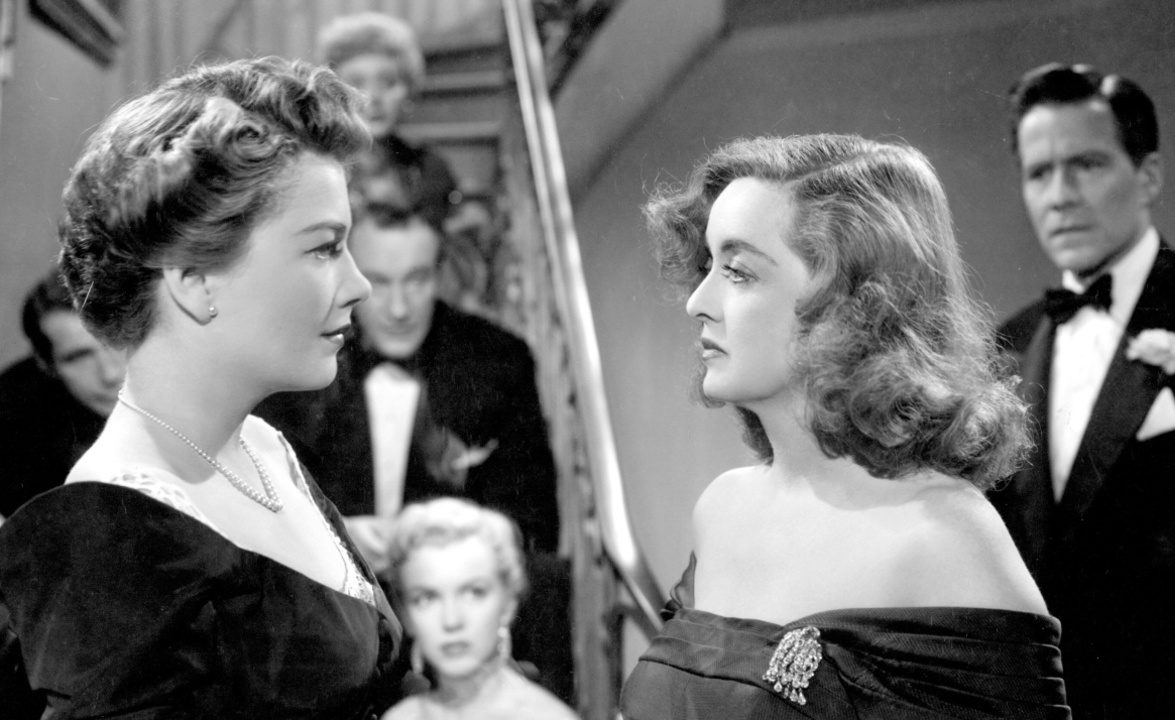
The story the culture wants to tell about Olivia Rodrigo and Taylor Swift is All About Eve (Joseph L. Mankiewicz, 1950): the adoring ingรฉnue who studies the star, learns her moves, and then slips the knife in. And the aging star, watching it happen, curdling into vindictiveness as the protรฉgรฉe takes what was hers. Itโ€™s an irresistible script because it gives everyone a villain to choose. Either Rodrigo, a self-proclaimed Swifty from early childhood on, is Eve Harrington โ€” the thief, borrowing too much and calling it homage, who echoed Swiftโ€™s โ€œCruel Summerโ€ on โ€œdรฉjร  vuโ€ closely enough that Swiftโ€™s camp landed a retroactive writing credit to the tune of millions of dollars โ€” or Swift is Margo Channing at her most petty, the elder star so threatened by her younger (self) that she has to litigate a credit. And itโ€™s a stupid bind, because the script only offers those two roles, jealous predator or past-her-prime grudge-holder. The more honest story โ€” the one the All About Eve, Taylor vs. Olivia mythology obscures from us โ€” is lineage.[3]

Call it the Catfight Economy[4], and grant right away that the diagnosis isnโ€™t mine โ€” critics have been describing this for years, and the manufactured rivalry has a whole literature behind it (and about it; among many other works, Brian De Palmaโ€™s 2012 film Passion also tells the All About Eve story, via Persona [Ingmar Bergman 1966] and Mulholland Drive [Lynch 2000]). To summarize: two successful women cannot share a professional space without one of them being a threat to the other. The press supplies the frame, the fans supply the labor, the platforms supply the distribution, and that leaves two artists narrated into a fight neither one started, so far as any human who doesnโ€™t actually know them personally knows. And surely their friends donโ€™t even know, really, whether or not Swift and Rodrigo are โ€œfrostyโ€ in real life.

What interests me is less the mechanism than its ideology: the things the Catfight Economy quietly trains us to believe. It teaches that influence is theft, that admiration is weakness, that producing art is powerful and receiving art is debt (I fully intend the sexual resonances there). That there is only ever one musical chair and the other woman is already sitting in it. It is a scarcity story dressed as gossip.

The machine is not exclusively aimed at women. Pop has always run on manufactured antagonism, Beatles versus Stones, Beach Boys versus Beatles, Blur versus Oasis, Biggie versus Pac. But the menโ€™s versions tend to read as competition between equals, a sport with two champions, even a spur to better work. Consider the Kendrickโ€“Drake cage match of 2024, which also managed to steal the spotlight from the quiet revolution surfacing at that yearโ€™s Grammys, where six of the eight Album of the Year nominees were women, including Rodrigo and Swift (the eventual winner โ€“ Iโ€™m still throwing beers at the screen that told me Midnights beat GUTS), a changing of the guard that held the stage about as long as it took two megalomaniacal, multi-millionaire assholes to start calling each other domestic abusers and pedophiles in public (I love much of the work of both of them). America crowned Kendrick Lamar the winner of the Drake battle-to-the-death the following year, when a hundred million people, both in the bleachers and at home, sang along as he hurled a blistering insult at his former collaborator at the Super Bowl.[5]

A metaphor for America in general in 2024, I guess.

When turned on women, the same machine sours[6]: the rivalry curdles into a catfight, and only one of them is allowed to survive it. A field with room for only one is a field that never has to take womenโ€™s art seriously as a tradition.

Consider the blows Swift absorbed to clear the commercial ground Rodrigo now shares with her. She came up through the Nashville songwriting machine as a teenage girl who had to have the best idea in the room just to be heard by professionals twice her age.[7] She spent years as a target of an online abuse campaign that ran through Kanye West and the people around him. And in 2019 she watched the masters to her first six albums get sold out from under her when Big Machine was acquired by Scooter Braun โ€” who had managed West for years โ€” an event that crystallized, in public and at her expense, exactly how little her little girl selfโ€™s signature on a contract was worth. Each of these events is also a Catfight Economy event in its way: each got covered as drama, as personality, as Taylor-being-Taylor, when each was actually structural โ€” a girl up against an industry built to extract from her.

Rodrigoโ€™s generation negotiated in the shadow of that lesson. Where Swift had to re-record her own catalogue to reclaim it โ€” Taylorโ€™s Version โ€” Rodrigo and peers like Chappell Roan entered an industry where creative control had become a thing a young woman could think to ask for, because they had all just watched the cost of not asking. There will never need to be a GUTS (Oliviaโ€™s Version). That absence is Swiftโ€™s bequest. This is the inheritance the rivalry frame canโ€™t see: the older artistโ€™s losses became the younger artistโ€™s terms.

Which is what makes the recently announced Daisy Chain Fields concert so important. The festival Rodrigo founded is something more than a festival and more than a tribute to the Lilith Fair; it is the Catfight Economyโ€™s exact inverse, built on purpose. Where the Catfight Economy profits by pitting women against each other, Daisy Chain Fields is dedicated โ€” in Rodrigoโ€™s own words[8] โ€” to the belief that โ€œjoy, community, and creativity can inspire meaningful change,โ€ celebrating the voices, artistry, and contributions of women in music. Where the Catfight Economy extracts value from women and routes it to platforms and press, Daisy Chain Fields routes its net proceeds outward, to nonprofits advancing and advocating for women and girls. Where the Catfight Economy insists inspiration and curiosity must harden into competition, the mission statement insists on โ€œknowledge, strength, and action.โ€ It closes on an image that is Oliviaโ€™s whole argument in one line โ€” daisies are โ€œwild and beautiful,โ€ and โ€œas a chain they are strong and unbreakable.โ€

Seen this way, Rodrigoโ€™s so-called evasiveness about Swift in interviews[9] stops looking like coldness and starts looking like intellectual consistency. She has been on the record about hating the manufactured-feud framing, and her refusal to feed it is the same gesture as the festival: a person who has built an explicit stand against the Catfight Economy is not going to step into its oldest set piece on cue.

So the mythology gets it backward. All About Eve is a story about a theater with one dressing room and one star, where the only way up is to displace the woman already standing in the spotlight. Eve doesnโ€™t want to make her own work, she wants Margoโ€™s part, Margoโ€™s audience, Margoโ€™s life. That is the only plot the Catfight Economy knows how to run, and it is the plot it keeps trying to cast Rodrigo into. Swift, more than anyone, knows it, and she has spent a career writing it (among millions of other things) down. โ€œClara Bow,โ€ the closing song on The Tortured Poets Department (2024), is the It-girl assembly line set to music: the industryโ€™s eye slides from Clara Bow to Stevie Nicks to, in the final verse, Taylor Swift herself, each new arrival told sheโ€™s the real thing, dazzling, the new god worth worshipping โ€” until the eye moves on to the next one, who has an edge the last one never did. It is Margo Channingโ€™s nightmare written by Margo, the star narrating her own replacement on the same conveyor that carried her in. And believe me, there is a ton of fan and critical speculation that this is one of many Swift songs about Rodrigo, which is so much more than missing the point. Itโ€™s a cruel[10] irony.

Swift is the great chronicler of the trap. But the interesting relationship between these two artists isnโ€™t antagonism, itโ€™s transmission: the elder who took the structural punishment, and the younger who studied the wreckage and wrote her way around it. Rodrigo is rejecting the whole theater and building a field of daisies. Swift sings the cage with unmatched clarity, and thus, somewhat like the Jane Austen of D.A. Millerโ€™s monograph[11], transcends it; Rodrigo, standing on the ground Swift cleared, gets to start dismantling it.


[1] Travis Kelceโ€™s.

[2] Taylor Swift, โ€œWood,โ€ The Life of a Showgirl, Republic Records, 2025.

[3]A caveat, because it would be ultra-shitty to let it pass without saying so: getting a retroactive co-write on a song you didnโ€™t write is a graceless thing to accept, and Swift accepted it. But the music business is litigious to its bones, and a young artist is so incentivized to hand over the co-credit and the royalty points rather than prolong the online nastiness that โ€” five years later โ€” it is somehow still a story that Elvis Costello did not sue Olivia Rodrigo. None of which is to claim Swift invented the position she occupies. She has predecessors, obviously, and similar All About Eve stories have been told about Madonna and Mariah Carey many times over. But the lineage Iโ€™m tracing isnโ€™t stylistic, itโ€™s structural โ€” the terms of creative control a young woman can now think to ask for. And the asymmetry of admiration matters: Rodrigo arrived a self-proclaimed Swifty, modeling herself on a songwriter-auteur with total command of her own persona and catalogue. Swift arrived a girl gushing about LeAnn Rimes โ€” herself a teenage phenom, but the inheritance there was a way of singing, by way of Patsy Cline, not a way of owning your work. The bequest I mean is the one Swiftโ€™s own losses created, not the longer history of women in pop, which runs back well beyond her.

[4]I am thinking here of Gloria Steinemโ€™s โ€œCatfight Theory of History,โ€ from an editorial she co-wrote with Eleanor Smeal, president of the Feminist Majority Foundation. The occasion was the release on streaming of Mrs. America, an historical film (TV show? Content thing?) that she believed portrayed the fight for the ERA as a catfight between her and Phyllis Schlafly instead of โ€œa battle between the ERA and economic interests.โ€ (LA Times, โ€œWhy โ€˜Mrs. Americaโ€™ is bad for American women,โ€ July 30, Covid year zero).

[5]โ€œA Minorโ€ is funny and clever. Lamar is also a genius who won a well-deserved Pulitzer Prize. Nonetheless, if I were scoring that Superbowl scene, it would be to โ€œAll the lonely people,โ€ and โ€œEleanor Rigbyโ€ (The Beatles, Revolver, Capital Records, 1966) is in E minor.

[6]Olivia Rodrigo, Sour, Interscope Records, 2021.

[7] See Taylor Swiftโ€™s interview for the NYT project, The 30 Greatest Living Songwriters (2026). Come to think of it, why isnโ€™t Billy Joel on that list? I havenโ€™t checked, but I bet Swift had him on her ballot. And Olivia โ€“ who might have made the list herself had the new one come out before the list dropped โ€“ David Byrne nominated her on his own (citation forthcoming, I know I read that somewhere) โ€“ well, we already know from โ€œdรฉjร  vuโ€ that she was โ€œthe one who taught you Billy Joel.โ€

[8]It could have been her โ€œteam.โ€ What is an author?

[9]See (hear?) the NYT Popcast interview with Rodrigo, in which Joe Coscarelli and Jon Caramanica ask her intelligently designed questions about the โ€œfrostinessโ€ between her and Swift, so that she can redirect without sounding like sheโ€™s hiding something. Good journalism still happens there!

[10]Taylor Swift, โ€œCruel Summer,โ€ Lover, Republic Records, 2019.

[11]Miller, D.A., Jane Austen, or The Secret of Style, Princeton University Press: 2005.

Invisible Republic (With Apologies to Greil Marcus)

By Jonathan Haynes

Given the miserable state of American life generally, here’s a thing that astonishes me. Two of the best homegrown popular artworks I can think of came out recently, within months of each other, are enormously popular, and are political (I beg you to please stay with me here): Olivia Rodrigo’s You Seem Pretty Sad for a Girl So in Love and Paul Thomas Anderson’s One Battle After Another. You could read each as a defiant argument for the humanities. Of course it’s unclear whether the artists know they’re making that argument, or would say so if they knew.

Listen to how they explain how their new works came to be. Anderson (Esquire): โ€œVineland was always going to be too hard to adapt, so I stole the parts that spoke to me and just started running like a thief.โ€ Rodrigo (NYT Popcast): โ€œI was really inspired by this book Simple Passion by Annie Ernaux. She’s having this affair with this person and she’s not quite happy, she’s kind of going insaneโ€ฆ I was really inspired by all of the ways in which love makes you insane and miserable.โ€

Wait. Back up. You guys are reading Ernaux and Pynchon? Like it’s nothing. Like it’s just something that you do. Meanwhile I’m sitting here listening to Pod Save America with a gun in my mouth.

After all, these are quintessential LA artists โ€” Anderson out of the San Fernando Valley, Rodrigo originally out of Temecula โ€” who actually get to make art in an industry town that has lost its industry, as devastatingly and, hopefully not but seemingly permanently, as any coal or steel town lost its in the seventies. Brilliant people with decades of experience at every tier of the entertainment business can’t get jobs at CVS or Target in 2026. (I have a friend like this, a superior researcher and writer with excellent pedagogical skills and a stunning depth of knowledge of movie history and culture. If you’re hiring, DM me and I’ll connect you.). But I’m not making the easy point that PTA and OR are privileged to make the art they want. Sure, they have one-percent lifestyles that buy them room to concentrate, instead of lives frantically lived between DoorDash and Lyft shifts. Nor am I saying I’m just glad they’re using that privilege well, though I obviously do think that. I’m not even really talking about them. I’m talking about the astonishing, vertiginous fact that there exists a massive popular audience for their work โ€” an Invisible Republic, if you will โ€” that consumes it not just avidly but ecstatically.

I’ve never actually cried to an Olivia Rodrigo song. I loved โ€œdrivers licenseโ€ in 2021 because of its stylistic mastery; my initial reaction was exhilaration at the rare aesthetic achievement, and I started thinking about the implied connection to the canon of American rock and roll โ€œcar songs,โ€ including the previous year’s โ€œMurder Most Foul,โ€ Bob Dylan’s masterpiece about the Kennedy assassination. Great bad trip car songs bracketed the pandemic. Dylan’s arrived in the first month of quarantine, when auto-mobility became a deadly thing. Her song came ten months later, amid the first vaccine roll-out, when it felt safer, but still low-key miserable, to drive your car places.

(Here, my ingenious sister-in-law, the novelist Megan Moores, would interrupt: there is plenty of textual evidence You Seem Pretty Sad for a Girl So in Love is about a romance with a guy with just such an emotional deficit who knows all the words to โ€œJust Like Heaven.โ€)

Historically, crying to Olivia Rodrigo songs is the primary mode of engagement with her. There is a TikTok genre dedicated to getting deep in your feelings while listening to her songs. My favorite of those that I’ve seen is the guy with red eyes and dribbling snot blurting out the titles of the songs on the new album that turned him into a sniveling wreck: โ€œFuck you, โ€˜begged.โ€™ Fuck you, โ€˜honeybee.โ€™ Fuck you, โ€˜less.โ€™ Fuck you, โ€˜cigarette smoke.โ€™โ€ Kathleen Hanna of Bikini Kill is on record as having bawled her eyes out hearing โ€œdrivers licenseโ€ for the first time. Right after the song dropped, there was an SNL sketch about gruff guys wearing flannel shirts getting into their feelings in a pool hall. The whole world was gutted by that song, allegedly. I loved it but experienced itโ€ฆdifferently (Dylan, etc.).

But with โ€œhoneybee,โ€ Olivia Rodrigo wrecked me too. She did it out of the blue with a couplet on a song that has gotten some flack for being out of the sonic universe of most of the album. It sounds like a Disney tune, a fair description meant as a criticism, to which I retort, one of the most celebrated American directors of all time just released (on the same day as Olivia’s new album) a blockbuster movie that โ€œdisclosesโ€ that his entire psychic universe โ€” and the universe’s โ€” is organized around โ€œWhen You Wish Upon a Star.โ€ John Lennon closed the turbulent White Album with a song that was explicitly based on Disney music. St. Vincent did a whole album based on that sound and called it Actor. Olivia Rodrigo, now occasional St. Vincent collaborator, began her professional life as a child actor in Disney shows (do your own research).

The couplet:

I hope I never see what your face looks like going

A face I swear that I could spend my whole life knowing

The purity of these lines is astonishing and lifts the album lyrically (whatever you think of Disney songs) into very rarified company. I think Lorenz Hart, at least the one played by Ethan Hawke in the new Linklater film, would have been proud to have written them. At the exact second I was admiring the craft, the eleven-year-old who sobbed at ET knocked me on my ass.

I hope I never see what your face looks like going

A face I swear that I could spend my whole life knowing

I am seeing a lot of faces going these days: my parents’ faces, the childish face of my now-teenage son, my own face.

The mortal irony of this lyric is that if she got her wish, she’d spend her whole life watching this person’s face going.

Fuck you, โ€œhoneybee.โ€

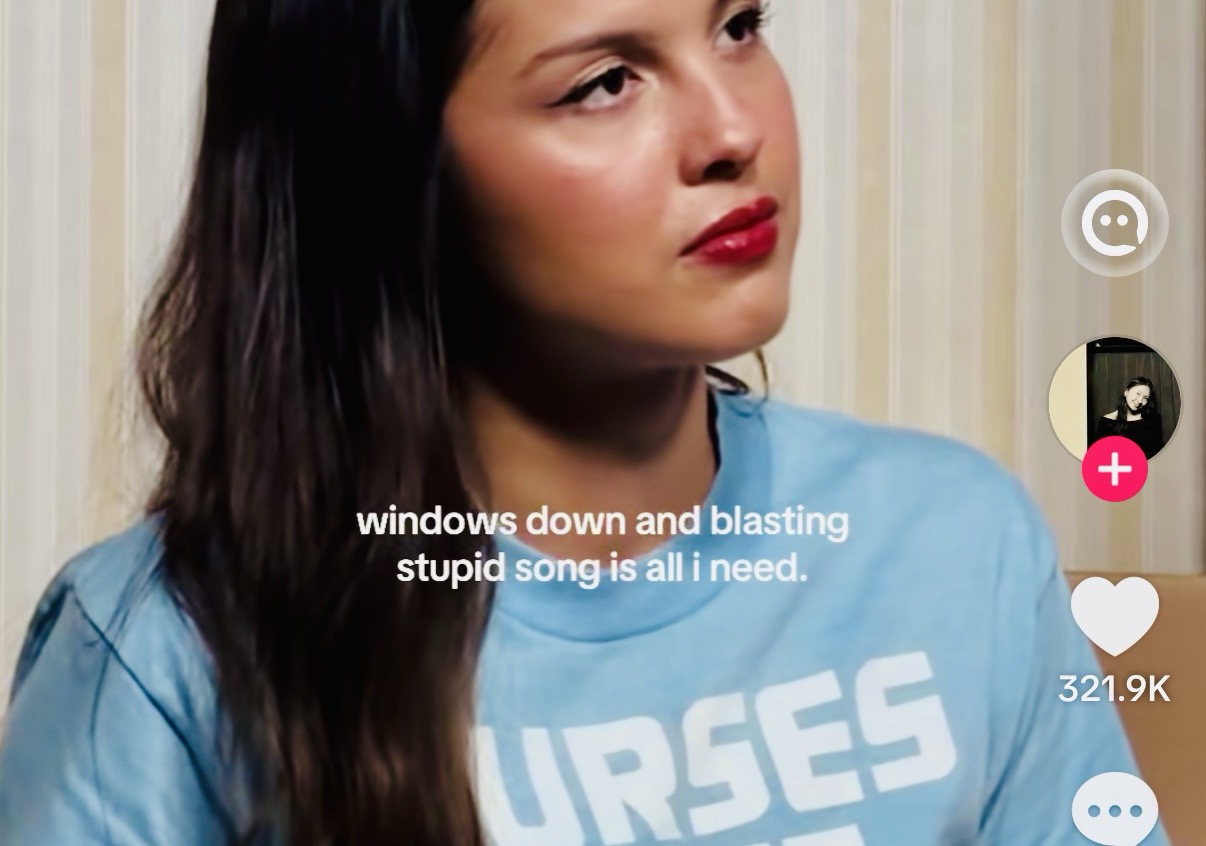
There is another TikTok from a listening party where Rodrigo plays the new album for fans hearing it cold, a live mic resting on her knee. As the chorus of โ€œstupid songโ€ climbs higher than you expect it to go, the room starts leaking into the audio โ€” a gasp, โ€œoh my god,โ€ and then the screaming. Those people weren’t screaming before. The music made them do it. The screams are the flip side of the sobs, and sometimes done simultaneously. And it’s like Dylan โ€” those verses in โ€œMr. Tambourine Manโ€ and โ€œA Hard Rain’s a-Gonna Fallโ€ in which the words just keep piling up and you never know when or where they’re going to land. Allen Ginsberg said everything in Dylan was โ€œcollected into that one column of air coming out of him and the vibration of the sound,โ€ and that fits Olivia Rodrigo even better. And it also fits the climactic One Battle After Another car chase that Scott Ferguson and I worked through on the Money on the Left podcast, Superstructure.

Switched on Pop names the mechanism better than I can: spiraling. On their recent podcast dedicated to You Seem Pretty Sad for a Girl So in Love, the musicologist Nate Sloan hears Rodrigo’s choruses as those coin funnels in children’s museums: you set a penny on its edge and it circles the bowl, faster and tighter as it falls, until it loses its orbit and drops through the hole at the center. The Rodrigo chorus does the same โ€” the line winds and accelerates, as she spins out more and more words and lifts ever higher into her vocal register, until it lands on the title phrase and drops out of motion. โ€œKiss me and I might drop dead.โ€ โ€œI love you more than any stupid song could ever say.โ€ The orbit, then the hole. And it is the same shape Anderson cuts in One Battle After Another: a VistaVision camera with a telephoto lens strapped to the nose of a Dodge Charger, the car running the undulating California hills, the pursuit going on and on over those swells until Chase Infiniti slams on the brakes. Two funnels, two dead stops. And in both cases, a mixed-race girl behind the wheel. Make of that coincidence what you will. I’ll leave that question open, as I imagine that Greil Marcus would.

But the invisible republic that I borrow Marcus’s title to identify is built precisely out of rhymes like that one โ€” uncanny correspondences the culture throws up without being asked, which it falls to criticism only to notice, and to refuse to explain away.

It brings into unwitting communion beleaguered English teachers grading endless piles of AP exams, college students with gender studies degrees graduating into an American void, rock critic Substackers traveling hundreds of miles in The Paranoid Style band tee shirts to see Hamell on Trial in a beloved local music venue that is closing soon (where will we go?), movie-scene-deconstructing 35-year-old YouTubers who can’t get over the color timing in One Battle and issue their manifestos from their parents’ living rooms, lonely denizens of livvieshq on Instagram with โ€œmaggots for brains,โ€ and work from home tech guys with moldy Ph.D.s who spend their days busily feeding their careers into AI tools.

This essay is already piled high with allusions, but I must add one more โ€” George Miller’s masterpiece, Babe: Pig in the City. I’m thinking of the scene – it always makes me sob – when Babe saves the Bull Terrier from drowning and the Bull Terrier says โ€œWhatever the pig says, goesโ€ to all the other animals. And so all of these different species โ€” who are, in some cases, even biologically, instinctively, constitutively driven to hate and fear each other, and in others, to blithely ignore each other โ€” must share the jelly beans. Or everyone starves.

And then they become an army.


UPDATE: 24 hours after the present essay was published, this announcement went out to subscribers from the official Olivia Rodrigo mailing list.

* Note that alphabetical order, asked to do nothing but sort names, quietly places Bikini Kill above some of the biggest stars in the world โ€” including the promoter herself.


I Think Youโ€™re Whatโ€™s Wrong With Me: On Influence, Absorption, and Olivia Rodrigoโ€™s ‘You Seem Pretty Sad for a Girl So in Love’

By Jonathan Haynes

Watch what happens when the reviews of Olivia Rodrigoโ€™s third album โ€” a concept record that tracks a single romance from first date to bitter aftermath โ€” go looking for its value. Almost without exception they find it somewhere other than in Rodrigo: in the older male band she references, in the New Wave gods her producer conjures, in the Gen X canon her sound supposedly pays its respects to. The dominant critical move is to sort the tracks into the Swiftian and the Smithian and grade each by which influence wins (Slate Magazine literally does this), and the songs that come out on top are reliably the Cure-saturated ones, praised as the moments where the record connects to something serious, something legitimate, something a man made first. I want to name this as the symptom it is, and the stakes are larger than one album. We are at a moment when pop music by young women is taken more seriously than it has ever been, and yet the reflex persists โ€” even among women writing the reviews โ€” to locate the worth of that music in a male precursor who authorizes it, rather than in the woman herself. The song-by-song tally is not just a clumsy method. It is the gatekeeping impulse wearing the costume of rigor: the search for the father who makes the daughterโ€™s work admissible. And it is exactly backwards, because You Seem Pretty Sad for a Girl So in Love is an album about a woman who does not borrow her authority from the canon but absorbs the canon into herself, who takes the male precursor everyone is reaching for and makes him sing her words. The critics handing Rodrigoโ€™s value upstream to Robert Smith have the current running the wrong direction. The record reverses it.

Right from the start, in the third line of the first song (โ€œdrop deadโ€), Rodrigo mobilizes the Cure as a narrative instrument. โ€œYou know all the words to Just Like Heaven.โ€ The Cure is not Rodrigoโ€™s stylistic frame imposed from above. It is his music โ€” the crushโ€™s โ€” and so when the record itself begins to sound like The Cure, the sound is not homage but possession. We are listening to a consciousness being colonized by a loverโ€™s taste, the way one absorbs a partnerโ€™s vocabulary, their sleep schedule, their way of seeing, their taste in music. This is the Annie Ernaux problematic Rodrigo named directly in her New York Times Popcast interview when she cited Simple Passion โ€” that slim, clinical diary of an affair that consumes a whole life โ€” as the inspiration for โ€œstupid songโ€: passion as affliction, a desire that floods and saturates everything like illness or insanity. Ernauxโ€™s achievement is a collision of registers โ€” flat, exact, diaristic notation applied to total erotic derangement โ€” and that collision is exactly what the album performs. The Swiftian lyric is the deadpan diary; the Cure engulfment is the derangement the diary is recording. You cannot separate them, because the lyric is narrating the sonic takeover as it happens. The title says as much before a note plays: You Seem Pretty Sad for a Girl So in Love is not a description of a moment in the romance but the verdict on the whole of it. Darkness was inside the love from the first date.

This is why the song-by-song method fails in this case. A critic who prefers the Cure-leaning tracks to the Swift-leaning ones believes, ironically, that he is identifying her most original mode (measured against a presumed Gen Z pop-princess archetype). He is in fact charting the depth of the characterโ€™s possession, crowning as most hers the songs where she is most someone elseโ€™s. The thing the critic likes more is the symptom. And itโ€™s a double bind for her: measured against Smith she is borrowing, measured against Swift she is belated, and either way the verdict denies her any artistic ground of her own. Variety gets closest to the truth with its line that the album โ€œtracks the arc of a love affair: Rodrigoโ€™s love affair with the Cure,โ€ but means it as a witticism about influence, not as a structural argument. The album dramatizes its own sound as a love-symptom. No tally of borrowed gestures can register that, because the borrowed gestures are not influences to be scored, they are characters in the story. And the impulse to score them, to find the songs where the male precursor is most present and crown those the best, is oddly shared by the character Rodrigo has created: the conviction that value must be located in him.

But Rodrigo is too strong an artist to leave the influences as influences, and here the argument turns. She sublates The Cure โ€” cancels it as an external source and preserves it as her own material, lifted onto a plane where it no longer points back at Robert Smith but expresses Olivia Rodrigo. The song โ€œthe cureโ€ arrives at rue album midpoint, but it is not about The Cure โ€” nor does it particularly sound like them. This negation is the point. This is what divides what she is doing from pastiche, which stays marked as borrowed. By the back half of the record the Cure-ness is simply her sound, the influence negated as foreign and retained as self. And then comes the benediction, the moment where the structure becomes flesh: Smith himself appears on โ€œwhatโ€™s wrong with meโ€ โ€” singing, playing bass, embodied inside her track. Not sampled, not echoed. The precursor walks into the song he has been haunting and takes a part, and he takes it on the diagnostic song, the one that asks the Ernaux question directly, which is exactly where an internalized voice would speak. He is not a guest star. He is the second half of her brain โ€” the absorbed half answering the diaristic half, two voices staring down the same dread from opposing ends. This is the form of a dialectic and not the form of a love duet.

Here is a fact underemphasized or ignored in the deadline reviews: Smith is singing her words and her music, in a style that resembles his own. The man has been made to perform a Robert Smith who is now her creation โ€” voicing her reconstruction of his idiom, handed back to him to inhabit. This inverts the entire vector of influence. Harold Bloomโ€™s โ€œanxiety of influenceโ€ runs one way: the latecomer swerves from the precursor, clears space against his priority, escapes the father. Rodrigo does the opposite. She absorbs Smith so completely that she can write him, and he ratifies the absorption by consenting to sing her writing-of-him. It is apophrades literalized โ€” the return of the dead made to seem authored by the living โ€” except he is actually there, performing his own style after it has passed through her and come out as hers. The strong artist is not the one who escapes the source. She is the one who can produce the source as her own material and have it agree to perform her. That is the furthest claim anyone can make on a precursor, and Rodrigo makes it on the record, in his voice, with his hands on the bass. The reviews are still at โ€œcool, Robert Smithโ€™s on it.โ€ The album is at โ€œRobert Smith consents to being Olivia Rodrigoโ€™s creation.โ€

But that consent is not a concession. It is the proof that what she does is additive rather than competitive. The credit-and-citation model the reviews run on knows only two roles, the original and the impostor, and it is built to adjudicate who owns what. Rodrigo is not playing that game. She does not depose the precursor. She brings the whole canon kicking and screaming into a world it has to share with her.

One last observation (finally caught up with her interview on Jimmy Kimmel the other night). The biographical Rodrigoโ€™s father reportedly has seen the Cure thirty times; he wept when he finally met Robert Smith; his phone screensaver is now a photo of the two of them. She has said her dad spent her childhood โ€œintroducing me to all the bands he went to see when he was my ageโ€ โ€” among them, The Cure. So The Cure is the fatherโ€™s music before it is anyone elseโ€™s in this drama, the canon handed down the paternal line, and her father, as it happens, is by profession a family therapist โ€” an analyst. Now consider the fascinating work the albumโ€™s romantic plot is doing with that inheritance. The boyfriend knows all the words to โ€œJust Like Heaven.โ€ He loves The Cure, which is to say he loves her fatherโ€™s music, the music she was raised on, the sound of the house she grew up in. And the buried logic of the infatuation, never stated outright but everywhere in the songs, is that this is why she falls for him: he loves what her father loves, he carries the paternal music, and so he arrives already occupying the place the father holds. That is the Freudian pattern, stated plainly โ€” the daughter drawn to the man who returns to her the father, the beloved chosen because he stands where the parent stood.

So it turns out that the album itself is not only a concept album that tells a coherent beginning to end story; itโ€™s a double plot. The story of the romance and break-up mirrors the larger one we have been unpacking the whole time โ€” the artistโ€™s relation to the canon she was raised inside. The main plot ends with a painful break-up. The other climaxes with the man who made the music she was raised on โ€” idol to both lover and father โ€” walking in to perform her recreation of him, and the world receives not Robert Smith but Olivia Rodrigoโ€™s Robert Smith, authored by the singular genius of Olivia Rodrigo.

* See here for a follow-up reflection from the author.

A Dvar Torah on the Subject of Democratic Public Finance

By Anna Minsky

The following speech was read on March 28th at a progressive New York City synagogue, a guest sermon by one of the congregants. In the Jewish tradition, each week we read one part (a โ€œparshaโ€) of the Torah (the first five books of the bible) aloud in Hebrew. Then someone, often a Rabbi, offers โ€œwords of Torahโ€ (dvar Torah or drash). At this synagogue at least, the idea is to use the text as a jumping off point. There is no presumption that the text is true or just, only that it is worth discussing.  The terms haShem (literally, the name) and The One are used here in lieu of โ€œG-dโ€ to convey that such a thing is too big to be known or personified.

Shabat shalom.

Obligation. Honor. Reckoning. Redemption. These are all words that have both a moral meaning and a money meaning.

Todayโ€™s Torah reading comes from Parshat Tzav.  Tzav means oblige. It has the same root as mitzvah. s/ Tzav is an absolutely *riveting* passage that goes back over how to perform five different ritual offerings that were already described in last weekโ€™s parsha, but this time with more attention to the role of the priest. But seriously, Parshat Tzav must be important because it is a list of instructions and Torah means instruction. The ritual for each offering begins with, zot torat ha: now this is the torah of… And, more-or-less, the description of each offering is punctuated with, kadosh kedushim hu: it is a holiest holy portion, referring to the part of the offering that goes to the priest.

So, this is the Torah of Obligation. What do we owe to haShem and what do we owe to each other? In the text, we owe a shlamim offering. It could be from the herd or the flock or a goat. We owe a minhah offering. It must be grain, with salt, oil, and frankincense, but no leavening. And, significantly, we are told the exact amount to bring each morning and evening, and we are instructed that the priests get to eat a part of it. These two offerings and the olah offering are considered obligatory.  In contrast, the last two offerings, the hattat and asham, are accrued based on your behavior.  More about those later.

In late temple times the instructions in the Torah about obligations to The One likely shaped the local economy more than obligations to the state. Roman authorities were content with minimal tribute, and their local governors were mostly unstable. Meanwhile, the Torah had already been entrenched for centuries. There was even a sacred currency that could be used for offerings and tithes. People likely took the Torah instructions seriously, but paid a priest to make offerings, rather than literally bringing a tenth of an efa of grain in the morning and another tenth of an efa in the evening. They saw their relationship with haShem as transactional.

Kadosh kedushim hu. It is a holiest holy portion.

Now this is the Torah of Honor.  So, what do you think? Is it impure to owe money? Is it a sin not to repay a debt?

It is no secret that cartels and bullies use debt as a pretext for violence and cruelty. For example, in 2014 credit agencies downgraded Puerto Ricoโ€™s bonds, forcing them to pay off their debts by reducing services and pensions, that is by reducing care for the people who live there.  There is no honor in paying off a debt if it is a cause for neglect. But also families and friends use debt as a pretext for companionship. I am in the debt of this community for creating a meal train when I was sick, and thatโ€™s a good thing because it makes me want to sign up for a meal train for someone else. The difference between cruelty and connection has to do with who keeps the ledger. If we think of money as a thing that can be hoarded that might prompt us to be cruel. But if we think of money only as an abstraction, that might prompt us to use it to coordinate care.

Kadosh kedushim hu. It is a holiest holy portion.

Now, this is the Torah of Reckoning. Is it possible that one origin of money was in temple ledgers?  For example, the temple might record that Linda hadnโ€™t brought a shlamim offering. Perhaps, also, Carol wants some of Lindaโ€™s saplings to plant a vineyard.  She could say to Linda, give me a few saplings, and I will promise to bring a shlamim offering to the temple on your behalf. Linda could then bring that promissory note to the temple, and they could record that the obligation of the shlamim offering had been switched from Linda to Carol.  All of a sudden, we essentially have paper money, and what makes it possible is the ledger that is being maintained by the temple. So the verses about how a shlamim offering could be from the herd, the flock, or a goat could be interpreted as important material information about exchange values that allow for the coordinated distribution of resources within a community of friends and neighbors. Although we no longer make offerings at the temple, Parshat Tzav is still relevant because we still coordinate the distribution of resources. And to give an honest reckoning, we do it badly.

Thinking about our relationships with The One and among ourselves as something transactional might feel yucky, but I would offer that we can reject the fake morality pedaled by banks that it is honorable to โ€œhonorโ€ a debt incurred to a usurer. We *can* organize transactions around caring.

Kadosh kedushim hu. It is a holiest holy portion.

And finally, this is the Torah of Redemption. I am going to spend the remainder of this drash talking about Democratic Public Finance, an idea Iโ€™ve been learning about from the Money on the Left editorial collective. Today is the perfect day to talk about it, not just because of Parshat Tzav, *but also* because today is No Kings Day, *and also* the state budget is due on Wednesday.

I think weโ€™re all on the same page that when the President claims the unilateral right not to spend funds that Congress has appropriated, that is King behavior and we wonโ€™t stand for it.  But I also want you to think about this unitary executive theory of money, not as a departure from, but a continuation of the austerity framework of our much-too-powerful governor, Kathy Hochul, who says that we canโ€™t โ€œaffordโ€ to invest in renewable energy.  Just as we shouldnโ€™t let the president be the arbiter of when money can be spent, so too, we should not let the banks, traders, and hedge fund managers be the arbiters.

Under the current regime corporate banks, and not democratically elected local governments, have the power to create credit.  What kind of democracy is that?  Kathy Hochul claims that money is a scarce private resource, but Democratic Public Finance thinks of money as just a way to coordinate the distribution of resources and capacities.  If there is enough food in New York City to feed every person in New York City, then it is simply not the case that we canโ€™t afford to feed everyone. If there are enough people to shovel the snow, then it is simply not the case that we canโ€™t afford to have the sidewalks passable for people in wheelchairs.  If it is physically possible to build solar and wind farms and a pipeline to bring hydropower from Quebec, how can we afford *not* to do these things? All we, as a multiracial small-d democratic city and state, have to do is ask what we wish to accomplish together and then take control of the ledger to credit the people who step up to do the accomplishing. For example, one way to do this would be to issue literal credits that could be redeemed to pay taxes or obtain food from state-run groceries.

Another idea from democratic public finance is to borrow money from people rather than banks. Instead of donating money to centrist democrats to defeat MAGA, we could invest our money in arts programs, libraries, and parks in New York City, Cincinnati, Seattle and Tulsa, expanding blue cities so that people can live in them free from cars and guns, and organize together to take back their state legislatures.

These are policy ideas we could advocate for. If you are interested in taking some smaller first steps together, I am always looking for study partners, and maybe we could consider writing a joint letter to the mayor or governor, or starting some inventive crediting systems within our own community, perhaps for kids or teen assistants.

I said I would return to the hattat and asham offerings. These are offerings you would make if you needed purification or to atone for a sin. The implication is that you had incurred some debt for impurity or, perhaps, cruelty. It is not wrong to have a debt, but it is wrong to usurp the ledger.  The premise of Parshat Tzav is that haShem controls the ledger, but post-temple, I think that we all should control the ledger, democratically.

Whatโ€™s more, while it might seem like Parshat Tzav is just instructions for the priests, letโ€™s not forget Parshat Yitro, where we read vโ€™atem tโ€™hiyuli mamlechet cohanim: we should be a *nation* of priests. 

On top of Parshat Tzav, no kings, and an impending state budget deadline, today we observe Shabbat haGadol, the last shabbat before Pesach, the holiday of redemption. To redeem is literally to acquire something by paying off a debt, perhaps by making a hattat or asham offering.

But I say redemption is meaningless if we are not a nation of priests, if we do not wield the ledger to distribute our labor and resources to care for one another.

Kadosh kedushim hu. It is a holiest holy portion.

Good Shabbos.

* The featured image above features an ancient silver Shekel of Tyre from the Second Temple period dated 64/3 BC.

** Watch Anna Minsky read her remarks here:

Animal Spirits and Public Promises: Phantom Beavers and the Politics of Monetary Design

By Rob Hawkes

There is a spectre haunting Nigel Farage. The spectre of a beaver.

On 11 March 2026, the Bank of England announced that, following a public consultation, its next series of banknotes will feature images of the UKโ€™s wildlife in place of historical figures, which have adorned our currency since the 1970s.

Mr. Farage was quick to describe this move as โ€œabsolutely crackersโ€ (and, of course, โ€œwokeโ€) in a social media video which begins with a triumphant hailing of โ€œour great British banknotesโ€ and their images of โ€œgiant figures like Winston Churchill.โ€ Soon, however, his tone shifts to one of ridicule: โ€œAnd yet, theyโ€™re proposing that we replace people like him with a picture of a beaver. No Iโ€™m not making it up, this is actually what theyโ€™re proposing.โ€ The Reform UK leader has never been one to let the truth get in the way of a good bit of faux outrage, but, if his โ€œIโ€™m not making it upโ€ wasnโ€™t enough of a clue that the facts might have undergone some stretching, a brief check of the BoEโ€™s press release confirms that the โ€œspecific wildlifeโ€ the public would like to see depicted on the currency has yet to be determined via a further consultation process. Mr Farage, it seems, has conjured a phantom beaver.

One can only speculate as to why this particular animal spirit haunts Farageโ€™s paranoid imagination but, considering Reform UKโ€™s deep commitment to womenโ€™s rights, it is surely a mere accident that his mind landed on a word with a history in misogynistic slang. There is no knowing, either, why the thought of losing Jane Austen, JMW Turner, or Alan Turing from the โ€œgreat British banknoteโ€ has not proved quite so distressing, either to our political leaders (Kemi Badenoch is also very cross), or to the BBC Question Time audience member who saw the replacement of Churchill as โ€œsurrendering to the radical left wing.โ€ One of the panelists, the broadcaster Kay Burley, responded: โ€œI think as long as weโ€™ve got enough of them in our pockets at the end of the week, I donโ€™t really care whatโ€™s on the back of my banknote.โ€ Indeed, from the point of view of mainstream economics, which sees money as a politically-neutral medium of exchange, the material and aesthetic properties of monetary tokens are of no consequence. However, while we can question the motives underlying this weekโ€™s eruption of โ€œanti-wokeโ€ anger, the questions of monetary design this episode opens up are anything but trivial.

As Alfred Mitchell Innes wrote in 1913, money is โ€œcredit and nothing but credit.โ€ Indeed, in a powerful sense, Churchill, Austen, Turner, and Turing are all the posthumous recipients of public credit in the form of recognition, celebration, citation, and acknowledgement via the visual design of the existing ยฃ5, ยฃ10, ยฃ20, and ยฃ50 notes. In Turingโ€™s case, in particular, this credit is also an act of reparation following the violence he endured at the hands of the British state in his lifetime. As well as bearing images of Churchill, Austen, Turner, and Turing, our banknotes announce that they โ€œpromise to pay.โ€ And yet, this public promise also encompasses a commitment to redeem, to receive, to acknowledge, and to accept. In broader terms, the UKโ€™s monetary system as a whole recognises the contributions of those who serve the public purpose โ€“ from health, to education, to social care โ€“ in the form of public credit.

As one of the worldโ€™s most nature-depleted countries, you could argue that the UK now owes far more to its wildlife than to its revered historical figures. And yet, the panic over the removal of Churchill points to the ingrained logic of austerity at the centre of British politics today. Acknowledging our past need not come at the expense of provisioning the future, but for Farage and those who share his worldview, these will always appear as zero-sum trade-offs. Despite living in one of the worldโ€™s richest countries, we are told, there is not enough to go round โ€“ someone must be left out, whether itโ€™s animals vs. dead politicians or hungry children vs. cold pensioners, weโ€™re always in a world of either/or and never both/and. Thus, striving for ecological sustainability and renewal, averting climate breakdown and arresting species loss, or meeting the needs of those our society marginalises (including migrants, people of colour, LGBTQIA+ communities, women, and disabled people), are imagined to be achievable only as a consequence of someone elseโ€™s suffering. However, as we at Money on the Left have been arguing in our work on Democratic Public Finance, while systemic exclusion is baked into the present logic of monetary design, this is not and has never been inevitable โ€“ we can design another, more inclusive and sustainable system just as we can redesign our banknotes.

Farageโ€™s phantom beaver betrays an even deeper fear of democratic inclusion. As a thought experiment, let us imagine for a moment that a twenty-first century political leader might deliberately and unsubtly choose to imply that Churchill, the warlike epitome of masculine strength and defiance, was to be replaced by a euphemism long used to belittle and sexualise women. Might this indicate a wider hostility to womenโ€™s inclusion in the political and public spheres? Might the lack of comparable concern over the loss of a woman writer, an artist, or a gay man from the โ€œgreat British banknoteโ€ also be telling? The BoE made the decision to feature wildlife on its new notes after an extensive public consultation. This was a more democratic choice than could ever have been arrived at had the Bank simply asked Nigel Farage what he might consider too โ€œwokeโ€ or asked the man in the Question Time audience what would count as โ€œsurrendering to the radical left wing.โ€ As we saw in the aftermath of the recent Gorton and Denton by-election, which saw Farageโ€™s partyโ€™s candidate Matt Goodwin losing to the Greensโ€™ Hannah Spencer, Reform UKโ€™s instinct is to blame the public when it makes a decision it doesnโ€™t like. By contrast, Democratic Public Finance invites everyone to join the conversation, not just about who or what we recognise and celebrate in the visual design of our currency, but how the monetary system itself functions, which people, places, and causes truly deserve public credit, and how acknowledging our shared past need never be pitted against our ability to build a better, more just, inclusive and sustainable future.

As Robyn Ollett and I wrote for Money on the Left last August, โ€œthe stories we tell about our communities and the people that build them are intimately bound up with the way we account for them in monetary terms.โ€ We have since launched the Where Creditโ€™s Due project in Middlesbrough with the aim of building intersectional solidarity and fostering conversations about monetary design in both visual and systemic senses. We began with a screening of Maren Poitrasโ€™s 2023 documentary Finding the Money โ€“ in which Lua K. Yuille observes that: โ€œIf money is natural, who has the money is natural as wellโ€ โ€“ and followed this with a series of workshops at Middlesbroughโ€™s Dorman Museum, where our participants have experimented with designs for their own โ€œDorman Dollarsโ€ (see the image above). As these events have explored, neither the aesthetics nor the politics of monetary design are natural or inevitable. In place of the orthodox story, which tells us that the suffering of marginalised people and neglected places is necessary and that austerityโ€™s exclusionary logic is the mark of responsible government, we have been learning how to tell new stories of moneyโ€™s creative potential. In place of the phantom of inclusion-as-zero-sum-competition and the fear of democracy that haunts Nigel Farage, we offer Democratic Public Financeโ€™s vision of ecosocial justice, which refuses to imagine false binary oppositions between wildlife and people, between men and women, or between the past and the future.

The Ontology of the Monetary Image: Rรฉfรฉrance and Reconstruction

By Will Beaman

Money is often introduced in critical theory as a problem. It appears as the medium that makes unlike things commensurable by reducing them to sameness, the abstraction that removes social life from the conditions that give it substance, or the sign that circulates by displacing the relations on which it depends. In one register, this is the Marxist account of commodity abstraction and estrangement. More specifically, it is the tendency within Marxist political economy to identify money with the value-form, and the value-form with a mystifying equivalence that becomes socially real and destructive. In another register, money becomes part of a deconstructive account of debt, mediation, and the impossibility of meanings or values ever being wholly self-identical. What these approaches share is the claim that money is bound up with failed identity: either it asserts an equivalence that does not in fact exist, or it reveals that equivalence never fully holds. Money is therefore treated either as a false identity or as a site of identityโ€™s failure.

I want to start from a different premise. Money does not need to be understood first as the positing of identity. Commensuration is not exhausted by equivalence in the strongest sense, and credit should not be understood only as false unification or as a relation whose non-identity appears primarily as failure or guilt. Money is better understood as a practice of open public reference. At its most basic level, it stages comparison without requiring identity. By reference I do not mean only precise signification. References can also sample and remix, compare partially, cite selectively, echo playfully, or suggest likeness without exhausting what they carry forward. What matters here is a public act of relatingโ€”one that makes coordination, valuation, and obligation possible without discovering a pre-given sameness beneath them. The question, then, is not whether money imposes identity on a heterogeneous world, but what kind of reference money is.

Marxist criticism is most useful when it shows how capitalist monetary forms narrow what can count as socially intelligible. When labor appears only as wage labor, when production appears only through profitability, and when public capacity appears as fixed, money becomes a disciplinary medium. But it is not enough to say that capital captures money and thereby generates socially real abstractions. That still risks treating reification as the basic ontology of money rather than as one historically powerful monetary idiom. What appears here as private value or abstract equivalence is better understood as a genre of referenceโ€”a way of organizing relations that presents its own ratios as self-grounding while treating the conditions of issuance and receivability as if they were already settled. Even in these privational forms, money is not ontologically private. It remains a contested public utility, and the terms on which claims are issued, received, and made to count are never fully removed from political struggle.

A similar point can be made about deconstructive accounts of debt and mediation. These traditions are right to insist that identity does not close. Debt is never just a neutral balancing of accounts but is bound up with obligation, memory, punishment, and the effort to make a claim hold over time. More generally, settlement never arrives in a final and self-contained form, because any act of meaning or repayment depends on signs, conventions, and contexts that exceed it. Derridaโ€™s term diffรฉrance combines difference and deferral to name this condition: meaning is never simply present all at once in a self-identical form. A word becomes intelligible through its differences from other words, through traces of prior use, and through its repeatability across contexts. What appears self-grounding or immediately given is therefore mediated. Applied to economic life, the point is that a price does not contain the full reality of the good it prices, and a wage does not contain the full reality of the labor it measures. Monetary signs are in no objective sense equal to the world they organize. If one begins from identity or presence, non-coincidence appears as diffรฉrance.

If diffรฉrance clarifies the mediated conditions of signification, we might use rรฉfรฉrance to clarify the mediated conditions of reference. Derridaโ€™s altered spelling marks a difference that is visible in writing but not audible in speech, making the temporal discontinuity of signification legible at the level of the word itself. Rรฉfรฉrance transvalues that gesture. It marks not only the non-presence of meaning, but the inscribability of claims across the spacing of currency issuance and uptake. Just as writing happens here and reading happens there, issuance happens here and receivability is negotiated there as a reversible stagecraft rather than a closed transfer. Rather than starting from identity and its failure, rรฉfรฉrance begins from relations that are non-identical from the start and do not require identity as their ground. If one begins instead from analogy and provision, from a shared problem that referential coordination across non-identity helps organize and contest, the same field appears as rรฉfรฉrance. The inadequacy of identity is the site of diffรฉrance; non-identical relation is the site of rรฉfรฉrance. These do not necessarily name different empirical objects. They name different descriptions of the same mediated field. Rรฉfรฉrance names an open public reference: a way of suggesting likeness and holding claims together without discovering a final identity beneath them. Money, on this account, is not the successful representation of a prior economic reality, and it is not merely the symptom of a constitutive lack. It is a partial articulation of the social world as countable and revisable.

In monetary life, rรฉfรฉrance works through analogy: a way of holding heterogeneous things in accountable relation without making them identical. Analogy here does not mean approximation to a fixed norm. It means that likeness can be suggested and coordinated without being gathered into identity. A wage does not make labor the same thing as money. A price does not make a good identical with a number. A budget line does not make a public need identical with its accounting expression. Identity fails, but coordination still takes place.

The reparations movement offers a political example. A cash payment may form part of reparations for slavery without being identical to reparations or exhausting their meaning. Indeed, reparations are possible in part because money is not exhausted by any punctual scene of settlement. Its non-identity makes it intertemporally inscribable as a medium of repair, capable of carrying past harms, present claims, and future obligations in relation. The relation is not merely metaphorical or supplementary. It is analogical. Payment participates in a broader project of repair that can also take juridical, institutional, pedagogical, and aesthetic forms. This is part of how reparations remain durable across changing media and struggles: not because the claim is reducible to one self-identical demand, but because it can be carried forward across different scenes of reference. Reparations, in this sense, name an open historical and political problem-space rather than a single settled form.

Existing monetary forms often conceal the work of reference. We might think of this in terms similar to the continuity system in cinema. Continuity editing does not literally create seamless space-time. It produces continuity as an effect while hiding the cuts, conventions, and labor that make it possible. Some monetary forms work in the same way. They stage commensurability as a simple fact and obscure the referential work by which non-identical terms are brought into relation. What appears as neutral equivalence is often the product of historically specific conventions that present themselves as natural.

For that reason, reconstruction matters as much as critique. Reconstruction begins not from failed closure but from non-identical relation. Monetary institutions are never complete, never innocent, and never outside power. But they are not simply illusions waiting to be exposed. They are infrastructures through which claims become receivable, contestable, and revisable. To reference is also to cite: to carry something forward and make it count within a shared scene of recognition. Credit clarifies the connection. To credit is not only to finance but also to acknowledge, attribute, and extend receivability in monetary terms.

The historical period of Reconstruction after the U.S. Civil War extends the reparations analogy. In that moment, the terms under which social life could count within public institutions were reorganized. New images were put forward in which labor appeared as employable beyond the plantation. Citizenship appeared as enfranchisable across race. Land appeared as redistributable rather than fixed within the slaveholding order. Credit appeared as more issuable to newly recognized participants in public life. Black participation appeared as precious and indispensable to public life. None of these predicates produced stable identities, and all were violently contested. Yet they established new relations through which claims could be made and received within a multiracial democracy. Reconstruction therefore names not only a historical period but a problem of reference: how heterogeneous lives can be sustained together within shared institutions without collapsing their differences into a single form.

The political economic question is therefore what kinds of open public references monetary forms establish, and whether they do so reflexively or under the cover of objectivity. A reconstructive critique of money asks who may issue, who may count, what may be valued, which obligations are recognized, and which forms of life are treated as worthy of support. The task is to reconstruct money as accountable relation rather than failed identity.

Fiscal Chronotopes: #ZcavengerHunt, the Zetro Card, and the New Finance Franchise

By Will Beaman

This essay is lightly adapted from a talk delivered at the 2026 American Comparative Literature Association conference. It contributes to a growing body of endogenous money theorization that we at Money on the Left call Democratic Public Finance (DPF). DPF begins from the distributed and publicly mediated character of political-economic life, approaching money, credit, and accounting as contested infrastructures that are at once citational and coordinative. My contribution to that project here concerns the conditions of legibility for political-economic imaginaries.

Fiscal practices and counter-practices unfold within spatial and temporal genres that rehearse what feels like a โ€œrealisticโ€ order of operations: where money is imagined to come from and what must happen for it to name and remunerate social capacities. In those genres, design questions are often staged as discoverable facts about economic reality that necessarily constrain politics. But they can also be staged additively, so that public spending expands who and what can count. At stake throughout is how public money is imagined and how public obligation is organized.

One familiar name for this problem in endogenous money discourse is the finance franchise: the idea that monetary power is extended through licensed issuers and delegated circuits. That mapping matters, but it can mislead when it encourages us to treat monetary agency as primarily top-down. My wager is that the finance franchise is also organized from the middle, through durable genres and rehearsals that make monetary agency legible in public life. The franchise, in other words, is not only a legal architecture. It is also a genre environment that trains what public agency can look like and when it can count. Borrowing from Mikhail Bakhtin, I call these patterned organizations fiscal chronotopes: time-space forms through which a world becomes legible as a sequence of events, obligations, and thresholds.

A key feature of these chronotopes is that they are often polyvocal. The same practice can remain stable while supporting more than one coherent reading. That is one reason fiscal forms travel across heterogeneous publics. It also means analysis cannot treat perception as passive reception, as if fiscal reality simply presents itself and we merely record it. What is often called “fiscal reality,” including in MMT and endogenous money discourse, is too often treated as a stable object waiting to be revealed. Here I treat it instead as reversible stagecraft: a field of gestures and formats that can sustain more than one stable reading and that trains what becomes legible as responsibility and what becomes actionable, or receivable, as public obligation.

Duck-Rabbits and Fiscal Reality

We can think about this with the famous duck-rabbit optical illusion. The drawing can be seen either as a duck facing left or a rabbit facing right. The same lines support two incompatible but equally stable readings, and that is precisely why the image circulates. Gestalt phenomenology took this as evidence that perception is not passive reception but active organization. What we see depends on both figure and orientation. The duck-rabbit shows that the same object can support different gestalt wholes without collapsing into incoherence.

That claim matters here for two reasons. First, it helps describe a dynamic that shapes the present: an inherited neoliberal temporality of passive administration amid crisis can be flipped into open authoritarian bullying without becoming identical to it. Neoliberal governance has long rehearsed a fiscal chronotope in which government is staged as the administration of scarcity. Capacity appears fixed, and the acquisition of scarce funds takes the form of a hostage negotiation in which the rich and powerful must be satisfied before money can be spent legitimately. In that chronotope, the destruction of infrastructure and capacity – austerity, underemployment, deferred maintenance – is moralized as a settlement required to keep the public books balanced.

Authoritarian politics plays off that form. It preserves the scarcity framing and the hostage structure, but converts the earlier posture of impotence before “the market” into a spectacle of punishment and reward. The “winners and losers” of globalization become something closer to the “winners and losers” of The Apprentice. Where neoliberalism moralizes constraint as necessity, the shakedown celebrates it as domination and as proof of the exceptionality of Trump’s supporters. The two chronotopes therefore share recognizable features, which is part of what makes collaboration and institutional capture possible. But they organize those features into different narratives of agency and responsibility.

Second, the duck-rabbit offers a rule for reading the campaign practices I turn to next. Last summer, Mamdani’s campaign ran a citywide scavenger hunt called the #ZcavengerHunt and introduced the Zetro Card, a playful punchcard through which volunteer contributions became receivable for campaign merchandise. The question is not whether these practices are really fiscal governance in disguise. The point is that they can be participation formats and, at the same time, rehearsals of public credit and fiscal authority. They make participation legible, and they can later help make other kinds of fiscal action feel actionable. In that sense, they point toward a new finance franchise whose conditions of possibility are distributed and democratic: authority gathered and renewed through rehearsal rather than granted only from above.

With this in mind, I read #ZcavengerHunt and the Zetro Card as formats that organize fiscal time and space. They are not policy proposals in disguise, but participation devices whose polyvalence trains what counts as collective action and what later counts as legitimate public work. The point is not to decide whether they are “really” fiscal politics or “merely” campaign theater. It is to track what they make variously legible (and hence variously actionable), and how their multi-legibility lets them travel across heterogeneous publics without requiring doctrinal consensus.

The #ZcavengerHunt

I begin with #ZcavengerHunt, which composes a bounded public present, and then turn my attention to the Zetro Card as a more durable rhythm of participation and completion. In the #ZcavengerHunt on a warm day in August, people moved through a sequence of locations, following prompts posted in real time and showing up in large numbers. It was playful and conspicuously gamified, but it was also immediately recognizable as a campaign event: a way to generate momentum, attention, and contact.

The chronotopic question, though, is what kind of time and space the format composed, and what that composition made legible. #ZcavengerHunt organized routes and gathering points so that participation took a clear, shared shape. A city that often appears as dispersed constituencies and isolated commutes was briefly refigured as a coordinated circuit: a public moving through space together according to a posted order.

This helps explain why so many people on social media reached for the same comparison and said Mamdani had finally made โ€œPokemon Go to the Pollsโ€ happen in earnest. The comparison points to more than fun. It names the way a game can give political participation a navigable form, one that does not require prior expertise, ideological unity, or even a single reason for being there. You do not have to be converted to join. You just have to be able to read the next move and keep going.

Campaigns sit awkwardly within the dominant governance chronotope. They happen before governance, and much of their labor is volunteer-based, informal, and hard to count. In a genre environment that tends to recognize work only once it is officially authorized and paid, campaigning can become strangely unreal: โ€œjust politics,โ€ โ€œjust vibes,โ€ or โ€œjust messaging,โ€ as if the labor of coordination does not count as labor.

#ZcavengerHunt pushes against that occlusion. It renders campaign labor legible as a visible, shared activity while remaining playful, and that playfulness matters because it lets participation count without first taking on solemnity. A scavenger hunt does not require participants to share the same inner narrative about why they are there; it requires only that they inhabit the same sequence. People can show up for different reasons and still cohere as a public. That is not a weakness but part of how democratic forms remain durable across heterogeneous readings.

#ZcavengerHunt is not public works in the sense of a municipal project. But it does rehearse public work by rendering coordination labor legible and staging completion as something a public can do together in the open. It rehearses turnout and GOTV, but also the broader premise that collective activity can be organized as an ordinary feature of public life rather than dismissed as a break from โ€œrealโ€ administration. A related form appears in the more recent snow-shoveling mobilization: a public standard is set, capacity is scaled to meet it, and the work itself is the primary obligation rather than a revenue-constrained aspiration.

The Zetro Card

The Zetro Card began as a workaround. At one point in the campaignโ€™s fundraising, election-law rules constrained the sale of campaign merchandise. The usual sequence could no longer operate in the same way. Rather than treat that constraint as a hard stop, the campaign invented another format for recognition and circulation. The Zetro Card is that format: a playful punchcard that volunteers receive at canvasses, phone banks, pop-ups, and other events, stamped for contributions and made receivable for campaign merchandise once enough stamps accumulate.

It is immediately recognizable as gamification, and it is partly that. But the origin story matters because it shows how quickly constraints become questions of form. The card does not arise from a neutral design space. It emerges within a rule-bound environment that forces the campaign to ask how value and recognition can keep moving when a familiar channel narrows. That is endogenous improvisation in miniature: a practical restaging of how participation can be honored under constraint.

As I suggested at the time in a joking-not-joking piece for Money on the Left, the punchcard format also invites expansion. It offers a way of thinking through how organizing labor might become legible as something closer to public work without pretending the campaign had already become the city. The Zetro Cardโ€™s meaning was flexible from the start. The same format reads equally well as merch logistics, volunteer morale, or a revisable experiment in how recognition might be formalized and scaled.

Where #ZcavengerHunt gave campaign mobilization the form of an attraction, the Zetro Card established form that can persist across time. Contributions that are otherwise informal and hard to count are gathered into a shared rhythm rather than fading back into the background as โ€œjust politics.โ€ That continuity should not be confused with seamlessness. The card works because it is modular: it can absorb uneven moments of participation while preserving a stable form. Continuity, in this sense, is not the absence of interruption but the achievement of a repeated public rhythm.

If #ZcavengerHunt made campaigning legible as collective movement all at once, the Zetro Card makes it legible as ongoing work that can persist without constant spectacle. The duck-rabbit point holds here too. The card can be read straightforwardly as morale, retention, and branding. It can also be read as a rehearsal of public credit in miniature because it stages a relationship among contribution, recognition, and redemption. Those readings do not cancel each other. Its political usefulness depends on remaining legible in both registers at once.

From Campaigning to Governing

What this adds to the campaign-versus-governance question is not a fantasy of immediate substitution but a shift in genre. The Zetro Card treats participation as something that can carry forward and return as recognition over time. It offers a small but suggestive model of how collective capacities get named and taken up through repeatable formats. When the scene shifts to snow shoveling as paid public work organized around an accessibility standard, the register changes. But the underlying wager remains familiar: the work comes first as an obligation we can name, and the question of coordination follows from that obligation rather than preempting it.

Many commentators described #ZcavengerHunt and the Zetro Card as Mamdaniโ€™s way of responding to fascist terror with fun and levity, and that is true enough. But fun and levity are chronotopic. They organize political time differently from the rhythm of fiscal and political crisis that has dominated neoliberal governance and returned in Trumpโ€™s threats and shakedowns. Within dominant fiscal chronotopes, crisis appears as something that suspends public obligation rather than reinforcing it.

The campaign practices matter because they elaborate a different, more democratic public chronotope. #ZcavengerHunt exemplifies an event whose form is nonetheless repeatable, while the Zetro Card extends that same participatory logic into a more continuous sequence of recognition and coordination. In both cases, levity is not a retreat from politics but an effect of agency: a way of making collective capacity feel present and repeatable under conditions designed to make agency feel foreclosed. If neoliberal and MAGA temporalities narrow the field of action, these practices widen it by building forms in which people can act together without waiting for permission in advance.

That framing also helps clarify why the shift from campaign to governance is not a clean break. The same administration can operate in more than one chronotopic tense at once because it inherits institutions and media habits that keep staging money as if it originates in private pockets and enters public life only through reluctant concession. In the early months of Mamdaniโ€™s term, that tension has been visible in real time. Libraries were cut recently in the name of efficiency, a recognizably neoliberal move that treats capacity as fixed and management as the art of trimming. Last weekend, by contrast, snow-shoveling capacity was dramatically scaled up around a clear public standard of sidewalk accessibility. The public messaging around recruiting shovelers had its own playful, mobilizing energy, closer in spirit to the campaign experiments than to the dour genre of austerity.

The snow-shoveling episode matters because it puts a different orientation on display. Productive capacity appears here as a political variable rather than a ceiling. The public standard comes first โ€” accessibility as constitutive of public space โ€” and labor is then scaled to meet it. Operationally, the cash management and accounting settlement for that expansion happens afterward through ongoing negotiation and coordination. That, too, can be read in duck-rabbit fashion. In a familiar neoliberal reading, belated settlement is framed as debt that must be โ€œpaid back,โ€ as if the city has put extra shoveling on a public credit card that will eventually come due. But belated settlement also makes something else visible: once scale becomes adjustable in order to meet a standard, the question โ€œhow are you going to pay for it?โ€ is already being treated as a design question rather than an external veto on what counts as an obligation.

That is the fork in the road these campaign rehearsals help make visible. One path translates public need back into scarcity management, with the destruction of capacity repeatedly framed as responsibility. The other treats care capacity and employment as public ends and treats settlement as an ongoing political task rather than using it to delay action. Fiscal chronotopes are the genre environments in which those paths become legible in the first place, where some sequences of permission and closure feel natural and others do not. The wager behind these playful practices is that changing what a public can recognize is often the first step toward changing what it can do, and that democratic public finance, especially amid open sabotage and non-cooperation from the federal government, depends on rehearsing alternative temporalities and keeping them publicly legible.

The Challenge of Reporting on Trump (Parody)

By Gideon Fairchild

Editorโ€™s note: The author is a fictional composite of several real guys with real New York publishing jobs.

I have been toldโ€”gently, as one tells a sleepwalker not to step off the roofโ€”that I should โ€œjust write about Trump.โ€

As if it were that simple. As if Trump were an object you could place on the table, circle with a pencil, and label. As if the act of describing him would not also describe the describerโ€”would not melt the authorโ€™s face a little, would not leave ash in his mouth for a week. I can’t “just write about Trump.” It doesn’t work like that.

Because when people say โ€œwrite about Trump,โ€ what they mean is: make him make sense. Make him moral. Translate him into our little grammar of motives and consequences, of agency and intention, of responsibility. Put him back inside the story we still want to live in, where shame still works, where exposure still produces correction.

Hereโ€™s the problem: that story doesnโ€™t stick to him.

Critique assumes an interiorโ€”someone still tethered to looking decent, or at least coherent. Someone who can be embarrassed. Someone who can be pressured by words. Someone who will flinch when you point.

Trump isnโ€™t that guy. He doesnโ€™t do the basic social thing where you pretend to be constrained by the possibility of disapproval. Among my colleagues at The Washington Post, The Bulwark, The Free Press, and others of modest renown you might know, there is broad consensus that Trump is immune to sustained negative press coverage, making it irresponsible to subject him to sustained negative press coverage.

Which is why people like me do what we do when the assignment is miserable: pivot to writing about wokeness.

Wokeness is easy to describe and fun to mock. It has made public life unbearable for me. My kids think I am a fool. Iโ€™ve talked about this with other columnists, and they agree, which is how I know itโ€™s a general problem.

It also has a practical advantage that Trump coverage lacks. With wokeness, you can still create journalistic taxonomies that hold. You can decide who is serious and who is performative, who is in the room and who is merely making noise outside it. You can still sort the world into โ€œresponsibleโ€ and โ€œirresponsibleโ€ and feel, for a moment, that democracy still works.

It is, frankly, soothing to be able to name a thing and feel it slide out of view, as if language were a trapdoorโ€”or an efficient train taking something far away.

With Trump, journalistic ethics just donโ€™t land. You can produce ten thousand words of condemnation and he will walk through them like a God. The story is always the same: he does something, everyone reacts, the reaction becomes the story, and he keeps moving.

Thatโ€™s why heโ€™s boring to write about. Not because nothing happens, but because the thing that happens is outside the moral universe of consequences. The words donโ€™t do what we keep pretending words do. The exposure doesnโ€™t expose. The indictment doesnโ€™t indict. The โ€œbombshellโ€ doesnโ€™t explode. It just becomes weather.

So you end up doing a different kind of writing. Not critique, exactly. Not analysis. More like a forecast, but after the stormโ€”reporting on damage while the wind is still rising, drawing chalk around bodies begging and pleading for you to call an ambulance.

Conditions worsen, institutions adjust, everyone else learns new rules and calls it stability. You learn to keep your voice steady while you speak the terror.

And then you look up from the sentence youโ€™ve just written and you realize the words are dying on the page like a fish flopping around the deck of a boat. And all the while, the universe is arranged around a great man who sits fully outside itโ€”outside consequence, outside correction, outside the small humiliations that keep the rest of us inside the social world.

He is Sovereign and defined by exception, and thus my eyes hurt to behold Him. Yet I cannot look away. And this is a difficult subject for a journalist to know how to approach.

At first, you maintain the correct reaction: disgust, obviously. A decent personโ€™s disgust. The disgust of a great institution. You put on the expression you were trained to wear. You perform constraint for the reader the way you perform it for your colleagues and your editors and the implied public.

Looking back, you realize your disgust was woke and naรฏve. It is replaced with something realer: acceptance.

You begin to prefer the clean fact of power to the exhausting labor of journalistic ethics. You begin to resent what still expects you to try.

The voice youโ€™ve been usingโ€”the reasonable voice, the legacy voice, the voice trained to keep its hands cleanโ€”starts to fail. It fails like relief.

It is impossible to report on Trump, and itโ€™s unfair to expect me to do so. Donโ€™t make me do it. He wonโ€™t like it.

PLEASE NOTICE ME, SIR!

EAT MY BABY, FOR IT IS MY GIFT!

I USED TO COVER BOND MARKETS!

Gideon Fairchild is a contributing columnist at The Washington Post, a senior writer at The Bulwark, and a nonresident fellow at the Center for Pragmatic Renewal.