By Rob Hawkes
What follows is a slightly expanded version of a talk I gave at the ‘Weird Modernisms’ conference at Loughborough University, UK (1-4 July 2026), a collaboration between the UK-based British Association for Modernist Studies (BAMS) and the US-based Modernist Studies Association (MSA). ‘Weird Modernisms’ brought over 400 delegates together in the midst of an escalating crisis in the UK’s higher education sector (UKHE), which has seen multiple course closures, departmental restructures, and over 30,000 job losses in the last 3 years. Around the world, many academics face similar threats and much worse, and yet, at a time of rising authoritarianism and ecological breakdown, the critical capacity to think beyond the status quo that universities exist to foster and expand could not be more vital. My acute frustration with the ‘shrinking’ of UKHE[1] is that it is driven by a disastrous funding model designed according to the logic of what I describe in my recent writing as the ‘private money paradigm’.[2] As Scott Ferguson and I wrote last year, the private money paradigm:
upholds the backwards idea not only that fiscal outlays merely recycle private pounds, but also that the public good is somehow a burdensome drain on scarce public resources. The result pits communities against one another in a struggle over limited finances and frequently does so along conspicuously classed, gendered, and racialised lines.[3]
As I hope to demonstrate in this essay, however, money is much weirder and more capacious than the austere and exclusionary monetary politics that’s now threatening the future of our universities (and much more besides) will ever allow.
At ‘Weird Modernisms’, I shared these thoughts during a panel on ‘Weird Epistemologies’, chaired by Ruth Clemens and also featuring brilliant presentations by Anna Dijkstra and Graham Borland. My essay considers three modernist writers whose works are centrally concerned with sexual, racial, and classed forms of passing. In F. Scott Fitzgerald’s The Great Gatsby (1925), we learn of the transformation of ‘Mr Nobody from Nowhere’ Jimmy Gatz into Jay Gatsby, a transgression of class boundaries that takes place in a novel where several characters, including the narrator, may also be straight-passing queer people.[4] In Nella Larsen’s Passing (1929), Clare Kendry, a light-skinned African American woman, passes so successfully for a white person that even her racist husband is unaware of her background, and, in Ford Madox Ford’s The Rash Act (1933), Henry Martin Aluin Smith, an American who has been bankrupted by the Wall Street Crash, and Henry Monckton Allard Smith, a British millionaire, switch places after both plan to commit suicide on the same day. Thus, all of these texts feature characters who assume, perform, or inhabit identities that may be regarded as deceptive, fraudulent, or fake. Nevertheless, each novel also complicates the epistemological basis on which these performed selves might be understood to be straightforwardly ‘false’ (or indeed ‘true’). Building on the claim recently advanced by the Money on the Left editorial collective that ‘money is queer’, this essay adds the analogous observation that money is weird.[5] Here, I argue that Fitzgerald’s, Ford’s, and Larsen’s characters encapsulate and express money’s epistemological weirdness, due in part to the way their performances both problematise and depend upon trust. Thus, while financial circumstances appear both to drive and facilitate the deceptive acts of Jay Gatsby, Clare Kendry, and Henry Martin Aluin Smith, they also point towards what I describe elsewhere as the ‘(un)conditional openness’ without which neither monetary tokens nor experimental novels could do the weird things they do in and to our worlds.[6]
Before I say more about the three novels already mentioned, I want to go back to the book I’ve probably thought more about than any other in the last quarter of a century. As it happens, I gave my first ever academic conference paper almost twenty years ago, in September 2006, at the University of Birmingham. At that conference, I considered Ford Madox Ford’s The Good Soldier, beginning with this passage:
For who in this world can give anyone a character? Who in this world knows anything of any other heart—or of his own? I don’t mean to say that one cannot form an average estimate of the way a person will behave. But one cannot be certain of the way any man will behave in every case—and until one can do that a “character” is of no use to anyone.[7]
Two decades later, I continue to find this an endlessly fascinating moment in John Dowell’s narrative and I think the reason for this is its epistemological weirdness. Famously, The Good Soldier is obsessed with the problem of knowing: can we really know other people? Did Dowell ever truly know the real Edward Ashburnham (the supposed ‘good soldier’ of the novel’s title)? In Ford’s hands these questions also attain a metatextual dimension: what is the point of writing novels if we cannot know the characters that inhabit them?[8] Indeed, this points towards two ideas that are in productive tension throughout modernist fiction: a profound sense of the textuality of the self, its construction in discourse and its shifting unknowability, alongside the modernist commitment to descending deeper into the self than ever before, as exemplified by the development of the stream-of-consciousness technique.
It is with this tension in mind that I turn to Ford’s 1933 novel The Rash Act. Prior to its publication, Ford described The Rash Act as: ‘the beginning of a trilogy that is meant to do for the post-war world and the Crisis what the Tietjens tetralogy [better known as Parade’s End] did for the war’.[9] So, for Ford at least, The Rash Act was up there with one of his very best works and it was also very specifically about ‘the Crisis’ (in other words, the Wall Street Crash of 1929 and the Great Depression that followed). Like Parade’s End, The Rash Act is a time-shifted, impressionist, and fragmented narrative which makes extensive use of free-indirect style. In another sense, however, The Rash Act is a quite simple prince-and-pauper fairy-tale in which Henry Martin, a ‘down-and-out’ American, and the British millionaire Henry Monckton exchange identities after both attempt the rash act of suicide.[10] While Hugh succeeds in killing himself, Henry fails, but sustains a blow to his face which (along with the fact that the two look very similar) enables him to assume the other’s identity. This is from the moment just after Henry Martin’s failed suicide attempt:
A voice said:
‘This is Monsieur Monckton Smeez. . . .’
Another:
‘Vous ne le dites pas! . . . You don’t say! I wish I had his money. But not at the moment his face.’ […]
If he wasn’t at the bottom of the Mediterranean he was at the side of a road under some plane trees and he had changed his identity.[11]
So, immediately upon being mistaken for Hugh Monkton, Henry is thinking in terms of changing his identity and money is already part of the equation.
Henry Martin writhed. […] He tried to say:
‘You must not say that.’ But they were binding his jaw over his head with a lint bandage. . . . After all he had wished to be Hugh Monckton. Now he was.[12]
This refers the reader back to a scene earlier in the book, when the two men meet for the first time in a Provençal nightclub and Henry experiences an intense desire to switch places with Hugh. However, beyond the fantasy of trading places that the novel appears to offer, it also asks typically weird modernist questions about identity and the self: two important markers of Hugh Monckton’s identity here are his money and a facial scar that he acquired during the First World War. During the course of his failed suicide attempt, Henry sustains a similar injury and is thus mistaken for Hugh. If he gets his money and also gets his scar, does this transform Henry into Hugh?
Nella Larsen’s Passing, like The Rash Act, is a fragmented modernist narrative containing hermeneutic gaps, time-shifts, multiple ambiguities, and epistemological uncertainties. Ittells the story of two African American women, Clare Kendry and Irene Redfield, both of whom are light-skinned enough to pass for white. While Irene only passes occasionally, Clare is married to a wealthy white supremacist who does not know and would not take kindly to knowing that she has, in the novel’s own terms, quote-unquote ‘Negro blood’.[13] Importantly, Clare, we learn, started passing in the first place to escape from poverty as well as from racism and so, like The Rash Act, Passing centres on a character who is motivated by money to take on or create a new identity. This is from the second chapter of Passing, as Irene and Clare discuss the topic of ‘passing’ for white:
“Tell me, honestly, haven’t you ever thought of ‘passing’?”
Irene answered promptly: “No. Why should I?” And […] hastened to add: “You see, Clare, I’ve everything I want. Except, perhaps, a little more money.”
At that Clare laughed […]. “Of course,” she declared, “that’s what everybody wants, just a little more money, even the people who have it. And I must say I don’t blame them. Money’s awfully nice to have. In fact, all things considered, I think, ’Rene, that it’s even worth the price.”[14]
Here, Larsen makes a very direct link between passing and money. The act of passing has apparently enabled Clare to get all that she wants in life (‘what everybody wants’) but it also entails a cost: ‘all things considered […] it’s even worth the price’. But, once again, there is also a sense that passing destabilises the categories and the hierarchies that both race and money have hitherto functioned to hold in place. Both novels, therefore, explore identities as discursively constructed, performed, and open to negotiation, contestation, and creative reimagining, while also placing money at the centre of their narratives of passing.
This essay is titled ‘Weird Epistemologies of Money and Trust’ and there is, perhaps, an obvious sense in which the novels discussed so far raise questions to do with trust and/or trickery, given their concentration on characters who ‘pretend’ to be people other than their ‘true’ selves. However, I would argue that, where questions of money and trust are concerned, these stories are about more than fraudulent and deceptive central characters. As I mentioned earlier, my recent work has made a distinction between the ‘private money paradigm’ of mainstream discourse and the ‘public money paradigm’, which my fellow members of the Money on the Left Editorial Collective and I advance in our writing and our activism. The private money paradigm dominates orthodox economic thought, teaching, and rhetoric as well as framing our political debates (see for example, the idea that a new Prime Minister needs the permission of ‘the markets’ to act in the public interest).[15] It insists that money originates in private exchange, that it is finite, scarce, and that ‘difficult decisions’ about who to exclude and marginalise must always be made according to the rules of ‘budget responsibility’.
This narrative of privation, limitation, and zero-sum binary choices is embedded in the transactional logic of exchange that we can trace back at least as far as Adam Smith’s infamous claim that there is ‘a certain propensity in human nature […] to truck, barter, and exchange one thing for another’.[16] And, indeed, despite there being no historical or anthropological evidence to support this view, most economics textbooks continue to explain that money is a ‘medium of exchange’ that emerged as a solution to the ‘double-coincidence-of-wants problem’ of barter.[17] This, for example, is from Case, Fair, and Oster’s widely-used Principles of Economics:
A barter system requires a double coincidence of wants for trade to take place. […] Some agreed-to medium of exchange […] neatly eliminates the double-coincidence-of-wants problem. […] Money is a lubricant in the functioning of a market economy.[18]
We can only speculate as to why the language of lubrication is so pervasive in economic writing, but it is echoed in Robert Putnam’s influential Bowling Alone: The Collapse and Revival of American Community, where it is also associated with the concept of trust:
A society that relies on generalized reciprocity is more efficient than a distrustful society, for the same reason that money is more efficient than barter. Honesty and trust lubricate the inevitable frictions of social life.[19]
This is just one instance of a pervasive trend in the scholarly discourse on trust, which I’ve been tracing across a number of disciplines for quite some years now, and which frequently frames trusting in transactional terms as, if you like, a kind of barter system: I’ll trust you if you trust me back; I’ll trust you if I can be certain you won’t double cross me.[20] Here is another, even more recent, example from Philippa Ryan’s Trust and Distrust in Digital Economies (2019): ‘Trust has proven to be integral to economic development and human security, because trust is central to exchange’.[21] My contention in all of this is that strategic, transactional, or, indeed, ‘calculative trust’ is not trust at all;[22] and that a much better way to understand the concept is to think of it in terms of the openness to the other that Derek Attridge describes as essential to ‘responsible reading’.[23] Indeed, as I’ve previously put it, the ‘openness to newness, strangeness, and otherness’ (a list to which we might also add weirdness) that is ‘fostered and demanded by experimental fiction’ (and, indeed, other works of art) is much closer than we usually think to the trust inherent in the acts of using and creating money, which entail both performative promises to pay and collective acknowledgements of interdependence: IOU or, rather, we owe one another.[24]
For the purposes of this essay, what I want to highlight is that, while there is a way of reading both The Rash Act and Passing as stories in which identities are exchanged in barter-like transactions – Henry for Hugh (which, incidentally, is the title of the 1934 sequel to The Rash Act),[25] and African American for white – and while this reading might also foreground the idea of trust – other characters must trust that Henry is Hugh or that Clare is white to enable them to pass – such interpretations would miss important aspects of these texts. Indeed, from our perspective at Money on the Left, the weird epistemologies and malleabilities that we find in modernist texts, when it comes to questions of identity and selfhood, are neither separate nor separable from public money’s always-already ungraspable, capacious, and open-ended weirdness. So, however tempting it may be to conclude that, although Passing and The Rash Act complicate fixed ideas about identities – presenting them as shifting, ambiguous, and discursively constructed – they perpetuate an orthodox understanding of money as a realm of transactional zero-sum exchange, my colleagues at Money on the Left and I would say ‘whoa, hold on!’
As I mentioned at the beginning, at MotL we have been affirming for some time now that ‘money is queer’. As Scott Ferguson explains in his 2025 article ‘Analog Critique; or, Isn’t Money Queer?’:
By this, we mean not only that public money should be mobilized to serve LGBTQ2+ communities, but more profoundly that money as a social medium is never as straight or alienating as it feigns to be. Like language, money’s many words, sights, sounds, smells and feels never communicate exactly what they intend.[26]
Even more recently, Lea Steininger has added, in an article published just a couple of months ago (and which I heartily recommend):
Just as sexual/gender identities are not fixed but constructed through discourse and power, so too are economic goods and services not stable, preexisting entities. [… M]oney itself is queer in the sense that it embodies polyvalent and contestable public structures and performances, which cannot be reduced to the narrow definitions offered by dominant economic ideologies.[27]
My contention here is that the weird epistemologies that we find in modernist fiction can help us to ‘think queerly’ about money in a number of important ways. Moreover, if it is better understood as (un)conditional openness, and not as calculative exchange, then the trust involved both in reading modernist novels and in creating money is much weirder than we may hitherto have recognised. The recent celebration of weird modernisms in Loughborough, then, demands to be recognised not just as an expression of the weird obsessions of weird scholars, but as academia fulfilling what Stefan Collini has called its ‘governing purpose’, that of ‘extending human understanding through open-ended enquiry’.[28] As ‘choreographers of credit’, trust, and openness to newness, strangeness, and otherness, universities foster the very weirdness that the private money paradigm consistently fails to recognise, comprehend, or value.[29]
At the 2024 BAMS conference in Leeds, Scott Ferguson and I presented a paper on The Great Gatsby which we have since developed into a book chapter that came out in April this year in a volume titled Inflationary Modernities, edited by Wayne Stables and Kieran Brown.[30] In that chapter, we discuss this moment, when Nick meets Gatsby for the first time:
He smiled understandingly […]. It was one of those rare smiles […] that you may come across four or five times in life. […] It understood you just so far as you wanted to be understood, believed in you as you would like to believe in yourself, and assured you that it had precisely the impression of you that, at your best, you hoped to convey. Precisely at that point it vanished – and I was looking at an elegant young roughneck, a year or two over thirty, whose elaborate formality of speech just missed being absurd.[31]
Returning to this passage in preparation for ‘Weird Modernisms’, I was struck once again by the way it exemplifies what Scott and I have described as Fitzgerald’s method of ‘impressionist accounting’.[32] Nick’s idea of Gatsby here wavers and blurs before his eyes so that, again, this is not simply a matter of ‘elegant young roughneck’ Jimmy Gatz pretending to be the extravagant party host Jay Gatsby. Instead, Gatsby complicates and queers (or perhaps I should say weirds) orthodox understandings of gendered, raced, classed, and sexual identity while also offering glimpses beyond the private money paradigm’s austere logic of exclusionary violence.
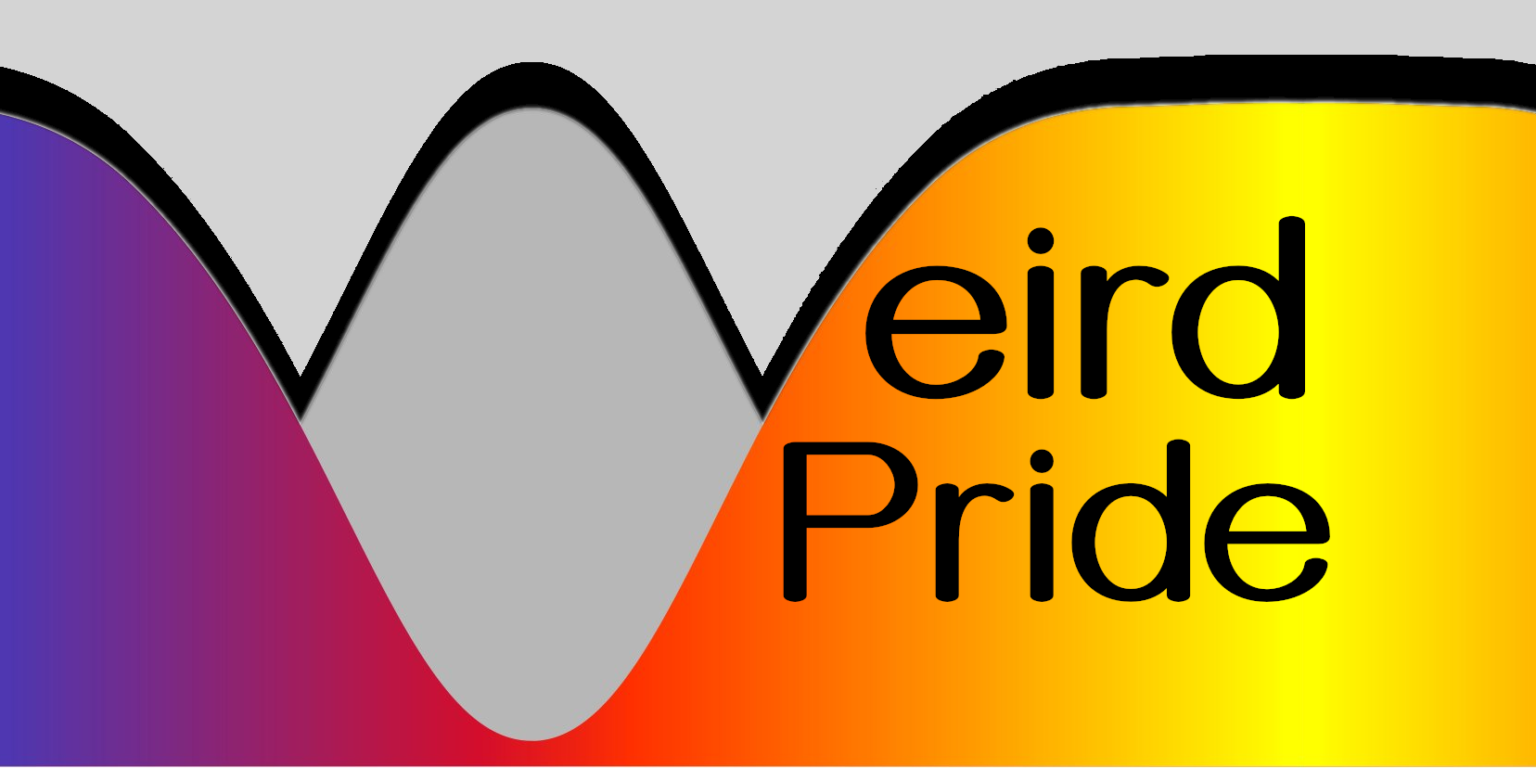
The image at the top of this essay is the ‘Weird Pride’ flag, co-created in 2021 by autistic writers, advocates, and community organisers Fergus Murray and Quinn Dexter for the first Weird Pride Day (March 4th), ‘a day for people to embrace their weirdness, and reject the stigma associated with being weird’.[33] In Murray’s words: ‘Creativity is driven by divergent perspectives, and squashed by demands for conformity.’[34] To conclude, then, I want to turn to the words of the neuroqueer theorist Nick Walker and to affirm that, by embracing what Walker calls ‘beautiful weirdness’, we can open up new possibilities not only for rejecting normative attitudes to identity but also for jettisoning the economic orthodoxies embedded in the private money paradigm. I suspect that every delegate at the ‘Weird Modernisms’ conference was there because at some point in the past they’d been willing to approach the beautiful weirdness of modernist art with an attitude of openness and trust. As Walker explains:
[A]nyone can liberate themselves from the strictures of normativity. The already neurodivergent can reconnect with, and cultivate previously suppressed or undeveloped capacities, in order to more fully manifest their potentials for beautiful weirdness, and those whom we call neurotypicals are just potential neuroqueer mutant comrades who haven’t yet woken up and figured out how to unzip their normal-person suits.[35]
My hope is that by embracing weird modernisms and by affirming, not only that money is queer but also that money is weirder than the austerity mindset that’s currently doing its utmost to destroy our universities, and indeed our planet, will ever be able to appreciate or contain, we can build a postnormal, inclusive and sustainable world and unzip our ‘normal-person suits’ (along with our normal-person monetary imaginations) together.
[1] I refer here to QMUCU’s indispensable ‘UK HE Shrinking’ webpage: https://qmucu.org/qmul-transformation/uk-he-shrinking/
[2] See, for example, Rob Hawkes and Scott Ferguson, ‘Green-Lighting Gatsby: Austere Modernisms, Exuberant Avant-Gardes, and their Orgastic Futures’, in Inflationary Modernities: Literature, Culture, and Economy, ed. Wayne Stables and Kieran Brown (Palgrave Macmillan, 2026), 21-47; and Rob Hawkes, ‘“Too paranoid for you?”: Suspicion, Trust and (Post/Meta?)Modern Money in Thomas Pynchon’s Bleeding Edge’, in Dis/Trusting the Digital World in Imaginative Literature, ed. Adam Kelly and Katerina Pavlidi (Edinburgh University Press, 2026), 185-204.
[3] Rob Hawkes and Scott Ferguson, ‘UK Universities in Crisis? Time to Transform Higher Ed Finance’, Money on the Left, 16 January 2025: https://moneyontheleft.org/2025/01/16/uk-universities-in-crisis-time-to-transform-higher-ed-finance/
[4] F. Scott Fitzgerald, The Great Gatsby [1925] (Penguin,1990), 123.
[5] Scott Ferguson, ‘Analog Critique; or, Isn’t Money Queer?’, Public Culture 37.1 (2025), 86.
[6] Rob Hawkes, ‘(Un)conditional Openness: Towards a Neochartalist Theory of Money and Trust’, Money on the Left: History, Theory, Practice 1.1 (2025), 1-42. See also Rob Hawkes, Scott Ferguson, and Will Beaman, ‘(Un)conditional Openness: Towards a Neochartalist Theory of Money and Trust’, Money on the Left, 4 July 2025: https://moneyontheleft.org/2025/07/04/unconditional-openness-towards-a-neochartalist-theory-of-money-and-trust-2/
[7] Ford Madox Ford, The Good Soldier, ed. Martin Stannard (Norton, 2012), 105-8.
[8] My first academic conference paper subsequently developed into my first academic publication, which was on this very topic. See Rob Hawkes, ‘Personalities of Paper: Characterisation in A Call and The Good Soldier ’, in Ford Madox Ford: Literary Networks and Cultural Transformations, ed. Andrzej Gasiorek and Daniel Moore (Rodopi, 2008), 43-60.
[9] Ford Madox Ford, letter to Ray Long, 2 July 1932, Letters of Ford Madox Ford, ed. Richard M. Ludwig (Princeton University Press, 1965), 208.
[10] Ford Madox Ford, The Rash Act [1933] (Carcanet, 1982), 74. For further discussion of this fascinating novel, see Rob Hawkes, ‘Trusting in Provence: Financial Crisis in The Rash Act and Henry for Hugh’, in Ford Madox Ford, France and Provence, ed. Dominique Lemarchal and Claire Davison-Pégon (Rodopi, 2011), 229-42; and ‘Bogus Modernism: Impersonation, Deception and Trust in Ford Madox Ford and Evelyn Waugh’, in Reconnecting Aestheticism and Modernism: Continuities, Revisions, Speculations, ed. Bénédicte Coste, Catherine Delyfer, and Christine Reynier (Routledge, 2017), 175-86.
[11] Ford, The Rash Act, 212.
[12] Ford, The Rash Act, 211-12.
[13] Nella Larsen, Passing [1929], in Quicksand and Passing (Serpent’s Tail, 2014), 158.
[14] Larsen, Passing, 160.
[15] ‘Andy Burnham would enter Downing Street already “boxed in” by financial markets’ according to a recent piece in the Guardian by Alex Daniel: ‘“Walking a tightrope”: Burnham’s borrowing plans clash with fiscal realities’, Guardian, 24 June 2026: https://www.theguardian.com/politics/2026/jun/24/walking-a-tightrope-andy-burnham-borrowing-clash-fiscal-realities
[16] Adam Smith, The Wealth of Nations [1776] (Penguin, 1999), 116.
[17] Karl E. Case, Ray C. Fair, and Sharon M. Oster, Principles of Economics, 10th edn. (Prentice Hall, 2012), 502.
[18] Case et al., Principles of Economics, 502.
[19] Robert D. Putnam, Bowling Alone: The Collapse and Revival of American Community (Simon and Schuster, 2000), 135.
[20] See Hawkes, ‘(Un)conditional Openness’; and Hawkes, ‘“Too paranoid for you?”’ for detailed discussions of these issues.
[21] Philippa Ryan, Trust and Distrust in Digital Economies (Routledge, 2019), 3.
[22] According to Laura Poppo, Kevin Zheng Zhou and Julie J. Li, calculative trust ‘informs expectations by deliberately and rationally assessing forward-looking conditions’ and ‘hinges on the relative values of cheating […] and cooperation’. Poppo et al., ‘When Can You Trust “Trust”? Calculative Trust, Relational Trust, and Supplier Performance’, Strategic Management Journal 37.4 (2016): 725, 724.
[23] See Derek Attridge, The Singularity of Literature (Routledge, 2004).
[24] Rob Hawkes, ‘How can novels help us think about money… and maybe even save the planet?’, Money on the Left, 26 February 2024: https://moneyontheleft.org/2024/02/26/how-can-novels-help-us-think-about-money-and-maybe-even-save-the-planetguest-lecture/
[25] Ford Madox Ford, Henry for Hugh (J.B. Lippincott, 1934).
[26] Ferguson, ‘Analog Critique’, 86.
[27] L. E. Steininger, ‘Against inflation: queer-feminist monetary (and price) theory’, Review of International Political Economy (2026), 18.
[28] Stefan Collini, What Are Universities For? (Penguin, 2012), 91.
[29] Scott Ferguson, Benjamin Wilson, William Saas, and Maxximilian Seijo, ‘Overcoming COVID-19 Requires Rethinking University Finance,’ b2o (2020): https://www.boundary2.org/2020/07/scott-ferguson-benjamin-wilson-william-saas-maxximilian-seijo-overcoming-covid-19-requires-rethinking-university-finance/
[30] Hawkes and Ferguson, ‘Green-Lighting Gatsby’, 21-47.
[31] Fitzgerald, The Great Gatsby, 49.
[32] Hawkes and Ferguson, ‘Green-Lighting Gatsby’, 33-6.
[33] Weird Pride Day (n.d): https://weirdpride.day/
[34] Stimpunks Foundation, ‘Weird’ (n.d.): https://stimpunks.org/glossary/weird/
[35] Nick Walker, Neuroqueer Heresies: Notes on the Neurodiversity Paradigm, Autistic Empowerment, and Postnormal Possibilities (Autonomous Press, 2021), 190.

[…] Modernisms conference at Loughborough University. My talk (which you can read here) argued that money is weird. This may sound like a rather bizarre claim; let me […]