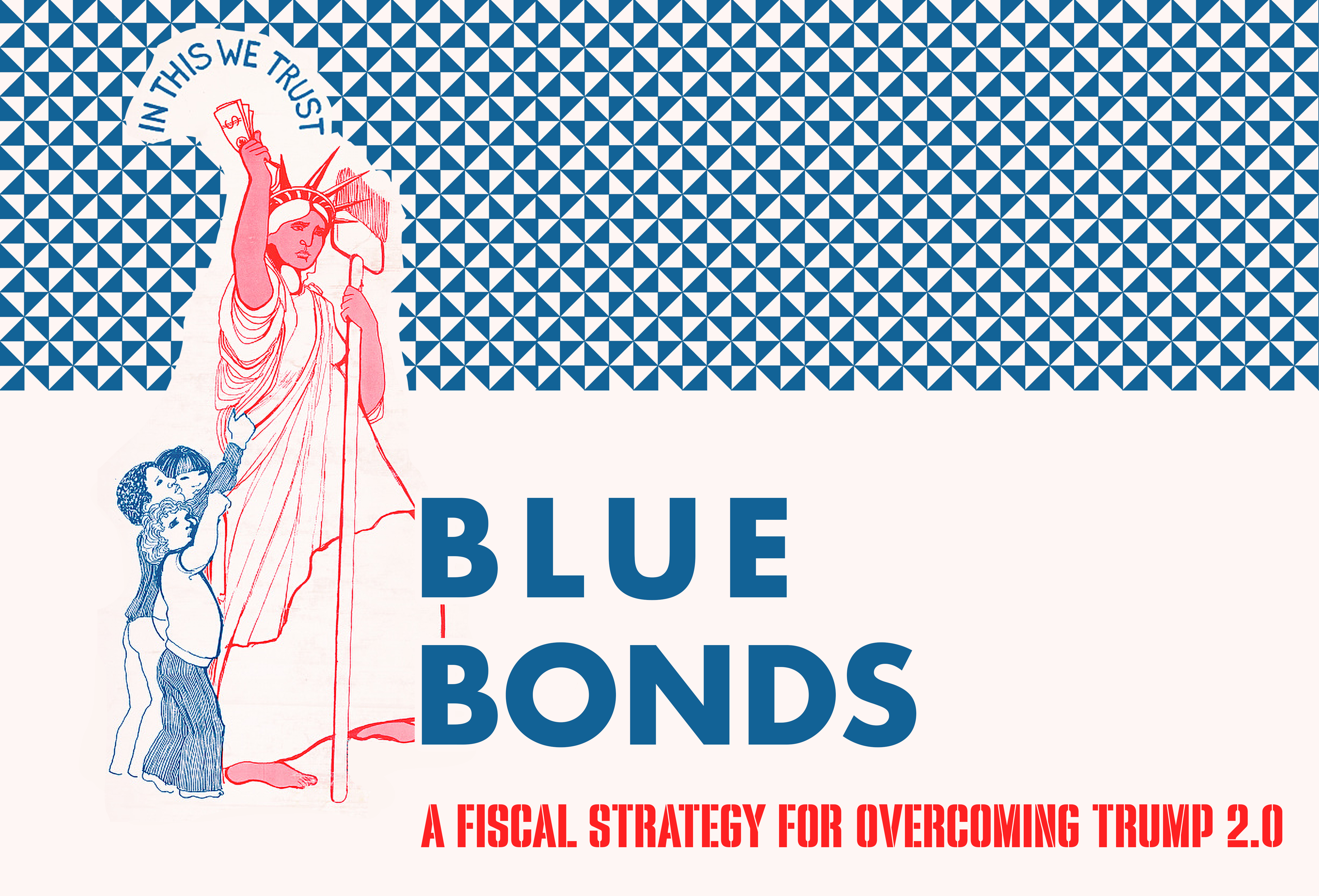
Blue Bonds Can Stop Trump’s Fiscal Authoritarianism

By the Money on the Left Editorial Collective

Less than a year into his second term, Donald Trump has launched an illegal and (as now) unfeasible mass deportation campaign—one that is tearing apart families, destabilize communities, and provoke mass resistance across the country.

He’s already begun deploying military force to enforce it.

The California National Guard has been deputized. Several Democrat-controlled cities are under threat of military occupation. And Trump’s administration is moving quickly to consolidate control over federal spending—using public money to reward allies, punish opposition, and fund his growing network of coercive agencies.

We think he’s overplayed his hand.

Authoritarian rule depends on fear, but fear alone can’t stabilize a society. To function, authoritarianism needs infrastructure. It needs jobs, logistics, paperwork, coordination. It needs people to show up and participate—to carry out orders, to staff the programs, to help make the unthinkable look routine.

Trump is relying on a kind of fiscal austerity—a politics of negative space—to suppress the alternatives and starve local capacity. But this strategy is weak and vulnerable. His agenda only works if there’s nothing else on offer.

Blue Bonds are the counter-offer.

Blue Bonds are routine municipal bonds, paired with a bold, public campaign to provision care, public employment, and reconstruction directly without waiting for permission from Washington. Jobs that communities want. Projects that rebuild trust. Wages that sustain families. A future in which people want to participate.

Instead of asking if these bonds are “creditworthy,” we flip the script. We demand that the Federal Reserve receive them—just like it already receives Treasury bonds and backs coercive public infrastructure without blinking.

This is not a financial trick. It’s a political strategy.

Blue Bonds make visible what austerity tries to hide: we already have the people, the projects, and the know-how to build a better world. What we lack is federal recognition and support. By demanding that recognition—not as a favor, but as a public right—we expose just how hollow Trump’s grip on power really is.

Authoritarians rule through fear, but they can’t govern that way forever. You don’t build loyalty or legitimacy by threatening people. You build it by showing up with care, with resources, and with good public work.

Blue Bonds do that—and they do it in a way that no speech or protest alone can.

Leaders in California such as Governor Gavin Newsom and Assembly Speaker Robert Rivas have recently floated the idea of withholding tens of billions in annual federal tax dollars as a means of resisting Trump’s executive tyranny and austerity. We affirm the impulse to vociferously politicize state money. Democrat-controlled states should be thinking big.

A California-led tax revolt, however, is a misguided half-measure. The Federal government hardly needs California’s tax dollars in order to spend and legal and operational realities would very likely obstruct such an action. Ultimately, California ought to utilize Blue Bonds to create a legal and genuinely productive circuit of credit in order take care of its communities and environs.

In the face of mass deportation, military overreach, and illegal fiscal retaliation against cities and states, Blue Bonds offer a peaceful, legal way to shift the balance of power. They don’t fight authoritarianism on its terms. They show that the emperor has no clothes—that authoritarians cannot actually sustain the work of public life without consent, participation, and public provision.

We are in a test of coordination. Trump is betting that he can consolidate power by cutting off air to everyone else.

Let’s prove him wrong. Let’s fund jobs, not jails. Let’s rebuild communities, not tear them apart. Let’s issue Blue Bonds to save the union once more.

Let’s make democratic public life irresistible.

Blue Bonds: A Press Kit

Executive Summary

Blue Bonds are an emergency bond initiative designed to protect Democratically controlled “Blue” states and municipalities from federal fiscal sabotage. Blue Bonds are not a new financial instrument. They are ordinary municipal bonds, issued through existing legal mechanisms and auctioned to institutional and private investors eager to defend democracy.

What’s new is the Blue Bond program’s volume, clarity, and purpose:

  • We issue Blue Bonds at scale to fill in gaps left by illegal federal impoundment and ongoing fiscal obstruction.
  • We name them Blue Bonds to signal what’s at stake: the Democratic Party’s commitment to communities and the planet.

When the federal government abandons states and municipalities, we must act decisively to care for our peoples and environs.

What Are Blue Bonds?

Blue Bonds are conventional municipal bonds. States and municipalities regularly issue bonds to fund capital projects like water mains, bridges, and other critical infrastructure. Blue Bonds are the same—only they are issued to meet an economic and constitutional crisis caused by federal impoundment.

Blue Bonds can be issued in the form of long-term municipal bonds as well as short-term Tax Anticipation Notes (TANs) and Revenue Anticipation Notes (RANs). Structuring Blue Bonds as both short- and long-term instruments means they can be devised with flexible interest rates and maturation schedules. 

Blue Bonds are neither risky nor reckless. They are responsible and forward-thinking.

We mobilized en masse for WWII with war bonds. We met the challenges of Covid-19 with emergency bond issuance. Now, Blue Bonds enable us to protect our states from federal havoc and devastation.

Same bonds. Different priorities.

Why Now?

  • The Trump Administration and DOGE have impounded congressionally-appropriated funds
  • A gridlocked Congress is controlled by the GOP
  • The federal purse is being weaponized against vulnerable communities
  • There is a crisis of confidence in Democratic leadership
  • Supporters of the Democratic Party want action, not mere messaging
  • The Fed continues to support private financial markets (banks, corporations, mortgage firms), but refuses to stabilize states and municipalities

We cannot afford to wait. If we do nothing, the collapse of public services will accelerate authoritarian drift.

Blue Bonds enable us to act before it’s too late.

Harnessing Democratic Support & Providing Investment Stability

  • Building on Proven Grassroots Support: The Democratic base has consistently demonstrated its power through small-dollar donations, raising record-breaking sums during the 2024 campaign cycle that can now be channeled toward critical state and municipal funding needs.
  • Creating Financial Stability During Market Volatility: As Trump’s aggressive tariff policies and international conflicts drive market uncertainty, Blue Bonds offer citizens a reliable, fixed-income investment option with predictable returns.
  • Dual-Purpose Investment: Blue Bonds serve both as a practical financial instrument and as a statement of civic values, allowing investors to earn returns while directly supporting essential services threatened by federal funding cuts.
  • Building Financial Resilience: By diversifying municipal funding sources through broad-based citizen investment, Blue states and municipalities become less vulnerable to federal funding manipulation and political pressure.
  • Transparent Impact Reporting: Investors will receive regular updates showing exactly how their Blue Bond investments are preserving essential services, infrastructure, and community programs.
  • Cross-State Solidarity Network: While issued by individual states and municipalities, a coordinated Blue Bond network allows citizens in any location to invest in and support progressive governance across state lines.

Calling the Fed’s Bluff

We ask the Federal Reserve to buy Blue Bonds and hold them on its balance sheet—just as it routinely does with Treasury securities, mortgage-backed securities, and corporate debt during times of crisis.

We are not asking the Fed to invent a new policy. We’re asking it to treat ordinary people the same way it already treats corporate and financial elites:

  • During COVID, it purchased corporate debt.
  • After SVB collapsed, it backstopped banks.
  • It routinely buys Treasury securities to stabilize national credit.

We challenge the Fed: if you can save banks, you can save states and municipalities.

Blue Bonds call the Fed’s bluff—and call in its social responsibility.

What Blue Bonds Will Fund

Priority: Replace impounded federal funds (basic operating continuity for education, housing, transit, and care).

Optional Addendum Projects: (evaluated by new Office of Democratic Resilience)

  • Public grocery expansion
  • Tenant stabilization
  • Climate adaptation (resilience centers, microgrids)
  • Direct employment programs
  • Broadband for NYCHA and public schools

This isn’t a wishlist. It’s a fail-safe.

Office of Democratic Resilience (ODR)

To manage emergency-scale Blue Bond funding and identify high-urgency public priorities, we propose creating a new coordinating body in each participating state and municipality: the Office of Democratic Resilience (ODR).

Functions:

  • Coordinate interagency bond-backed responses
  • Evaluate and execute rapid deployments
  • Interface with civic coalitions and labor unions to identify priority gaps

The goal: make emergency liquidity democratic, targeted, and fast.

Interest Funded by the Wealthy

Blue Bonds will pay interest, which participating states and municipalities can readily cover. Still, if Blue Bond interest proves to be politically divisive or daunting, then the interest ought to be funded by the wealthy.

Mechanisms may include:

  • High-income surtax
  • Repealed luxury real estate abatements
  • Vacancy tax redirection

Why?

  • Because the wealthy already benefit from public guarantees
  • Because they expect interest when they lend to the public
  • Because this time, they should help pay it forward

Messaging:

  • “The public is investing in democracy. The rich should cover the interest.”
  • “The wealthy have profited from the system—now is the time ensure its resilience.”

Union Pension Investment in Blue Bonds

Public sector unions can play a direct role in stabilizing democracy by investing portions of their pension funds in Blue Bonds.

Why This Matters:

  • It signals that labor is not just fighting for better contracts, but for the survival of public infrastructure itself.
  • It reclaims public retirement savings from risky speculation and redirects them toward collective civic security.
  • It reverses the symbolic origins of neoliberalism, when unions were pushed to invest pensions in Wall Street as a gesture of market “maturity.”

This time, union investment powers democracy.

Impact:

  • Strengthens the credibility and uptake of Blue Bonds
  • Anchors the campaign in labor-led solidarity and institutional trust
  • Offers unions a visible and dignified stake in defending our future

Messaging:

  • “Unions once fueled Wall Street’s rise. Now they can fund democracy’s defense.”
  • “Your pension should be an investment in your state—not a bet against it.”

Public Message Architecture

  • Core Message: These are just bonds. Ordinary tools. Extraordinary moment.
  • Who Buys Blue Bonds? Ordinary people, institutions, citizens who believe in democracy.
  • Why the Name? To name the crisis. To name who is taking responsibility.
  • What It Feels Like: The moral urgency of war bonds. The civic imagination of the WPA. The financial clarity of COVID relief.

FAQ

Q: Isn’t this just routine bond issuance?
A: Yes. That’s the point.

Q: Isn’t this risky?
A: Not as much as the risk of doing nothing while Washington destroys infrastructures upon which we regularly rely

Q: Can the Fed really be asked to buy municipal bonds?
A: It already buys corporate and federal debt. This is no different in structure—only in the values that it conveys.

Q: Is this partisan?
A: Is democracy partisan?

Blue Bonds: A Fiscal Strategy for Overcoming Trump 2.0

By the Money on the Left Editorial Collective

The Trump Administration has plunged the United States into a constitutional crisis. The President’s destructive executive orders and Elon Musk’s aggressive interventions in state agencies and payment systems have repeatedly violated federal law and undermined Congress’s constitutional authority over spending and taxation. Central to the right’s “Cold Civil War,” these actions not only erode the foundational principle of separation of powers; they also threaten livelihoods, ecosystems, and vital infrastructure. Some commentators have gone as far as to call it a “coup.” The resistance continues to mobilize—taking to the streets, publishing damning reports, building mutual aid networks, and challenging the administration in court. Yet such efforts still lack what is desperately needed: a comprehensive public finance program capable of countering right-wing austerity.

A powerful fiscal counter-strategy stands ready for deployment: a bond drive for democracy. Democrat-controlled “Blue” states and allied municipalities can issue municipal bonds to supplant funds illegally cut and impounded by the federal government. These Blue Bonds would represent a bold financial resistance. Blue Bonds can harness the Democratic base’s demonstrated history of small donation support. They can also furnish the public with reliable investment and savings instruments during the market turbulence resulting from Trump’s aggressive tariffs and geopolitical combativeness.

With Blue Bonds, states can replace dollar-for-dollar funds that were appropriated by Congress for state agencies. Dollars for housing and rental assistance, infrastructure and construction projects, rural energy and development, public health programs, veterans’ services, K-12 schools, colleges and universities, arts and culture: all public money previously authorized by congressional procedures should be reinstated in compliance with the Constitution. For this reason, Blue Bonds will be collateralized by constitutional law, at least initially. 

The Blue Bond scheme aligns aggressive fiscal policy with the Federal Reserve’s now-standard crisis management procedures. The Fed can purchase Blue Bonds as soon as they are issued, immediately converting them into circulating U.S. dollars. The Fed can hold Blue Bonds on their balance sheet until repaid, or until the courts settle the constitutional crisis. 

The Blue Bond uses ordinary tools in extraordinary ways. All it takes is political courage. 

Devil in a Blue Dress

The devil is always in the details. Blue Bonds, for example, can replace funds that go directly to states, state institutions, and municipalities, but they cannot seamlessly substitute all blocked federal funds on a one-to-one basis. Blue states would remain powerless to finance or resurrect federally governed agencies and programs that have been gutted or eliminated by the administration. They can only restore funds for programs under participating states’ legal jurisdiction. 

Technically speaking, Blue Bonds need not all be issued in the form of traditional municipal bonds. Any conventional state debt instrument will do, including short-term Tax Anticipation Notes (TANs) and Revenue Anticipation Notes (RANs). Structuring Blue Bonds as both short- and long-term instruments means they can be devised with flexible interest rates and maturation schedules.  

States can insulate Blue Bonds against right wing obstruction by promising to receive blue TANs and RANs in payment for taxes, fees and fines. As economists from Adam Smith to John Maynard Keynes have pointed out, money gains value not solely through private sector activity, but more fundamentally through the public sector’s willingness to accept it in payment. Thus while conservative states and municipalities may reject it, the Blue Bond’s tax-driven structure anchored in California’s and New York’s flourishing economies should safeguard its strength and stability for years to come. 

The Fed is fully equipped to accommodate Blue Bonds. Section 13(3) of the Federal Reserve Act permits the Central Bank to purchase debt in any amount “in unusual and exigent circumstances,” such as during financial crises. More than a formal possibility, the Fed has taken advantage of its emergency powers on multiple occasions in recent history. It has established what are called “Special Purpose Vehicles” (SPVs) to stabilize balance sheets across multiple critical sectors during both the Global Financial Crisis and the Covid-19 Pandemic. In 2023, it even called upon its Section 13(3) authority to redress the failure of Silicon Valley Bank. As a result, the Fed currently holds nearly $7 trillion of purchased assets and, as Central Bank representatives have repeatedly emphasized, it can continue to do so without limit. 

To purchase Blue Bonds, the Fed can revive the “Municipal Liquidity Facility” (MLF), which was established during the Covid-19 pandemic to assist sub-federal governments threatened by plummeting tax receipts. To be effective, however, this time around the MLF necessitates more capacious terms and eligibility conditions

While Fed intervention may represent the most expeditious path to success, the Blue Bond’s heart and soul remains fiscal in nature. Indeed, restructuring state finance is long overdue. For too long legislatures have been ensnared by the deceptions of sound finance, which cloak the cruelties of fiscal constraint in a false morality of sacrificial rectitude. Governments are not private businesses or households which, as the dominant narrative has it, must balance expenditures against their income. In truth, government expenditure constitutes the beating heart of the U.S. economy. Austerity is irresponsible and dangerous. 

Conventional economic discourse misleads when it refers to state debt as “borrowing.” Such language positions state governments as weak and fundamentally lacking in capacity. Public debt issuance, on this view, is akin to holding out the proverbial beggar’s hat for private sector donations. Yet the dominant conception has it precisely backwards. State debt is generative. It proceeds not from deficiency, but from robust public powers and resources. Bond issuances scaffold investment and spur social production. Legally speaking, states cannot be forced into bankruptcy. What matters, however, is precisely how states mobilize debt to facilitate qualitative aims, not the arbitrary quantity of outstanding debt circulating at a given moment.

State legislatures can further fortify Blue Bonds by repealing their balanced budget amendments via supermajority vote. Such amendments are predicated on faulty premises and unnecessarily confine fiscal capacities in every state but Vermont. Contrary to what the reigning ideology supposes, public deficits are healthy, so long as they support communities and take care of our planet. What is debt but a promise to bring about a desired outcome in the future? At this critical hour, we must relinquish our phobia of promises in the name of saving democracy. 

Besides, if Blue Bond debt grows larger than its supporters prefer, then Blue states can raise taxes on the wealthy, God forbid. For that matter, debt-skittish states can from the jump implement wealth taxes designed to cover Blue Bond interest payments. In the long run, however, a post-Trump Congress can readily take responsibility for the costs of Blue Bonds with its unlimited fiscal power: a small price to pay for vanquishing tyranny. 

Sky’s the Limit

Liberating state financing is only part of the path forward. The Harris campaign’s record-breaking fundraising in 2024 demonstrates that the American public is eager to invest in democracy, while market volatility precipitated by Trump’s reckless trade wars raises demand for secure forms of investment and savings. Irrespective of Fed participation, then, Blue Bonds in all of its forms should be made available for purchase by the wider public in and beyond Blue states. Traditional institutional investors will take the lead in purchasing Blue Bonds in large denominations. Yet through such institutions, individual investors can purchase Blue Bonds in relatively small denominations. As a consequence, Blue Bond investment stands to become a great galvanizer of democratic pride and economic stability from the financial sector to main street. 

If continuously publicized by trusted organizations and leaders, Blue Bond investment can dethrone so-called “bond vigilantes,” investors who perennially leverage their market position to undermine government’s willingness to spend. In this upside-down world, bond vigilantes sell, or threaten to sell bonds en masse in an effort to push up yields and discipline ostensibly profligate legislatures. On principle, the public sector should never simply bend to the whims of market actors. However, avid and consistent investment in Blue Bonds from the Democratic base can go far to nullify the menace of bond vigilantes, in effect, drowning their anxieties in waves of prosperity. 

Better still, Blue Bonds free states to do more than maintain existing systems that are chronically underfunded. States can innovate creatively. A capacious fiscal strategy can expand resources for state universities and children’s welfare programs, finance new state agencies to fulfill responsibilities abandoned by the federal government, and sustain vital non-profits and mutual aid networks combating the human cost of right-wing policies. Echoing calls from across the Democratic coalition to transcend mere messaging, the Blue Bond’s potential extends far beyond emergency patching to enable genuine institutional renewal. 

Make Blue states outdo each other. Blue Bonds should catalyse a “race to the top,” wherein states support communities with ample public resources and amenities, while attracting new residents with the promise of a better life. The American people desire the high-quality schools and infrastructures that Blue states provide; but they have rightly grown frustrated with the exorbitant costs that make it next to impossible to survive in such states. Blue Bonds introduce a genuine abundance agenda, not the diet Reaganism currently on offer by Ezra Klein and Derek Thompson. Instead of cutting red tape to unleash outcome-oriented markets, true abundance builds robust public systems, including newly chartered public banks, that put people over profits. 

Guided by expansive state-level public finance, lawmakers can use Blue Bonds to implement popular programs such as a Job Guarantee. Predicated on a legal right to remunerative employment, the Job Guarantee provides meaningful work at a living wage for all that wish to serve their communities. Administered by governments in cooperation with non-profits, the Job Guarantee sets a base wage and humane working conditions that private employers must match or exceed. With its focus on inclusion, participation, and uplift, such a program can help return the Democratic party to the center of working and middle class politics in a way that avoids the divisive nationalistic rhetoric that has characterized both Biden’s and Trump’s economic policies. 

Turning the Tide

Unprecedented crises demand unprecedented solutions. The Blue Bond strategy doesn’t counter illegality with illegality—it is a principled fiscal response to the Trump regime’s constitutional violations, embodying the very spirit of checks and balances. The separation of powers forms the backbone of the U.S. Constitution, designed precisely to prevent democratic collapse under authoritarian abuse. The Blue Bond initiative should therefore be advanced explicitly in democracy’s name, fortifying the American experiment’s long-term resilience against this unprecedented and destabilizing assault.

Blue states face a stark choice: They can become managers of Trumpian austerity, and struggle to keep up with the enormous pain and anger this foments. Or, they can beget prosperous Blue Bond economies that save lives, motivate voters, and model politics for the post-Trump era. 

A thriving democracy requires nothing less than rejecting Republican intimidation and liberal cowardice. The time has come for fearless invention.

Let the dollar circulate.

* The above artwork draws from “In this We Trust : The Women of the World are Serving Notice!” (Jacquie Ursula Caldwell, 1976), a political poster created for the feminist Wages for Housework movement.