It’s Time for Complementary Currencies

By the Money on the Left Editorial Collective

Introduction

Zohran Mamdani’s landslide win was not just a local upset—it was a turning point. It proved that member-led, volunteer-powered campaigns can defeat political dynasties even under conditions of national authoritarian drift. And now, others are lining up behind him. MN state Sen. Omar Fateh—another Democratic Socialist—won the local Democratic Party’s endorsement for Mayor of Minneapolis against three-term Democratic Mayor Jacob Frey. Kat Abughazaleh, a progressive digital commentator formerly affiliated with Media Matters, is winning major party endorsements for her congressional campaign in Illinois’s 9th District. More campaigns are getting ready. 

But the window is narrow, and the threat is clear. Donald Trump is terrified of an insurgent movement rising out of the cities he cannot control. His plan is to withhold federal funds, punish sanctuary cities, and weaponize austerity against local governments that refuse to comply. He wants mayors and city councils too scared to fund anything beyond police. And the Democratic establishment will go along with nearly all of it. The economic establishment will cheer it on in the name of fiscal moderation and pragmatism.

To meet this moment, we need new tactical registers–new tools for organizing local capacities and coordinating them at scale.

What follows is not a singular proposal. It is a framework for coordinating, scaling and financing the work that so many organizers do for free. A shared practice of issuing and receiving credit in solidarity—between campaigns, between cities, between institutions willing to govern together. We do not need to wait for reactionary statehouses or federal financing to tell us what’s possible. We can build systems of solidarity and accountability that scale without sovereignty.

Mamdani’s campaign did not simply win—it ran a logistical operation, coordinated policy development, and cared for people. Fifty thousand volunteers who didn’t beg for permission got organized.

To understand how we can scale up that infrastructure, we need to first understand the tool: complementary currencies.

What Are Complementary Currencies?

Complementary currencies are locally issued forms of credit that supplement and expand the currencies we think of as “official”. When imagined alongside the dollar rather than in opposition to it, complementary currencies do not merely reveal new possibilities. They help us see the dollar differently, too.

Imagine this: a canvasser in Brooklyn earns credits for a weekend of turnout work. Those credits are then accepted by another chapter to help fund a print run. A local labor union recognizes those credits as dues. A food co-op accepts them for groceries. A pilot municipal grocery store, created by a city council aligned with the movement, honors the credits for fresh produce. A sanctuary city program uses them for transit access. Under pressure from organizers, the local government agrees to accept those credits for partial tax payments, fines, or fees. This isn’t “exchange”; it’s organizing. 

Instead of treating money as a scarce resource to be unlocked from the top down, complementary currencies reveal money to be a flexible and inscribable record of solidarity and coordination. They allow communities and coalitions to express their own priorities, provision their own infrastructures, and deliberate what kinds of labor and care should be receivable across shared space. 

There are many historical precedents for complementary currencies in U.S. history—from colonial-era land bank notes and settler-issued paper money to Depression-era scrip, mutual aid societies, time banks, and local exchange trading systems—each reflecting periods when ordinary people experimented with monetary design in the absence of sufficient national currency or in response to systemic exclusion from formal credit systems. Even Lincoln’s greenbacks and FDR’s war bonds grounded new money issuance in real economic capacities rather than abstract pools of tax dollars. Money on the Left proposals like Blue Bonds and the Uni draw on these traditions to reimagine democratic finance as a practice of coordination, not austerity.

From Command to Coordination

We do not need a movement that controls everything. We need movements that can coordinate across what is already happening, provisioning at scale without turning participation into tactical bottlenecks and zero-sum debates over which “theory of change” is correct. That is already the lesson of the campaigns and organizations that are winning: field ops that trust volunteers to become leaders; member-led organizations that practice deliberative democracy; housing and mutual aid coalitions that prototype new forms of care without waiting for policy permission.

These campaigns are not spontaneous. They are deeply organized. But they are also strategically diverse. What links them is not control or discipline—it is solidarity. We need forms of coordination that let us hold many strategic priorities as valid without collapsing them into a single strategic hierarchy. That is what complementary credit experiments can offer: not a command center or vanguard, but flexible infrastructures of coordination and provision. Built from below, from diverse middles, and even daring city halls that refuse to wait for Albany’s approval.

Money as Credit, Not Scarcity

We are used to thinking of money as something we need to get—from donors, from state budgets, from foundations that never quite agree with our politics. At the heart of a complementary currency strategy is a different understanding of what money is. Money is not a scarce thing to be hoarded or unlocked. Nor is it a capitalist medium of exchange. Money is a flexible infrastructure of recognition, designed through politics. 

Because the truth is, we already can do the things that we supposedly need billionaires and middle class taxpayers to fund. Indeed, we already do extend care, time, labor, risk, translation, food, design, coordination, and protection across every campaign, community org, and institution that we build.

Complementary currencies do not introduce a new kind of value. They enlarge the democratic value systems that already exist—and allow wider scales of recognition and inclusion in the infrastructures we need to live.

In an insurgent democratic politics, no single node of issuance or receivability calls all the shots—but each one takes responsibility to extend trust and good faith as part of a shared infrastructure of democratic provisioning.

Swap Lines as Democratic Pedagogy

The left does not need central discipline from a vanguard of strategists or an idealized mass organization imagined as external to the broader public. We need infrastructures that enact the same solidarity and flexibility we already extend to each other, honoring diverse valuations of what work is important, and agreeing to receive what others provision—even when it comes in unfamiliar forms.

That is the logic of a swap line.

In high finance, a swap line is a mutual agreement to recognize credit across systems without collapsing them into one. Central banks use them to stabilize currencies, but the principle of connecting different currencies to facilitate economic coordination shows up everywhere. It is how bank deposits, paper money, coins, reserve—all forms of money with different institutional histories—come together to make the US dollar feel singular and continuous. What appears as the dollar or imagined as a gold standard has always been an invisible choreography between institutions.

But that invisibility is part of the problem. As Jakob Feinig argues, monetary systems are kept deliberately opaque, a process he calls monetary silencing. The more our systems rely on coordination, the more that coordination is hidden, treated as technical or natural rather than political and participatory.

Complementary currencies make the logic of the swap line public. They give us ways to politicize the agreements we already depend on, to deliberate openly about what kinds of work and care we’re willing to receive—and from whom. They turn financial interoperability into a practice of democratic solidarity.

Monetary Silencing and the Battle for Legibility

This political moment isn’t emerging in a vacuum. For decades, our fiscal and monetary institutions have rehearsed a worldview in which credit is something earned—a borrowing right extended only to the deserving. But “deserving” has never been neutral. Creditworthiness has long stood in for segregation, racism, and exclusion—baked into zoning laws, lending practices, public education funding, and municipal bond markets. Home loans, student debt, and city budgets were more than neutral financial instruments. They rehearsed the ideologies of American racism: who belongs, who can be trusted, who is safe to invest in, and who must be controlled or abandoned?

That regime fractured in 2008. Some responses moved in a hopeful direction: mutual aid networks, debt resistance campaigns, diverse anti-carceral movements from Black Lives Matter to the mainstreaming of abolition and defund, and resurgent interest in public banking and economic democracy. But the collapse also made room for something else. If the 20th century home loan once staged middle-class exceptionalism, Trumpism offered a permission structure for outlaw cruelty. A way to break rules without consequence, to treat others’ suffering as proof of one’s own sovereignty.

But that is not the only story. Mutual aid networks, abolitionist coalitions, and movements like Mamdani’s have rehearsed alternative credit infrastructures—ones grounded not in discipline, but in coordination, care, and lived solidarity. These movements did not necessarily name their practices as monetary, but they began to build the legibilities we need to overcome monetary silence. They have not been able to fully elaborate these unconscious participatory impulses. Still, they have created the conditions to make such impulses visible–and to politicize them.

Complementary credit systems offer a trajectory for elaboration. They do not moralize worthiness. They do not reward obedience. They do not ask who deserves a loan. They rewrite the script, treating credit not as exception, but as infrastructure: a shared capacity to issue and receive trust without hierarchy or purity tests. 

The issue is not whether labor is paid or unpaid—credited or uncredited. Nominally “volunteer” labor builds good faith and trust within a community, but that kind of credit is not usable at a grocery store. What is relevant is where credit is receivable. Today, as campaigns like Mamdani’s promote pilots of municipal grocery stores and other public institutions, we have the opportunity to publicly deliberate receivability itself. We no longer need to maintain the fiction that political labor and public provisioning belong to separate spheres. We can develop new forms of credit—and new institutions that receive them—to bridge the false binary between activism and public works, and to reveal that distinction as something far more messy, lived-in, and democratic than we’ve been taught.

Insurgent campaigns like Mamdani’s are not pausing for Albany’s blessing. They are already rehearsing a creative, coalitional politics—one that provisions capacity across communities, builds trust across organizations, and coordinates across difference. Complementary credit systems do not replace that work. They extend it.

Conclusion: Coordinating What We Already Know How to Do

There is no shortage of capacity on the left. We have organizers, campaigns, coalitions, and institutions already doing the work of governance: feeding people, housing people, translating policy into action, building coalitions across lines of difference. What we lack is the infrastructure to recognize that work as connected.

Complementary credit systems can help us coordinate what we already know how to do. Not by replacing the dollar or disavowing the state, but by recognizing that public trust is not something we must win permission to issue. It is something we are already extending to each other, every time we organize a shift, open our homes, cook a meal, or build a spreadsheet.

This is not a project of exit. It’s a project of refusing to defer. We need not delay unlocking capacity for a future administration. We can name what we are already provisioning—and build systems that make that provisioning visible, receivable, and durable across space and time.

What we’re describing is not a singular plan. It’s a tactical register—one that can help insurgent movements reimagine good government not as control, but as coordination. This is not bureaucracy; it is collective trust. In the face of austerity threats and coercive attacks, we need cities and campaigns willing to issue and receive public credit in solidarity. Not someday, but now.

An insurgent movement of good government connected by local currencies can spread courage and coordination faster than Trump’s tenuous coalition of the fearful and battered ever could.

Accounting Identities or Accounting Analogies?

by Will Beaman

Most people’s first exposure to Modern Monetary Theory (MMT) comes with a gentle promise: It is just accounting. The government’s deficit is the non-government sector’s surplus, by simple double-entry logic. Sectoral balances show it clearly—your fear of public debt is a confusion. Every liability is someone else’s asset. The numbers must sum to zero.

This framing has done enormous work. It has disarmed austerians, reassured the cautious, and made deficits sound boring in the best possible way. If money is just a set of balancing books, then maybe we can stop moralizing it. Maybe we can finally get to the real work of provisioning public life.

But even within MMT, the picture is more complicated than is suggested by the T-account’s clean offsetting lines. One of MMT’s most striking ideas—the proposal for a job guarantee—quietly shows why. At first glance, the job guarantee seems to illustrate a familiar differentiation between obligations and rights: the public commits to spend, creating jobs, while people get to work. Obligations and rights line up, tidily offset on the ledger. Each person’s duty is matched by someone else’s claim. It is a vision of economic life built from clear, reciprocally balanced units. It implies a methodological commitment to difference, where every distinct role is defined precisely by not being its counterpart.

Look a little closer, however, and the job guarantee reveals something more interesting. A right to a job is not simply the opposite of a duty. It mixes together rights and duties. After all, a job in such a program is both a right to work and a duty to fulfill one’s role in that job. The job guarantee thus entangles provision, participation, maintenance, and shared decisions about what kinds of work matter. Who is supporting whom? Who is being guaranteed by whom? It is hard to say, because these functions are detailed and diverse, constantly overlapping and rebalancing. 

The point is not to collapse differences into sameness, or to stage every difference as a kind of isolated disjunction. It is that these differences lean on each other, line up in ways that let us keep building a shared life. We at Money on the Left call this an analogical metaphysics because it describes how unlike contributions and claims can still coordinate, not by forcing them into sameness or opposition, but by letting them participate together in shaping what we owe and receive.

Seen through the prism of analogy, the job guarantee is more than a clever accounting offset. It helps us glimpse how the very categories of rights and obligations stand neither in one place nor wholly still. They are not parceled out among atomized people and perfectly counterweighted. They are always being provisioned and adjusted through systems that rely on many roles at once—linked by analogy, not by strict equivalence or pure contrast.

To recognize the full social power of sectoral balances, we must move beyond seeing them as either reassuring identities or sobering non-identities, and instead approach them as sites of relational coordination. The theory of sectoral balance works by showing that government deficits and private surpluses are equal and opposite. But then, almost inevitably, comes the clarification: yes, they are numerically identical, but experientially and socially they are not the same. Owing is different from being owed. Holding a government bond is not the same as carrying the tax obligations that ultimately sustain it.

This move—from identity to non-identity—has been crucial for demystifying fear around public debt. It has helped people see that when the government spends, it simultaneously creates private savings. That the line from liabilities to assets does not mark a fall from grace, it is just how collective economic life is recorded.

And yet, even this picture can be more limiting than we realize. It rests on the idea that there are discrete obligations and discrete entitlements, held by discrete people, neatly offsetting each other in the social ledger. You can see this logic everywhere, even in critical traditions. Legal realists, for example, did vital work by showing that rights imply obligations—that private property is not really a relationship between you and an object, but between you and everyone else with respect to that object. It is a crucial insight that exposes how social these arrangements always are. But it often still pictures them as static, reciprocal claims: your right is another person’s duty, precisely counterbalanced. It reveals the contingency of property or contract, yet does not quite unsettle the deeper frame of equal-but-opposite units distributed among atomized individuals.

This is broadly characteristic of the methodological commitment to difference that is found across myriad critical traditions from the humanities to legal theory. It proceeds from an image of agency as refusal and non-identity—as a break or departure from whatever has tried to define us. By contrast, Money on the Left’s analogical metaphysics begins from subtly different premises. It sees agency not primarily as an act of refusal, but as a form of non-identical participation: a way of entering into shared systems and relations that never collapse our differences, yet still provision us together.

So maybe what we are seeing here is not a shift from identity to non-identity, but something else entirely—a deeper logic of analogy. An identity tries to equate things, to say they are the same in all the ways that matter. A statement of non-identity unquestioningly insists they are not the same, often leaving them standing apart. But an analogy allows different varieties of contribution, need, and entitlement to resonate with one another—to lean in, adjust, and coordinate without collapsing into sameness. It is a way of linking relationships that are not reducible to a single measure, yet are not altogether unrelated either. Different varieties of participation can still echo across shared infrastructures, sustaining life together even when they do not match or mirror each other exactly.

Yet an analogical view of sectoral balances does not dissolve difference into uniformity or reduce participation to equivalence. A balance sheet, seen this way, does not flatten everything into sameness. It becomes a tool for tracking how these diverse obligations and promises continue to rely on one another, sometimes matching, often overlapping awkwardly, always requiring ongoing attention. At its best, this is what MMT illuminates: that ledgers stage analogies rather than identities. They do not capture a pure equivalence that might later turn out to be false, as in so many liberal or Marxist accounts of money as a failed or mystified sameness. Instead, they set up relationships that were never supposed to be identical — relationships that hold together by analogy, linking what is unlike in ways that still let it provision us.

This matters for how we think about politics across global, national and local registers. Take Zohran Mamdani’s broad coalition in Astoria, which I have written about elsewhere. Mamdani did not win by treating the city as a flat service provider handing out identical benefits. It brought together renters, workers, immigrants, and small business owners, each helping sustain the city in ways that were detailed and diverse without being exactly the same. By that same logic, we could also push back on the common view of free buses as a simple consumer giveaway that drains the city budget. Instead, we might see them as a living asset: building capacities and relationships that far exceed what shows up on a fiscal spreadsheet.

It is not hard to imagine a small pilot in New York that plays this out more explicitly—say, a modest community service program that offers credits for helping at local cleanups, libraries, or tenant meetings. Those credits could be quietly recorded across the ledgers of multiple public benefit corporations that already keep the city going: the MTA, NYCHA, HDC, even the water authority. Each could treat these credits not only as costs or subsidies, but also as partial assets that help sustain their own infrastructures—a way of literally accounting for how participation builds collective capacity. It is one loose idea for how we might use the ledgers we already have, not only to tally expenses, but to reflect all the different ways we help build and maintain the city together.

Which might be the deeper promise hiding inside MMT all along. It is not merely that we can afford more spending, or that debts do not matter the way we were taught. MMT reveals that our lives are already held together by a web of overlapping credits and obligations, none of them exactly the same, all of them linked by analogy. Accounting can still show us how to balance, but only if we let it reveal what we are balancing for: the chance to provision a world that holds us, differently and together.

How to New York Times-Proof Mamdani’s Playbook: Turning Coalition Specifics into Fiscal Possibilities

by Will Beaman

In a recent video recapping his primary victory in Queens, Zohran Mamdani did something almost radical for today’s political landscape: he cut through the usual Beltway euphemisms and mapped out the varied, living elements of the coalition that won.

Most postmortems stay tangled in polite code. We get anxious talk of “electability,” “swing voters,” whether the left is “too extreme.” It’s what my Money on the Left colleague Billy Saas calls “rhetorical red tape” — language that sounds prudent while quietly narrowing what’s imaginable.

Mamdani’s video blew right past that. Instead of treating voters like abstract blocs, he named them: South Asian neighborhoods in City Line, Ozone Park, and Jamaica Hills; Latino communities in Corona, Washington Heights, and Woodhaven; many of the same Chinese voters who had turned out for Trump in Flushing, Chinatown, and Bensonhurst; and young Black New Yorkers in places like Harlem and Flatbush. It wasn’t just sharper. It was an inviting kind of specificity — the sort that gives others something to riff on, remix, and grow. A coalition rendered in flexible detail, practically begging for more hands to join and expand it.

He even zoomed in on remarkable local swings: Brighton Beach, which had gone for Trump by 44 points, flipped to Mamdani by 16. College Point, a plus-11 Trump neighborhood, swung eight points to his campaign. They flipped Crown Heights by 45 points, North Corona by 33, and Jamaica by a staggering 57. It all added up to a mosaic that conventional wisdom — and most turnout models — completely missed.

The fiscal conversation needs this same generosity

So why do our fiscal debates still drown in stale, cautious language? We hear more red tape: “How will you pay for it?” “What if taxpayers flee?” “Is this fiscally responsible?” It’s all carefully coded to sound like common sense while discouraging deeper questions or bolder plans.

But what if we approached local financing like Mamdani approached his voter coalition? What if, instead of defaulting to old tropes about budgets and bond markets, we laid out the city’s diverse, adaptable capacities — in vivid, participatory detail?

Imagine short videos or posts that show:

  • The 30 million square feet of city-owned buildings that could be reshaped into clinics, childcare centers, or climate hubs.
  • Parks Department crews and gear, already skilled, open to new kinds of neighborhood care.
  • The Health + Hospitals system, sturdy yet brimming with potential under local fiscal tools.
  • Thousands of underemployed youth who could be hired to green roofs, retrofit apartments, care for elders — whatever we dream up together.

Once you see it, the question stops being “Can we afford it?” and becomes “Why aren’t we weaving this into something more ambitious?” It shifts from a cage of prudence to a field of possibilities. It arms neighbors, tenants, unions — anyone paying attention — with the raw materials to start sketching their own expansions.

Meanwhile, the right is already doing this — in covert, coercive ways

Look at Trump’s ICE expansion plan. It’s not some hazy threat; it’s meticulously mapped out: $50 billion to build detention centers, hire new agents, embed local economies in raids and removals. But notice — it’s never presented that way. There’s no campaign video laying out who stands to benefit or inviting communities to shape how these resources will be used.

Instead, it’s done by stealth and indirection, quietly tying economic relief for some to the growth of a modern gestapo. It manipulates public opinion not by openly building coalitional power, but by splintering it — making certain towns materially reliant on policing and detention, so that backlash fractures into local self-interest.

It’s a deeply demobilizing and disempowering use of fiscal power, designed precisely to prevent the kind of open, participatory strategizing that Mamdani’s coalition breakdown encourages. Where his approach lays out possibilities that anyone can join and reshape, Trump’s operates by backdoor compulsion — binding jobs and budgets to cruelty, without ever saying so outright.

A blueprint for Trump-proofing — and New York Times-proofing — New York City

That’s why Mamdani’s style of vivid coalition storytelling hints at something urgent. Imagine if his next video did for the city’s fiscal fabric what he just did for his voter base: named it, mapped it, showed how easily it could be recombined into new forms of shared work and care.

So when Albany, billionaires, or Trump try to choke off funds, New Yorkers don’t flinch. They’ve already seen what’s abundantly available in their neighborhoods — and they’re halfway to figuring out how to link it up through Blue Bonds, local payroll guarantees, or municipal swap lines.

It’s a way to Trump-proof the city, by showing we’re not stuck waiting on federal mercy to pay ourselves to do work we’re more than capable of staging together in countless ways. And it’s a way to NYT-proof the city, undercutting the familiar hand-wringing that usually sets in when local projects run up against manufactured crises.
This is what Money on the Left has argued all along: money isn’t some distant pool of permission. It’s a means of weaving together the diverse, often overlooked capacities we already provision for each other. But that’s not just a technical point. It’s an invitation to cut through the old cautious scripts and replace them with stories so textured, so flexible, so participatory, they practically insist we jump in and try something new.

Assignment Prompt: A Classroom Currency Experiment

Adapted from a prompt by Professor Benjamin Wilson (SUNY Cortland, Spring 2025), this assignment encourages students to perceive money and the labor it mobilizes as social forms that we can collectively remake. We share it here for educators and organizers invested in expanding the democratic imagination.

Introduction

Traditional economics defines and models money as a commodity like all other commodities—a modeling choice that renders money neutral or irrelevant to economic functions. This theoretical invisibility of money stands in stark contrast to lived experience, where virtually nothing occurs without monetary circuits connecting issuance to redemption, from securing food to maintaining shelter.

While orthodox economics treats money as merely facilitating trade, other schools of thought often characterize money as extractive or harmful, encouraging selfish behavior and decisions that may harm others. Even Modern Monetary Theory (MMT), which centers money in its analysis, incorporates undertones of state violence and coercion in explaining money’s value.

Margaret Atwood offers a provocative alternative perspective in her 2008 work Payback, where she examines debt’s literary history and the stories used to justify extractive social relations. She argues:

“Like all our financial arrangements, and like all our rules of moral conduct—in fact, like language itself—notions about debt form part of the elaborate imaginative construct that is human society. What is true of each part of mental construct is also true of debt, in all its many variations: because it is a mental construct, how we think about it changes how it works.”

This observation raises compelling questions: How can we change how we think about credit/debt relations? Is it possible to change how money actually works?

The Experiment

Hypothesis: If money is a designed human construct, then we can design experiments that test various design elements to yield alternative outcomes.

Theoretical Framework

Our classroom monetary model incorporates two fundamental design elements that establish money as a public project:

  1. The Tax Circuit: Following the model used by currency-issuing governments, taxation creates demand for the currency. The tax doesn’t fund government activity but establishes need for the currency, making it receivable throughout the economic system. This creates a circuit from issuance to redemption that gives money its social power.
  2. Real Resource Constraints: While the currency issuer faces no financial constraints (except socially constructed ones), real resource constraints remain. If no people are available to do work, you cannot mobilize them through monetary payment. That said, real resources are also socially constructed, which means that such constraints are mutable over the long term. 

Implementation

Currency Creation as Governance: Students will earn classroom currency ([insert your currency name]) through productive activities. As the monetary authority, the instructor can issue unlimited currency but cannot create additional real resources (time, labor, expertise). This demonstrates money as a creature of law and governance, not alleged “market forces.”

Tax Obligation as Demand Creation: Each student enterprise faces a tax of [X amount] in classroom currency. This tax obligation creates demand for the currency and establishes its circulation within the classroom economy, completing the circuit from issuance to redemption.

Monetary Philosophy: Rather than treating money as a commodity or medium of dyadic trade, we define it as a collective relation and accounting tool. Money represents both credit and debit, asset and liability—an IOU or promise to pay. When students earn currency, they hold an asset while the instructor holds a corresponding liability, creating the collective relationship that gives money meaning.

Enterprise Structure and Goals

Organization

Students form social enterprises of [3-5] members. Each enterprise must collectively earn sufficient currency to meet all members’ tax obligations ([X × number of members]).

Objectives

The primary goal extends beyond mere tax settlement to achieving the highest level of public good production, including enhanced student learning outcomes. Enterprises may organize efforts in various ways:

  • Collective action with shared responsibilities
  • Individual optimization with separate efforts
  • Hybrid approaches combining cooperation and specialization

Earning Opportunities Through Public Purpose

Students can earn classroom currency through activities designed to serve public purposes while providing personal development:

  1. Community Service: Volunteer work with non-profit organizations, mobilizing underutilized labor for social benefit
  2. Academic Engagement: Attendance and participation in approved campus cultural and intellectual events
  3. Research Participation: Data collection exercises supporting academic research
  4. Enhanced Class Participation: Above-and-beyond contributions to class discussions and peer learning support

[Instructors should customize these categories based on institutional resources and learning objectives]

Strategic Considerations

Enterprises should consider these questions when organizing their efforts:

Impact Assessment:

  • Can your enterprise create impact across all earning categories?
  • Will you specialize in particular areas?
  • How will you measure and assess your impact?
  • What quantitative measures will you track (people reached, events attended, meaningful contributions?

Organizational Design:

  • What institutional parameters will you establish to generate collective success?
  • How will these parameters evolve during the semester?
  • Will leaders emerge naturally or be formally designated?
  • How will you resolve conflicts and make decisions?

Learning Outcomes

This experiment illuminates several key concepts about money as a public project:

  • How monetary circuits from issuance to redemption create social relationships
  • Money as a creature of governance and law rather than so-called “market forces”
  • Alternative values and motives beyond profit maximization
  • Non-zero-sum approaches to production through public purpose
  • The interplay between competition and cooperation in productive activity
  • Benefits of effort and work outside traditional wage relationships
  • How different monetary designs generate different forms of production and returns
  • Money’s role in mobilizing underutilized resources for public benefit

Assessment and Data Collection

Qualitative Assessment

Students submit reflection essays addressing:

  • Enterprise impact and innovation strategies
  • Leadership emergence and conflict resolution
  • Changes in understanding of money’s function as a public project
  • Implications for real-world monetary systems
  • Comparative experiences (e.g., non-profit vs. retail work)
  • Collaborative work satisfaction and challenges

Quantitative Metrics

  • Hours of community service and resource mobilization
  • Data collection contributions
  • Campus event attendance
  • Course assignment performance
  • Comparative class performance (if applicable)

Timeline and Payment Schedule

Tax Day: [Insert date – typically end of semester] Payment Opportunities: Regular class sessions and approved events Documentation: Students must complete effort verification forms and obtain appropriate signatures for currency payment

[Instructors should establish specific procedures for currency distribution and verification]

Research Questions

This experiment helps verify or reject our central hypothesis while exploring broader questions:

  • Can monetary systems be designed as public projects to improve human happiness and well-being?
  • How do circuits of issuance and redemption create different social relationships?
  • Are such improvements subject to diminishing returns?
  • Does this demonstrate money’s potential as a tool for mobilizing underutilized resources?

Adaptation Guidelines for Instructors

Customization Considerations:

  • Adjust currency amounts based on class size and semester length
  • Modify earning categories to reflect available institutional resources
  • Adapt enterprise size to accommodate class enrollment
  • Establish verification procedures appropriate to your context
  • Consider incentive structures that align with your learning objectives

Implementation Tips:

  • Clearly communicate the experimental nature and learning goals
  • Establish partnerships with campus organizations for earning opportunities
  • Create simple tracking systems for currency distribution
  • Plan regular check-ins to monitor enterprise progress
  • Prepare discussion prompts to connect experiences to theoretical concepts
  • Emphasize money’s role as governance tool rather than market mechanism

This experiment transforms abstract monetary theory into lived experience, helping students understand money as a social technology and public project that can be redesigned to serve different purposes and values through circuits of issuance and redemption.

Care After Structure

by Scott Ferguson

This essay accompanies After Structure, an exhibition curated by Mark Fredricks for University of South Florida’s Contemporary Art Museum, June 13 – August 2, 2025.

After Structure brings together works by Richard Tuttle and Mike Cloud to reconsider a notion that is central to modern visual art: structure.

The question of structure has long divided critics and art historians. Art is autonomous, says one tradition; its structure must be bounded, self-sufficient, and free from external contamination.1 Think Mondrian, Pollack, and Hirschhorn. Art should be integrated into everyday life, retorts the opposition. They point to Duchamp, Warhol, and Bruguera for whom structures are open, participatory, and receptive.2

After Structure transcends the terms of the dispute by foregrounding far-flung riddles of care.3 In doing so, it challenges what both sides unwittingly share: an attachment to the artwork’s physical location in the here-and-now. Commencing from the here-and-now compels art to choose: autonomy or integration, containment or exposure?4 Care, however, is omnipresent. Unlike structure, it concerns everything and anything, admitting no necessary trade-offs between inside and outside, near and far.

What, then, comes after structure? The exhibition answers this query by way of seemingly opposed strategies. At first glance, Tuttle’s series of encaustic monotype paintings on muslin appear woefully under-structured. Colorful splotches, smudges, streaks, and drips on white are delicately pinned to the wall, forgoing the solidity and support afforded by customary framing. On closer inspection, the apparent fragility of this arrangement reveals a highly structured configuration sculpted by precise drapings, curls, creases, and folds. Conversely, Cloud’s pieces give an initial impression of over-structuring. Painted mottles, figures, signs, and symbols spread across multiple strata of paper, photographs, cloth, and wood. In several works, Cloud deploys a superabundance of irregularly cut or broken stretcher bars to create criss-crossing patterns, borders, and frames-within-frames. With time, however, structural profusion gives way to systemic precarity, as compounding instances of overlap, mismatch, and imbalance imperil the art’s material and semantic integrity.

Richard Tuttle, Renaissance Unframed #21, 1994.
Mike Cloud, Body Builder Paper Quilt, 2010.

Through these inversions, Tuttle’s and Cloud’s works enfold structural insufficiency and excess into a single dynamic that construes aesthetic form as a problem of boundless care. Breaking with dominant models of structure, care circumvents eternal oscillations between openness and closure, unity and dissolution. It denies hard ontological boundaries, on one hand, and radical lawlessness, on the other hand. In After Structure, aesthetic saliencies, fissures, and edges admit no primordial exclusion. Smudges, crumples, and shards show little tendency toward disintegration. When Tuttle forsakes traditional framing, we discover quickly that any attempt to flee care’s responsibilities routes us back to fresh aesthetic quandaries and needs. In this deliberate destabilization, Tuttle compels us to consider: How else might we buttress social forms when customary supports become inadequate? When Cloud’s contributions multiply structure to the point of bewilderment, dozens of fresh vulnerabilities and hazards emerge that even the utmost care cannot master. In this labyrinthine complexity, Cloud poses a vital question: How to heed exigencies and complications that develop from fervid organization?

In this, care after structure demands a commitment to what might be called remote co-presence. Care is irreducible to proximity. Its forms do not merely circulate from one place to another. Its causal horizon requires no immediate displacements. To the contrary, care convenes meaning in disparate locales at once. Its forms engage non-adjacent events and concerns. Its causality encompasses the whole of collectivity. The mysteries of belonging–of joy as well as suffering–remain inescapably ubiquitous. Why should art proceed any differently?

In After Structure, care’s remote co-presence turns the conventional image of structure on its head. Take Tuttle’s series of twenty-five monotype paintings, tellingly titled Renaissance Unframed, which was completed at Graphicstudio in 1995. Visibly indebted to both Minimalism and Conceptualism, Tuttle’s frameless canvases lend painting’s surfaces palpable, even sculptural, qualities. Yet the works’ conceptual gesture is hardly unidirectional; it does not advance from flatness to volume à la Minimalism. From start to finish, surface markings diversely shape the muslin’s perceived texture, pliability, and weight. Reciprocally, each sculpted pleat, bend, and crinkle communicates from afar no less than Tuttle’s painterly inscriptions. It is not simply that the hand of the artist is forever absent. By relying on museum or gallery officials to carry out the artists’ detailed instructions for pinning, hanging, and folding, Tuttle’s canvases indicate that art depends on constant mediation at a remove.

It is tempting to read the heavy bronze floor sculptures that accompany Renaissance Unframed as stabilizing perceptual anchors for viewers faced with the uncanny origami of Tuttle’s painted fabric. It turns out, however, that these ponderous elements participate in mediations that are no less remote and playful. The sculptures are cast from a Styrofoam carving then coated with a jet black patina. Their contours recall the roughness of basalt, the igneous rock that Robert Smithson arranged en masse in his monumental land art sculpture, Spiral Jetty (1970). Yet the impenetrable density and smooth inner faces of Tuttle’s sculptures maintain the trappings of highly manufactured artifacts. The sculptures come in pairs, each half giving the appearance of having been sliced neatly in two. Although circumstances vary, installation guidelines instruct exhibitors to fit the two parts together and place them on the floor precisely one foot in front of each wall hanging. Positioned this way, Tuttle’s bronze sculptures at once activate and whimsically undermine minimalist phenomenology. With Minimalism, what Robert Morris once characterized as “the autonomous and literal nature of sculpture” puts into question the corporeal orientation and movement of artist and viewer in a manner that trades painterly illusionism for direct reckonings with a universal gravity.5 Minimalism, at least on this account, achieves art’s elusive dream of autonomy by contracting gravity’s all-consuming pull into a circumscribed arena—one where freedom emerges by leveraging inner balance against outward resistance.

Richard Tuttle, Renaissance Unframed #10, 1994.
Richard Tuttle, Renaissance Unframed #26, 1994.

When it comes to Tuttle’s floor sculptures, however, Morris’s “obdurate, literal mass[es]” become optical and signifying riddles, which mediate physical things and forces from the jump.6 The sculptures present a tripping hazard to viewers engrossed by the wall hangings—a subtle challenge to museum officials striving to balance aesthetics with safety. One wonders: Is litigation merely another medium in the artist’s toolbox? Tuttle’s instructions recommend the use of a compass to align the two pieces along the north-south axis of the exhibition space and, of course, the planet. In this sense, the pieces function as geometric points that, together, form a line that wraps around the globe. As a consequence, Tuttle’s sculptures simultaneously satirize and profoundly amplify routine museum safeguards—floor demarcations, signage, and vigilant personnel—employed to preserve artistic works. Where exactly does the essence of the artwork reside? When, if ever, does concern end?

With Cloud’s ultra-structured fabrications, After Structure turns care’s ambit toward persons, domains, and events that one will likely never know or experience in any direct sense. In contemporary parlance, the established term for such phenomena is “parasocial,” defined as one-sided and ostensibly imaginary relations with celebrities, influencers, or fictional characters with whom one has no immediate or mutual interactions. Social scientists and cultural commentators regularly evaluate the costs and benefits of parasocial relations. Parasocial investments can be beneficial in moderate doses, they claim. Yet because this discourse fundamentally pathologizes physical separation and unreciprocated feelings, purveyors of such reasoning fret that inordinate parasocial devotion is damaging to psychological well-being.7

Cloud’s work weighs questions of remote association from a more salutary vantage. Cloud does not assume an atomized subject, whose flirtations with real and make-believe strangers teeters dangerously between health and illness. Instead, his art affirms sociality’s wide breadth at the outset. From here, Cloud deploys what he describes as “a wide range of marks, symbols, motifs, palettes and forms” to query traumas and ecstasies, fascinations and repulsions. The resulting lexicon is singular, heterogeneously shared, and thoroughly social. Cloud reports that he is frequently inspired by contemporary news stories. Sometimes, he includes URL addresses for news sources within the compositions of works themselves. When Cloud variously problematizes and hyperbolizes structure, it is this captivating realm of parasociality that commands our attention.

Take Rabbit Quilt (2008), which treats mismatched pajamas as canvas and make-shift frame. The pajama bottoms display the queer children’s television character SpongeBob SquarePants in pirate paraphernalia. The tank top comes from U. S. illustrator Jim Benton’s cynical novelty brand, It’s Happy Bunny. It features a pink, smiling bunny flanked below by a less-than-clever slogan: “You are perfect–except for 9 or 10 things.” (More acerbic quips from the same line of merchandise include, “Hi Loser” and “You suck, and that’s sad.”) Here, Cloud joins top and bottom in a roughly hewn fashion to construct something like a quilt of 1990’s pop juvenilia, a cross-section of high-neoliberal commodity culture.

Mike Cloud, Rabbit Quilt, 2008.

Significantly, Rabbit Quilt’s central seam draws attention to micro-generational rifts between the inclusive zaniness of SpongeBob and the misanthropic irony of Benton’s black-pilled cutesiness. As a result, “tops” and “bottoms” (in multiple senses) bristle uneasily side by side. Across the textiles, Cloud paints an impressionistic calico rabbit in mid-sprint, which enmeshes the aforementioned rift in ‘90’s youth culture in wider historical thickets. Is this a primordial cave painting of a totemic animal that is spellbound by movement? Is it roadkill flattened pajamas-and-all by a careless semi-truck? Is it Br’er Rabbit, the anti-authoritarian trickster from the Afro-American oral tradition, later white-washed by Walt Disney’s offensive mixed-animation feature, Song of the South (1948)? The answer, of course, is an all-encompassing yes. Rabbit Quilt thickens parasociality’s historical dimensions. It ensconces us in intimate and ongoing entanglements from which no person is exempt. The artwork tenders no stock judgments. It intensifies ethical evaluation and political accountability as it stages a wide-ranging aesthetic inquiry into seemingly unrelated pasts.

Cloud’s most disquieting entries are his so-called “hanging paintings.” The hanging paintings comprise a series of triangular constructions from which dangle several off-the-rack belts that serve as nooses. These works include S of B (2016), Ames 2017 (2019), Uehara 2011 (2019), and Khan 2013 (2019). Cloud deems them portraits because they represent persons who died by means of hanging–though the works show only hand-written names rather than visual likenesses. Some of the paintings are group portraits, including multiple names dispersed across several wooden stretcher bars. As a consequence, the hanging paintings foster unlikely and sometimes unnerving associations among strangers, including museum attendees. Exemplary is S of B, which names Sandra Bland, the 28-year-old Black woman whose alleged 2015 suicide in a Texas jail was fiercely contested by protestors opposed to racialized police brutality. Yet it also identifies actor David Carradine, rumored to suffocate from auto-erotic asphyxiation, and model Cheyenne Brando, daughter of Marlon Brando, who took her own life after suffering years of neglect, abuse, and mental illness.

Mike Cloud, S of B, 2016.

The point, it seems, is not to flatten differences between heterogeneous social conditions. Surely Cloud, a contemporary Black artist, has little interest in forcing equivalences between Bland, Carridine, and Brando. The idea, rather, is to play up resonances across differences, such that what counts as death’s proper context is socially defamiliarized and reconfigured. With this, the social loss of Bland accrues a cryptic communal importance beyond the confines of an isolated Black history. It would require many more pages to do justice to S of B’s polysemic title, painted cubes and swirls, tottering rocket-like architecture, and uncanny correspondences, not to mention the manifold aesthetic and social connotations at stake in Cloud’s references to “hanging.” Even so, my sense is that none of this dilutes the singularity of death; rather, it deepens and transmogrifies hanging’s collective implications.

I would be remiss if, by way of conclusion, I did not draw out After Structure’s relevance for the present moment. Since January 20, 2025, punishing fiscal austerity and lawless state violence have lacerated communities, destroyed vital infrastructures, and undermined public trust both across the United States and around the world. The current administration operates under a fiercely zero-sum conception of structure. Because they presume that there is never enough to go around, the powers that be fortify structure to protect a chosen minority. Everyone else is forsaken as internal parasites or expelled as external threats. Alternatively, After Structure teaches that there is no outside; collectivity is replete with untold riches; and nobody can exhaust the unending enigmas of care.

Notes

  1. A contemporary defense of autonomy can be found in Nicholas Brown, Autonomy: The Social Ontology of Art under Capitalism (Durham: Duke University Press, 2019). ↩︎
  2. For a recent affirmation of the integrative approach, see Grant Kester, Beyond the Sovereign Self: Aesthetic Autonomy from the Avant-Garde to Socially Engaged Art (Durham: Duke University Press, 2024).
    ↩︎
  3. Scott Ferguson, Declarations of Dependence: Money, Aesthetics & the Politics of Care (Lincoln: University of Nebraska Press, 2018). ↩︎
  4. To be sure, aesthetic theory has articulated the central binary between autonomy and integration (or “heteronomy”) in complex ways. For Theodor Adorno, autonomy involves a contradictory gambit wherein art’s utopian impulse toward freedom is only realized when its aesthetic structure fails to perfectly cohere. Jacques Derrida taught us to deconstruct the “truth in painting” by unleashing unsettling interdependencies between inside and outside that frames of all kinds are called upon to contain. Philosophers of process and difference such as Gilles Deleuze prioritize flows of becoming that at once undercut and overwhelm structural boundaries. Still, even when avowing the porous, intertwined, and unstable, such discourses constrain structure within a restricted and zero-sum model of art that is grounded in the here-and-now. See, Theodor W. Adorno, Aesthetic Theory, trans. Robert Hullot-Kentor (Minneapolis: University of Minnesota Press, 2020); Jacques Derrida, The Truth in Painting, trans. Thomas F.H. Meck (Chicago: University of Chicago Press, 1987), Gilles Deleuze, Difference & Repetition, trans. Paul Patton (New York: Columbia University Press, 1995). ↩︎
  5. Robert Morris, “Notes on Sculpture,” Artforum 4, no. 6 (Feb. 1966): 42 – 44. ↩︎
  6. Robert Morris, “Notes of Sculpture.” ↩︎
  7. Thanks to Will Beaman for educating me about the anti-social assumptions inherent in the discourse of parasociality. ↩︎

Blue Bonds Can Stop Trump’s Fiscal Authoritarianism

By the Money on the Left Editorial Collective

Less than a year into his second term, Donald Trump has launched an illegal and (as now) unfeasible mass deportation campaign—one that is tearing apart families, destabilize communities, and provoke mass resistance across the country.

He’s already begun deploying military force to enforce it.

The California National Guard has been deputized. Several Democrat-controlled cities are under threat of military occupation. And Trump’s administration is moving quickly to consolidate control over federal spending—using public money to reward allies, punish opposition, and fund his growing network of coercive agencies.

We think he’s overplayed his hand.

Authoritarian rule depends on fear, but fear alone can’t stabilize a society. To function, authoritarianism needs infrastructure. It needs jobs, logistics, paperwork, coordination. It needs people to show up and participate—to carry out orders, to staff the programs, to help make the unthinkable look routine.

Trump is relying on a kind of fiscal austerity—a politics of negative space—to suppress the alternatives and starve local capacity. But this strategy is weak and vulnerable. His agenda only works if there’s nothing else on offer.

Blue Bonds are the counter-offer.

Blue Bonds are routine municipal bonds, paired with a bold, public campaign to provision care, public employment, and reconstruction directly without waiting for permission from Washington. Jobs that communities want. Projects that rebuild trust. Wages that sustain families. A future in which people want to participate.

Instead of asking if these bonds are “creditworthy,” we flip the script. We demand that the Federal Reserve receive them—just like it already receives Treasury bonds and backs coercive public infrastructure without blinking.

This is not a financial trick. It’s a political strategy.

Blue Bonds make visible what austerity tries to hide: we already have the people, the projects, and the know-how to build a better world. What we lack is federal recognition and support. By demanding that recognition—not as a favor, but as a public right—we expose just how hollow Trump’s grip on power really is.

Authoritarians rule through fear, but they can’t govern that way forever. You don’t build loyalty or legitimacy by threatening people. You build it by showing up with care, with resources, and with good public work.

Blue Bonds do that—and they do it in a way that no speech or protest alone can.

Leaders in California such as Governor Gavin Newsom and Assembly Speaker Robert Rivas have recently floated the idea of withholding tens of billions in annual federal tax dollars as a means of resisting Trump’s executive tyranny and austerity. We affirm the impulse to vociferously politicize state money. Democrat-controlled states should be thinking big.

A California-led tax revolt, however, is a misguided half-measure. The Federal government hardly needs California’s tax dollars in order to spend and legal and operational realities would very likely obstruct such an action. Ultimately, California ought to utilize Blue Bonds to create a legal and genuinely productive circuit of credit in order take care of its communities and environs.

In the face of mass deportation, military overreach, and illegal fiscal retaliation against cities and states, Blue Bonds offer a peaceful, legal way to shift the balance of power. They don’t fight authoritarianism on its terms. They show that the emperor has no clothes—that authoritarians cannot actually sustain the work of public life without consent, participation, and public provision.

We are in a test of coordination. Trump is betting that he can consolidate power by cutting off air to everyone else.

Let’s prove him wrong. Let’s fund jobs, not jails. Let’s rebuild communities, not tear them apart. Let’s issue Blue Bonds to save the union once more.

Let’s make democratic public life irresistible.

Blue Bonds: A Press Kit

Executive Summary

Blue Bonds are an emergency bond initiative designed to protect Democratically controlled “Blue” states and municipalities from federal fiscal sabotage. Blue Bonds are not a new financial instrument. They are ordinary municipal bonds, issued through existing legal mechanisms and auctioned to institutional and private investors eager to defend democracy.

What’s new is the Blue Bond program’s volume, clarity, and purpose:

  • We issue Blue Bonds at scale to fill in gaps left by illegal federal impoundment and ongoing fiscal obstruction.
  • We name them Blue Bonds to signal what’s at stake: the Democratic Party’s commitment to communities and the planet.

When the federal government abandons states and municipalities, we must act decisively to care for our peoples and environs.

What Are Blue Bonds?

Blue Bonds are conventional municipal bonds. States and municipalities regularly issue bonds to fund capital projects like water mains, bridges, and other critical infrastructure. Blue Bonds are the same—only they are issued to meet an economic and constitutional crisis caused by federal impoundment.

Blue Bonds can be issued in the form of long-term municipal bonds as well as short-term Tax Anticipation Notes (TANs) and Revenue Anticipation Notes (RANs). Structuring Blue Bonds as both short- and long-term instruments means they can be devised with flexible interest rates and maturation schedules. 

Blue Bonds are neither risky nor reckless. They are responsible and forward-thinking.

We mobilized en masse for WWII with war bonds. We met the challenges of Covid-19 with emergency bond issuance. Now, Blue Bonds enable us to protect our states from federal havoc and devastation.

Same bonds. Different priorities.

Why Now?

  • The Trump Administration and DOGE have impounded congressionally-appropriated funds
  • A gridlocked Congress is controlled by the GOP
  • The federal purse is being weaponized against vulnerable communities
  • There is a crisis of confidence in Democratic leadership
  • Supporters of the Democratic Party want action, not mere messaging
  • The Fed continues to support private financial markets (banks, corporations, mortgage firms), but refuses to stabilize states and municipalities

We cannot afford to wait. If we do nothing, the collapse of public services will accelerate authoritarian drift.

Blue Bonds enable us to act before it’s too late.

Harnessing Democratic Support & Providing Investment Stability

  • Building on Proven Grassroots Support: The Democratic base has consistently demonstrated its power through small-dollar donations, raising record-breaking sums during the 2024 campaign cycle that can now be channeled toward critical state and municipal funding needs.
  • Creating Financial Stability During Market Volatility: As Trump’s aggressive tariff policies and international conflicts drive market uncertainty, Blue Bonds offer citizens a reliable, fixed-income investment option with predictable returns.
  • Dual-Purpose Investment: Blue Bonds serve both as a practical financial instrument and as a statement of civic values, allowing investors to earn returns while directly supporting essential services threatened by federal funding cuts.
  • Building Financial Resilience: By diversifying municipal funding sources through broad-based citizen investment, Blue states and municipalities become less vulnerable to federal funding manipulation and political pressure.
  • Transparent Impact Reporting: Investors will receive regular updates showing exactly how their Blue Bond investments are preserving essential services, infrastructure, and community programs.
  • Cross-State Solidarity Network: While issued by individual states and municipalities, a coordinated Blue Bond network allows citizens in any location to invest in and support progressive governance across state lines.

Calling the Fed’s Bluff

We ask the Federal Reserve to buy Blue Bonds and hold them on its balance sheet—just as it routinely does with Treasury securities, mortgage-backed securities, and corporate debt during times of crisis.

We are not asking the Fed to invent a new policy. We’re asking it to treat ordinary people the same way it already treats corporate and financial elites:

  • During COVID, it purchased corporate debt.
  • After SVB collapsed, it backstopped banks.
  • It routinely buys Treasury securities to stabilize national credit.

We challenge the Fed: if you can save banks, you can save states and municipalities.

Blue Bonds call the Fed’s bluff—and call in its social responsibility.

What Blue Bonds Will Fund

Priority: Replace impounded federal funds (basic operating continuity for education, housing, transit, and care).

Optional Addendum Projects: (evaluated by new Office of Democratic Resilience)

  • Public grocery expansion
  • Tenant stabilization
  • Climate adaptation (resilience centers, microgrids)
  • Direct employment programs
  • Broadband for NYCHA and public schools

This isn’t a wishlist. It’s a fail-safe.

Office of Democratic Resilience (ODR)

To manage emergency-scale Blue Bond funding and identify high-urgency public priorities, we propose creating a new coordinating body in each participating state and municipality: the Office of Democratic Resilience (ODR).

Functions:

  • Coordinate interagency bond-backed responses
  • Evaluate and execute rapid deployments
  • Interface with civic coalitions and labor unions to identify priority gaps

The goal: make emergency liquidity democratic, targeted, and fast.

Interest Funded by the Wealthy

Blue Bonds will pay interest, which participating states and municipalities can readily cover. Still, if Blue Bond interest proves to be politically divisive or daunting, then the interest ought to be funded by the wealthy.

Mechanisms may include:

  • High-income surtax
  • Repealed luxury real estate abatements
  • Vacancy tax redirection

Why?

  • Because the wealthy already benefit from public guarantees
  • Because they expect interest when they lend to the public
  • Because this time, they should help pay it forward

Messaging:

  • “The public is investing in democracy. The rich should cover the interest.”
  • “The wealthy have profited from the system—now is the time ensure its resilience.”

Union Pension Investment in Blue Bonds

Public sector unions can play a direct role in stabilizing democracy by investing portions of their pension funds in Blue Bonds.

Why This Matters:

  • It signals that labor is not just fighting for better contracts, but for the survival of public infrastructure itself.
  • It reclaims public retirement savings from risky speculation and redirects them toward collective civic security.
  • It reverses the symbolic origins of neoliberalism, when unions were pushed to invest pensions in Wall Street as a gesture of market “maturity.”

This time, union investment powers democracy.

Impact:

  • Strengthens the credibility and uptake of Blue Bonds
  • Anchors the campaign in labor-led solidarity and institutional trust
  • Offers unions a visible and dignified stake in defending our future

Messaging:

  • “Unions once fueled Wall Street’s rise. Now they can fund democracy’s defense.”
  • “Your pension should be an investment in your state—not a bet against it.”

Public Message Architecture

  • Core Message: These are just bonds. Ordinary tools. Extraordinary moment.
  • Who Buys Blue Bonds? Ordinary people, institutions, citizens who believe in democracy.
  • Why the Name? To name the crisis. To name who is taking responsibility.
  • What It Feels Like: The moral urgency of war bonds. The civic imagination of the WPA. The financial clarity of COVID relief.

FAQ

Q: Isn’t this just routine bond issuance?
A: Yes. That’s the point.

Q: Isn’t this risky?
A: Not as much as the risk of doing nothing while Washington destroys infrastructures upon which we regularly rely

Q: Can the Fed really be asked to buy municipal bonds?
A: It already buys corporate and federal debt. This is no different in structure—only in the values that it conveys.

Q: Is this partisan?
A: Is democracy partisan?

Blue Bonds: A Fiscal Strategy for Overcoming Trump 2.0

By the Money on the Left Editorial Collective

The Trump Administration has plunged the United States into a constitutional crisis. The President’s destructive executive orders and Elon Musk’s aggressive interventions in state agencies and payment systems have repeatedly violated federal law and undermined Congress’s constitutional authority over spending and taxation. Central to the right’s “Cold Civil War,” these actions not only erode the foundational principle of separation of powers; they also threaten livelihoods, ecosystems, and vital infrastructure. Some commentators have gone as far as to call it a “coup.” The resistance continues to mobilize—taking to the streets, publishing damning reports, building mutual aid networks, and challenging the administration in court. Yet such efforts still lack what is desperately needed: a comprehensive public finance program capable of countering right-wing austerity.

A powerful fiscal counter-strategy stands ready for deployment: a bond drive for democracy. Democrat-controlled “Blue” states and allied municipalities can issue municipal bonds to supplant funds illegally cut and impounded by the federal government. These Blue Bonds would represent a bold financial resistance. Blue Bonds can harness the Democratic base’s demonstrated history of small donation support. They can also furnish the public with reliable investment and savings instruments during the market turbulence resulting from Trump’s aggressive tariffs and geopolitical combativeness.

With Blue Bonds, states can replace dollar-for-dollar funds that were appropriated by Congress for state agencies. Dollars for housing and rental assistance, infrastructure and construction projects, rural energy and development, public health programs, veterans’ services, K-12 schools, colleges and universities, arts and culture: all public money previously authorized by congressional procedures should be reinstated in compliance with the Constitution. For this reason, Blue Bonds will be collateralized by constitutional law, at least initially. 

The Blue Bond scheme aligns aggressive fiscal policy with the Federal Reserve’s now-standard crisis management procedures. The Fed can purchase Blue Bonds as soon as they are issued, immediately converting them into circulating U.S. dollars. The Fed can hold Blue Bonds on their balance sheet until repaid, or until the courts settle the constitutional crisis. 

The Blue Bond uses ordinary tools in extraordinary ways. All it takes is political courage. 

Devil in a Blue Dress

The devil is always in the details. Blue Bonds, for example, can replace funds that go directly to states, state institutions, and municipalities, but they cannot seamlessly substitute all blocked federal funds on a one-to-one basis. Blue states would remain powerless to finance or resurrect federally governed agencies and programs that have been gutted or eliminated by the administration. They can only restore funds for programs under participating states’ legal jurisdiction. 

Technically speaking, Blue Bonds need not all be issued in the form of traditional municipal bonds. Any conventional state debt instrument will do, including short-term Tax Anticipation Notes (TANs) and Revenue Anticipation Notes (RANs). Structuring Blue Bonds as both short- and long-term instruments means they can be devised with flexible interest rates and maturation schedules.  

States can insulate Blue Bonds against right wing obstruction by promising to receive blue TANs and RANs in payment for taxes, fees and fines. As economists from Adam Smith to John Maynard Keynes have pointed out, money gains value not solely through private sector activity, but more fundamentally through the public sector’s willingness to accept it in payment. Thus while conservative states and municipalities may reject it, the Blue Bond’s tax-driven structure anchored in California’s and New York’s flourishing economies should safeguard its strength and stability for years to come. 

The Fed is fully equipped to accommodate Blue Bonds. Section 13(3) of the Federal Reserve Act permits the Central Bank to purchase debt in any amount “in unusual and exigent circumstances,” such as during financial crises. More than a formal possibility, the Fed has taken advantage of its emergency powers on multiple occasions in recent history. It has established what are called “Special Purpose Vehicles” (SPVs) to stabilize balance sheets across multiple critical sectors during both the Global Financial Crisis and the Covid-19 Pandemic. In 2023, it even called upon its Section 13(3) authority to redress the failure of Silicon Valley Bank. As a result, the Fed currently holds nearly $7 trillion of purchased assets and, as Central Bank representatives have repeatedly emphasized, it can continue to do so without limit. 

To purchase Blue Bonds, the Fed can revive the “Municipal Liquidity Facility” (MLF), which was established during the Covid-19 pandemic to assist sub-federal governments threatened by plummeting tax receipts. To be effective, however, this time around the MLF necessitates more capacious terms and eligibility conditions

While Fed intervention may represent the most expeditious path to success, the Blue Bond’s heart and soul remains fiscal in nature. Indeed, restructuring state finance is long overdue. For too long legislatures have been ensnared by the deceptions of sound finance, which cloak the cruelties of fiscal constraint in a false morality of sacrificial rectitude. Governments are not private businesses or households which, as the dominant narrative has it, must balance expenditures against their income. In truth, government expenditure constitutes the beating heart of the U.S. economy. Austerity is irresponsible and dangerous. 

Conventional economic discourse misleads when it refers to state debt as “borrowing.” Such language positions state governments as weak and fundamentally lacking in capacity. Public debt issuance, on this view, is akin to holding out the proverbial beggar’s hat for private sector donations. Yet the dominant conception has it precisely backwards. State debt is generative. It proceeds not from deficiency, but from robust public powers and resources. Bond issuances scaffold investment and spur social production. Legally speaking, states cannot be forced into bankruptcy. What matters, however, is precisely how states mobilize debt to facilitate qualitative aims, not the arbitrary quantity of outstanding debt circulating at a given moment.

State legislatures can further fortify Blue Bonds by repealing their balanced budget amendments via supermajority vote. Such amendments are predicated on faulty premises and unnecessarily confine fiscal capacities in every state but Vermont. Contrary to what the reigning ideology supposes, public deficits are healthy, so long as they support communities and take care of our planet. What is debt but a promise to bring about a desired outcome in the future? At this critical hour, we must relinquish our phobia of promises in the name of saving democracy. 

Besides, if Blue Bond debt grows larger than its supporters prefer, then Blue states can raise taxes on the wealthy, God forbid. For that matter, debt-skittish states can from the jump implement wealth taxes designed to cover Blue Bond interest payments. In the long run, however, a post-Trump Congress can readily take responsibility for the costs of Blue Bonds with its unlimited fiscal power: a small price to pay for vanquishing tyranny. 

Sky’s the Limit

Liberating state financing is only part of the path forward. The Harris campaign’s record-breaking fundraising in 2024 demonstrates that the American public is eager to invest in democracy, while market volatility precipitated by Trump’s reckless trade wars raises demand for secure forms of investment and savings. Irrespective of Fed participation, then, Blue Bonds in all of its forms should be made available for purchase by the wider public in and beyond Blue states. Traditional institutional investors will take the lead in purchasing Blue Bonds in large denominations. Yet through such institutions, individual investors can purchase Blue Bonds in relatively small denominations. As a consequence, Blue Bond investment stands to become a great galvanizer of democratic pride and economic stability from the financial sector to main street. 

If continuously publicized by trusted organizations and leaders, Blue Bond investment can dethrone so-called “bond vigilantes,” investors who perennially leverage their market position to undermine government’s willingness to spend. In this upside-down world, bond vigilantes sell, or threaten to sell bonds en masse in an effort to push up yields and discipline ostensibly profligate legislatures. On principle, the public sector should never simply bend to the whims of market actors. However, avid and consistent investment in Blue Bonds from the Democratic base can go far to nullify the menace of bond vigilantes, in effect, drowning their anxieties in waves of prosperity. 

Better still, Blue Bonds free states to do more than maintain existing systems that are chronically underfunded. States can innovate creatively. A capacious fiscal strategy can expand resources for state universities and children’s welfare programs, finance new state agencies to fulfill responsibilities abandoned by the federal government, and sustain vital non-profits and mutual aid networks combating the human cost of right-wing policies. Echoing calls from across the Democratic coalition to transcend mere messaging, the Blue Bond’s potential extends far beyond emergency patching to enable genuine institutional renewal. 

Make Blue states outdo each other. Blue Bonds should catalyse a “race to the top,” wherein states support communities with ample public resources and amenities, while attracting new residents with the promise of a better life. The American people desire the high-quality schools and infrastructures that Blue states provide; but they have rightly grown frustrated with the exorbitant costs that make it next to impossible to survive in such states. Blue Bonds introduce a genuine abundance agenda, not the diet Reaganism currently on offer by Ezra Klein and Derek Thompson. Instead of cutting red tape to unleash outcome-oriented markets, true abundance builds robust public systems, including newly chartered public banks, that put people over profits. 

Guided by expansive state-level public finance, lawmakers can use Blue Bonds to implement popular programs such as a Job Guarantee. Predicated on a legal right to remunerative employment, the Job Guarantee provides meaningful work at a living wage for all that wish to serve their communities. Administered by governments in cooperation with non-profits, the Job Guarantee sets a base wage and humane working conditions that private employers must match or exceed. With its focus on inclusion, participation, and uplift, such a program can help return the Democratic party to the center of working and middle class politics in a way that avoids the divisive nationalistic rhetoric that has characterized both Biden’s and Trump’s economic policies. 

Turning the Tide

Unprecedented crises demand unprecedented solutions. The Blue Bond strategy doesn’t counter illegality with illegality—it is a principled fiscal response to the Trump regime’s constitutional violations, embodying the very spirit of checks and balances. The separation of powers forms the backbone of the U.S. Constitution, designed precisely to prevent democratic collapse under authoritarian abuse. The Blue Bond initiative should therefore be advanced explicitly in democracy’s name, fortifying the American experiment’s long-term resilience against this unprecedented and destabilizing assault.

Blue states face a stark choice: They can become managers of Trumpian austerity, and struggle to keep up with the enormous pain and anger this foments. Or, they can beget prosperous Blue Bond economies that save lives, motivate voters, and model politics for the post-Trump era. 

A thriving democracy requires nothing less than rejecting Republican intimidation and liberal cowardice. The time has come for fearless invention.

Let the dollar circulate.

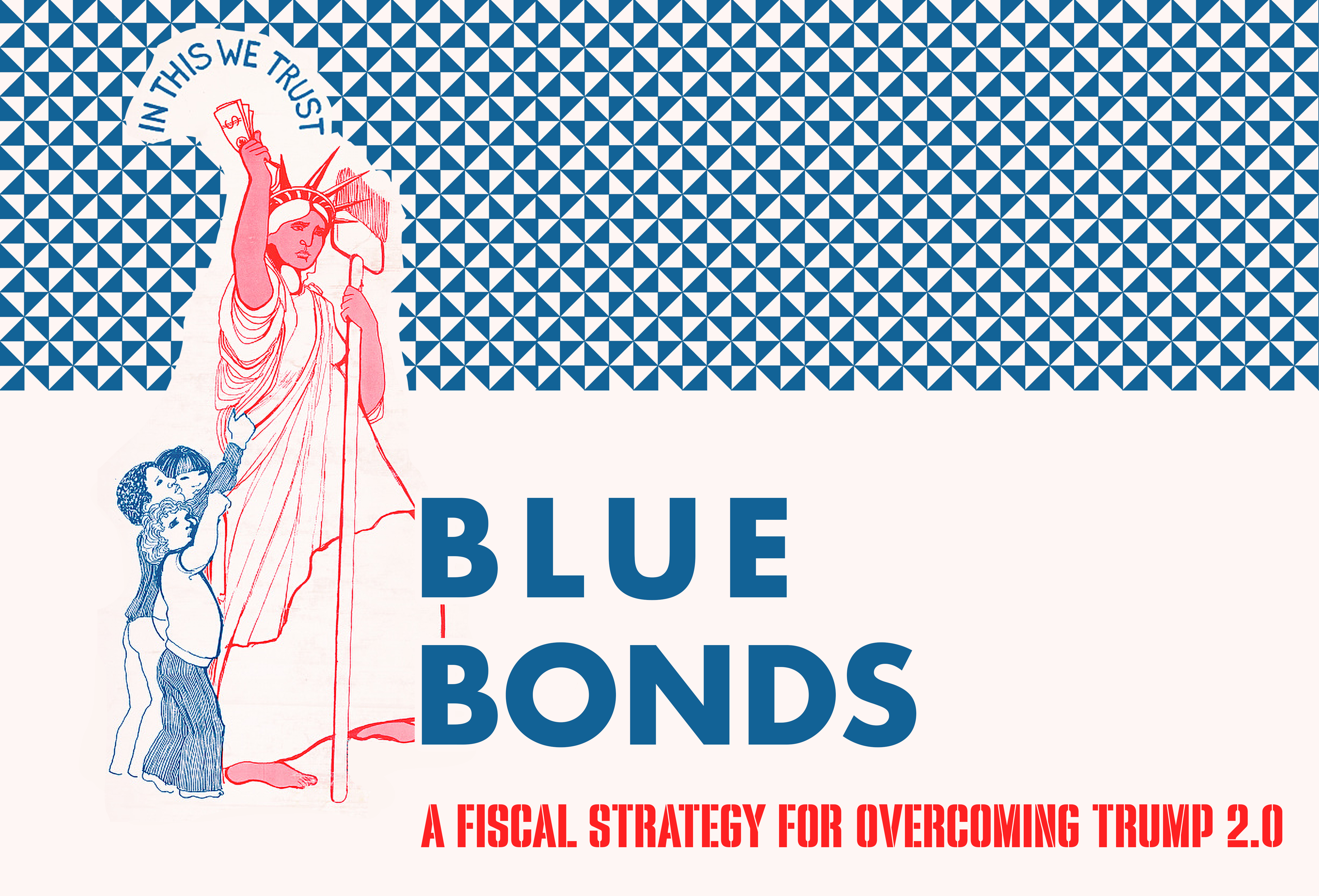
* The above artwork draws from “In this We Trust : The Women of the World are Serving Notice!” (Jacquie Ursula Caldwell, 1976), a political poster created for the feminist Wages for Housework movement.

Money is Not a Medium of Exchange

by Jens Martignoni

With this brief provocation, Jens Martignoni develops a suggestion first put forth in an essay published in the International Journal of Community Currency Research (IJCCR). There, he questioned the problematic idea that money is essentially a “medium of exchange,” which is still strongly rooted in the complementary currency scene. In this follow-up piece, Martignoni critiques the notion that money is a medium of exchange, along with claims that money should be defined according to its apparent functions. If a real change in the monetary system is to succeed, he argues, we must reconceive money as an inherently collective project and rethink monetary functions as resulting from political design. The following text was previously published by the IJCCR in 2023. The Money on the Left Collective thanks Martignoni for permitting us to republish his text here.

I used this “provocative title” already in a past contribution to International Journal of Community Currency Research (Martignoni, 2018) as a chapter heading. The idea was, to explain that the common functional definition: money is a medium of exchange, which is used in practically all economics textbooks is misleading or worse: completely wrong. But as such details in long papers may be read but may not be understood as fundamental (as there is still no extensive debate about this topic), it is worth repeating and deepening. Therefore, I dare to cite a large part of that section of the article first (with slight corrections in language, style, and references) and will add some more aspects after:

“Money is not a medium of exchange: This provocative title is intended to help us check the claim that “money is a medium of exchange”, which is used in practically all economics books and the widespread definition of money. More and more scholars have been arguing otherwise. The analysis of the exchange and market conception is an important building block for an understanding of money, but even more, the collective aspects of monetary structures must be taken into consideration. Ingham (2004, p.69) makes it short: the focus on money, as a medium of exchange, results in a categoric error in which specific forms of money are mistaken for the generic quality of ‘moneyness’.”

It is interesting to note that in ordinary textbooks of the national economy (for example, Samuelson, 2004) the exchange itself is not treated fundamentally, but presumed as a given.

A popular definition of exchange in the dictionary of business (Grüske / Recktenwald) says: “Exchange is the economic transfer of goods, the exchange of services based on the division of labour. Legally, exchange is a mutual contract, which is directed at the turnover of goods against goods, in contrast to the purchase, which is the turnover of goods against money due to prices.”

Here even the purchase is referred to as a contrast for exchange. Also, in no other definition money gets introduced as an exchange category, but as part of the purchase. While in exchange someone receives directly from the partner a product or service, which he (hopefully) desired, at the purchase he receives a payment in money, i.e. several vouchers for which the exchange partner is not responsible, but unnamed third parties. The vendor expects that these vouchers (when he wants and at whom he wants) can be redeemed. The decisive point is not that the exchange is now divided into two separate acts, and that each of these two acts can again be represented as an exchange, commodity against money and money against commodity (Röpke, 1979, p.114), but with the introduction of money a change of the level from the individual to the collective took place.

Röpke also mentions this shortly afterward (1979, p.116): money has therefore also been compared with an entry ticket to the “social product” (i.e. to the existing fund of goods and services), or as a “statement to the social product”. Röpke himself, however, doubts this point of view. Nevertheless, it is easy to see that money can only exist with “many” participants, i.e. in the collective. It must be recognized by a sufficiently large number of people and institutions, voluntarily or compulsory, otherwise it loses its money character quickly.

The first mistake in the “individualistic exchange theory” or commodity theory of money is therefore, that in the transition from exchange to money, money itself is presumed unquestioned and is taken as a commodity as it would just replace the exchanged good. Amato and Fantacci (2012, p.41) summon this up as follows: money properly called by its name is not a commodity based on the indistinguishability of its first two functions, but an institution designed to determine its relationship with a view to payment.

The foundation for money, however, is a collective that has already introduced money and the simplest and most effective introduction of money must also be done collectively, e.g. by the sovereign, or more recently by the modern manifestation of the sovereign, the state. Polanyi has already established this for social and historical reasons: the state, […] was in fact the guarantor of the value of token money, which it accepted in payment for taxes and otherwise. This money was not a means of exchange, it was a means of payment; it was not a commodity, it was purchasing power; far from having utility itself, it was merely a counter embodying a quantified claim to things that might be purchased. Clearly, a society in which distribution depended upon the possession of such tokens of purchasing power was a construction entirely different from market economy. (Polanyi, 2001, p.205).

From this point of view, money loses all the characteristics of exchange and commodity and is used as a means of legal remedy, primarily as a means of payment guaranteed by a community, usually to this day, by the nationalized large community called the state. This is reproduced everywhere by legislation on the money and the monetary system” (Martignoni, 2018, p.22-23).

But what if there is no medium of exchange and only a means of payment? And what about the functions of money as a useful definition anyway? The answer may not be so pleasant even for alert people who are trying to invent and introduce better forms of money as community or complementary currencies: If money and currencies were not to be defined by these functions, alternatives too would have to align themselves with other principles.

If we (I include myself here as a “money changer”) positively accept the search for other principles as a challenge, we can derive an even clearer mission from this, which must be addressed as an essential basis for changing money. It is necessary to gain a better understanding or awareness of the matter to be transformed. A very good guide to this can be found on Brett Scott’s (fantastic) blog Altered States of Monetary Consciousness (ASOMOCO) in the article How the ‘Functions of Money’ blind us to the Structure of Money. He points out three important aspects of how we should start to see money more clearly, which I have adapted slightly here:

  1. Firstly, we must start to draw the structure [of currencies and money], so that every time the word
    ‘money’ is uttered, a clear and full structural image appears, instead of sole individual aspects or dogmatic
    sentences from outdated economics. But we should be patient: we have a long way to go before the full
    structure reveals itself!
  2. Secondly, we need not agree exactly on what the structure looks like, but we do need to agree that it
    should be foregrounded. This will be a major step forward from the current status quo, which simply refuses to foreground it.
  3. Thirdly, we must be able to make a clear distinction between the individual experience of money – the
    everyday feeling of using money tokens at a street level – and the hidden structure which transcends that.
    Much like we experience the sun as a thing that ‘rises’ rather than something that stays fixed while the earth
    turns, there is a phenomenological realm of money that can differ from the reality of its structure, and –
    sometimes – the vague functional definitions can get by in this realm. When it comes to the politics of
    money, however, it is a downright deadly to stay in that realm (Scott, 2021).

When we embark on this journey to reshape our ideas about money, the confusion caused by false doctrines and
their unreflected application in our understanding of the economy and money begins to clear up surprisingly
quickly.

In this way, we can place the approach of currency functions in new contexts. Currency functions are not there to
define money but are essential foundations of currency design, i.e. the art of creating a usable currency. A function
must be subordinate to a purpose, otherwise it is not justified in this place. For example, the purpose of a car is to
transport people from one place to another. To do this, the car must have various functions, e.g., it must be able to
roll, be steerable, have a drive, protect the occupants from the weather, etc. It is then relatively clear which functions are right and which are out of place. For example, a “watering” function or a “baking” function in a car is absurd in the first instance. Money can and must therefore be defined by its purpose and not by its functions. However, the purpose of money is already subordinate. It starts with human existence and then is derived from there by willful
decisions:

  1. All people must provide themselves with the necessities of life according to their constitution together
    (this begins at birth).
  2. The economy is an instrument to coordinate and organize humans to provide at least the material existence for everyone.2
  3. In order to manage the economy in its complexity of contributing and receiving, a means could be created
    that makes the transactions (contributions and purchases) recordable and assessable.
    This could now be a monetary system that serves the above purposes.
  4. Accordingly, functions can now be derived as to how the purpose could be achieved in action. These
    functions can then be combined and built into a specific currency as an expression of a hopefully functioning monetary system. The currency should now contribute to fulfilling the purpose as well as possible.

So, it would be important that in the future textbooks would reflect on the purpose of money as a means of running the economy, as a kind of operating system of the economy.

However, this raises many questions about our lives and our coexistence on this planet, which must first be addressed in order to be able to jointly determine the purpose of the economy.

I’ll stop here and am curious to see whether a discussion can develop from this and whether such ideas will also be debated.

REFERENCES
Amato, Massimo; Fantacci, Luca (2012). The End of Finance. Polity Press. Cambridge UK.

Grüske, Karl-Dieter; Recktenwald, Horst Claus (1995). Wörterbuch der Wirtschaft. Kröner Verlag. Stuttgart. 12. Auflage.

Ingham, Geoffrey (2004). The Nature of Money. Polity Press. Cambridge UK.

Martignoni, Jens (2018). The district currency: a new currency design for managing the commons. International Journal of Community Currency Research. Volume 22 (Summer) 16-38. DOI http://dx.doi.org/10.15133/j.ijccr.2018.014

Polanyi, Karl (2001). The Great Transformation – The political and economic origins of our time. Beacon Press. Boston.

Röpke, Wilhelm (1979). Die Lehre von der Wirtschaft. Bern und Stuttgart. 12.Auflage.

Samuelson, Paul A.; Nordhaus, William D. (2004). Economics. 18th Edition. McGraw-Hill. New York.

Scott, Brett (2021). How the ‘Functions of Money’ blind us to the Structure of Money. Altered States of Monetary Consciousness (ASOMOCO). Substack Blog. https://www.asomo.co/p/structure-vs-functions-ofmoney?utm_source=%2Fsearch%2F%2522medium%2520of%2520exchange%2522&utm_medium=reader2 (accessed, 30.03.2024)

NOTES
1 Only very few of the articles submitted to this journal in recent years were not based on or did not reference the
“classical three functions of money” (medium of exchange, store of value, unit of account) as a definitional basis.
2 An evaluation is already taking place here. Not all people want to put everyone else on the same level as they put
themselves. Different people will therefore differently set the purpose of the economy.

UK Universities in Crisis? Time to Transform Higher Ed Finance

by Rob Hawkes and Scott Ferguson

Universities in the UK are in crisis. Job cuts in the sector are reaching ‘cataclysmic’ levels, with an estimated 10,000 already lost and many more at risk. Just days before Christmas, Coventry University confirmed shocking plans to make nearly 100 redundancies while transferring remaining staff to a subsidiary company on poorer terms and conditions. Such cuts harm the faculty and staff leaving the higher-education system as well as the diminished departments and institutions that remain. Downsizing higher education in the name of corporate efficiency squanders the collective expertise and experience in which immense public resources have been invested. This manufactured crisis, however, is far from inevitable. The time has come to revitalise higher education funding in the UK by extending what Cornell legal scholars Robert Hockett and Saule Omarova call ‘the finance franchise’ to universities.

Mischaracterised by university leaders as financial ‘saving’, austerity is in truth vandalism. It ravages decades of training, accrued and accredited knowledge, and publicly funded research. It abandons generations of students as the campuses and scholarly communities we invite them to join become, in multiple senses, impoverished. The fact that the asphyxiation of British higher education does not instantly count as a national scandal underlines the extent to which the austerity mindset continues to constrain our political imagination: even when the collapse of higher education is perceived as a problem, policymakers, academics, and the communities they serve are left with little recourse. One can only despair at the lack of viable alternatives. 

The immediate cause of the present catastrophe is a broken funding model. This model is based principally on tuition fees, financed by publicly provisioned student loans. Such fees rank among the highest in the world. The system is fundamentally unjust because it individualises the responsibility to fund higher education rather than treating it as a collective treasure. It also places the stability and supposed viability of courses of study, departments, institutions, and entire academic disciplines at the whim of a government-manufactured market. The Labour Party previously committed to eliminating tuition fees for universities. Keir Starmer’s Labour, however, dropped its pledge to scrap fees in England before the 2024 general election and, since entering government, has opted to increase fees for the first time since 2017. 

While student-based financing of higher education is the proximate cause of the present predicament, the roots of the crisis penetrate deep into the collective psyche. At its core, the current disaster stems from a deceptive Thatcherite conceit: ‘There is no such thing as public money; there is only taxpayers’ money.’ Such thinking is fantastical. It is also false. The private money paradigm essentially wishes away the British pound’s institutional foundations in the public sphere–namely, in Parliament, the Bank of England, and the Royal Mint. Instead, it imagines that the pound rises up from private individuals, as in the misleading myth that money originates in barter between otherwise unrelated agents. Thus beneath this twisted logic lies another Thatcherite pretense: There is no such thing as society; there are only individuals and their families

Those who oppose the current system of fees and loans regularly argue that the university system is a public good. We agree wholeheartedly. Yet in adopting the private money paradigm, the very same defenders of public education presuppose that the only alternative to the existing university loans system is one in which higher education is funded by the taxpayer. The trope of taxpayer money is the lynchpin in Thatcher’s private money paradigm. It upholds the backwards idea not only that fiscal outlays merely recycle private pounds, but also that the public good is somehow a burdensome drain on scarce public resources. The result pits communities against one another in a struggle over limited finances and frequently does so along conspicuously classed, gendered, and racialised lines. 

The reality–call it the public money paradigm–is just the reverse. Society exists. Contra libertine reveries, community is in fact inescapable. Money is a public good. The monetary system is a function of government, which can grant money-creation privileges to private banks and financial institutions. State capacity to finance public institutions is inexhaustible. In the words of John Maynard Keynes, ‘Anything we can actually do, we can afford.’ Taxation controls the distribution of wealth. At bottom, however, state spending never rests on private profit. This means that an impoverished public good such as the present higher-education system reflects an impoverished public imagination. Far from necessary medicine for economic ills, austerity answers injury with violence, attacking our capacity to provision and to hope. 

Now is the moment to think boldly and creatively about the financing of British universities. If higher education genuinely matters, then the state possesses all the monetary power needed to support it. The question is not if, but how

Practically speaking, Britain has any number of options at its disposal. The most conventional approach is, of course, for Parliament to provide funds by way of legislative appropriation. In addition to stemming recent and proposed cuts, such legislation would expand higher-ed provisioning where it is needed. Labour could also renew its pledge to eliminate tuition fees and shift the burden of payment from private to public. 

A second, more daring option is a public franchise model, elsewhere dubbed the uni currency project. According to this model, Parliament extends public money creation powers—Hockett and Omarova’s ‘finance franchise’—directly to the British university system. In this scenario, British universities would function much like banks, creating credit as needed in response to shifting needs and demands. As with private banks, university liquidity would be backstopped by the Bank of England, only in this case, universities would not generate money as private loans in order to turn a profit. Instead, universities would structure uni credit in the form of public grants payable to academic facilities and units charged with fulfilling specific academic missions and projects. 

In addition to eliminating tuition fees and repudiating austerity, a uni public franchise model for higher ed would go a long way to democratise university finance. First, putting budget decisions in the hands of universities stands to make such institutions more responsive to local circumstances. Second, the university finance franchise occasions opportunities to involve faculty, staff, students, and community stakeholders in establishing budgeting priorities. Third, liberating finance from hard monetary constraints promotes free thinking and debate across universities, in part, by widening job security and benefits to include all workers on public campuses and ending casualisation once and for all. The aim of the public franchise model is not to license willy-nilly cronyism or court moral hazard. It is to develop a new system of democratic accountability designed to cultivate talent, innovation, and problem-solving for the public good. 

A key challenge for transforming higher-ed finance is revising how we account for the university in crisis. When a student takes up study at a university, our current system accounts for their participation as if it were a cost or a liability rather than a benefit or an asset. We ask who should bear this cost rather than reckoning with the collective social benefits of education. We decide that the individual who studies must pay, in the future, via an interest-bearing loan. Likewise, university leadership counts the academic experts they employ as burdensome costs that, when faced with budgetary obstacles, must be efficiently trimmed. Rather than genuinely ameliorate extant problems, this type of accounting merely facilitates the managed decline of the education sector. 

The public-money paradigm, by contrast, enables us to account for the present situation differently. Indeed, we can tell another story, if we wish. Even now, undergraduate courses are provisioned and financed by a government-owned public body, which transfers funds directly to universities when students join their academic communities. This enables a process that educators and educatees the world over recognise as enriching. As all involved in higher education well know, students gain far more than mere subject knowledge or transferrable skills. Moreover, these gains do not end on graduation day. According to Judith Butler, ‘[A]s we leave the university,’ we take our ‘critical practices with us onto the street, into those spaces of work and love, and into our public lives.’ A university, in other words, does not exclusively benefit students. It is a locus of civic uplift and transformation. That we ever came to understand the gifts of higher education as unaffordable liabilities is absurd. 

At this hour of profound crisis, no options should be off the table, including the extension of the finance franchise to universities. In view of the cataclysmic failures of the present system and the dearth of alternative proposals, it is time to unleash the public credit that has always been at the heart of higher education and to recognise its potential to arrest the current crisis and to advance the public purpose. 

Unless we change course, British universities will no longer function as the community anchors they are today, nor will they continue to foster the attitudes of open-ended inquiry for which they are rightly championed or pioneer the solutions we desperately need to local, national, and global challenges. 

Unless we are open to new approaches to university finance, we will remain trapped by the austere logics that are destroying our cherished institutions. 

Unless we are willing to act imaginatively and fearlessly to save our universities now, we will soon find that there is nothing left to save.

* Every UK news outlet to which the authors sent this essay declined to publish it.