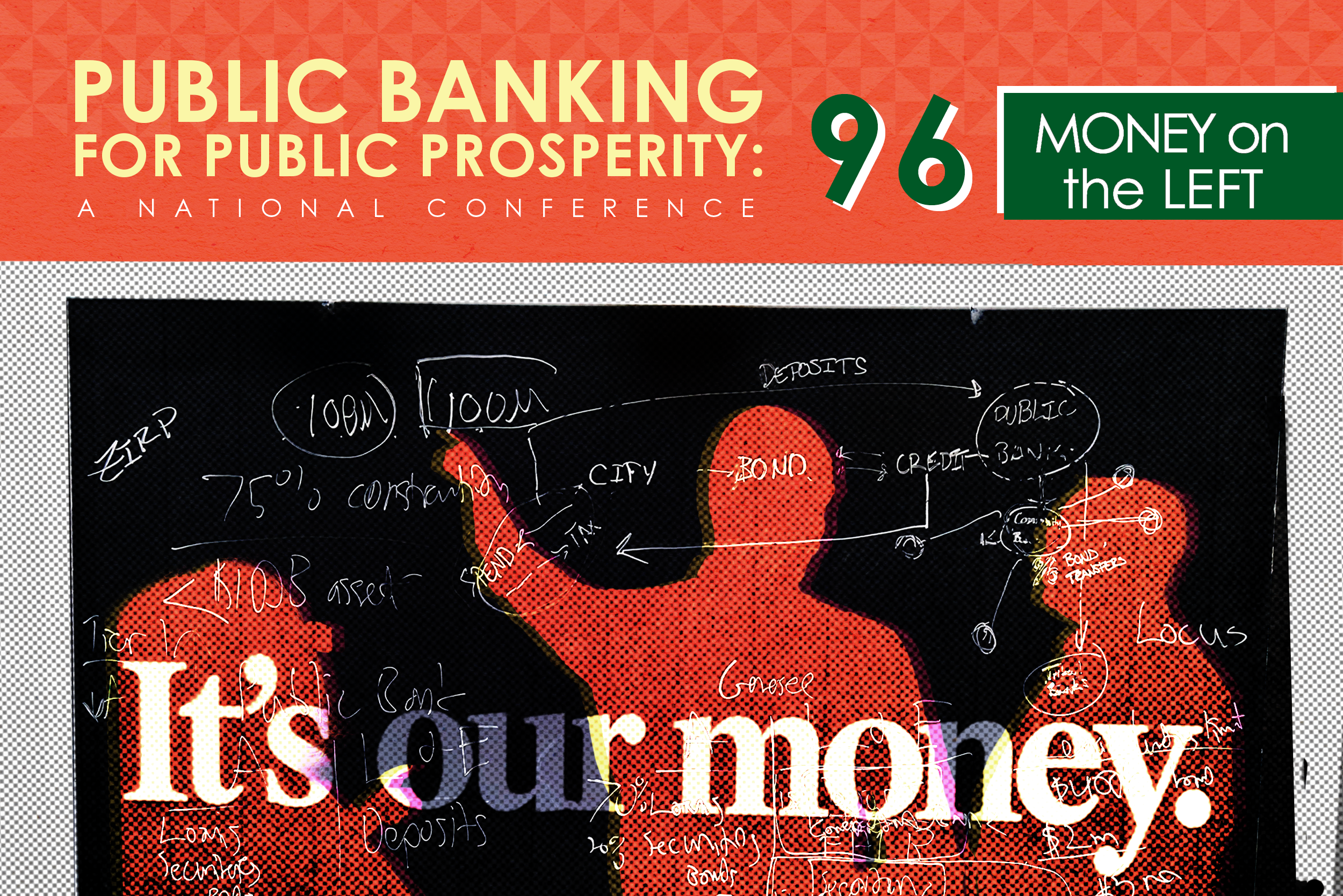
This month, Money on the Left shares audio selections from our participation at the Public Banking Institute’s national conference: Public Banking for Public Prosperity: A Declaration of Financial Independence. The conference took place in Philadelphia, Pennsylvania from October 22 through October 24, 2026.
Convened in the city where American banking started almost three hundred years ago, the event featured vital contributions from progressive leaders, including Congresswoman Rashida Tlaib, Ralph Nader, and over twenty others from around the United States and Canada. Building upon the U.S. tradition of public self-financing through the creation of bank credit, academics, bankers, regulators, politicians, and civic activists engaged with intensive presentations designed to catalyze a national movement now underway in over thirty locales.
The episode begins with Scott Ferguson presenting Money on the Left’s overarching vision of Democratic Public Finance in which he argues against zero-sum logics of austerity that treat money as a scarce, privately hoarded resource tied solely to public and private revenues. Instead, Ferguson frames money as an endogenous, malleable public architecture of credit and debt capable of bypassing the revenue chokepoint to directly finance social and ecological care. Because his live address was condensed due to time limitations, listeners are encouraged to read the unabridged manuscript here, which features Money on the Left’s full argument for Public Grant-Making Banks, designed to grant public money in addition to making traditional loans.
The episode then transitions to a panel featuring Tyler Suksawat, Benjamin Wilson, and Billy Saas, who expand on the practical and theoretical horizons of Democratic Public Finance. Suksawat details our proposal for “the Loop,” explaining how establishing a sub-federal public bank to buy municipal debt stops interest payments from leaking to Wall Street creditors, thereby transforming public debt into a self-growing circuit that finances public goods. Wilson then challenges how the public uses language, metrics, and accounting to value communities, lands, and infrastructures [see here for accompanying slides]. He implores us to get creative with how we value our shared world in order to drastically expand what the public sector presently harbors and can do. Finally, Saas explicates Money on the Left’s historical commitments to both critical and generative thought. He notes that while we share the broader left’s “hermeneutics of suspicion” to unmask exploitative power structures, we equally insist on actively pursuing a “hermeneutics of provision,” which imaginatively mobilizes money’s inexhaustible public powers to solve today’s urgent social and environmental crises.
Video footage of the full conference is still being edited, but the raw session recordings can be viewed on the Public Banking Institute’s YouTube channel: Day One, Day Two, and Day Three.
Visit our Patreon page here: https://www.patreon.com/MoLsuperstructure
Music by Nahneen Kula: www.nahneenkula.com
Transcript
This transcript has been edited for readability.
Walt McRee
Our next speaker is another one of these philosophy guys. And I’m proud to say, a new member of our board of directors at Public Banking Institute. I came across Scott Ferguson in an article that was written by Money on the Left, and that Scott penned back before Mamdani was elected. It was about headlined, Democratic Public Finance. I think that’s not exactly the title, but it was generally about introducing a concept about how we understand money and banking in a context of democratic need and organization and the kind of strength that we really already have, but that we don’t utilize because we’ve acquiesced, we’ve abrogated the rights that we have as citizens to our banking franchise.
The article really talked about the opportunities that would be there if we would see money in a correct way, in the way that it really exists and how we can replace neoliberal public finance, where we get our money from the organized profiteers from Wall Street and the bond markets and all of those capital centric places, and instead generate it on our own, endogenously, if you will, and please do it that way.
So I want to welcome Scott Ferguson, a professor from the University of South Florida. Please come on up, Scott. Don’t talk back there. Yeah. So welcome, Scott. Take it away.
Scott Ferguson
Thank you. My talk today is titled “Democratic Public Finance and the Future of Public Banking.”
We who gather here today agree: public banking is an indispensable instrument for reclaiming governing power and economic capacity from a rapacious financial sector and a feckless federal government. We have endured decades of anti-democratic austerity, compounding private wealth, and now, brazenly authoritarian fiscal sabotage. The time has come to break the duopoly of Wall Street’s private credit and a paralyzed federal purse by establishing a nationwide network of democratically accountable public banks—an infrastructure that operates explicitly in the common interest and treats credit as an inalienable public resource, rather than a delimited vehicle for private exploitation and profit.
My name is Scott Ferguson. I am an Associate Professor in the Department of Humanities, Arts, & Film at the University of South Florida and a co-founder of the Money on the Left Editorial Collective. Our mission at Money on the Left is straightforward, but formidable. Money, we insist, is an inexhaustible public utility and, faced with nearly insurmountable social and environmental crises, there is no more urgent task today than reconstructing the global monetary system. However captured or abused by private interests, we argue, money remains a thoroughly malleable public instrument for social and ecological care. For this reason, we place money’s public design at the center of left thought and organizing, bridging political economy with law, culture, and aesthetics. Money, we contend, is neither a neutral medium of private exchange nor an irredeemable device of class domination. Whatever its historical entanglements with capitalist apologetics and political violence, money is the primary medium through which we organize our eco-social interdependence—and our most powerful tool for collective stewardship.
Following Modern Monetary Theory (or “MMT”) and Christine Desan’s “constitutional” legal theory, we understand money to be fundamentally public and, as Walt mentioned, endogenous. Monetary forms do not bubble up spontaneously from private barter or market exchange; they are active products of political governance and legal design that are rooted in the public sector. Money is an endogenous architecture of credit and debt, issuance and redemption—a dynamic legal institution that continuously brings monetary forms into existence and retires them through public authority. Money on the Left explicitly rejects dogmas that see money as exogenous: a scarce, privately hoarded value governed by immutable economic laws that no one supposedly controls. MMT correctly demonstrates that issuance precedes redemption and that currency-issuing governments can always afford to mobilize idle resources and labor. Yet while standard versions of MMT restrict such capacity to what it defines as national “monetary sovereigns,” Money on the Left extends this logic across the entire institutional landscape. We see fiscal and crediting capacity everywhere—no matter how smothered by balanced-budget amendments, bond-market discipline, or ideological defeatism our public institutions appear to be.
My colleagues and I are honored to join this conference alongside such an extraordinary lineup of thinkers and organizers. If Money on the Left has a distinct contribution to offer this room, it lies not in technical banking mechanics or financial law, but in an overarching political-economic vision: what we call Democratic Public Finance, or DPF for short. DPF is designed to energize, guide, and protect our movement over the long haul. Public banking in the United States will necessarily be heterogeneous and adaptive, coordinating campaigns across municipal, state, and federal scales. Yet as we embrace pragmatic strategies tailored to distinct political terrain, we must ensure that tactical flexibility does not degrade into technocratic compromise, complacency, or capitulation.
Replicating the Bank of North Dakota across all fifty states would be a monumental political triumph. It would claw back billions in public wealth from Wall Street and revitalize local economies. Still, such a triumph leaves the underlying logic of the commercial loan model more or less intact. This model casts cash-strapped institutions and organizations as perpetual debtors, forced to squeeze scarce revenues out of local communities to service principal and interest. A public bank that functions only as a benevolent lender, we warn, actually short-circuits money’s true social power. This is where DPF proves indispensable: by refusing to accept zero-sum logics of scarcity as inherent to monetary design, Democratic Public Finance keeps our movement’s horizon maximally open, experimental, and ambitious.
“Money is not a thing,” wrote Karl Marx in The Poverty of Philosophy, “it is a social relation.” This familiar gesture aims to de-naturalize money, recasting political economy as a thoroughly social, and therefore contestable, domain of collective life. The trouble is that most modern political economy—Marxism included—promptly betrays its own constructionism, reducing money’s social functionality right back to a private, alienable, and ultimately exogenous thingliness. We know very well that money is not an inert fact of nature; yet we continue to envision its possibilities as if it were a freestanding token caught in a closed, quasi-physical system. Whether pinned to marginal utility, behavior, or labor time, money is envisioned as a finite chit moving through real or virtual space, carrying a scarce substance from here to there via invisible market forces. Monetary value is always tethered to the past: either to yesterday’s accumulated revenues or to debts mortgaged against future earnings. In this prevailing credo, spending–and especially public spending–remains forever prisoner to money’s supposed pastness. Shackled to tax receipts and bond yields, government is warned incessantly that ample fiscal investment will only “crowd out” private capital or trigger runaway inflation.
Trapped in this worldview, collective life is forced to operate within perversely narrow and punitive limits. Care for the many is made dependent upon the taxable gains of the wealthy few. Framing public provision as mere “redistribution” pits interdependent communities against one another as antagonistic voting blocs. At the center of this theater stands the all-powerful figure of the “taxpayer”—the mythic, hardworking, and tacitly white American around whom all legitimate public finance supposedly turns. Right and left polarize around mutually defining resentments. ‘Me first’ or ‘thee first’? ‘Taxation is theft’ or ‘generosity toward the unfortunate’? Inevitably, economic divides metastasize into cultural antagonisms: ‘High T’ versus ‘bleeding heart.’ NASCAR or Broadway? Kid Rock or Chappell Roan? Raw milk or oat-milk?
In this warped reality, abandonment is baseline. Nurture is the rare exception—born of impossible choices within a rigged game ruled by artificial scarcity. From this vantage, our most vulnerable communities count primarily as liabilities. Though replete with heterogeneous potentials and desires, they are entered into the ledger primarily as costs. Women of color, immigrants, the unhoused, disabled people, trans kids: in the eyes of orthodox finance, they are perpetual drains on the public purse, whether pitied, despised, or simply ignored. Assisting one community requires starving another. Pitched as zero-sum sacrifices, tenuous public investments in such areas rarely survive the next fiscal crisis. Last year, we funded disability services, so replenishing urban tree canopies had to wait. Next year, we will correct decades of library neglect, which means the light-rail line passed five years ago is indefinitely on hold. Want property tax relief for fixed-income seniors? That requires gutting budgets for public schools, who are then told to cross their fingers, protect their credit ratings, and beg Wall Street for bond financing.
Whereas the luminaries of Ancient Greece adopted a complex allegorical view of their gods, modern economic commentators across the political spectrum worship revenues as deadly literal deities, imagined to be the supreme fulcrum of all future finance. This is zero-sum metaphysics in extremis. According to today’s revenue fundamentalism, tomorrow’s activities are intrinsically constrained by yesterday’s returns. We at Money on the Left are sympathetic to left critiques of the profit motive as, at best, inadequate and, at worst, poisonous for collective flourishing. What such criticisms regularly overlook, however, is the far more tenacious fantasy that revenue constitutes the sole chokepoint for future provisioning across public and private domains. The tragedy of the neoliberal “bailout state” is not that it courts “moral hazard,” violating the apparently sacred principle that all institutions and organizations should be self-funding without public assistance. Rather, bailouts are unjust simply because they mobilize public credit exclusively to rescue big capital, while abandoning the rest of us to austerity.
Under neoliberalism, fiscal sabotage becomes a routine sacrifice: a ritual bloodletting designed to coax private revenues out of sluggish markets. Someday, we are promised, we will tax away private surpluses for the common good. In the meantime, belt-tightening remains our penance. Somehow, indeterminable austerity will conjure the resources upon which our collective survival depends. Through this twisted prism, collective care is forced to wait on private accumulation, rather than answering the urgent needs and democratic desires of the body politic.
Enter contemporary fascism. Today’s fascism is neither an unnatural perversion of market forces nor simply their authoritarian triumph. Instead, it takes neoliberalism’s zero-sum callousness and strips away the polite fiction of economic neutrality—touting austerity not as an unfortunate market necessity, but as an overt, cruel, and often vengeful political choice. Fighting corrupt oligarchs and authoritarian puppeteers is necessary, but in doing so we also need to repudiate the fatal premise that revenue is the primordial origin of human capacity. Never forget: because, at bottom, money is not a zero-sum game, collective life need not wait on private permission to thrive.
Herein lies the core revelation of Democratic Public Finance. If, according to DPF, money is a fundamentally public and endogenous infrastructure of credit and debt, then it arises not from the needle’s eye of past returns, but rather as a function of ongoing politics and the wide berth of systemic legal design. Credit, in this view, represents the broad granting power at the heart of monetary issuance. It is not a micro-scale agreement between two parties, nor is it predicated upon inherent scarcity. When a government, institution, or organization provides credit to recipients, it gives community members permission to carry out specific social activities. Though shaped by quantitative measures, the power of credit is thoroughly qualitative, malleable, and inexhaustible. Debt is equally plastic. Obligations can be structured in any number of ways. What is a grant but a form of credit that prioritizes qualitative commitments over quantitative returns? From this perspective, revenue is not a scarce token hoarded and spent; it is an operation of redemption—the settlement phase of the monetary circuit, not its restrictive wellspring. In our current system, revenue concentrates staggering purchasing power in private hands. Yet that distribution is not an immutable economic law; it is an active political design that must be radically contested. Revenue is neither the spontaneous outcome of market efficacy nor the indispensable precondition for future investment. To reduce left politics to revenue redistribution is to surrender our greatest instrument of collective coordination before the struggle begins. Redistributionism, in other words, is inherently weak, like pointing a pocketknife at a firing squad.
With this in mind, Democratic Public Finance demands that we thoroughly re-engineer the public sector and how it variously grants and obliges. Stop trying to “find the money” as if it were a finite hoard buried in the sand. Our task is to design monetary architectures that are public, capacious, and democratically accountable. At Money on the Left, we articulate this project across five strategic areas: First, we challenge the dominant fiscal rhetoric at the level of rhetoric, exposing existing tax and debt limits as both arbitrary and politically irresponsible constraints. Balanced-budget amendments, statutory borrowing caps, and debt ceilings are not laws of nature; they are legal straitjackets designed to enforce artificial scarcity and devalue our collective labor. We have everything to gain by unmasking these rules and showing the public how these institutional bottlenecks are constructed to suppress human capacity and ecological renewal.
Second, DPF directly confronts and aims to dismantle the deep legal architectures that enforce neoliberal austerity and protect authoritarian power. In this way, our project very much dovetails with Chris Armitage’s work. These structures are etched into federal and state constitutions, designed precisely to preempt public power and discipline democratic ambition. To leave these legal boundaries unchallenged is to resign before public mobilization even starts—conceding the myth of monetary scarcity and preemptively suffocating what our communities imagine to be possible.
Third, we seek to creatively multiply public crediting operations across the monetary hierarchy. In doing so, we redefine what counts as socially valuable by deploying complementary crediting tools across the public sector. By establishing diverse crediting channels, we can drive a planned, sustained expansion of public investment. We can revalue care and reproductive labor, mobilize neglected community capacities, and repair ecological harm. Though taxing billionaires out of existence remains a vital responsibility for any democratic movement, DPF ensures collective flourishing and participation without robbing Peter to pay Paul or deepening electoral divides over taxpayer money. Crucially, this proliferation also serves a profound pedagogical purpose: it demystifies finance in practice, proving that money is an alterable political technology open to democratic imagination and disputation.
Fourth, DPF politicizes and democratizes pricing. Supply, of course, matters. Demand is just as important. But pricing has little to do with the widely held fantasy that somehow together supply and demand naturally gravitate toward a market equilibrium that is fair, efficient, or inevitable. Prices are, in truth, always administered, playing a key part in money’s ongoing design. The question is not if or when pricing is administered; it is how, by whom, and for what social purpose. Should we allow a corporate oligarchy and algorithmic software to raise prices in the name of maximizing private profit? Or, ought we to set a strong floor on pricing through robust public options, legal regulations, and perhaps even community pricing boards?
Fifth and finally, DPF demands far-reaching experiments in public banking and digital payment systems. Today, banking and payments are dominated by commercial banks, private equity, shadow banking, credit card companies, Silicon Valley apps, and payday lenders. If crediting operations engender our collective future, then we must place democratizing such operations at the core of political organization and action. By chartering public banks, we wrest public funds from Wall Street, deploy stabilizing credit during downturns, channel investment into historically divested communities, and eradicate the banking deserts manufactured by financial consolidation. Alongside these banks, we need to establish free public digital payment rails. These systems will liberate small businesses and workers from predatory transaction tolls and expand public clearing. A robust public payment apparatus is what brings municipal economic stewardship to life: keeping prices low, eliminating middleman fees, and allocating wealth locally through transparent public ledgers rather than private conduits.
Democratic Public Finance enthusiastically champions every initiative to establish public banks. Yet it also challenges us to reach further—to stretch far beyond the conventional boundaries that have historically hemmed in the movement. What, after all, is a public bank? What can a public bank truly achieve? Rather than assuming a single, uniform template—or merely redirecting commercial loan protocols toward benevolent ends—DPF treats public banking as an adaptable, modular project. Above all, it shatters the zero-sum fallacy that sees revenue as an absolute barrier to collective flourishing rather than as an adjustable coordinate of public policy.
A dazzling example of what DPF offers public banking is what we at Money on the Left have termed the Loop. First developed by our colleague Tyler Suksawat, who is right there, the Loop resolves several systemic crises in a single stroke, while uncovering money’s public endogeneity for all to see. The core problem is simple: every year, billions of public dollars exit our cities, counties, and states into the vaults of Wall Street. Whenever a state or municipality issues debt to build schools, fix transit, or repair water systems, it is forced to surrender massive interest payments to private underwriters and investors. This continuous financial depletion is a primary cause of regional austerity, cementing the manufactured illusion that the public is forever broke, even as our communities overflow with real capacity and urgent needs.
By establishing a government-owned public bank, we propose, a state or municipality can not only expand public investment through municipal lending; it can also purchase its own bonds and, what we call, “loop” the interest back to the government itself, rather than to Wall Street. Over time, the Loop promises to reclaim the public interest, pun intended, in at least two senses. First, it quite literally saves states and municipalities—not to mention school districts, universities, housing authorities, and any number of sub-federal public institutions—hundreds of millions, if not billions of dollars in interest payments annually. In doing so, it turns bond issuance into a self-reinforcing system of public finance, capable of addressing community and environmental suffering far more democratically and robustly than ever before in the United States, or that’s our hope. Second, the Loop recuperates the public interest in the sense of collective concern and collective will, asserting democratic control over debt allocation from Wall Street gatekeepers, punishing rating agencies, and fickle investors. Ultimately, the Loop reveals what hegemonic forces conspire endlessly to conceal: namely, that money is a boundless and contestable public utility that we can always reorganize to serve community and environmental endeavors. We need only to cultivate enough knowledge, creativity, and grit to unlock money’s repressed ecosocial potentials.
Stay tuned for the Money on the Left panel later today during which my colleagues will dive into DPF and the Loop in greater detail. I am going to skip ahead to my conclusion.
Money on the Left does not claim to hold every answer—whether legal, political, social, or aesthetic. Instead, our vision for Democratic Public Finance offers a guiding ethos for collective activism and structural transformation. We offer it to inspire the public banking movement to remain inventive, resilient, and undeluded by prevailing creeds of scarcity, ensuring that even when tactical compromises are necessary, we never mistake provisional constraints for the outer limits of what is possible.
Thank you.
[See here for Ferguson’s entire talk, which was condensed at the conference to meet the time constraints of live delivery.]
Walt McRee
You will find this fascinating. Very extraordinary and different. Something a lot out of the usual. It will feature rising stars of economic progressivism. These gentlemen here, professors and protagonists from Money on the Left. Money on the Left. I first heard about Money on the Left when the written piece about democratic public finance that these gentlemen did came out. I read into what they were doing and said, “hey, man, we should be working together.” I found out that they had been at this for five years, right?
Scott Ferguson
Officially since 2018. Unofficially since 2012.
Walt McRee
But you could tell by the presentation of how progressive the whole concept is about the endogenous nature, unlimited nature of finance that we actually have to work with if we would change our mindset and also look at the assets that we have to work with. So I want to introduce Money on the Left: Ben Wilson, Will Sass, Tyler Suksawat and Scott Ferguson.
Okay. And you know, guys, I think I’ll just let you take it away, like the four freshmen. Oh, and a little bit more context. I didn’t say the Seattle Loop because that was on your program. They’re the originators of the Seattle Loop idea, which is a brilliant context for how we can proceed in local investing.
Tyler Suksawat
So earlier we heard Scott’s poetry on Democratic Public Finance. But now it’s time to contextualize the idea, the lens of democratic public finance and how public banking and municipal finance in general fits into this context. So part of our current predicament that we’re dealing with is we have a federal government that is using fiscal austerity as a weapon.
It’s a weaponized approach. So I actually came up with this idea when President Trump had announced federal funding cuts to sanctuary states and cities. So the response comes, what hope do states and municipalities have when the federal government is openly hostile or just outright feckless in its fiscal authority and responsibilities?
So this leads us to the Seattle Loop, which is a public bank. The easy task of starting a public bank, we would start from that point. But the state or municipality that controls the bank would legally designate it as the sole purchaser of municipal bonds.
Basically, the intention here is to not only look at bonds as a revenue generating measure that our municipalities use to kind of fill in the blanks when they can’t make up revenue through taxes. We want to basically take a look at that and how extractive municipal finance is from our communities in general.
When we look at a city, like my home city, Seattle. Our debt service in 2026 was $103 million plus dollars. So that’s the interest payments that we’re paying. Recently, Washington State passed a progressive millionaires tax. The total tax draw from Seattle is $116 million estimated annually. But it doesn’t feel too good to know that we’re handing the majority of that back in interest payments right back to private equity.
So the idea is to create a resilient, insular system of circular flows within our public financial system that kind of has these reciprocal flows and this more resilient nature to them. So when we look at how this works, we know from [Richard] Werner’s talk that loans create deposits. That banks create credit endogenously. So what would happen in this instance is the municipality, the legislature would authorize the issuance of municipal bonds. The bank would then create the credit to purchase the bond and deposit the principal into the municipalities accounts. That credit then enters the local economy through the tax credit and redemption, the life cycle of a dollar. When it’s recollected to pay the principal and interest payments on those municipal bonds over time, the bank would keep a little bit for its own financing purposes and capitalization requirements. The rest would be deposited back into the municipality or state’s general fund. This would give the municipality or state immediate liquidity. It would give the bank profitability. And it would allow us to leverage the public credit rather than chase a finite amount of tax dollars in order to finance public spending.
There’s an added benefit of not paying interest to Wall Street institutions anymore. This idea came about because the Federal Reserve during the pandemic had opened up the municipal liquidity facility. That program made it really hard for municipalities to even get it. And what it allowed municipalities to do was sell their bonds directly to the Federal Reserve to meet their liquidity needs.
Now, as funding is kind of drying up, we need to think really critically and institutionally about what’s happening to our public infrastructure. So when we think about our universities closing, or hospitals shutting down their DEI departments to meet requirements so they can continue to get federal grant dollars.
In Seattle, there’s a cancer research center that recently had to do that because their primary source of funding was federal funds. So we can be inventive and find new workarounds for our financial system. I don’t think I’m the first person to ever think of this, but I think that it’s something that may be concealed for a reason.
Profit motive and growth is not the sole aspect of this thing. I think it’s vitally important for us to think about new forms of credit and how we can reform things that are already existing.
What we’re funding through through the public bank and purchasing bonds, it can be any form of public bonds, whether it be a housing authority selling bonds to the bank. Whether it be a public utility company selling their bonds to the bank. This also shores up the bank’s assets.
So the things we invest in with the public bank make the public bank a stronger institution. And that is how we need to pivot. The thinking of this is the bank enables us to do this, but it’s a reciprocal thing. So our communities and those investments actually empower the fiscal strength of this institution.
Ben Wilson
[See here for the slides that accompany these remarks.]
All right. Greetings.
Thank you, Walt and Public Banking Institute for hosting us. It’s a great honor to be here. My name is Ben Wilson, and I’m a professor of economics at SUNY Cortland, just upstate here. And for me, DPF is super exciting because I studied at the University of Missouri-Kansas city. Trained in Modern Monetary Theory and a number of things with Modern Monetary Theory always troubled me.
One of them was this idea of the real resource constraint is the constraint on what the federal government can spend. What are real resources and how do we define those? And what can be mobilized with public money? And the second is, hierarchically, none of us are speaking to our congressperson on a regular basis or the President of the United States.
So at a sub federal sort of level, how can we leverage the power of credit creation in new and unique ways that meet the needs of communities? So my project is really looking at what are the real resources and if we’re going to take Democratic public finance seriously, what do the assets of the vehicles for investment look like through public banking?
If we want to move beyond the idea of the loan and think about granting as an investment structure from a public bank to make sure that our hospitals don’t close or we expand public transportation, or we clean up waterways that have been polluted. How would we underwrite such projects? And I think lots of the underwriting is already being done in the form of grants.
But grants right now are structured very competitively and limited by the ways in which those funds are created. So I think a public bank would be a vehicle for thinking about how we might reorganize these. This quote here from Bernard Harcourt comes from a paper of one of our colleagues and fellow travelers, Andrew Douglas, who writes about W.E.B. Du Bois vision of the black university concept, which problematizes the way that many of us in higher ed lament that the university is run like a corporation, but really it’s run like a corporation because of the legal structure that underpins it.
They are essentially corporations by law and the board of trustees primary responsibility is to protect the property. So W.E.B Dubois said that it shouldn’t be a property organization. It should be a cooperative. So if we were to design public banks as a cooperative, what would that look like? And further, the legal coding or understanding of the way that we’re organizing these organizations, as mentioned by a number of the speakers so far today, is really based on orthodox economics and grounded in the individual.
Right. So how do we break free from individualist logics and think more broadly about how to cooperate? So at SUNY Cortland, we’re starting a lab that we’re calling PERL, the Political Economy Research Lab. And this is going to host and help mobilize a number of our projects. I run a currency project in my classroom where I am the state and I issue money.
That money mobilizes resources, and I collect taxes at the end of the semester. Every semester I mobilize hundreds of hours of community service and engagement and participation on campus events. Every time I run the economy, every student who is willing and able to work has a job. So it’s a full employment economy that is starting to expand. And one of the things that we have to think through as a collective and as a faculty is how do we find common value in how we’re taxing and what we’re mobilizing. But one of the exciting things is that as we grow the project is how do we coordinate and build capacity for larger projects?
And a couple of the larger projects that we’re currently working on is this state property tax data and public asset mapping project, which is thinking about how much value does the public really have. What aren’t we mobilizing and how do we leverage the capacity of our equity in our parks and our hospitals and our schools? SUNY Cortland is constantly complaining about its budget deficit and its lack of resources, but it’s the largest landowner in the county.
Right? The same goes down the street with Cornell as being the largest property owner in both Tompkins and Cortland County with significant value. So we’re partnering with a group in the Adirondack Park to expand their bike trail expansion project. I’ve got a micro project that I’m working on with a small group, the Homer Center for the Arts, to advance literacy at a time where we most definitely need to advance literacy.
So the State of New York publishes, and every state publishes a breakdown of their parcel level property taxes. I’m most interested in the properties that are tax exempt because these are publicly owned spaces and the privately owned, which is the tallest bar chart there, are organizations that are not for profit. So they are all ostensibly properties across the state of New York that are working toward the public good.
The valuation of those properties range significantly. The private non-for-profit parcels is $156 billion. In the public state properties are $43 billion. But that’s a significant amount of real estate that’s not paying any property taxes. It’s not going to the local government to mobilize resources and meet public needs. So how is it that we might be able to envision a way of releasing those tax credits to circulate to support local initiatives and activities?
So, you know, spatially, this is the centroid. So these are dots of all those parts that are taking place in the center of all those parcels. The one on my left, on your right, is all of them. Right. So you can see that there’s no line there. That’s just the density that shapes New York.
Where there are no centroids is the Adirondack Park, which is a really fascinating place to do research because it’s larger than seven US states geographically, but only around 150,000 people live there year round. So they’re suffering from many of the same problems that most of rural America is struggling with in terms of young people not returning to live there, aging population, no hospitals, closing school districts, all these sorts of really big problems. In the middle, that is the non-for-profit state and public owned agricultural space.
So the center of the stage is a big agricultural hub. It’s interesting how much of that is on Long Island. And we have a number of Long Island students at SUNY Cortland, so I’m excited to break that down a little bit more specifically. And then on the right, or your left, is all the community services. So these are the ways in which the state of New York breaks down the property classes: agricultural, residential, vacant community services, industrial. We can look at all of these different ways in which the properties are being used and compare them based on ownerships and I’ve highlighted there the state owned community service centroids on that. One of the things that’s great about spatial analysis is that you can really drill down closer.
So in the center of our screen here is Cortland County. And all the public resources, you can see, are really clustered there on that one side, which is where SUNY Cortland is. And then Tompkins County, just the county next door, you can see the expansive number of community resources that are available there, largely because of Cornell and also Ithaca College.
Not every county in New York state publishes the parcel level data. They just give you the centroid. But Cortland County is one that gives us the parcel level. So you can actually see the space that these occupy and these closer maps. And so in my classes with my students in urban economics, what we’re doing is we’re looking at how these are proximate to each other.
So how do we organize the state, the county, the municipal, the village parcels toward common goals? How many of these are in approximation to the nonprofits, our private partners? Right. Public private partnerships that are for-nonprofit, I think are much better than the alternative, where tax exemption is being leveraged in places like Arizona State and Columbia to facilitate mixed use residential properties or labs for a private pharmaceutical company.
So connecting the dots and blurring the boundaries, right. If we’re connecting these different geographies that are, for lack of a better word, just invisible lines that we trip over constantly as a public. The county is obstructive, the village, the municipality. If we can find ways to connect the dots across those for similar public purpose through a public bank as that mediating institution, maybe we can leverage some of this value to continuing the public purpose more progressively, and start thinking about the underwriting of a grant based cooperation rather than competition. We’re currently already doing this. We work with a number of groups that are actively writing grants, but we’re writing grants that are being written by neighbors and other organizations that are trying to achieve the same thing.
So we’re fighting over scarce resources, but this would be a way of structuring cooperation. Rather than one grantee, we would have multiple that are working toward the same objective. The public bank could be the underwriter mediator of that sort of cooperation. Along the way, right, we can be much more creative in the way that we’re developing and collecting our data for assessment of whether these projects are meeting their public promise.
If we’re going to grant a public instrument in order to mobilize resources to expand literacy, to clean up our waters, to diversify our food system, those are things that we can measure very specifically to realize whether or not the credit creation is meeting the promise that was meant to be delivered.
Wendell Berry recently passed on, but his work has always been a strong influence on the way that I think about life and work and food and agriculture and culture in general. And stewardship, I think, is a structure that should be added into our language around these legal instruments. Right. How do we bring and support people in place?
First, how do we redefine value systems and think about local accountability? I mean, the profit motive is a deeply flawed value system. So starting with real resources, right. Let’s just map it and find out where the people and resources are, and then figure out how to mobilize it in productive and meaningful ways. As a contrast, this comes from Paul Krugman’s Substack. Right now, we are essentially only investing in data centers. Right. This is bad, really, really bad, right? It cements rare Earth minerals. As an educator, I am deeply troubled by the very real cognitive surrender that is occurring in my classrooms. I mean, we absolutely need a better way to store and share and produce knowledge. So I’ll leave it there.
Billy Saas
That was a very heavy note to end on, I am processing it very much. As an educator, I share Ben’s concerns.
I want to start by thanking everyone for your time here and the Public Banking Institute for this opportunity. I’m very pleased to be here and to meet some of you in person for the first time, perhaps especially Walt, with whom I first corresponded just over ten years ago in January 2016. I had just published a letter to the editor for my local newspaper, the Baton Rouge Advocate, in which I argued that the timing was right to launch a public bank for Louisiana.
Our new Democratic governor was about to take office and was talking pretty loudly about putting Louisiana first in his post campaign rhetoric. What better way to put Louisiana first, I thought, than to follow the Bank of North Dakota’s example and charter our own state bank? Doing so would go far, after all, toward keeping financial flow circulating within our outrageously resource rich but simultaneously, outrageously financially poor state of Louisiana.
I also happened to know, and shared in my letter to the editor, that the state’s contract with Chase was up for renewal in the coming year. Incidentally, all it took was a friendly call to the State Treasurer office to get that information. Although, I will say after the letter came out, it was harder to make additional inquiries about that.
So double whammy, right? You have all this excitement around our new incoming Democratic governor after eight years of Bobby Jindal, plus a looming opportunity to just not renew Chase’s contract to extract money from Louisiana and Louisianans, a state, again, near or at the bottom of almost every list measuring for quality of state public infrastructures. Now, I can no longer access the comment section for that letter’s online publication.
I don’t know what happened to them. They’re just gone, it’s over ten years ago now. But I recall going over pretty poorly with all but one commenter who posted something along the lines of this is the best idea ever.
We subsequently connected through social media and had coffee. Lovely guy. It was awesome to talk about public banking. Of course, I was quick to say, in the letter I was citing Ellen Brown and Public Banking Institute and all of the advocacy that y’all had been doing that sort of inspired that action to write that letter at that time.
I also learned, around that time in doing this research, that I wasn’t the first person in Louisiana to make a proposal for a public bank in that state in the 21st century. In fact, there had already been a few years prior a state congressperson named Michael Jackson, who had basically pitched something that looked a lot like what we talk about when we talk about a public bank. That bill died in committee.
The proposal went nowhere. But it was interesting to find that this was a conversation that had been happening. So anyway, I got an email from Walt the same day that letter was published, and I presume that was the result of a public bank Google alert. I don’t know why you were reading the Baton Rouge Advocate, probably that. He promptly plugged me into PBIs monthly conference calls.
I learned a lot from those as I’m learning a lot from y’all here today and anticipate learning throughout the rest of our time together. Here comes the corny segway. This feels like a full circle moment for me. The closing of a loop and the opening of another. So the purpose of this panel is to discuss and develop, I think, which my colleagues have been doing for a while now, the Seattle Loop. Scott, Tyler, and Will Beaman, who could not be here, have written and spoken quite a bit about this proposal over the last six months.
And you can find some of that lengthy writing and stimulating discussion, including with Bob Hasegawa, an advocate of public banking in Washington, in our podcast and their podcast “In the Loop,” through the Money on the Left feed. And I’m really looking forward to and love being in this room, and I appreciate being able to talk about the Loop in this context with such a brain trust here.
So I’m eager to be quiet here in just a moment and open up to discussion and questions and poking and prodding at the Loop as a concept. Before I do that, though, if you were to be at our website, you would also find that the Loop is the latest in a series of like-minded credit facility creating and public money mobilizing initiatives we’ve cooked up at Money on the Left over the last seven years or so.
Before the Loop, there was Blue Bonds, a scheme for generating municipal liquidity in an era of political crisis. Before Blue Bonds, the Uni currency project, a plan for higher education institutions to exercise authorities already established latent in any higher education institution to create an issue their own forms of credit in order to sustain themselves.
This is an idea that came up in the context of the early days of Covid when, getting way ahead of themselves when people were talking about closing down universities and withdrawing state funding from them.
So the bulk of us are humanities scholars, Ben and Tyler excluded. Although I don’t want to exclude them. They’re awesome people. But Scott and I certainly came into this from the humanities perspective, and policy development isn’t typically what’s expected of us. So we’re a bit strange. So we come humbly before you with that acknowledgment. But I want to say and contextualize what we’ve been doing at Money on the Left since roughly 2012 in the context of broader conversations in the humanities and in critical theory generally, to kind of explain and account for our sort of interpretive framework, how we interact with and see the world and do the kind of analysis that would be expected of humanities and cultural studies scholars.
You know, I would submit that critical and cultural scholarship that Scott and I and others in the collective would have encountered and have continued to encounter and have much respect for is really, really, really, really good at diagnosing the problem in really fine detail and making clear things that we might not have otherwise seen or appreciated about systems of domination that we participate in and live in all the time and that stuff is really important. Where we come in is we find that to be sort of insufficient to facing the problems that are in front of us right now. We need to not only diagnose and demystify and disclose, but propose and discover and, I don’t want to say innovate, but imagine. Yeah. Imagine. Imagine together collectively and new ways and new spaces and new contexts with new faces across disciplines, outside of the university. Right. So, you know, broadly understood, I understand the kind of existing paradigm that we’re ready to complement with our own as the hermeneutics of suspicion, which looks at everything for evidence of domination and powers expression throughout our lives and our culture, which again, I think is valuable and worthwhile, but also doesn’t go far enough.
And we’re trying to provide through the Loop, today, Blue Bonds, or the Uni currency project, other stuff that we’ve put out, the podcast, we’ve been trying to articulate the hermeneutics of provision or an alternate way of seeing the world that is always oriented toward the discovery and cultivation of new practices for radically democratic monetary alternatives to neoliberalism, impoverished monetary imagination. We don’t, again, reject the hermeneutics of suspicion outright, but understand it instead is telling only part of the story. We want to directly address the problems that we’re facing today. We are pretty evidently not embarrassed to propose novel policy solutions to do so.
So I’ll leave it there and open up to what I hope will be a pretty robust discussion of the Loop.
* Thank you to Zachary Nosbisch for the episode graphic, Nahneen Kula for the theme tune, and Thomas Chaplin for the transcript.

Published by