By Rob Hawkes
There is a spectre haunting Nigel Farage. The spectre of a beaver.
On 11 March 2026, the Bank of England announced that, following a public consultation, its next series of banknotes will feature images of the UK’s wildlife in place of historical figures, which have adorned our currency since the 1970s.
Mr. Farage was quick to describe this move as “absolutely crackers” (and, of course, “woke”) in a social media video which begins with a triumphant hailing of “our great British banknotes” and their images of “giant figures like Winston Churchill.” Soon, however, his tone shifts to one of ridicule: “And yet, they’re proposing that we replace people like him with a picture of a beaver. No I’m not making it up, this is actually what they’re proposing.” The Reform UK leader has never been one to let the truth get in the way of a good bit of faux outrage, but, if his “I’m not making it up” wasn’t enough of a clue that the facts might have undergone some stretching, a brief check of the BoE’s press release confirms that the “specific wildlife” the public would like to see depicted on the currency has yet to be determined via a further consultation process. Mr Farage, it seems, has conjured a phantom beaver.
One can only speculate as to why this particular animal spirit haunts Farage’s paranoid imagination but, considering Reform UK’s deep commitment to women’s rights, it is surely a mere accident that his mind landed on a word with a history in misogynistic slang. There is no knowing, either, why the thought of losing Jane Austen, JMW Turner, or Alan Turing from the “great British banknote” has not proved quite so distressing, either to our political leaders (Kemi Badenoch is also very cross), or to the BBC Question Time audience member who saw the replacement of Churchill as “surrendering to the radical left wing.” One of the panelists, the broadcaster Kay Burley, responded: “I think as long as we’ve got enough of them in our pockets at the end of the week, I don’t really care what’s on the back of my banknote.” Indeed, from the point of view of mainstream economics, which sees money as a politically-neutral medium of exchange, the material and aesthetic properties of monetary tokens are of no consequence. However, while we can question the motives underlying this week’s eruption of “anti-woke” anger, the questions of monetary design this episode opens up are anything but trivial.
As Alfred Mitchell Innes wrote in 1913, money is “credit and nothing but credit.” Indeed, in a powerful sense, Churchill, Austen, Turner, and Turing are all the posthumous recipients of public credit in the form of recognition, celebration, citation, and acknowledgement via the visual design of the existing £5, £10, £20, and £50 notes. In Turing’s case, in particular, this credit is also an act of reparation following the violence he endured at the hands of the British state in his lifetime. As well as bearing images of Churchill, Austen, Turner, and Turing, our banknotes announce that they “promise to pay.” And yet, this public promise also encompasses a commitment to redeem, to receive, to acknowledge, and to accept. In broader terms, the UK’s monetary system as a whole recognises the contributions of those who serve the public purpose – from health, to education, to social care – in the form of public credit.
As one of the world’s most nature-depleted countries, you could argue that the UK now owes far more to its wildlife than to its revered historical figures. And yet, the panic over the removal of Churchill points to the ingrained logic of austerity at the centre of British politics today. Acknowledging our past need not come at the expense of provisioning the future, but for Farage and those who share his worldview, these will always appear as zero-sum trade-offs. Despite living in one of the world’s richest countries, we are told, there is not enough to go round – someone must be left out, whether it’s animals vs. dead politicians or hungry children vs. cold pensioners, we’re always in a world of either/or and never both/and. Thus, striving for ecological sustainability and renewal, averting climate breakdown and arresting species loss, or meeting the needs of those our society marginalises (including migrants, people of colour, LGBTQIA+ communities, women, and disabled people), are imagined to be achievable only as a consequence of someone else’s suffering. However, as we at Money on the Left have been arguing in our work on Democratic Public Finance, while systemic exclusion is baked into the present logic of monetary design, this is not and has never been inevitable – we can design another, more inclusive and sustainable system just as we can redesign our banknotes.
Farage’s phantom beaver betrays an even deeper fear of democratic inclusion. As a thought experiment, let us imagine for a moment that a twenty-first century political leader might deliberately and unsubtly choose to imply that Churchill, the warlike epitome of masculine strength and defiance, was to be replaced by a euphemism long used to belittle and sexualise women. Might this indicate a wider hostility to women’s inclusion in the political and public spheres? Might the lack of comparable concern over the loss of a woman writer, an artist, or a gay man from the “great British banknote” also be telling? The BoE made the decision to feature wildlife on its new notes after an extensive public consultation. This was a more democratic choice than could ever have been arrived at had the Bank simply asked Nigel Farage what he might consider too “woke” or asked the man in the Question Time audience what would count as “surrendering to the radical left wing.” As we saw in the aftermath of the recent Gorton and Denton by-election, which saw Farage’s party’s candidate Matt Goodwin losing to the Greens’ Hannah Spencer, Reform UK’s instinct is to blame the public when it makes a decision it doesn’t like. By contrast, Democratic Public Finance invites everyone to join the conversation, not just about who or what we recognise and celebrate in the visual design of our currency, but how the monetary system itself functions, which people, places, and causes truly deserve public credit, and how acknowledging our shared past need never be pitted against our ability to build a better, more just, inclusive and sustainable future.
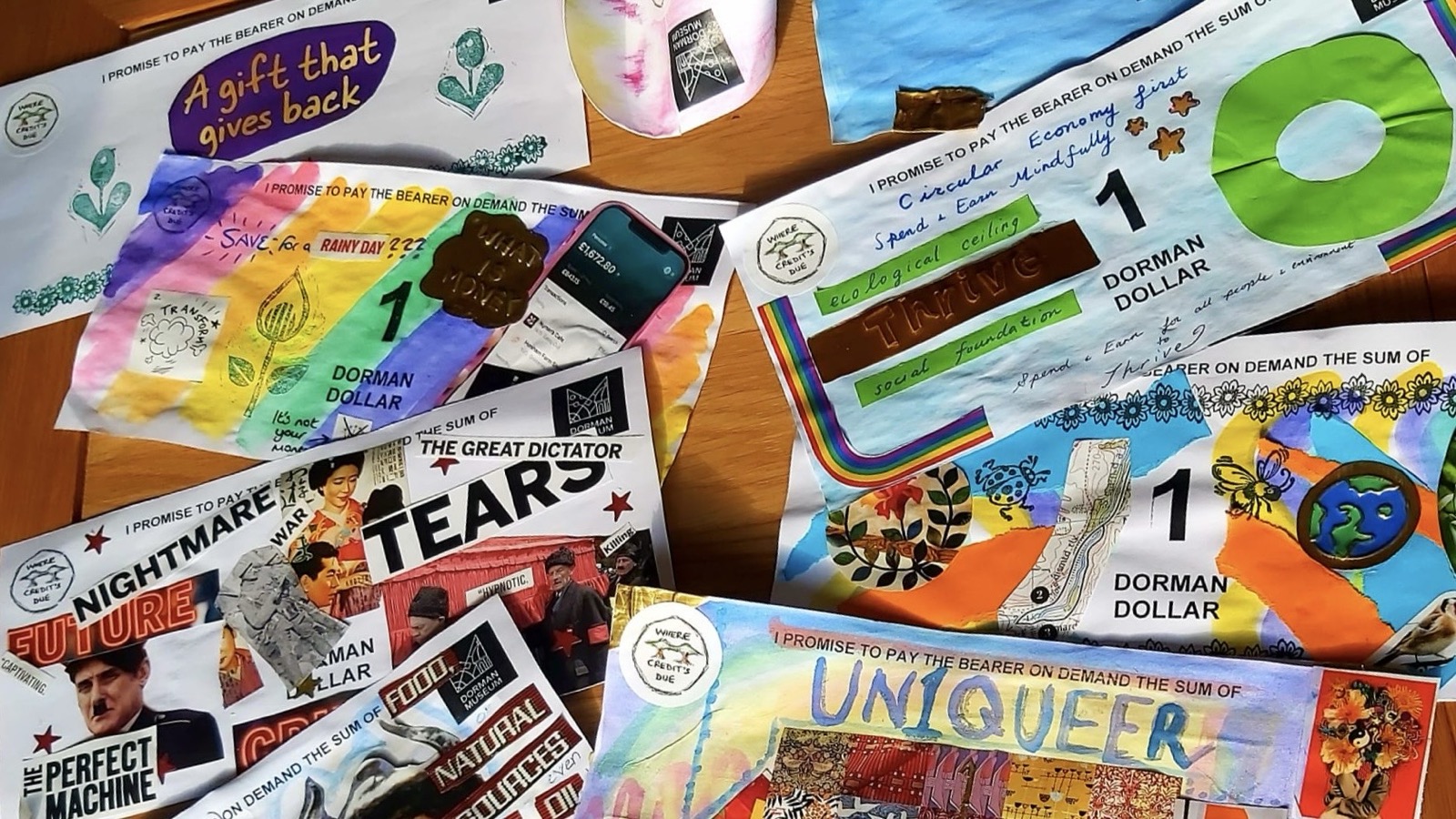
As Robyn Ollett and I wrote for Money on the Left last August, “the stories we tell about our communities and the people that build them are intimately bound up with the way we account for them in monetary terms.” We have since launched the Where Credit’s Due project in Middlesbrough with the aim of building intersectional solidarity and fostering conversations about monetary design in both visual and systemic senses. We began with a screening of Maren Poitras’s 2023 documentary Finding the Money – in which Lua K. Yuille observes that: “If money is natural, who has the money is natural as well” – and followed this with a series of workshops at Middlesbrough’s Dorman Museum, where our participants have experimented with designs for their own “Dorman Dollars” (see the image above). As these events have explored, neither the aesthetics nor the politics of monetary design are natural or inevitable. In place of the orthodox story, which tells us that the suffering of marginalised people and neglected places is necessary and that austerity’s exclusionary logic is the mark of responsible government, we have been learning how to tell new stories of money’s creative potential. In place of the phantom of inclusion-as-zero-sum-competition and the fear of democracy that haunts Nigel Farage, we offer Democratic Public Finance’s vision of ecosocial justice, which refuses to imagine false binary oppositions between wildlife and people, between men and women, or between the past and the future.

Published by